Australian equities – don’t concentrate too hard


Market volatility has exposed structural concentration risks in the ASX, prompting a renewed focus on diversification, equal weighting and alternative portfolio construction approaches.
Since the start of the outbreak of war in Iran, many Australian investors have been disproportionately impacted by concentration, as one of the biggest companies on ASX, BHP, has fallen by over 12%, a fall far greater than the overall market.
Concentration is a risk, and the Australian share market, as represented by the S&P/ASX 200, is one of the most concentrated in the world.
Overcrowded trades and leverage mean that market-wide shocks can potentially be exacerbated among those companies more broadly held.
The problem for many investors is that they are exposed to this risk via funds that track or are benchmarked to the S&P/ASX 200.
Diversification has always been a risk management tool for investors, and investors seeking a portfolio of up to 200 companies would expect that half of the portfolio would include more than 5% of the names.
While no one knows what will happen for the rest of 2026, we think diversification, rather than concentration, is a prudent approach.
This problem of concentrating too hard
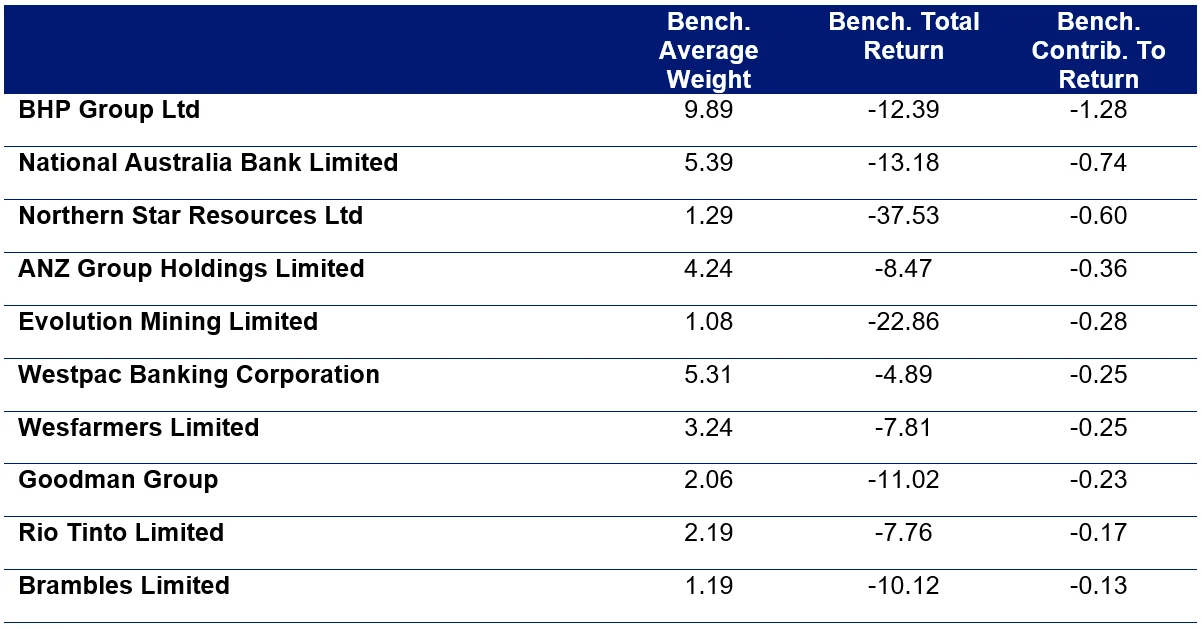
The S&P/ASX 200 has slumped by over 8% since the start of the month, the period coinciding with the escalation of tensions in the Middle East. An analysis of the contributors to that performance highlights an alarming issue with the Australian market. The table below shows that of the 10 companies that have detracted most from performance so far in March, all of them are in the top 20, by market capitalisation. These ten companies represent over 35% of the S&P/ASX 200. VanEck’s MVW is underweight most of these companies, so their fall is not as detrimental to MVW.
Table 1: Month-to-date top 10 detractors from S&P/ASX 200 returns
Source FactSet, 28 Feb 2026 to 26 Mar 2026. Past performance is not indicative of future performance. Not a recommendation to act.
While you expect the larger companies to have the largest impact on performance, the size of the falls, relative to the rest of the market, should give investors pause for concern. BHP, NAB, Northern Star and Goodman stand out. BHP and Goodman, in particular, have been over-owned and overcrowded trades.
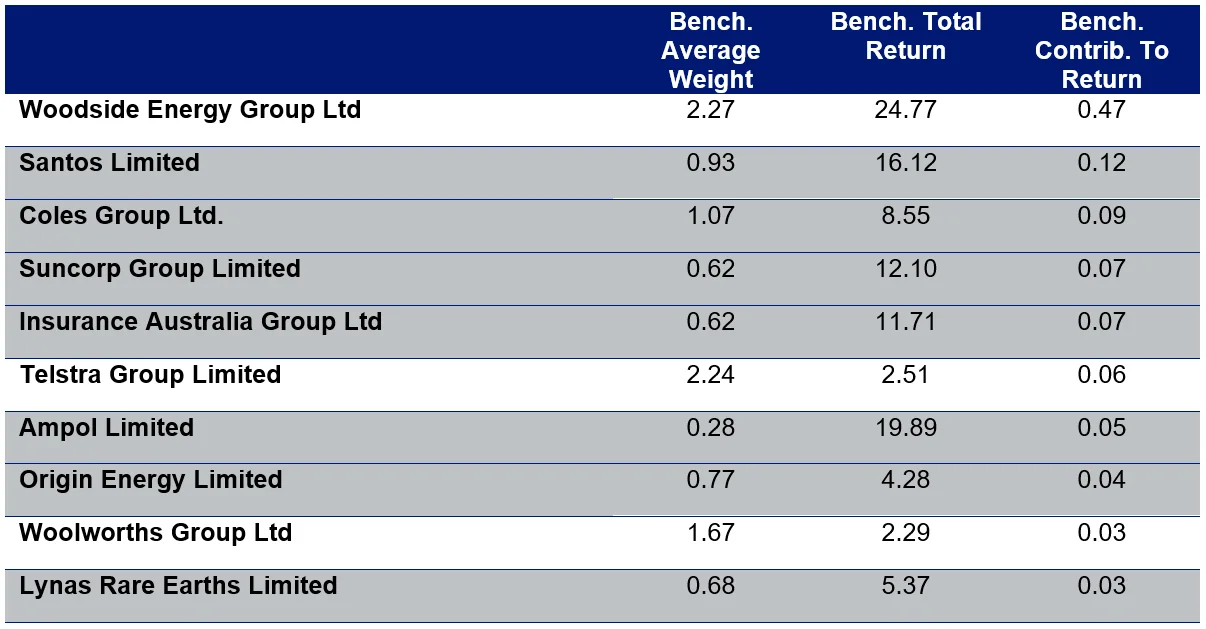
At the other end of the contribution spectrum, only three companies are inside the S&P/ASX 200’s top 20: Woodside, Telstra and Woolworths. Of the others, VanEck’s MVW is overweight all seven. By being overweight, these companies contribute more to MVW’s performance.
Table 2: Month-to-date top 10 contributors to S&P/ASX 200 returns
Source FactSet, 28 Feb 2026 to 26 Mar 2026. Companies MVW is overweight are shaded. Past performance is not indicative of future performance. Not a recommendation to act.
Concentration has been an issue for Australian investors who track or closely track the S&P/ASX 200.
The VanEck Australian Equal Weight ETF (MVW) is a portfolio construction solution that reduces concentration risk to banks and can be deployed to diversify without one security or sector dominating, providing a more balanced exposure to Australia’s economy.
Rate rising environments have also, in the past, been a period when MVW has outperformed the S&P/ASX 200; we also think that the current dividend yields of MVW, relative to the S&P/ASX 200, support its consideration.
In addition, we think that as prices fall, large-cap dividends are vulnerable to increases.
MVW’s dividend yield and performance
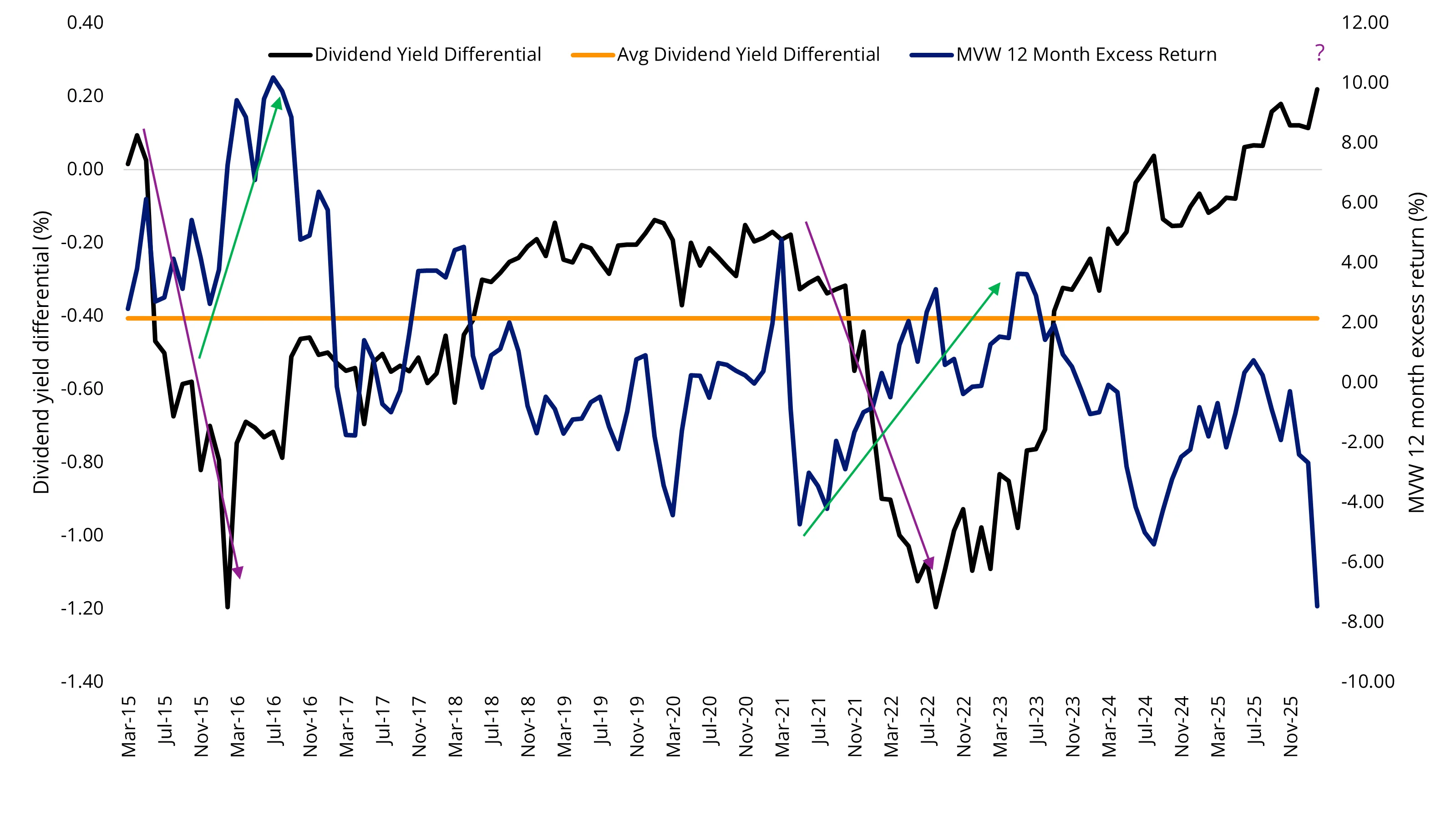
To understand how MVW has historically performed over the long term, below we chart the rolling 12-month excess return of the MVW above the S&P/ASX 200 (the dark blue line). We have compared this outperformance to the difference of MVW dividend yield and the S&P/ASX 200 dividend yield (the light blue line), along with the long-term average of this ratio (orange line).
Chart 1: Performance and dividend yield comparison: MVW v S&P/ASX 200 Index
Source: Factset, As at 28 February 2026. Not a recommendation to act. Past performance is not indicative of future performance.
The chart shows that in 2015, when the dividend yield difference was falling, MVW outperformed. The same is observable in 2021. Right now, the yield difference is as high as it has ever been; should it return to average, MVW may outperform.
MVW in a rate rising environment
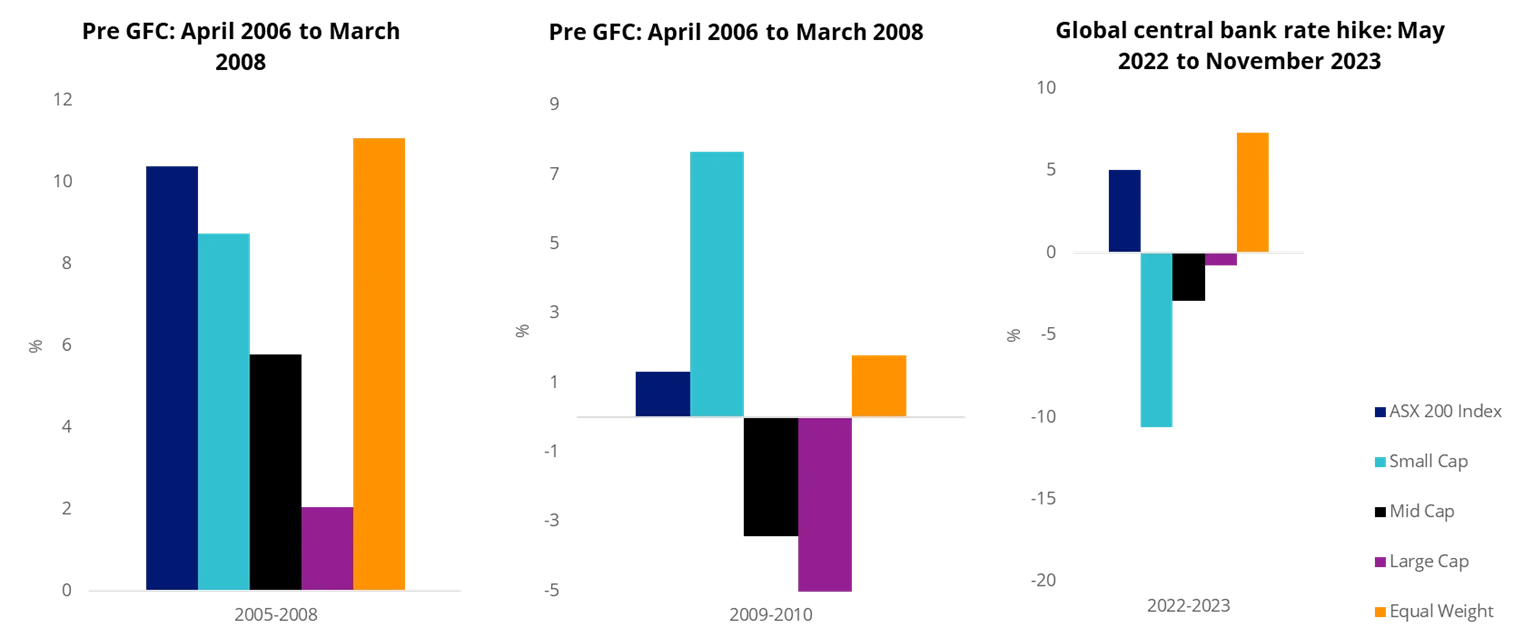
Another rationale for considering MVW is the interest rate environment. MVW tracks the MVIS Australia Equal Weight Index (MVW Index), which has a longer history than MVW. Going back to the previous rate hiking cycles, the MVW Index outperformed. Noting that the past performance of the MVW Index is not indicative of the performance of MVW.
Chart 2 to 4: Australian equity index performance during previous hiking cycles
Source: VanEck, Bloomberg. Small Cap is ASX Small Ords Index. Mid Cap is ASX Mid 50 Index. Large Cap is ASX 20 Index. Equal weight is MVIS Australia Equal Weight Index. Performance in AUD. Past performance is not indicative of future performance. You cannot invest an Index.
We have written in the past (here and here) how equal weighting has historically outperformed in a recovery, so we think this drawdown could represent a compelling entry point for MVW.
Many advisers and their investors are already using MVW as their core Australian equity allocation, around which they can add high-conviction satellite ideas.
Smaller companies offering ‘growth at a reasonable price’
The recent market drawdown and revisions after the February earnings season have made the valuations of smaller companies increasingly attractive, particularly when you consider they’re also offering higher forecast EPS growth over the long term. Despite large caps pulling back, the price to 12 month forward earnings is still at the upper bound of their historical average. Whereas mid, equal weight and small caps are close to or below their historical average.
Chart 5: EPS growth skews outside the top 10
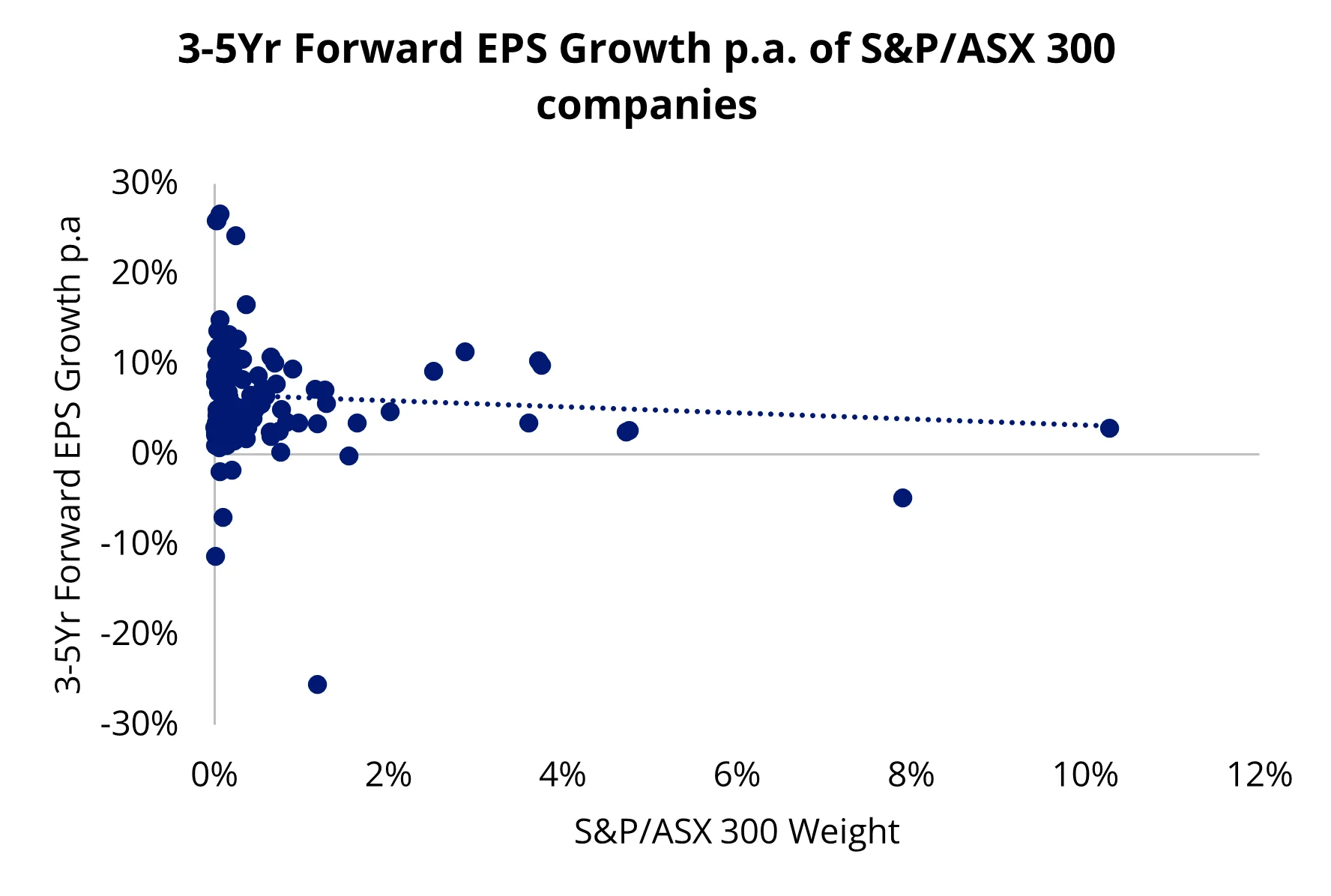
Source: Factset, VanEck. 28 February 2026.
Chart 6: Only Large caps at near historical highs
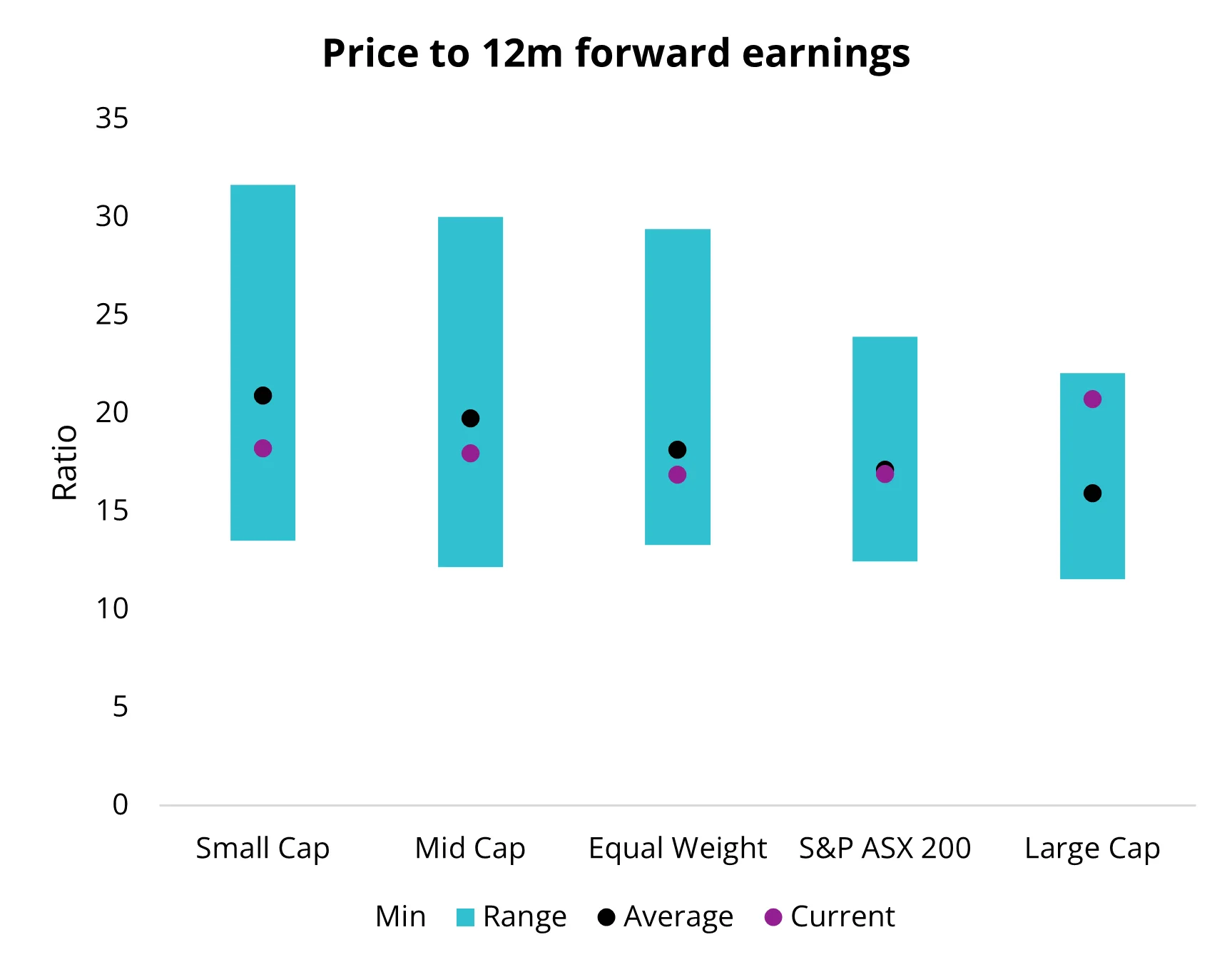
Source: Bloomberg. Large cap is S&P/ASX 20 Index. Mid cap is S&P/ASX Midcap 50 Index. Small Cap is S&P/ASX Small Ordinaries Index. Data from 31 January 2015 to 25 March 2025. Past performance is not indicative of future performance. You cannot invest in an index.
Taking positions outside the mega-caps may be opportune.
Using ALFA as a high conviction satellite.
ALFA is an unconstrained high conviction Australian equity portfolio that targets long and short positions. It uses a dynamic quantitative stock selection approach utilising sophisticated computations and programmed learning designed to be agnostic of market cycles and style rotations.
In a way, equal weighting and long-short are complementary expressions of the same insight: the ASX is systematically distorted by concentration.
MVW corrects the concentration passively.
ALFA monetises it by running a long book of quality businesses that the market tends to be underweight and a short book of those companies expected to be among the market’s poorest performers. Notably, ALFA’s management fee is approximately one-third of that charged by many comparable Australian equity long/short strategies. In a market where genuine long/short capability often comes at hedge fund-level pricing, ALFA offers access to this expanded toolkit at a lower cost.
To receive a copy of research reports or for more information on MVW or ALFA, please contact me or visit our website here.
And please do not hesitate to reach out for a customised portfolio solution. I am happy to show how MVW could be included as a low-cost core portfolio to replace/complement an active manager and/or S&P/ASX index tracker, or how ALFA could be used as a satellite position.
Key risks
An investment in the ETFs carries risks. For MVW, these include risks associated with financial markets generally, individual company management, industry sectors, fund operations and tracking an index. ALFA is considered to have a higher investment risk than a comparable fund that does not engage in short selling and leverage. Investors should actively monitor their investment as frequently as daily to ensure it continues to meet their investment objectives. Risks associated with an investment in ALFA include those associated with short-selling risk, leverage risk, prime broker risk, counterparties risk, concentration risk, operational risk and material portfolio information risk. See the relevant PDS and TMD for details.


Published: 30 March 2026
Any views expressed are opinions of the author at the time of writing and is not a recommendation to act.
VanEck Investments Limited (ACN 146 596 116 AFSL 416755) (‘VanEck’) is the issuer and responsible entity of all VanEck exchange traded funds (Funds) listed on the ASX. This is general advice only and does not take into account any person’s financial objectives, situation or needs. The product disclosure statement (PDS) and the target market determination (TMD) for all Funds are available at vaneck.com.au. You should consider whether or not any Fund is appropriate for you. Investments in a Fund involve risks associated with financial markets. These risks vary depending on a Fund’s investment objective. Refer to the applicable PDS and TMD for more details on risks. Investment returns and capital are not guaranteed.