Energy shock meets AI surge


The recent attacks in the Middle East have many investors on edge about the impact of rising oil prices. As most investors are aware, geopolitics has an impact on the prices of energy and materials.
While the outcome and duration of the war are unknown, the demand for energy and critical minerals from the expanding influence of AI continues unabated.
The result is that demand for traditional energy has increased, and investors are once again turning to traditional resources as well as critical minerals.
Energy (oil and gas), coal and the companies that produce them tend to do what they are supposed to do when they are supposed to do it. In a world of rising structural demand and constrained supply, this sector's recent outperformance can continue.
However, While escalating Middle East tensions and tightening oil supply are (rightly) at the forefront of investors' minds, it's important to remember that there is also rising AI-driven demand. It’s important to consider both as they drive markets in the short term and structurally, over the long term.
Geopolitics and global energy markets
The obvious impact of the war in the Middle East is rising energy costs as the supply of oil and gas is affected. While geopolitical machinations impact short-term pricing and create a “risk premium,” it is the balance between supply and demand that determines the fundamental direction of prices.
The term “risk premium” suggests a temporary effect, and often it is. It is not uncommon for crude oil prices to rise following major international disruptions. Markets have, at times, grown almost impervious to one-off events. The current escalation in a region central to global energy flows could be different.
Rather than a transitory shock, we may be entering a situation that lasts months. Supply of crude oil and LNG will be disrupted, perhaps for a meaningful period. The implications extend beyond headline risk and into the structural functioning of the energy ecosystem.
Initial equity and commodity reactions in the Gulf region reflected knee-jerk volatility, with moves in the 5–10% range that settled soon after. Investors initially hoped for a contained outcome. But there is an increasing probability of a disruptive and prolonged conflict. The structural impacts could span infrastructure, transportation, production and refining.
Several developments reinforce this view:
- Leadership vacuum and retaliation risk
The death of senior Iranian leadership figures and vows of revenge introduce profound uncertainty. A power vacuum increases the probability of responsive actions taken with limited restraint. - Strait of Hormuz disruption
Shipping through the Strait has halted amid tanker attacks, and major regional ports have suspended operations. Roughly 15–20% of global crude oil and approximately 20% of LNG flows through the Strait of Hormuz. The longer this persists, the more profound the impact on global energy markets. - Limited OPEC+ offset
OPEC+ has agreed to resume production increases, adding 206,000 bbl/d, only modestly above prior plans. This suggests the group is either unwilling or, in our view, unable to raise production enough to offset potential regional interruptions. - Gulf states isolate Iran
Other Gulf states, including Saudi Arabia, the UAE, Qatar, Oman, Kuwait and Bahrain, have hardened their stance, isolating Iran. This raises the risk of retaliatory strikes and reinforces the likelihood of a severe and extended conflict.
Taken together, these factors point toward oil prices reflecting this situation over a longer horizon than just days. Longer-term impacts could suggest meaningful upward pressure under a prolonged disruption scenario. A swift diplomatic resolution or de-escalation could put downward pressure on prices. We think, therefore, energy and oil companies outside of the Gulf could potentially do well as the conflict continues.
A megatrend continues to accelerate demand
At the same time, the global economy faces the reality of expanding AI influence and the massive amounts of energy and critical minerals required to power it.
Chart 1: Real private non-residential fixed investment, Quarterly
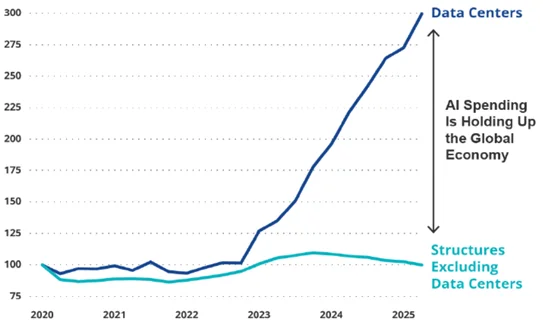
Source: BofA Global Research, 31 December 2025. Note: Index measures the change in the seasonally adjusted annual rate. Q1 2020=100.
AI demands scalable power generation, transmission infrastructure and critical minerals. Ensuring sufficient energy and accessible materials is becoming a challenge.
We think, therefore, exposure to critical minerals is important.
Don’t forget gold miners
The attacks in the Middle East create uncertainty. In periods of uncertainty, gold (and its miners) tend to outperform.
Investing for the intersection of tightening and energy supply and long-term structural trends
Considering all of this, a diversified resources exposure should be overweight gold miners, oil and gas and other fossil fuels, and overweight critical minerals.
The VanEck Australian Resources ETF (ASX: MVR) is index MVR tracks caps its holdings at 8% each rebalance. What this means is that, compared to other resources ETFs, it is not a BHP proxy (over 35% in the S&P/ASX 200 Resources Index), it delivers real critical minerals exposure, almost a quarter of the fund is in gold miners, and it has more meaningful exposure to energy companies like Santos and Woodside.
The table below illustrates the structural story and the problem with a broad S&P/ASX 200 Resources Index exposure that has 37.10% exposure to BHP versus 9.0% in MVR. The weight freed up by the 8% cap (at each rebalance) is redistributed across the broader resources complex:
Table 1: MVR, a diversified resources exposure
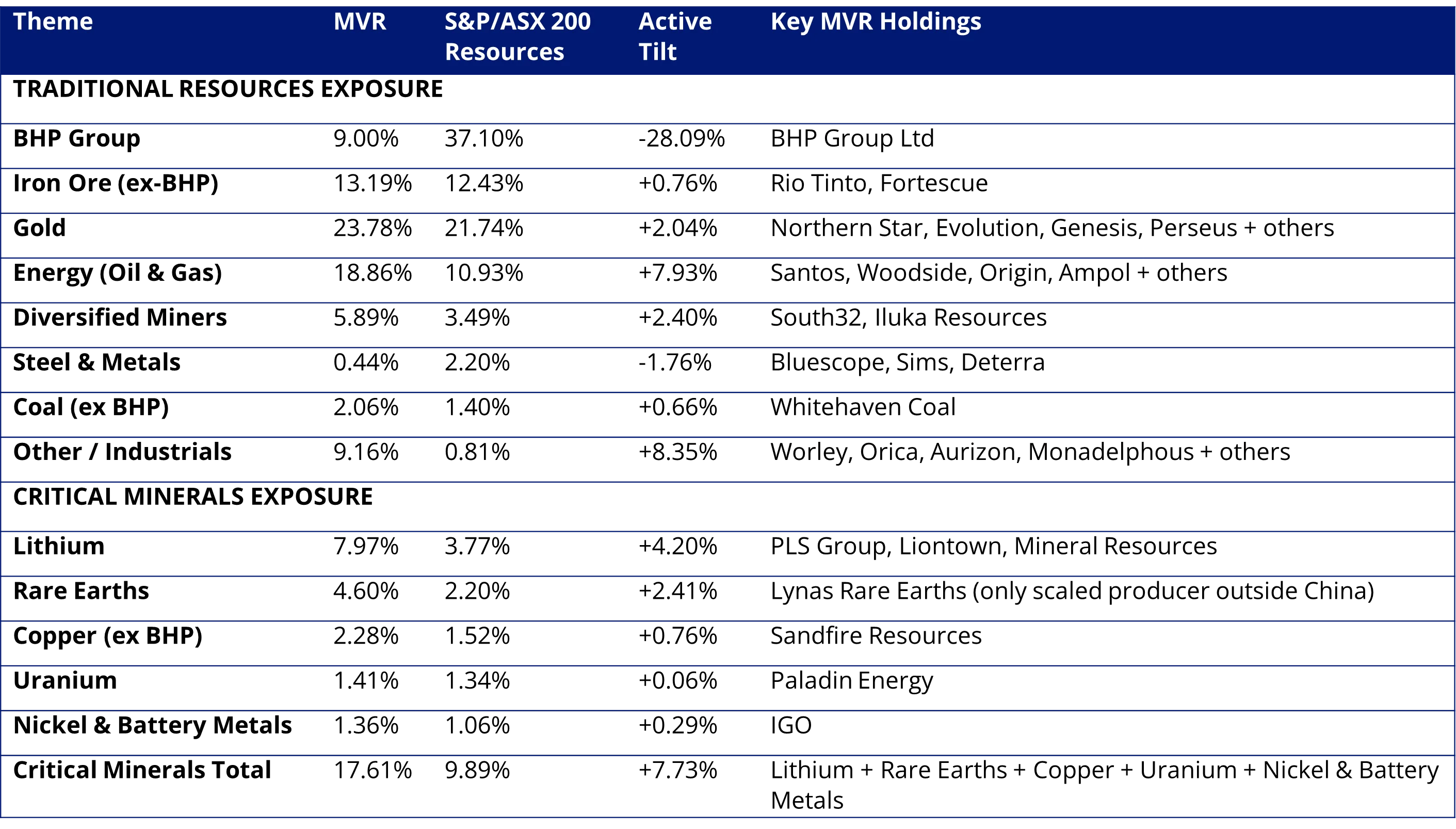
Source: FactSet, as at 28 February 2026
MVR vs S&P/ASX 200 Resources - Performance
MVR has outperformed the S&P/ASX 200 Resources Index by 0.97% p.a. since its inception. As always, past performance is not indicative of future performance.
Table 2: Trailing performance to 28 February 2026

* MVR Inception date is 13 October 2013. A copy of the factsheet is here.
Source: Morningstar Direct, VanEck as at 28 February 2026. The chart and table above show past performance of MVR and of the S&P/ASX 200 Resources Index. You cannot invest directly in an index. Results are calculated to the last business day of the month and assume immediate reinvestment of distributions. MVR results are net of management fees and other costs incurred in the fund, but before brokerage fees and bid/ask spreads incurred when investors buy/sell on the ASX. Returns for periods longer than one year are annualised. Past performance is not a reliable indicator of future performance. The S&P/ASX 200 Index is shown for comparison purposes as it is the widely recognised benchmark used to measure the performance of the broad Australian market. It includes the 200 largest ASX-listed companies, weighted by market capitalisation. The S&P/ASX 200 Index is shown for information and discussion purposes only and is not a comparable benchmark for MVR. The S&P/ASX 200 Resources Index is shown for comparison purposes as it is the widely recognised benchmark used to measure the performance of the resources companies included in the S&P/ASX 200, weighted by market capitalisation. MVR’s index measures the performance of the largest and most liquid ASX-listed companies that generate at least 50% of their revenues or assets from the Australian resources sector, with a maximum weight of 8% in each company at rebalance. Consequently, it has fewer companies and different industry allocations than the S&P/ASX 200 Resources Index. Click here for more details.
Key points:
Diversify across Australian resources
Invest across the range of Australia's resource companies, including BHP, Rio Tinto, Woodside and more, in one trade on ASX.
Benefit from Australia's international trade
Resource companies leverage off Australia's international trade partners, including growing nations such as China and India and more developed countries such as the USA and Japan.
Tactical exposure
Targeted investment position to one of the pillars of Australia's economy and our major exports.
To receive a copy of the Lonsec report or for more information on MVR, please contact me or visit our website.
For large trade execution, please contact our Capital Markets desk on 02 8038 3317.
Key risks
An investment in our Australian Resources ETF carries risks associated with: financial markets generally, individual company management, industry sectors, stock and sector concentration, fund operations and tracking an index. See the VanEck Australian Resources ETF PDS and TMD for more details.
MVR is likely to be appropriate for a consumer who is seeking capital growth and a regular income distribution, is intending to use the product as a minor or satellite allocation within a portfolio, has an investment timeframe of at least 5 years, and has a high risk/return profile.


Published: 10 March 2026
Any views expressed are opinions of the author at the time of writing and is not a recommendation to act.
VanEck Investments Limited (ACN 146 596 116 AFSL 416755) (VanEck) is the issuer and responsible entity of all VanEck exchange traded funds (Funds) trading on the ASX. This information is general in nature and not personal advice, it does not take into account any person’s financial objectives, situation or needs. You should consider whether or not an investment in any Fund is appropriate for you. Investments in a Fund involve risks associated with financial markets. These risks vary depending on a Fund’s investment objective. Refer to the applicable product disclosure statement (PDS) and target market determination (TMD) available at vaneck.com.au for more