


Resources have long underpinned Australia’s economy and continue to rank among the nation’s largest export earners. Discover the key forces now accelerating demand.
Expert Analysis: MVR
Most Australian investors have exposure to the resources sector. The resources sector has been one of the pillars of Australia’s economy and our biggest exporter. Most Australian investors have exposure to this sector directly, either via a single blue chip or indirectly, via a fund.
Investing in resources requires specialist knowledge that many stock pickers do not have, and that is why some investors prefer to utilise resource sector ETFs to gain additional resources exposure.
Many resources funds follow market capitalisation indices. A limitation of a market capitalisation index is the potential for concentration, and the Australian resources market capitalisation index, the S&P/ASX 200 Resources Index, is an example of this. BHP is over 37% of this index. In other words, if you invest in a fund that tracks this index, you are investing almost two-fifths of your money in just one company. It also means BHP can be the single driver of performance for the entire sector, which adds a layer of unintended risk. BHP is also a company many investors already own, either directly or indirectly.
MVR’s ‘smarter’ approach
VanEck Australian Resources ETF (MVR) tracks the MVIS Australia Resources Index. This index is a ‘smart beta’ index, which means it is constructed differently from the market capitalisation index.
The MVIS Australia Resources Index caps its holdings at 8%. What this means is that MVR is not just a proxy BHP exposure. At rebalance, no stock, including BHP, is more than 8%. The impact of this capping is that it reduces the dominance of the mega/large-cap stocks and increases exposure to mid-caps.
So let’s walk through the difference between MVR and the S&P/ASX 200 Resources Index.
MVR and the S&P/ASX 200 Resources Index - Top 10 holdings
Below you can see the top 10 companies. The differences are stark – to see all the holdings in MVR and its weightings click here.
Table 1: Top 10 holdings MVR & Table 2: Top 10 S&P/ASX 200 Resources
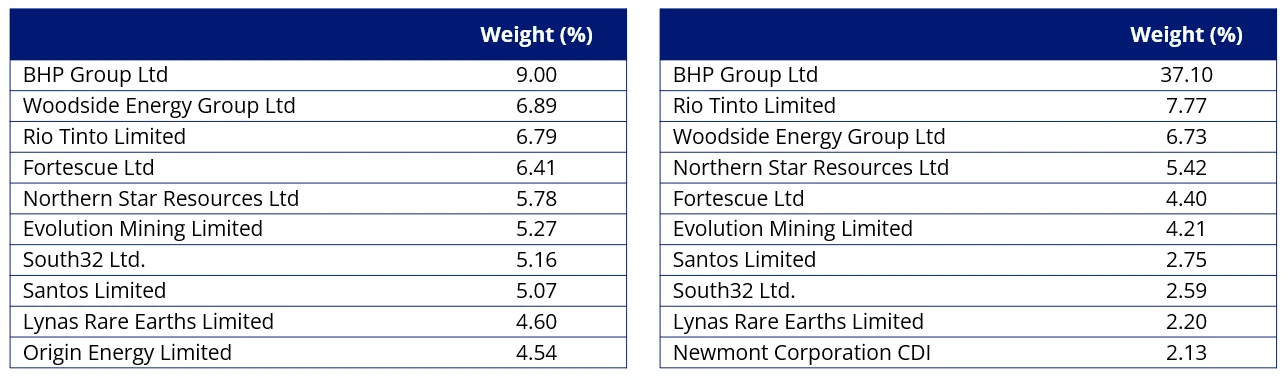
Source: FactSet, VanEck, MarketVector, as at 28 February 2026
MVR and the S&P/ASX 200 Resources Index – Sub-sector exposures
MVR is currently underweight the diversified metals and mining sectors compared to the S&P/ASX 200 Resources Index. BHP sits in this sector. Conversely, MVR is overweight the oil subsectors, gold, coal, copper and aluminium.
Chart 1: S&P/ASX 200 Resources and MVR sub sector
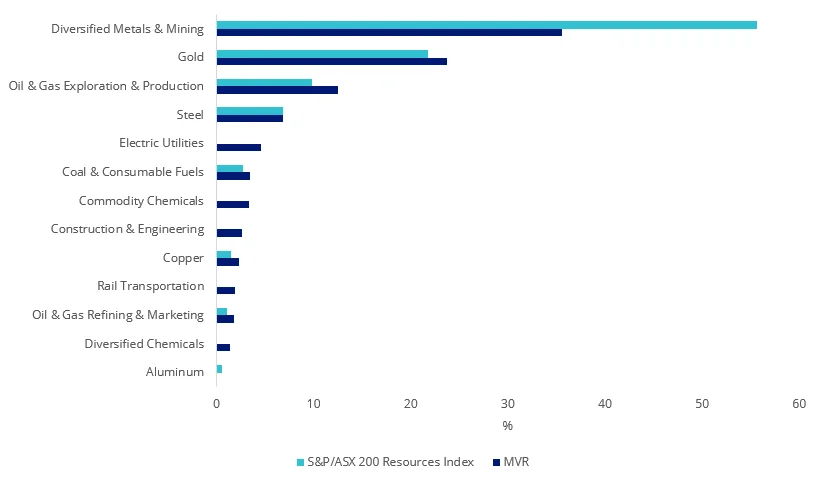
Source: FactSet, 28 February 2026
MVR vs S&P/ASX 200 Resources - Performance
MVR has outperformed the S&P/ASX 200 Resources Index by 1.01% p.a. since its inception. As always, past performance is not indicative of future performance.
Table 3: Trailing performance to 28 February 2026

* MVR Inception date is 13 October 2013 a copy of the factsheet is here.
Source: Morningstar Direct, VanEck The chart and table above show past performance of MVR and of the S&P/ASX 200 Resources Index. You cannot invest directly in an index. Results are calculated to the last business day of the month and assume immediate reinvestment of distributions. MVR results are net of management fees and other costs incurred in the fund, but before brokerage fees and bid/ask spreads incurred when investors buy/sell on the ASX. Returns for periods longer than one year are annualised. Past performance is not a reliable indicator of future performance. The S&P/ASX 200 Resources Index is shown for comparison purposes as it is the widely recognised benchmark used to measure the performance of the resources companies included in the S&P/ASX 200, weighted by market capitalisation. MVR’s index measures the performance of the largest and most liquid ASX-listed companies that generate at least 50% of their revenues or assets from the Australian resources sector, with a maximum weight of 8% in each company at rebalance. Consequently it has fewer companies and different industry allocations than the S&P/ASX 200 Resources Index. Click here for more details.
MVR has performed well due to its exposure to gold miners benefiting from the price rise of the yellow metal, and critical mineral miners that have benefited from increased demand from clean energy and defence.
When you consider MVR’s critical minerals exposure, which would incorporate rare earths, lithium, cobalt, nickel, copper, uranium, manganese and zinc, this equates to ~20% of MVR’s revenue.
Table 4: MVR’s revenue breakdown
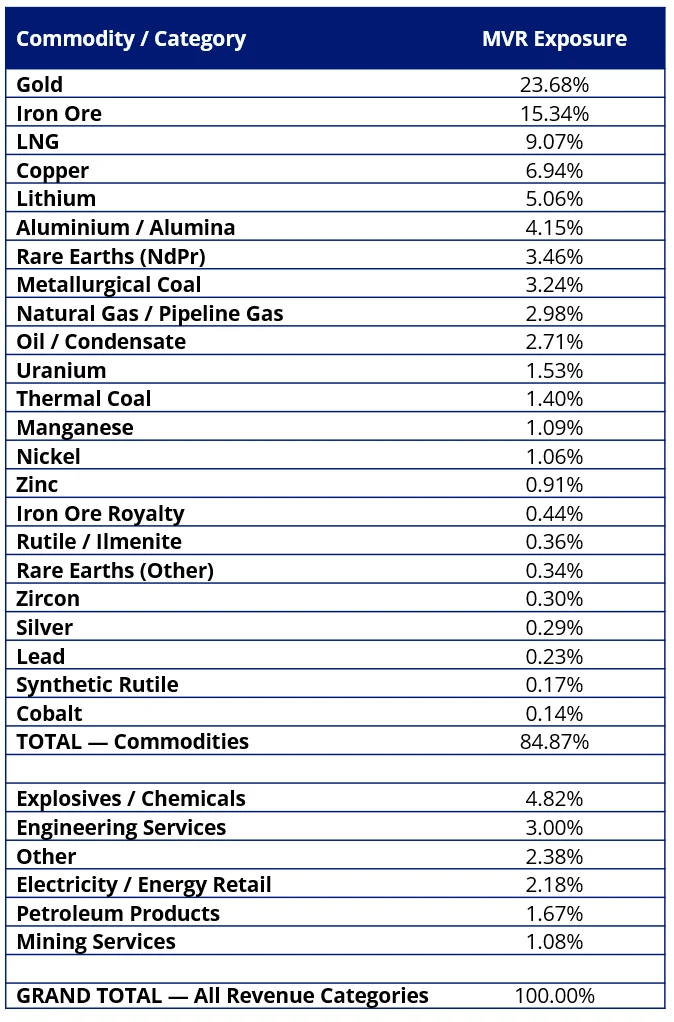
Source: FactSet, VanEck, 25 February 2026
Past performance is not indicative of future performance. The above is not a recommendation to act. Please speak to your financial adviser or stock broker.
For further information you can email us or call on us on +61 2 8038 3300.
Key risks
An investment MVR carries risks associated with: ASX trading time differences, financial markets generally, individual company management, industry sectors, country or sector concentration, political, regulatory and tax risks, fund operations and tracking an index. See the PDS and TMD for details.
MVR is likely to be appropriate for a consumer who is seeking capital growth and a regular income distribution, is intending to use the product as a minor or satellite allocation within a portfolio, has an investment timeframe of at least 5 years, and has a high risk/return profile.


Published: 05 March 2026
Any views expressed are opinions of the author at the time of writing and is not a recommendation to act.
VanEck Investments Limited (ACN 146 596 116 AFSL 416755) (‘VanEck’) is the issuer and responsible entity of all VanEck exchange trades funds (Funds) listed on the ASX. This is general advice only and does not take into account any person’s financial objectives, situation or needs. The product disclosure statement (PDS) and the target market determination (TMD) for all Funds are available at vaneck.com.au. You should consider whether or not an investment in any Fund is appropriate for you. Investments in a Fund involve risks associated with financial markets. These risks vary depending on a Fund’s investment objective. Refer to the applicable PDS and TMD for more details on risks. Investment returns and capital are not guaranteed.
MarketVector Indexes GmbH (MarketVector), a related body corporate of VanEck Investments Limited, the responsible entity and issuer of VanEck Australian Resources ETF (Fund).
The MVIS Australia Resources Index is created and maintained by MarketVector. MarketVector does not sponsor, endorse, issue, sell, or promote the Fund and makes no representation or warranty, express or implied, to VanEck or any member of the public regarding the advisability of investing in securities generally or in the Fund particularly and bears no liability with respect to the Fund. Read the PDS for the full index disclaimer.
1 - 3 of 3



Education
ETFs Explained
About Smart Beta
International Investing
Emerging Markets
Quality Investing
Moat Investing
Investing for Income
Property Investing
Investing in Infrastructure
Gold Investing
Expert Insights
ViewPoint Quarterly
ESG Investing
Investing in Healthcare
Video Gaming & Esports
Investing In Clean Energy