China A-Shares: Resilience in a volatile world?


As geopolitical tensions rattle global markets, China’s onshore equities are showing resilience.
Periods of geopolitical tension and energy market disruption tend to result in broad volatility across global equities.
Countries that rely heavily on imported energy can be particularly exposed, as rising oil prices feed through to inflation and production, and negatively impacting economic growth expectations.
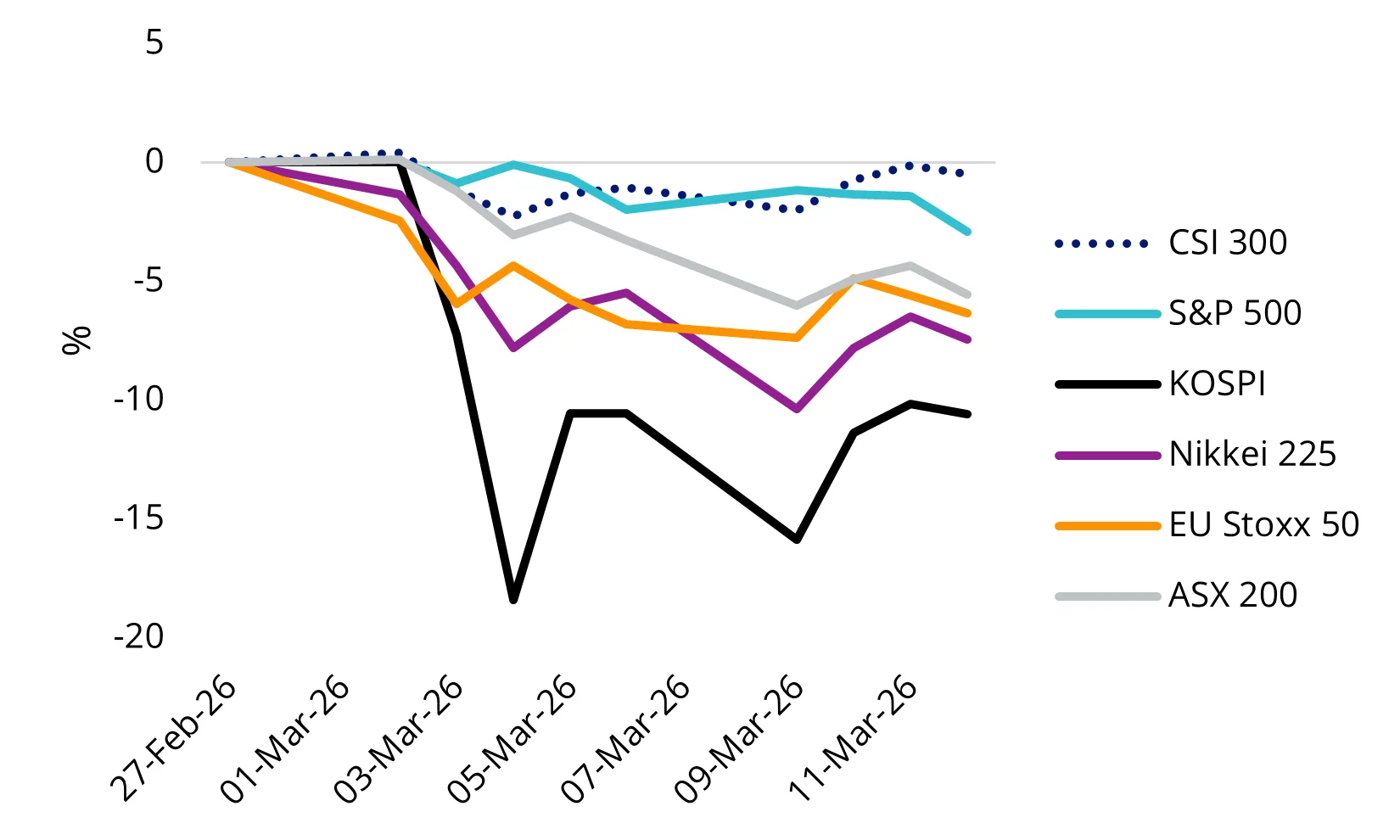
However, China’s onshore equity market has shown relative resilience. During the recent oil price spike following tensions in the Middle East, the CSI 300 Index, the benchmark for China’s A-share market, experienced comparatively modest moves relative to many global equity markets.
Chart 1: China A-shares are relatively unscathed amid the Iran oil shock episode
Source: Bloomberg as at 12 March 2026. Past performance is not indicative of future performance.
Why have Chinese equities held up better? There are two structural factors that may help explain this resilience.
Energy strategy as a macro stabiliser
China has spent years pursuing a more diversified energy strategy, which may help cushion the impact of oil market shocks. Strategic oil reserves have been steadily built up since last year, helping reduce the immediate sensitivity of the economy to supply disruptions.
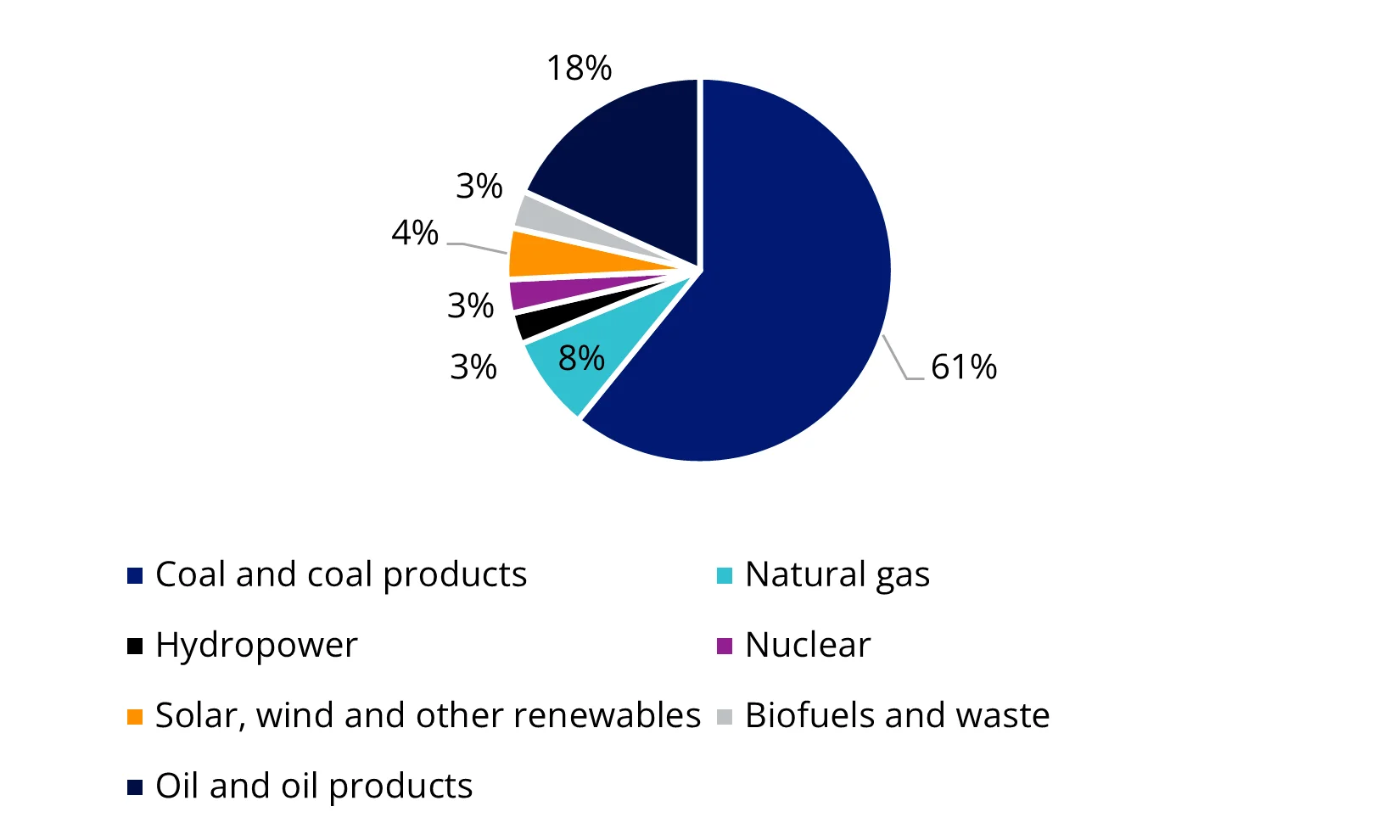
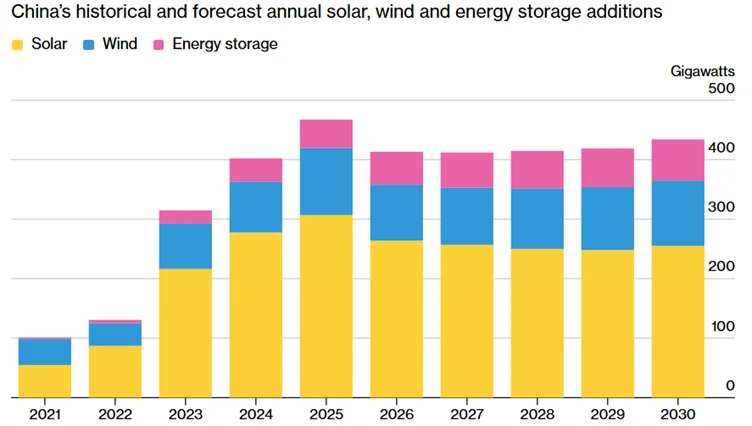
While coal remains the dominant source of energy, China has also been increasing its renewable energy capacity for many years.
According to the International Energy Agency, IEA, China accounted for roughly 40% of global renewable capacity expansion between 2019 and 2024. Enhance competitiveness of both solar and onshore wind energy generation, combined with improvements in energy storage and system integration, is gradually broadening the country’s energy base.
Chart 2: China relies on coal more than oil and gas
Source: IEA, 2023.
Chart 3: China’s solar, wind and energy storage additions
Source: BloombergNEF, National Energy Administration. Figures from 2025 to 2030 are BNEF forecasts as of December 2025.
This is significant for A-shares, as many listed companies and sectors rely more on domestic cost structures and energy supply conditions than on direct export-driven demand.
Two sessions: Continuity and domestic bias
While the conflict in the Middle East continues to dominate headlines, China has quietly set its economic direction for the year. At the recent “Two Sessions”, the annual meetings where policymakers outline economic priorities, authorities signalled comfort with more moderate headline growth without resorting to aggressive stimulus. Instead, the focus remains on “quality growth”, driven by domestic demand, technological self-reliance and structural transformation.
Both monetary and fiscal policy are expected to remain accommodative, with funding directed toward strategically important sectors. Notably, a new RMB100 billion fund has been announced to support domestic consumption.
This policy stance supports sectors tied to domestic demand, including advanced manufacturing, cleantech and consumer services, areas that are well represented in China’s A-share market.
Diversification and defence potential
While China A-shares are not traditionally viewed as a defensive asset class, recent market behaviour has highlighted how domestic policy drivers and structural economic trends can sometimes decouple the market from global macro shocks.
For investors, this can serve as a tactical allocation for diversification within broader global equity allocations.
VanEck offers three ETFs that provide exposure to Chinese equities:
- China New Economy ETF (CNEW): Invests in 120 fundamentally sound and attractively valued companies with growth prospects in China's New Economy, targeting technology, healthcare, and consumer staples and consumer discretionary sectors.
- FTSE China A50 ETF (CETF): Invests in a diversified portfolio comprising the 50 largest companies in the mainland (A-shares) Chinese market.
- MSCI Multifactor Emerging Markets Equity ETF (EMKT): Invests in a diversified portfolio of emerging market companies with value, low size, momentum and quality characteristics. ~25% of the fund is currently allocated to China, as at 28 Feb 2026
Key Risks
An investment in these ETFs carries risks associated with: ASX trading time differences, China (CNEW & CETF), emerging markets (EMKT), financial markets generally, individual company management, industry sectors, foreign currency, sector concentration, political, regulatory and tax risks, fund operations, liquidity and tracking an index. See the relevant ETF PDS and TMD for more details.
CNEW and CETF are likely to be appropriate for a consumer who is seeking capital growth, is intending to use the product as a minor or satellite allocation within a portfolio, has an investment timeframe of at least 5 years, and has a very high risk/return profile.
EMKT is likely to be appropriate for a consumer who is seeking capital growth, is intending to use the product as a core, minor or satellite allocation within a portfolio, has an investment timeframe of at least 5 years, and has a high risk/return profile.


Published: 17 March 2026
Any views expressed are opinions of the author at the time of writing and is not a recommendation to act.
VanEck Investments Limited (ACN 146 596 116 AFSL 416755) (VanEck) is the issuer and responsible entity of all VanEck exchange traded funds (Funds) trading on the ASX. This information is general in nature and not personal advice, it does not take into account any person’s financial objectives, situation or needs. The product disclosure statement (PDS) and the target market determination (TMD) for all Funds are available at vaneck.com.au. You should consider whether or not any Fund is appropriate for you. Investments in a Fund involve risks associated with financial markets. These risks vary depending on a Fund’s investment objective. Refer to the applicable PDS and TMD for more details on risks. Investment returns and capital are not guaranteed.