China’s AI rush is moving upstream


Getting exposure to the AI boom typically comes at a premium, but there are reasonably-priced opportunities beyond the usual hunting grounds.
AI euphoria continues to reach new levels in the US. Nvidia posted gravity-defying earnings in the most recent October quarter as the AI economy increasingly looped back on itself and the major players invested in each other’s technologies.
With giants like OpenAI and Oracle locking in the chip supply needed to scale their models, demand for Nvidia hardware could soar even more.
But this AI elation isn’t limited to the US. The Chinese equity market has also been celebrating the rise of homegrown AI technology and chipmaking, and valuations for pure-play AI stocks have soared. Cambricon Technologies (ticker: 688256), a major Chinese developer of AI chips, is trading at 236x 12-month forward P/E (Bloomberg, as at 24 November 2025).
While China is a global leader in semiconductor production, it isn’t limiting its AI participation to this segment, and we think it may be taking a different, more holistic approach compared to the western world, with a growing recognition that real AI scale doesn’t just require advanced algorithms or GPUs. The tremendous amounts of electricity, cooling, metal-intensive data centres, and resilient power supply required by AI have been the focus of many Chinese companies that have been specialising in these systems for decades.
For investors, this means there could be more reasonably priced opportunities across the broader supply chain that powers the physical backbone of AI: metals producers, energy storage leaders, and optical fibre manufacturers.
Copper and aluminium: powering and cooling the AI boom
The AI boom isn’t just digital, rather it’s intensely physical. Data centres require vast amounts of copper and aluminium in servers and heatsinks, due to their characteristics of high conductivity and resistance to corrosion.
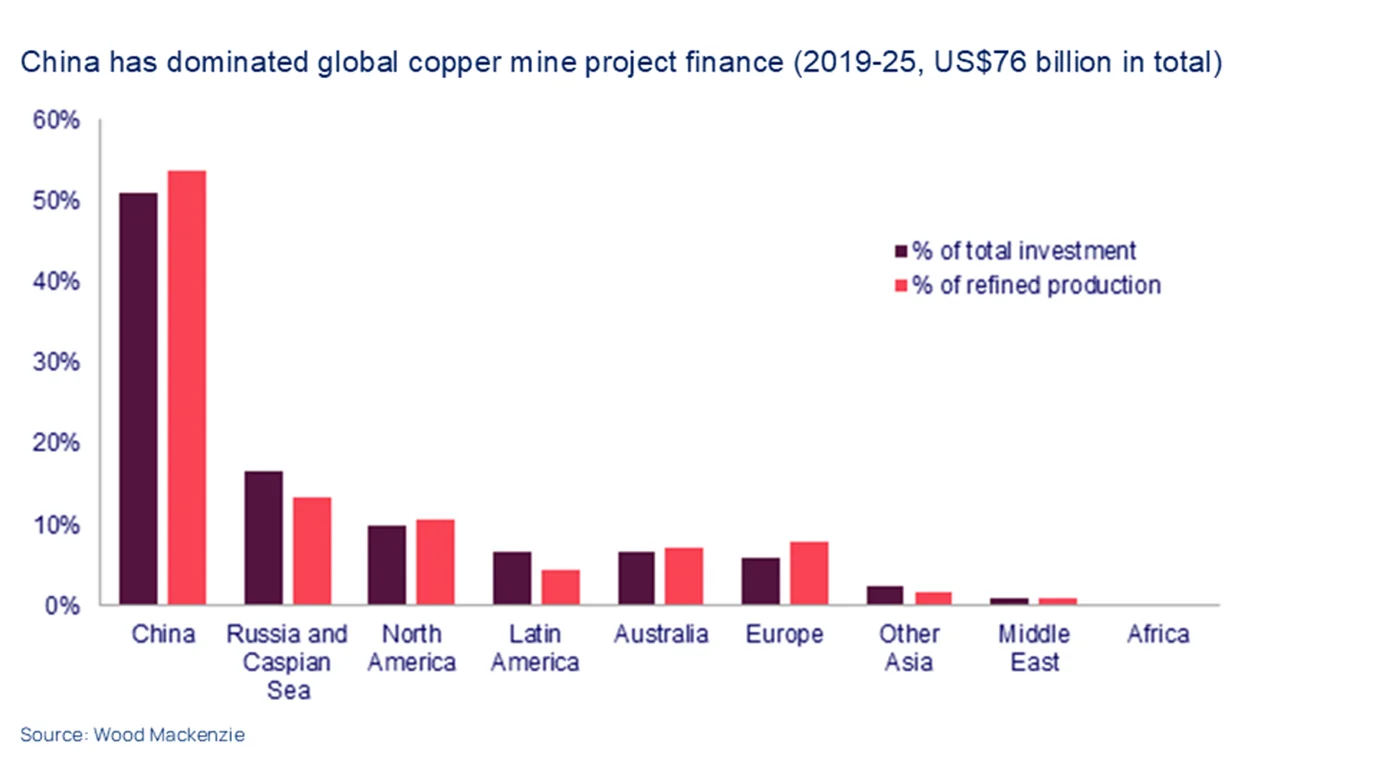
According to a recent report by Wood Mackenzie, global copper demand is expected to surge 24% by 2035, with data centre expansion being one of the key drivers. China’s advantage is its integrated value chain across mining, refining and manufacturing.
Chart 1: China leads the world in copper production
Source: Wood Mackenzie.
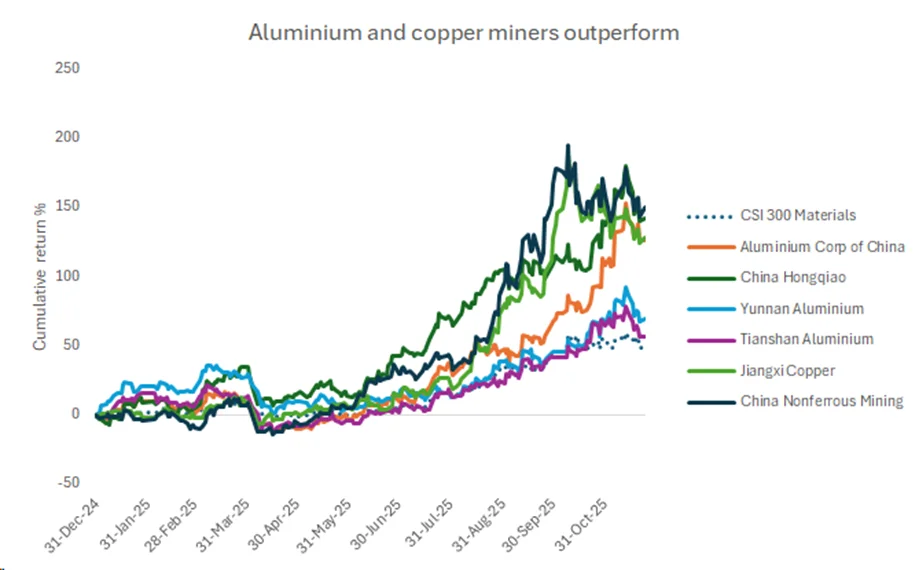
Several Chinese copper and aluminium miners have been outperforming the CSI 300 Materials Index this year. In our view, investing in these metals may offer a more cost-effective and direct way to participate in China’s AI capex cycle.
Chart 2: Chinese aluminium and copper miners have outperformed the benchmark this year
Source: Bloomberg, as at 24 November 2025.Past performance is not a reliable indicator of future performance. This is not a recommendation to act.
Energy storage systems: the power of a backup
AI cannot afford downtime. As hyperscale data centres are built across China, domestic demand for energy storage systems (ESS) is surging, especially for emergency backup installations.
World Economic Forum reported that China’s ESS capacity has increased year-on-year by more than 260%, and almost 10 times since 2020.
The standout winner is Contemporary Amperex Technology (CATL) (ticker: 300750), China’s top battery maker, with its Shenzhen-listed shares hit an all-time high after locking in a massive 200 GWh battery order from Beijing Hyperstrong Technology.
Optical fibre: The hidden hero linking GPUs
Behind every AI model lies a network of GPUs that need to be connected through ultra-high-speed optical transceivers. This segment has quietly produced some of China’s biggest winners this year (Bloomberg, as at 24 November 2025) such as Zhongji Innolight (266.24%) and Eoptolink Technology (251.03%). As China races to build multi-million-GPU clusters, optical fibre makers could experience further upside reminiscent of the early 2000s telecom supercycle when the foundation of the modern internet was first rolled out.
In many ways, the AI story mirrors China’s historical strengths: massive capex cycles, industrial policy alignment, and world-leading infrastructure deployment. The next phase of AI investment return may not come from the chips themselves, but from the companies supplying the energy and metals that fuel them.
Accessing Chinese equities
VanEck offers three ETFs that provide exposure to Chinese equities:
- China New Economy ETF (CNEW): Invests in 120 fundamentally sound and attractively valued companies with growth prospects in China's New Economy, targeting technology, healthcare, and consumer staples and consumer discretionary sectors.
- FTSE China A50 ETF (CETF): Invests in a diversified portfolio comprising the 50 largest companies in the mainland (A-shares) Chinese market.
- MSCI Multifactor Emerging Markets Equity ETF (EMKT): Invests in a diversified portfolio of emerging market companies with value, low size, momentum and quality characteristics. ~30% of the fund is currently allocated to China.
Key risks
An investment in the CNEW or CETF ETF carries risks associated with: ASX trading time differences, China, financial markets generally, individual company management, industry sectors, foreign currency, sector concentration, political, regulatory and tax risks, fund operations, liquidity and tracking an index. See the PDS and TMD for more details.
An investment in our emerging markets ETF carries risks associated with: ASX trading time differences, emerging markets, financial markets generally, individual company management, industry sectors, foreign currency, country or sector concentration, political, regulatory and tax risks, fund operations, liquidity and tracking an index. See the VanEck MSCI Emerging Markets Equity ETF PDS and TMD for more details.
EMKT is likely to be appropriate for a consumer who is seeking capital growth, is intending to use the product as a core, minor or satellite allocation within a portfolio, has an investment timeframe of at least 5 years, and has a high risk/return profile.
CNEW and CETF are likely to be appropriate for a consumer who is seeking capital growth, is intending to use the product as a minor or satellite allocation within a portfolio, has an investment timeframe of at least 5 years, and has a very high risk/return profile.


Published: 28 November 2025
Any views expressed are opinions of the author at the time of writing and is not a recommendation to act.
VanEck Investments Limited (ACN 146 596 116 AFSL 416755) (VanEck) is the issuer and responsible entity of all VanEck exchange traded funds (Funds) trading on the ASX. This information is general in nature and not personal advice, it does not take into account any person’s financial objectives, situation or needs. The product disclosure statement (PDS) and the target market determination (TMD) for all Funds are available at vaneck.com.au. You should consider whether or not an investment in any Fund is appropriate for you. Investments in a Fund involve risks associated with financial markets. These risks vary depending on a Fund’s investment objective. Refer to the applicable PDS and TMD for more details on risks. Investment returns and capital are not guaranteed.