US dollar weakness has been good for EM


US dollar weakness as an opportunity for emerging markets to shine.
The weakness of the US dollar was one of the stories in the first month of 2026.
The historical link between the US dollar and emerging markets (EM) equities is unmistakable, and it has been traditionally attributed to EM’s commodity bias and the reliance on borrowing and trade in US dollars.
EM equities are an often-overlooked asset class, and we think that as we enter the next global cycle, now could be an attractive entry point for EM equities: Valuations are attractive relative to history and developed markets (DM).
In addition to long-term tailwinds, we believe EM are better positioned than in previous periods of global economic uncertainty.
However, not all EM companies are desirable from an investment perspective, and quantifying factors in these markets is near impossible for non-institutional investors.
The US dollar is under renewed pressure
The fall of the US dollar has been well covered in the financial press. The relative value of the US dollar remains a cornerstone of the EM investment case because of its bias to commodity-exporting, which is often traded in US dollars. In the chart below, you can see that, since 2010, as the US dollar has risen (the US dollar index is inverted, so as the dollar increases in value, its line goes down), so too has EM underperformed developed markets. Should the US dollar continue to weaken, EM could start to outperform.
Chart 1: The relationship between the US dollar and EM equities
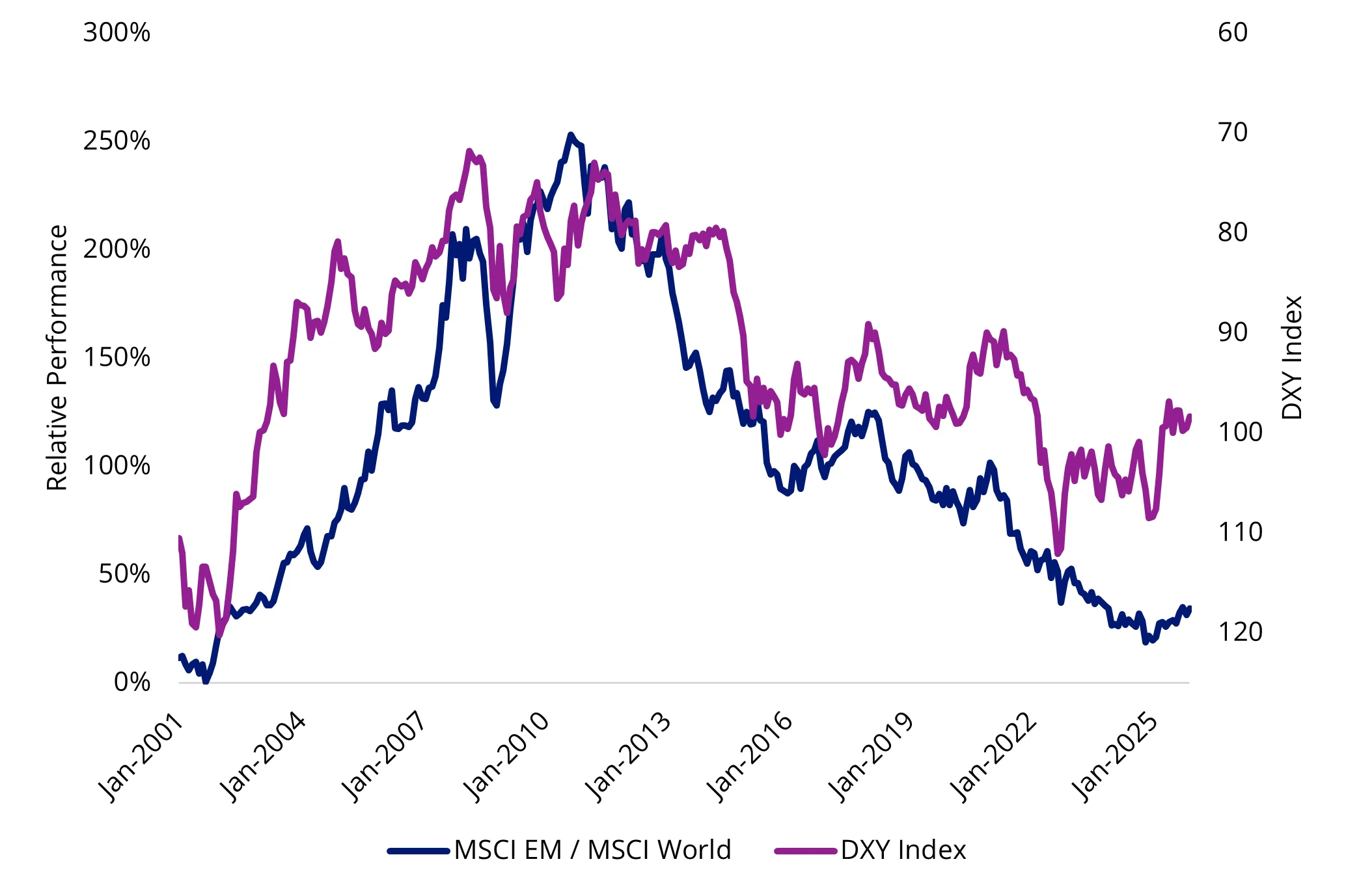
Source: Bloomberg, MSCI, to 28 January 2026. US dollar is the DXY Index. You cannot invest in an index. Past performance is not indicative of future performance.
EMs are more resilient than in the past
So far in 2026, EM equities have been more resilient to broader equity market drawdowns and the recent steepening in long-end rates. As the market grapples with geopolitical issues, more potential Fed cuts (and the fight for its independence) and fiscal issues exacerbated by mounting US debt, EM equities (as represented by the MSCI Emerging Markets Index) have outperformed DM equities (as represented by the MSCI World ex Australia Index) so far in 2026, noting that this is a short time period and past performance is not a reliable indicator of future performance.
Chart 2: Year-to-date performance (%)
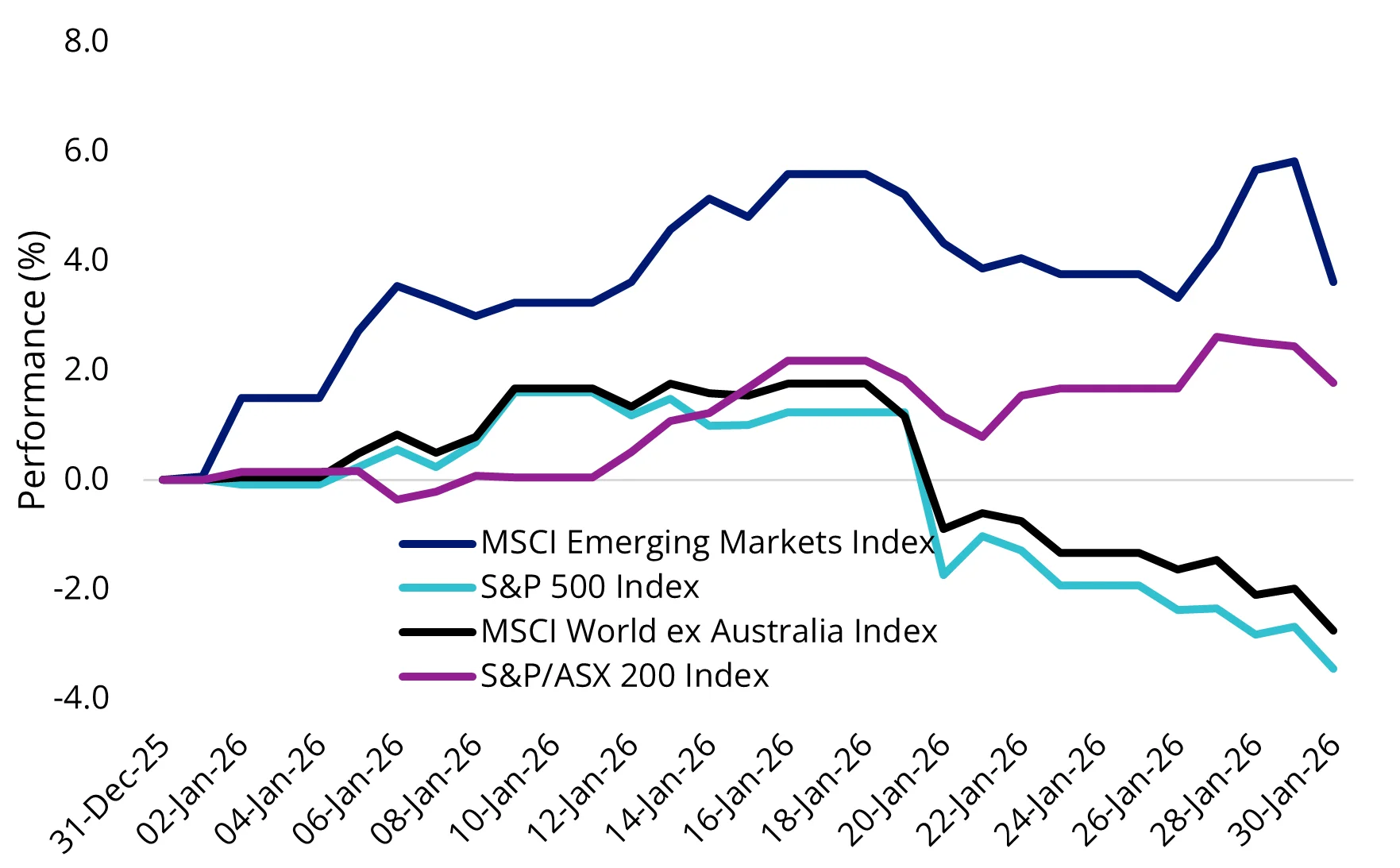
Source: Morningstar Direct, 31 December 2025 to 30 January 2026. Past performance is not indicative of future performance. You cannot invest directly in an index
This EM outperformance, relative to DM, has been attributed to the US dollar weakness this year, better fundamentals and demand from investors who are shifting assets to where they have been underweight, including emerging markets.
Valuations are compelling
EM, relative to DM equities are relatively cheap. EM equities, as represented by the MSCI Emerging Markets Index are currently trading at 29% and 45% discount on a price-to-earnings (P/E) and a price-to-book (P/B) basis to developed markets, respectively. The MSCI Emerging Markets Multi-Factor Select Index (EMKT Index), offers lower valuation ratios, so it potentially represents value.
Chart 3: P/E of Developed Markets and Emerging Markets
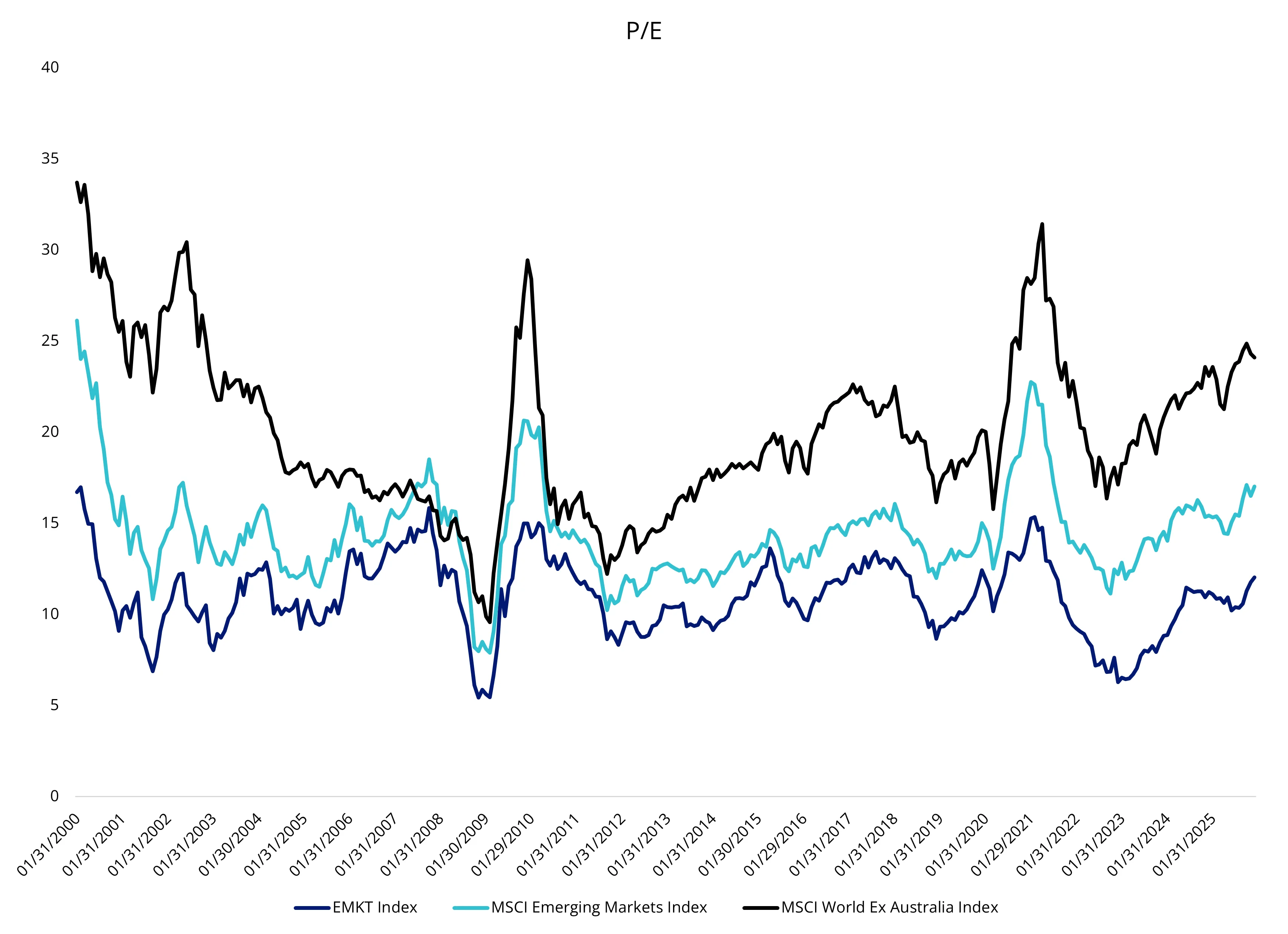
Source: MSCI, FactSet1 January 2000 to 31 December 2025. You cannot invest in an index.
Chart 4: P/B of Developed Markets and Emerging Markets
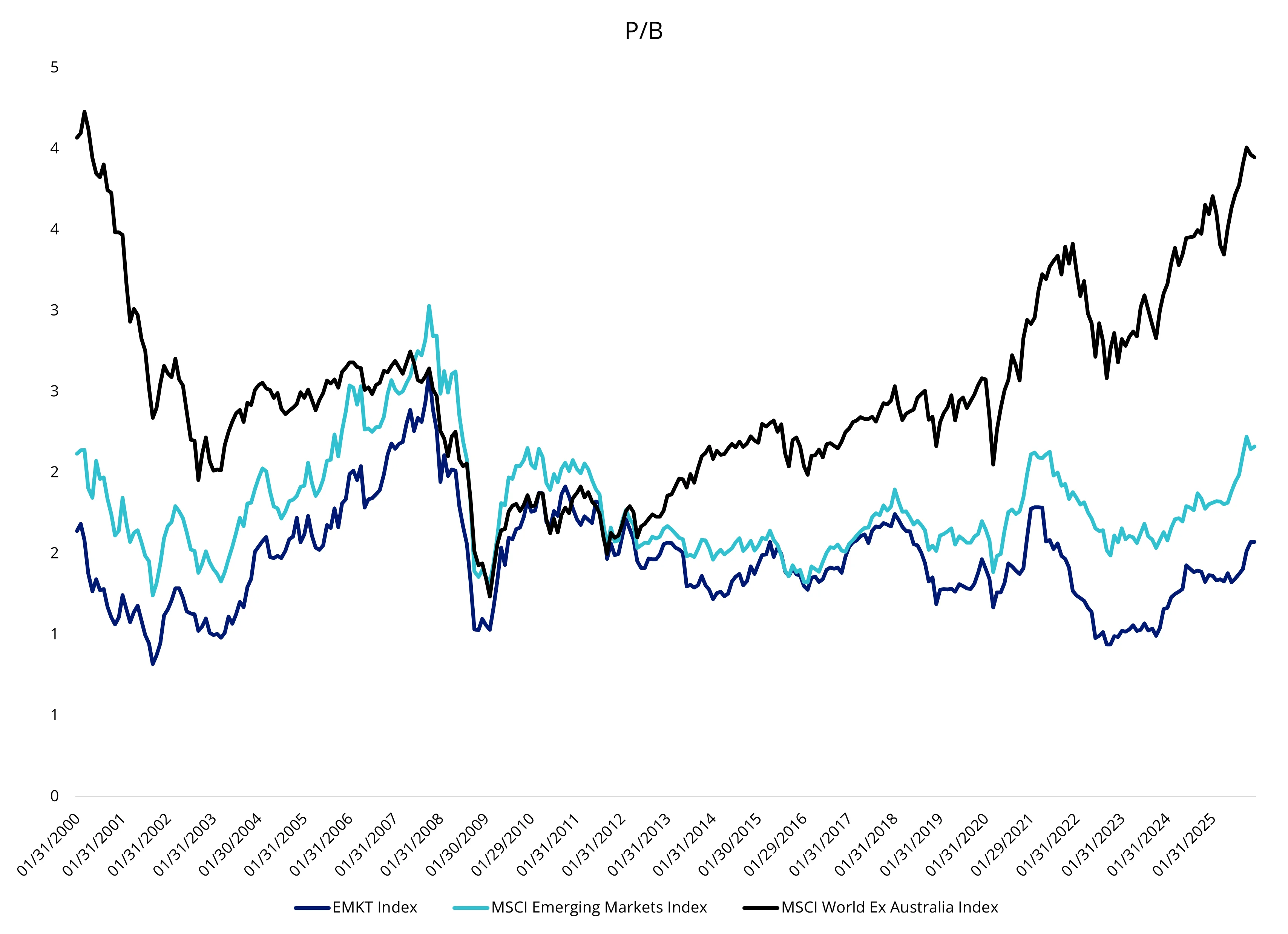
Source: MSCI, FactSet, 1 January 2000 to 31 December 2025. You cannot invest in an index.
Investing in emerging markets is no easy feat
Selective investment in emerging markets has traditionally been the domain of expensive active managers, and returns between them vary significantly from year-to-year. This is because it is almost impossible for active managers to time factors in emerging markets.
The VanEck MSCI Multifactor Emerging Markets Equity ETF (ASX: EMKT) tracks the MSCI Emerging Markets Multi-Factor Select Index (EMKT Index), which includes companies on the basis of four factors: Value, Momentum, Low Size and Quality. The result is a portfolio that, at last rebalance, includes 232 companies diversified across 19 countries.
EMKT has outperformed since it launched on ASX in 2018. As always noting, past performance is not indicative of future performance.
Table 1: EMKT performance as at 30 January 2026
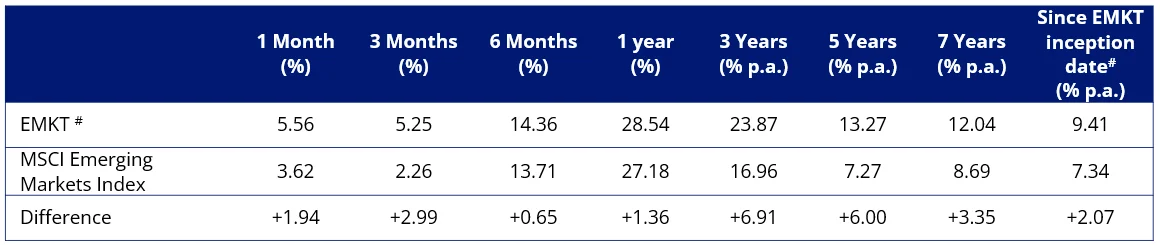
Source: VanEck, Morningstar Direct
#EMKT inception date is 10 April 2018 and a copy of the factsheet is here.
Performance is calculated net of management costs, calculated daily but do not include brokerage costs or buy/sell spreads of investing in EMKT. Past performance is not indicative of future performance.
The MSCI Emerging Markets Index (“MSCI EMI”) is shown for comparison purposes as it is the widely recognised benchmark used to measure the performance of emerging markets large- and mid-cap companies, weighted by market capitalisation. EMKT’s index measures the performance of emerging markets companies selected on the basis of their exposure to value, momentum, low size and quality factors, while maintaining a total risk profile similar to that of the MSCI EMI, at rebalance. EMKT’s index has fewer companies and different country and industry allocations than MSCI EMI. Click here for more details
Key points:
- EMKT provides investors with a diversified portfolio of emerging markets equities included on the basis of:
- value;
- low size;
- momentum; and
- quality.
- EMKT has demonstrated outperformance since its inception against the MSCI Emerging Markets Index, noting as we always do, this is by no means indicative of future performance.
- Access emerging markets equities for a significantly lower cost than comparable active management strategies at a management fee of 0.69% p.a.
- With one trade, EMKT provides access to 19 emerging market countries and is overweight sectors such as healthcare, industrials and information technology.
Key risks:
All investments carry risk. An investment in EMKT carries risks associated with ASX trading time differences, emerging markets, financial markets generally, individual company management, industry sectors, foreign currency, country or sector concentration, political, regulatory and tax risks, fund operations, liquidity and tracking an index. See the PDS for details.
EMKT is likely to be appropriate for a consumer who is seeking capital growth, is intending to use the product as a core, minor or satellite allocation within a portfolio, has an investment timeframe of at least 5 years, and has a high risk/return profile.


Published: 03 February 2026
Any views expressed are opinions of the author at the time of writing and is not a recommendation to act.
VanEck Investments Limited (ACN 146 596 116 AFSL 416755) (VanEck) is the issuer and responsible entity of all VanEck exchange traded funds (Funds) trading on the ASX. This information is general in nature and not personal advice, it does not take into account any person’s financial objectives, situation or needs. You should consider whether or not an investment in any Fund is appropriate for you. Investments in a Fund involve risks associated with financial markets. These risks vary depending on a Fund’s investment objective. Refer to the applicable product disclosure statement (PDS) and target market determination (TMD) available at vaneck.com.au for more details. Investment returns and capital are not guaranteed.