Gold: Oversold opportunity?


The gold price has been volatile since the tensions in the Middle East came to a head.
Interest in gold and its miners had been gaining momentum through 2025 into the start of the year.
Despite recent volatility, the structural drivers of gold remain firmly in place and in some cases are strengthening.
Gold is currently trading around US$4,400 per ounce, down approximately 22% from its all-time high of US$5,595 in late January. While the drawdown is significant, in our view it is presenting a compelling entry point for investors looking to add gold exposure.
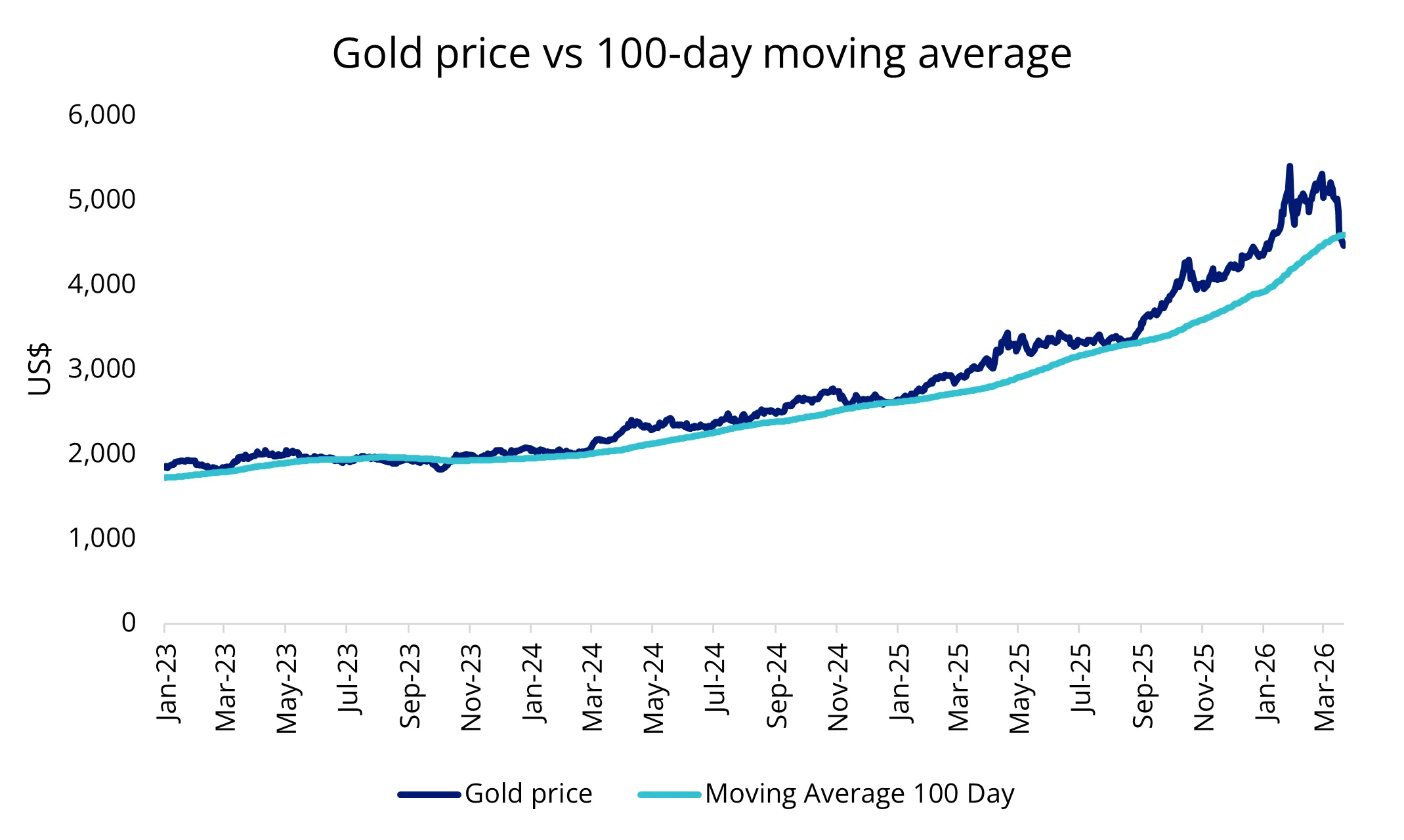
Source: Bloomberg. Spot gold price in USD. Data from 1 Jan 2023 to 23 March 2026. Past performance is not indicative of future performance.
What is driving the selloff
VanEck CEO Jan van Eck addressed the pullback overnight, highlighting that several forces have hit gold simultaneously. Importantly, these drivers appear cyclical and technical rather than structural:
- Technical reset
Gold had been trading well above its long-term averages. The recent break below the 200-day moving average is consistent with prior corrections within bull markets, rather than signalling a new bear trend. - Forced sovereign selling
The US-Iran conflict and disruption to energy revenues have forced some sovereign holders to liquidate assets, including gold, to meet short-term funding needs. We think this is distressed selling, not a change in long-term demand. - Speculative unwinds
After record ETF inflows in 2025, positioning had become crowded. The recent pullback reflects a sharp but typical unwind of some of those positions. - Short-term macro headwinds
While geopolitical risk is typically supportive for gold, this episode has strengthened the US dollar and pushed interest rate expectations higher, both of which are near-term negatives for gold.
Why the medium-term setup is strong
Despite recent volatility, the structural drivers of gold remain firmly in place and in some cases are strengthening.
Geopolitical regime shift supports gold demand
The current conflict reinforces a broader trend that began post-Ukraine. Central banks are increasingly diversifying reserves away from USD-denominated assets. This structural shift continues to underpin gold demand.
Central banks are still buying
Global central bank net purchases exceeded 1,000 tonnes annually from 2022 to 2024, the highest sustained pace since the 1960s. Purchases moderated to 863 tonnes in 2025 as prices surged, but remain historically elevated. The World Gold Council’s latest survey shows 95% of central banks expect global gold reserves to increase over the next 12 months. The current conflict is more likely to accelerate that trend than reverse it.
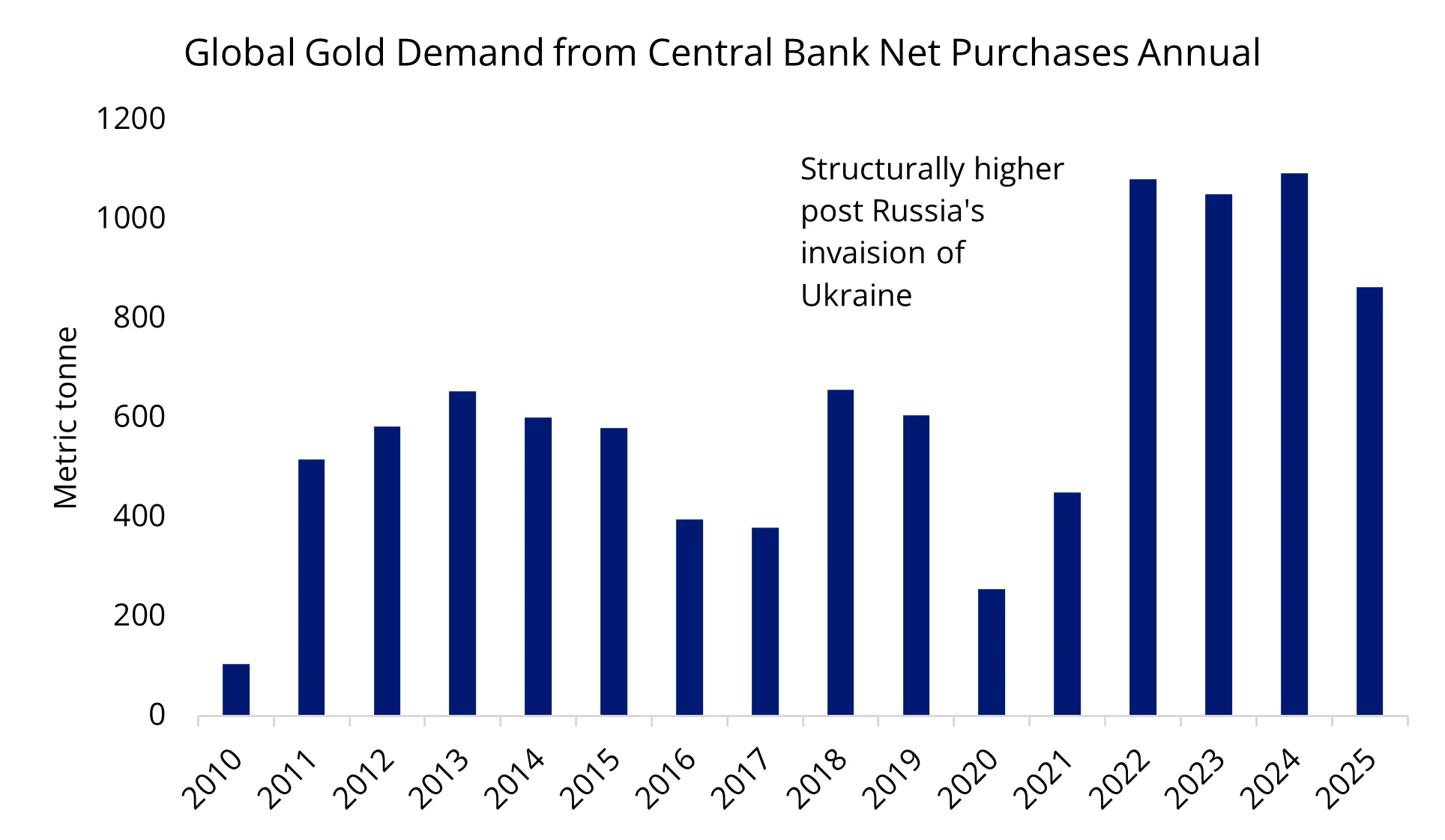
Source: Bloomberg. Metals focus. Global Gold Demand from Central Bank Net Purchases.
Oil shock dynamics favour gold over time
While the immediate impact of the conflict has pressured gold, history shows that oil shock events ultimately drive higher inflation and macro uncertainty, conditions under which gold has historiacally performed strongly.
During previous oil-shock conflicts, particularly the 1973 Yom Kippur War, the 1979 Iranian Revolution and the 1991 Gulf War, gold demand surged over the medium term as investors priced in higher inflation and persistent macro uncertainty.
The current conflict has disrupted roughly 20% of global seaborne oil supply, the largest such disruption in modern history.
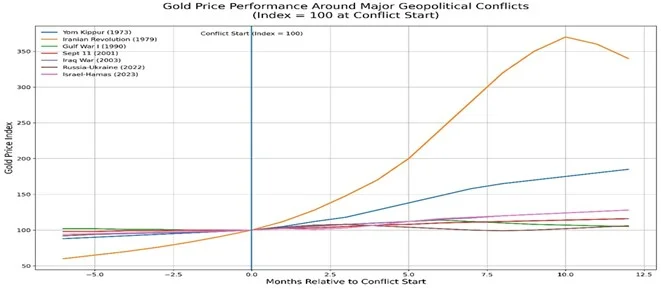
Source: LBMA, Bloomberg. Gold price indexed to 100 at conflict start date. Past performance is not indicative of future performance.
US dollar weakness remains a key tailwind
As markets refocus on elevated US fiscal deficits and debt levels, the US dollar may weaken over the medium term, which is typically supportive for gold.
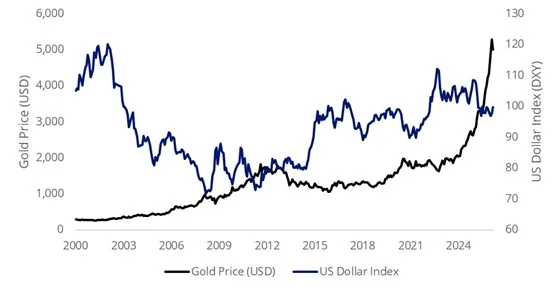
Source: Bloomberg. 28 February 2026. Past performance is not indicative of future performance.
Falling real yields support gold
The oil price shock raises the risk of slower growth alongside higher inflation. If realised, it is expected that this would push real yields lower, historically one of the strongest drivers of gold performance.
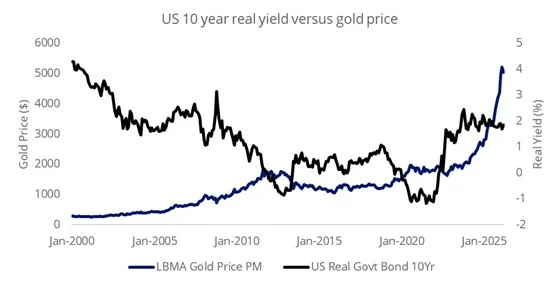
Source: Bloomberg. 28 February 2026. Past performance is not indicative of future performance.
De-escalation could be the catalyst
On 23 March, President Trump announced a five-day postponement of strikes on Iranian energy infrastructure, citing productive conversations with Tehran. Oil prices fell sharply on the news. A resolution would likely lead to lower oil prices, easing inflation expectations, a weaker US dollar and lower real yields. Together, we believe these would represent a meaningful tailwind for gold.
How to position
For advisers looking to add gold exposure at current levels, VanEck offers two complementary approaches on the ASX:
- NUGG (VanEck Gold Bullion ETF)
Direct exposure to physical gold. This is a clean expression of the gold thesis, particularly in an environment of central bank demand and currency debasement. - GDX (VanEck Gold Miners ETF)
Exposure to global gold mining companies. Miners offer operating leverage to the gold price, meaning they can outperform during a recovery and vice versa.
Bottom line
While the recent selloff has been sharp, it appears driven by short-term technical and liquidity factors rather than a deterioration in fundamentals.
Looking through the volatility, we think the current environment continues to support gold’s role as a strategic portfolio allocation and reinforces the case for adding exposure at current levels.
Key risks of NUGG and GDX:
An investment in NUGG or GDX carries investment risk. These risks vary depending on the fund and may include gold pricing risk, currency risk, custody risk, Australian sourced gold bullion risk, ASX trading time differences, financial markets generally, individual company management, industry sectors, country or sector concentration, political, regulatory and tax risks, fund operations and tracking an index. See the PDSs and TMDs for details on risks.
NUGG is likely to be appropriate for a consumer who is seeking capital growth, is intending to use the product as a minor or satellite allocation within a portfolio, has no investment timeframe, and has a high or very high risk/return profile.
GDX is likely to be appropriate for a consumer who is seeking capital growth, is intending to use the product as a minor or satellite allocation within a portfolio, has an investment timeframe of at least 5 years, and has a very high risk/return profile.

Published: 30 March 2026
Any views expressed are opinions of the author at the time of writing and is not a recommendation to act.
VanEck Investments Limited (ACN 146 596 116 AFSL 416755) (‘VanEck’) is the issuer and responsible entity of all VanEck exchange traded funds (Funds) listed on the ASX. This is general advice only and does not take into account any person’s financial objectives, situation or needs. The product disclosure statement (PDS) and the target market determination (TMD) for all Funds are available at vaneck.com.au. You should consider whether or not any Fund is appropriate for you. Investments in a Fund involve risks associated with financial markets. These risks vary depending on a Fund’s investment objective. Refer to the applicable PDS and TMD for more details on risks. Investment returns and capital are not guaranteed.