Good things come in quality small packages


For many investors, the pursuit of ‘quality’ companies has been a successful strategy underlying their portfolio approach.
Often, companies exhibiting the characteristics of the ‘quality’ factor, being a strong balance sheet, stable earnings and low leverage, are expensive as many investors seek these companies, driving up their prices.
For many large-caps, this has pushed valuations higher. Small-caps may offer more upside than mega-caps because they have lagged the mega-caps in the recent past. With markets forecasting two rate cuts in 2026 to stimulate demand, quality small companies could benefit should faster economic growth eventuate, as they have historically outperformed during expansionary environments.
Global small companies are trading at historically low levels
The speculative 2024/25 rally led by mega-caps, notably the “Magnificent Seven” resulted in the relative underperformance of global small caps, compared to the broader small cap market as measured by the Russell 2000 over the past two years.
Chart 1: Global small companies have been trailing large caps
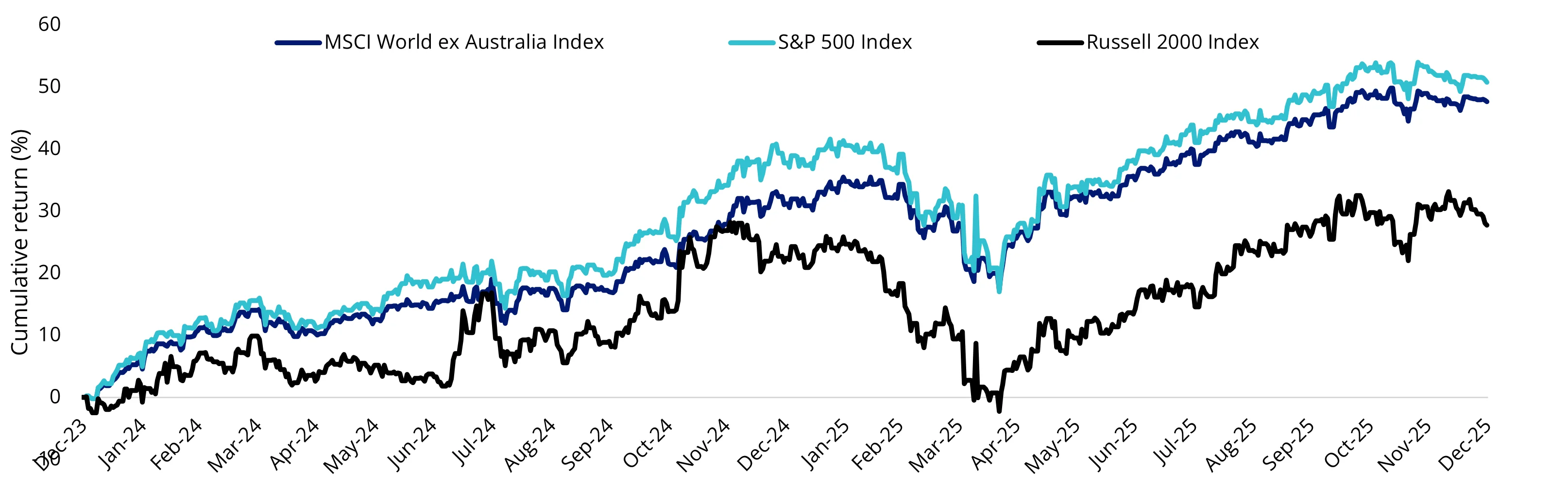
Source: Morningstar Direct, 31 December 2025. Performance in Australian dollars. Results assume immediate reinvestment of all dividends and exclude costs associated with investing and taxes. You cannot invest directly in an index. Past performance is not a reliable indicator of future performance.
Within small companies, the speculative rally has led to strong outperformance of low-quality small companies, as investors sought those companies that may have been positioned to benefit from the rise of AI, irrespective of their profitability. However, with political uncertainty, geopolitical risks, and inflation concerns flaring up again, speculative assets have started to come under pressure during the last quarter of 2025. If these market conditions persist, we could experience an uptick in market volatility in 2026 despite overall economic growth remaining strong. Taking history as a guide, this backdrop bodes well for a quality rotation within the global small companies complex.
Chart 2: Within small caps, low quality outperformed quality
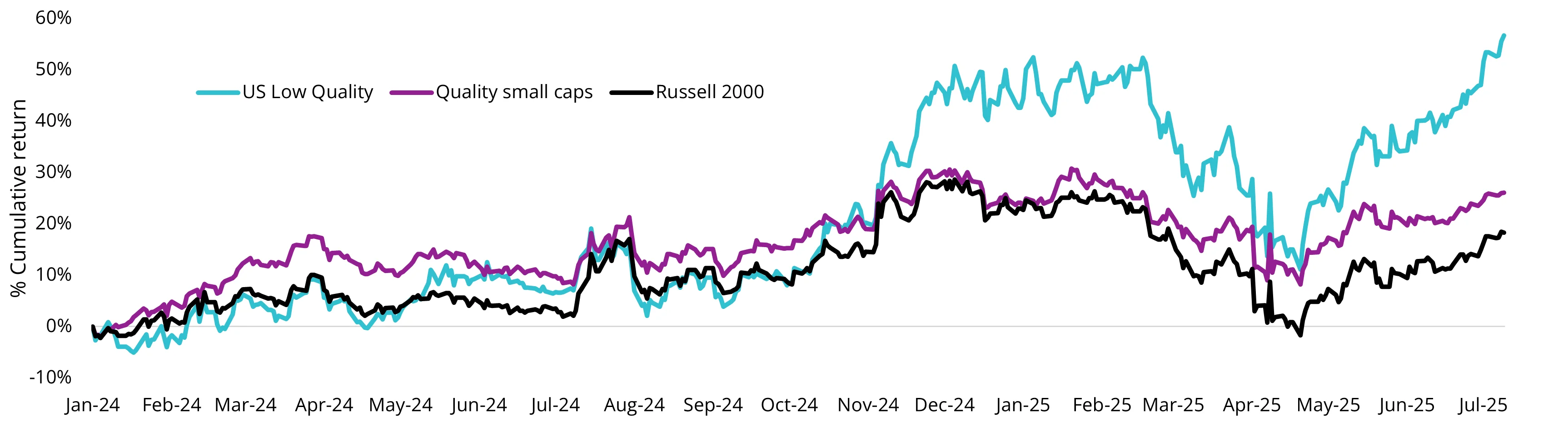
Source: VanEck. Bloomberg, 31 December 2025. Performance in Australian dollars. Results assume immediate reinvestment of all dividends and exclude costs associated with investing and taxes. You cannot invest directly in an index. Past performance is not a reliable indicator of future performance. Quality small caps is MSCI World ex Australia Small Cap Quality 150 Index. US low quality is the UBS Low Quality basket.
Chart 3: Quality small-cap companies have historically outperformed amid volatile times
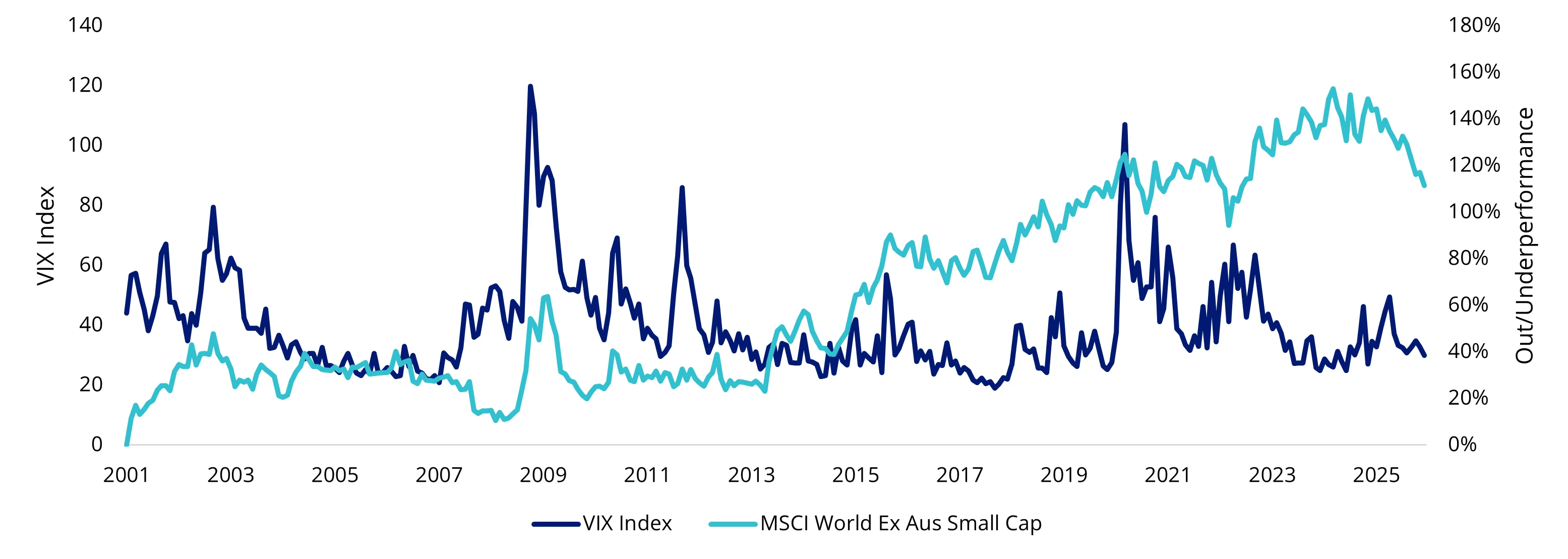
Source: VanEck. Bloomberg. 31 December 2025. Performance in Australian dollars. Results assume immediate reinvestment of all dividends and exclude costs associated with investing and taxes. You cannot invest directly in an index. Past performance is not a reliable indicator of future performance.. Index performance is not illustrative of fund performance.
Valuations for global small caps are reasonable/attractive relative to global large caps (MSCI World Index), with valuations at 25-year lows.
Chart 4: Global small less large cap valuation z-score 25-year low
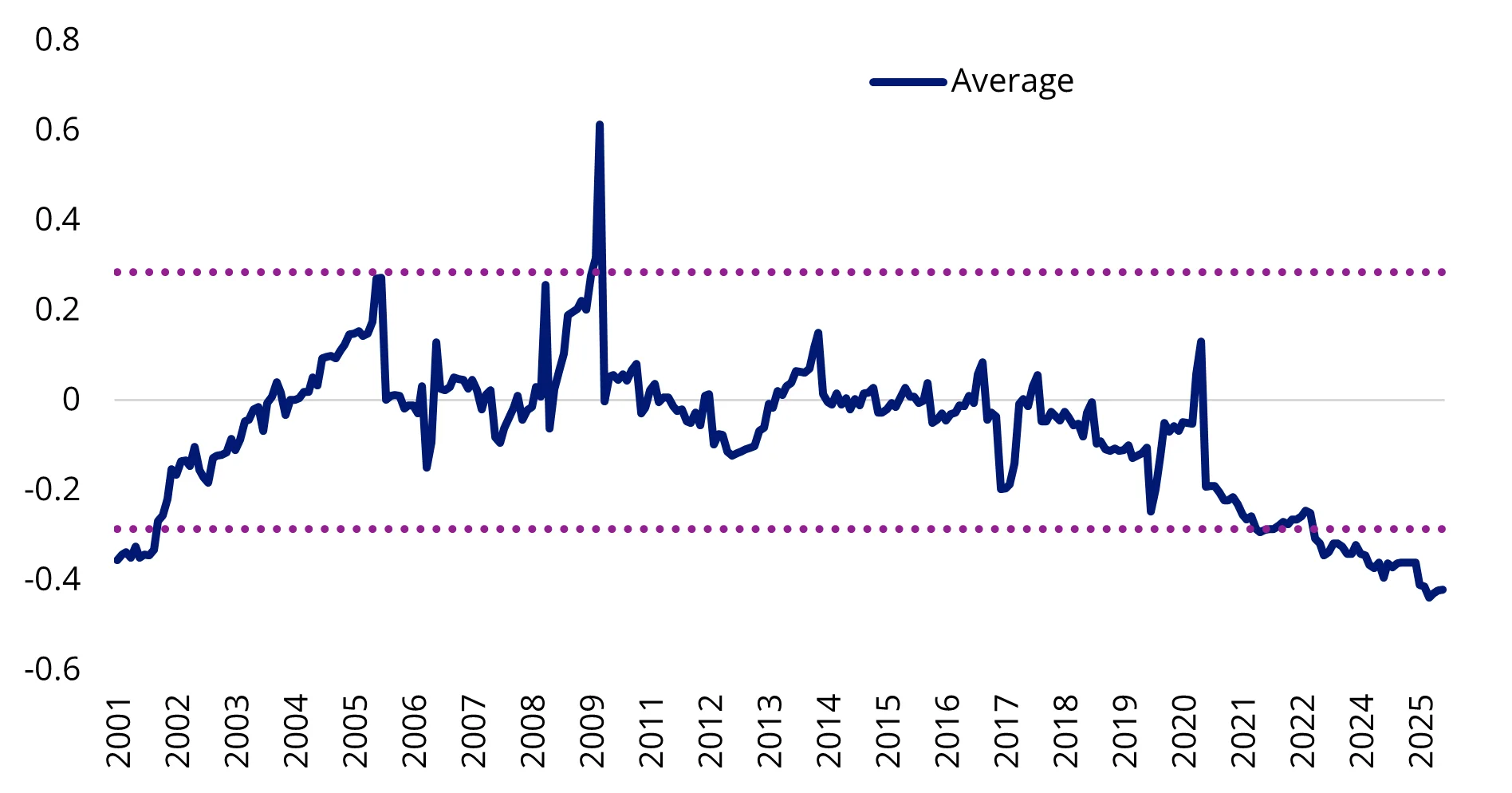
Source: Bloomberg, Z-score quantifies how many standard deviations valuations are different to the historical average. The graph above shows the average z-score by 12 month forward price to earnings, 12 month forward price to book, 12 month forward price to sales. Global small is the MSCI World Small Cap Index. Large caps represented by the MSCI World Index.
Focusing on fundamentals
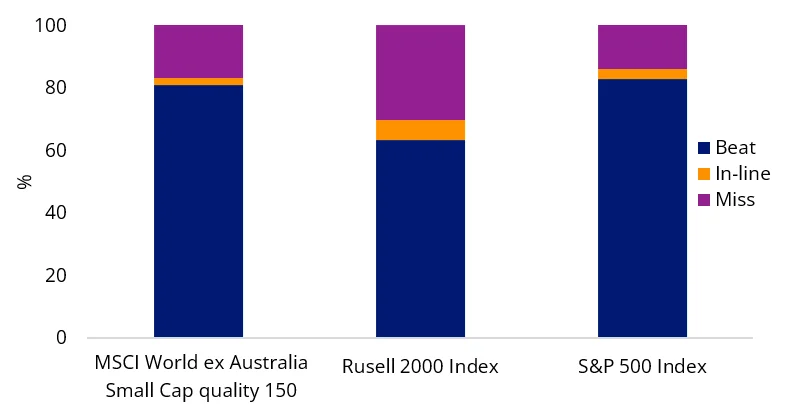
Fundamentals within global quality small companies has been improving. An analysis of the quarter three earnings results, for example, shows that ~80% of companies within the MSCI World ex Australia Small Cap quality 150 Index were ‘beats’. In addition, median US earnings growth is positive.
Chart 5: Q3 2025 earnings season results
Source: VanEck. Bloomberg. As at Q3 2025 earnings results.
A ‘quality’ macro backdrop
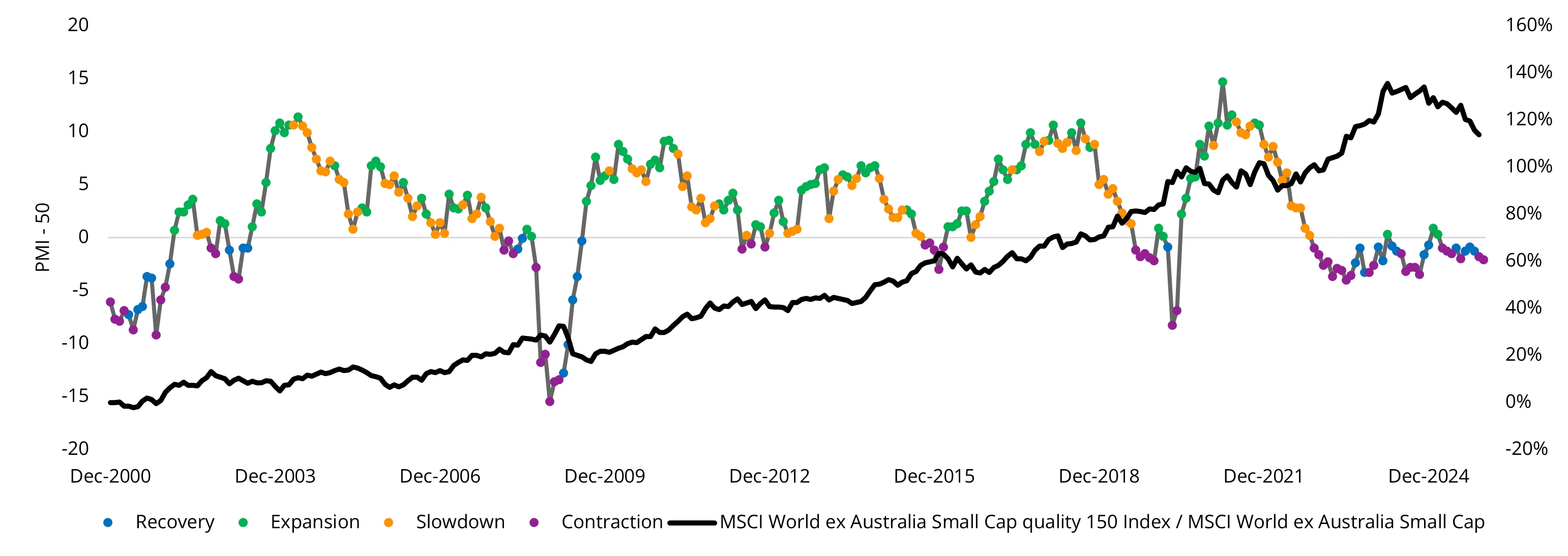
In the medium term, assuming further rollback tariff policy, US economy could be transitioning into a manufacturing expansionary environment. This is typically where quality small caps outperform the broader equities.
Chart 6: Quality small caps typically outperform in an expansionary environment
Source: VanEck. Bloomberg. 31 December 2025. Performance in Australian dollars. Results assume immediate reinvestment of all dividends and exclude costs associated with investing and taxes. You cannot invest directly in an index. Past performance is not a reliable indicator of future performance. Index performance is not illustrative of fund performance.
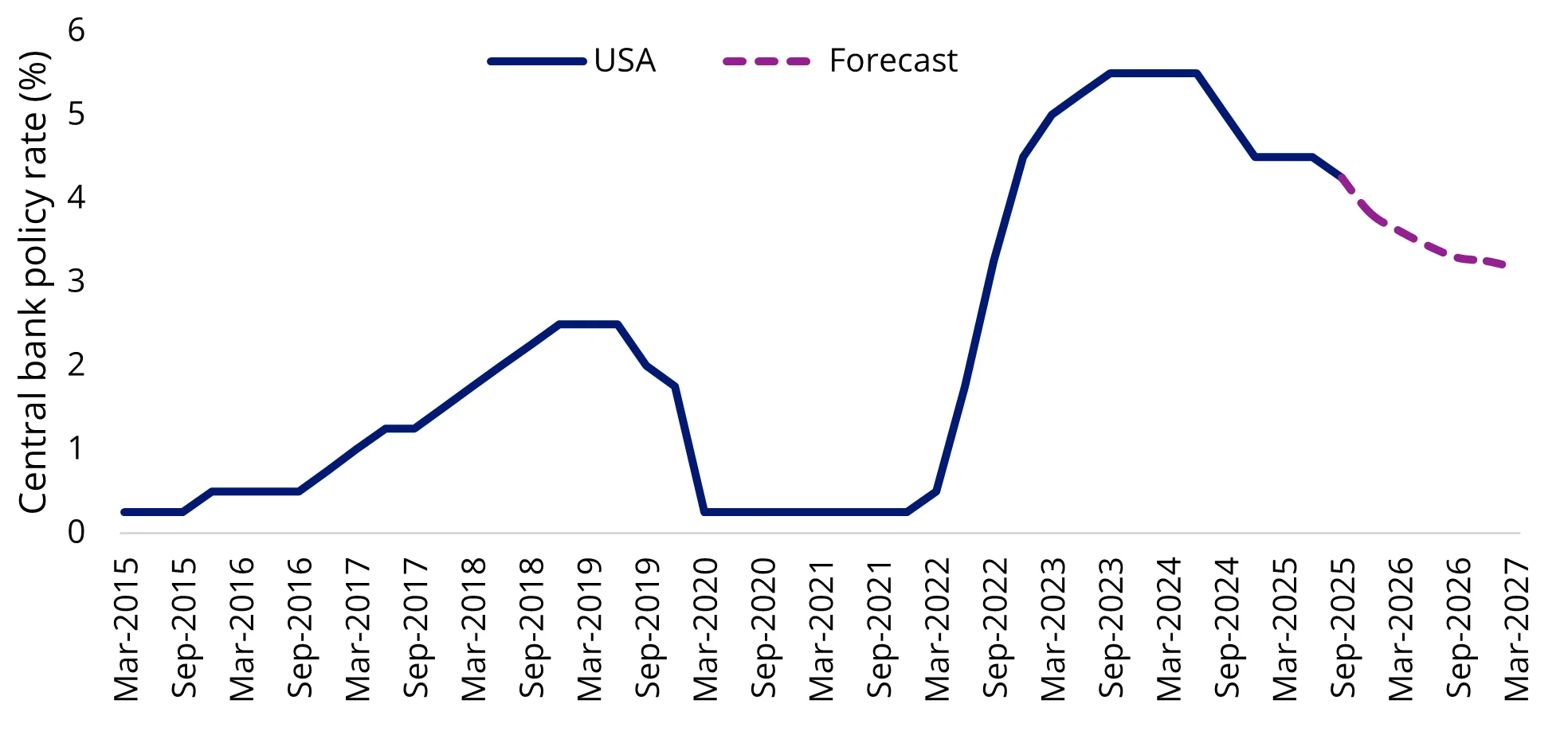
Further, markets are forecasting two more rate cuts in 2026. This is typically positive for small caps, as cheaper access to credit enables them to grow their businesses.
Chart 7: The Fed funds rate & market forecast
Source: VanEck. Bloomberg. Date as of 31 December 2025.
We think the small size of these companies means that double digit growth is potentially more achievable as they are coming off a lower base than large caps.
Global quality small caps could shine in 2026.
The VanEck MSCI International Small Companies ETF (ASX: QSML) tracks the MSCI World ex Australia Small Cap quality 150 Index.
Key points of QSML:
- 150 of the world's highest quality small companies: Access a diversified portfolio containing some of the world's highest quality small companies based on key fundamentals including (i) high return on equity, (ii) earnings stability and (iii) low financial leverage.
- Outperformance potential in growing companies: Investments focusing on quality small companies that have delivered outperformance over the long term relative to other global small companies benchmarks and also relative to large- and mid-cap benchmarks.
- Diversified across countries, sectors and companies: Offering investors a portfolio of 150 companies across a range of geographies, sectors and economies.
Key risks: An investment in the ETF carries risks associated with ASX trading time differences, financial markets generally, individual company management, industry sectors, foreign currency, country or sector concentration, political, regulatory and tax risks, fund operations, liquidity and tracking an index. See the PDS for details.
QSML is likely to be appropriate for a consumer who is seeking capital growth, is intending to use the product as a core, minor or satellite allocation within a portfolio, has an investment timeframe of at least 5 years, and has a high risk/return profile.


Published: 19 January 2026