Three reasons growth companies could outperform in 2026


While valuations appear stretched, several drivers continue to support the growth factor this year.
The growth factor outperformed for most of 2025 until year end when market sentiment shifted from risk-on to cautious, driven by elevated equity valuation concerns, particularly among large US technology companies.
Global valuations now appear stretched across most sectors, suggesting limited headroom for further P/E expansion. These concerns are understandable. However, the growth factor could continue to outperform in 2026 for three key reasons: 1. Robust earnings outlook; 2. Diversification of equity growth drivers; and 3. Macroeconomic backdrop remains supportive.
Charts 1 & 2: Performance of US large tech companies and global sector valuations
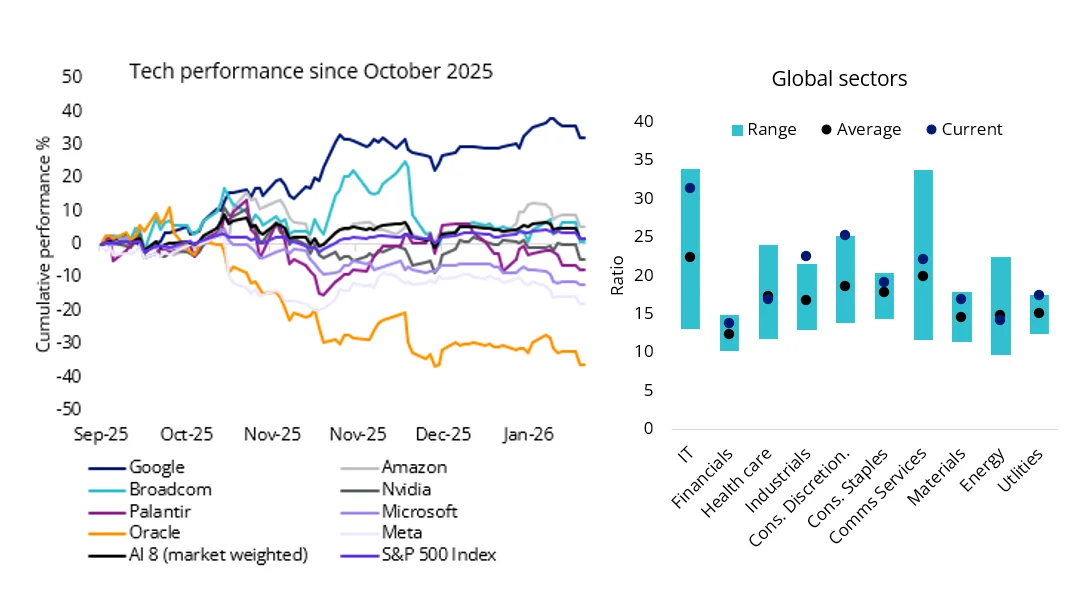
Source: VanEck. Bloomberg. LHS chart performance in USD. RHS chart MSCI World sector indices. Data as of 21 January 2026. Past performance is not indicative of future performance. Not a recommendation to act.
1. Robust earnings outlook
Recent earnings seasons have reinforced the resilience of corporate fundamentals, despite ongoing trade and geopolitical headwinds. Over the past year, EPS growth has served as the primary driver of global equity performance, in particular for growth names, as valuation expansion potential became increasingly constrained.
Stepping into 2026, based on Bloomberg data, market consensus is pointing to higher EPS growth of roughly 20% over the next 12 to 24 months for growth companies. If this is sustained, we could see growth companies continue to outperform, supported by fundamentals rather than by multiple expansion, reinforcing the constructive outlook.
Chart 3 & 4: 1 Year Performance Contribution and EPS growth outlook
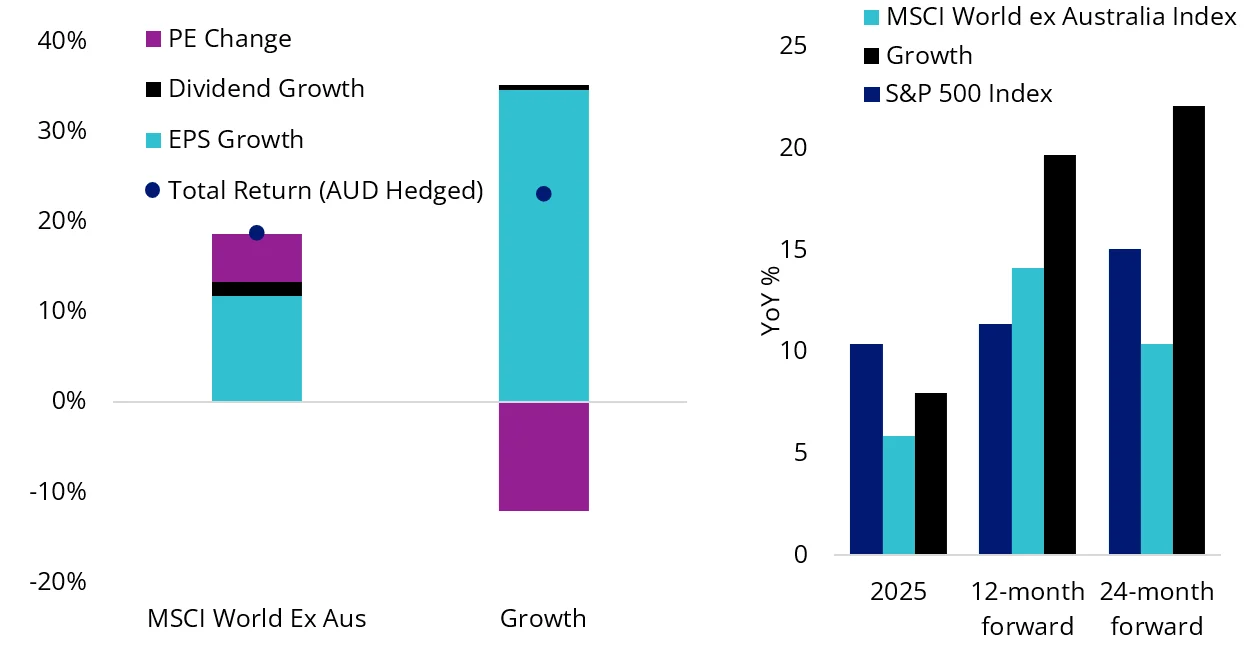
Source: VanEck. Bloomberg. Growth is MSCI World ex Australia Growth Select Index. LHS chart as at 31 December 2025.
Furthermore, the current Q4 2025 US earnings season has delivered strong results. At the time of writing, 61 out of 500 companies had reported and over 80% of those beat street expectations. This reinforces the underlying strength of corporate fundamentals, which remains a key tailwind for the growth factor.
2. Diversification of equity growth drivers
A key concern of investors has been the risk of an AI-driven “bubble”, particularly given the heavy influence of the Magnificent Seven on recent overall market performance. Evidently, the second half of 2025 saw growing doubt about the near-term return on investment (ROI) from aggressive data centre capital expenditure, raising the risk of valuation compression within parts of the sector.
While the AI thematic remains high-stake, it’s worth highlighting the diversity of equity return drivers. In 2025, industrials and financials in combination have contributed to ~40% (2024: 28%; 2023: 21%) of the broader index growth, close to information technology and communications services which contributed 45% (2024: 46%; 2023: 57%), according to Bloomberg.
Chart 5: Performance attribution has broadened
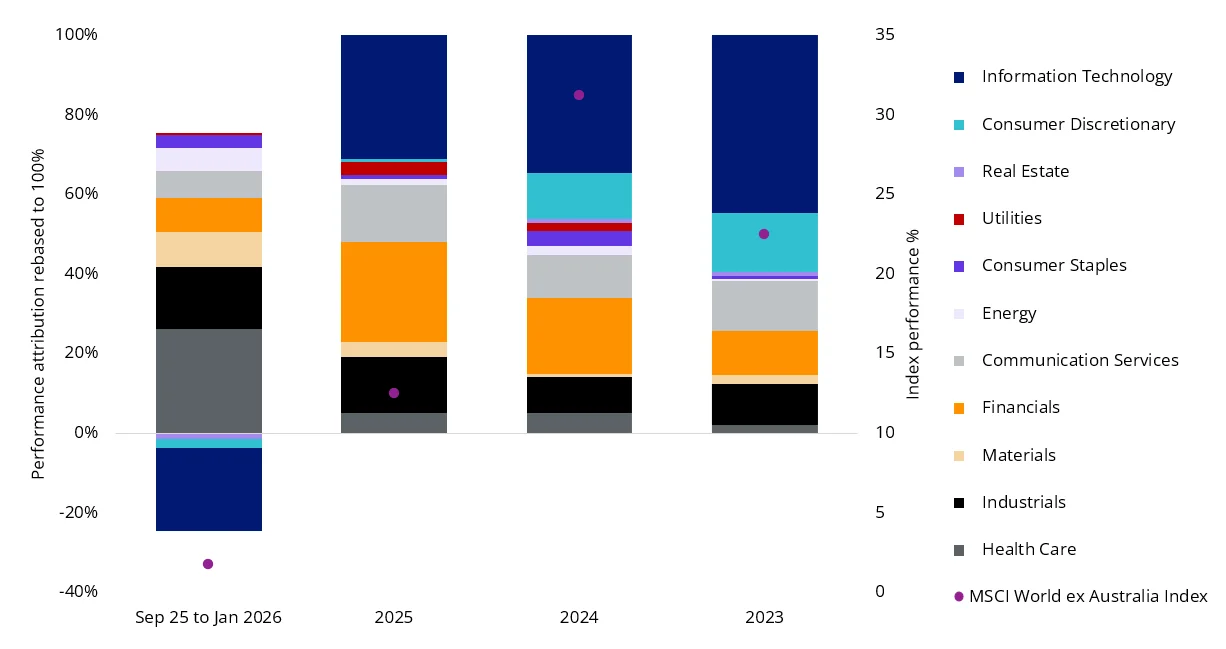
Source: Bloomberg. MSCI World ex Australia Index. Current in AUD.
This highlights the importance of taking a diversified approach across sectors in attempting to harvest the growth factor.
3. Macroeconomic backdrop remains supportive
If history is any guide, the growth factor typically outperforms the broader market during periods when US real GDP growth is above 2% and trending upward.
Chart 6: Growth performance vs GDP growth
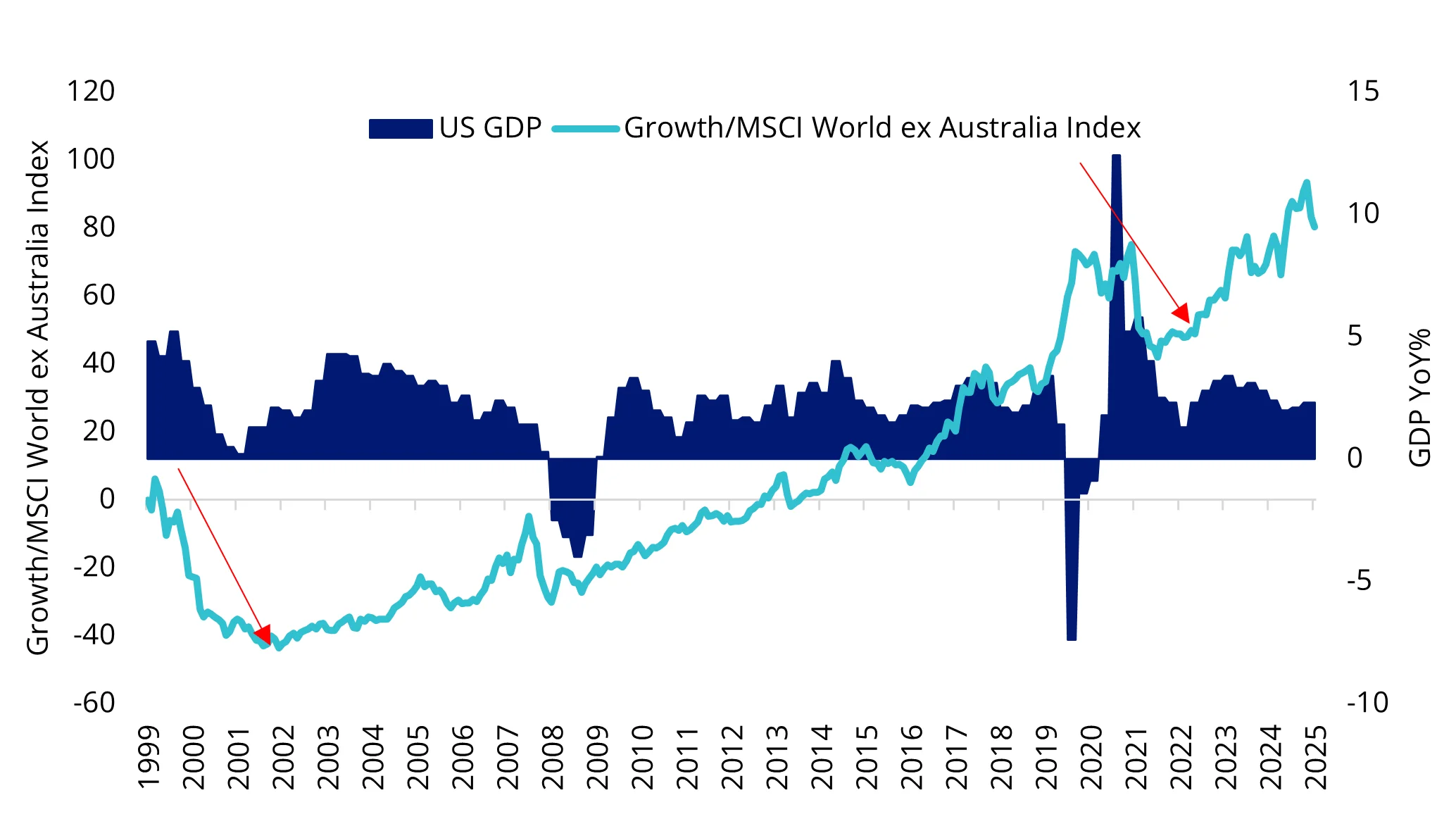
Source: VanEck. Bloomberg. Growth is MSCI World ex Australia Growth Select Index. Currency in AUD. Data from 31 December 1999 to 31 December 2025. Past performance is not indicative of future performance.
Recent US economic data indicate that real GDP growth is expected to sit comfortably above 2% over the medium-term, with AI-driven productivity a potential upside booster. In the near term, easing interest rates and a resilient labour market suggest no immediate threat to growth.
In aggregate, this could create a backdrop supportive for further growth factor outperformance into the new year.
Charts 7 & 8: US real GDP YoY% and forecast; US unemployment YoY% and forecast
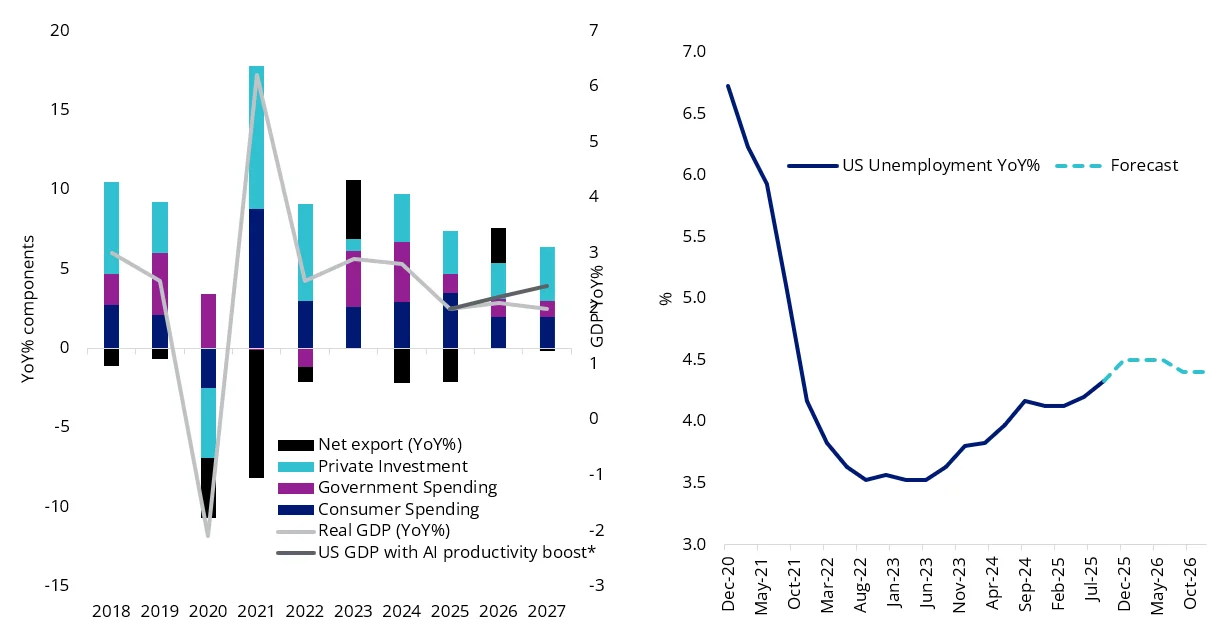
Source: Bloomberg, National Bureau of Economic Research. 2025, 2026 and 2027 full year GDP growth based on street estimates. GDP growth with AI productivity boost was based on Morgan Stanley’s forecast.
Access the growth factor
Investors can again exposure to the growth factor with the VanEck MSCI International Growth ETF (ASX code: GWTH). The ETF provides access to a portfolio of the highest growth companies based on key fundamentals including long-term forward-looking EPS growth rate, short-term forward-looking EPS growth rate, internal growth rate, long-term historical EPS growth trend and long-term historical sales growth trend.
GWTH can also serve as an important diversifier within a growth allocation, reducing reliance on companies that may already be heavily represented across other ETFs or funds, with the portfolio currently underweight the Magnificent Seven.
Key risks: An investment in the ETF carries risks associated with: ASX trading time differences, financial markets generally, individual company management, industry sectors, foreign currency, country or sector concentration, political, regulatory and tax risks, fund operations and tracking an index. See the PDS and TMD for more details.
GWTH is likely to be appropriate for a consumer who is seeking capital growth, is intending to use the product as a major, core, minor or satellite allocation within a portfolio, has an investment timeframe of at least 5 years, and has a high risk/return profile.


Published: 04 February 2026
Any views expressed are opinions of the author at the time of writing and is not a recommendation to act.
VanEck Investments Limited (ACN 146 596 116 AFSL 416755) (VanEck) is the issuer and responsible entity of all VanEck exchange traded funds (Funds) trading on the ASX. This information is general in nature and not personal advice, it does not take into account any person’s financial objectives, situation or needs. The product disclosure statement (PDS) and the target market determination (TMD) for all Funds are available at vaneck.com.au. You should consider whether or not an investment in any Fund is appropriate for you. Investments in a Fund involve risks associated with financial markets. These risks vary depending on a Fund’s investment objective. Refer to the applicable PDS and TMD for more details on risks. Investment returns and capital are not guaranteed.