Capitalising on Australia’s office REIT recovery


Many investors will recall how challenging recent years have been for office markets. COVID-driven shifts in work patterns combined with poorly timed new supply drove vacancies higher, and rents lower across Australia’s major CBDs, with asset values following suit.
However, the tide appears to have turned with Office REITs being among the best-performing A-REIT subsectors in 2025, and we think this momentum could continue in 2026 for several reasons. Supply pipelines are thinning, economic conditions are favourable and elevated 10-year yields may begin to provide a more supportive backdrop for sector performance.
We think the medium-term outlook for office REITs in particular is positive, albeit one that still demands selectivity.
Office space supply demand dynamics are improving
In the post-pandemic period, office REITs have been particularly affected by excess supply and reduced floor-space requirements driven by the rise of hybrid working. These factors weighed on sector performance, with prime office vacancy rates currently sitting at the upper end of their historical range.
However, vacancy rates have stabilised and are expected to trend lower, with the supply/demand office space dynamics potentially improving. High replacement costs, restrictive financing conditions and limited development pipelines are likely to constrain further supply, with leading leasing agent Jones Lang LaSalle Incorporated (JLL) forecasting new supply to be almost half the 20 year calendar average.
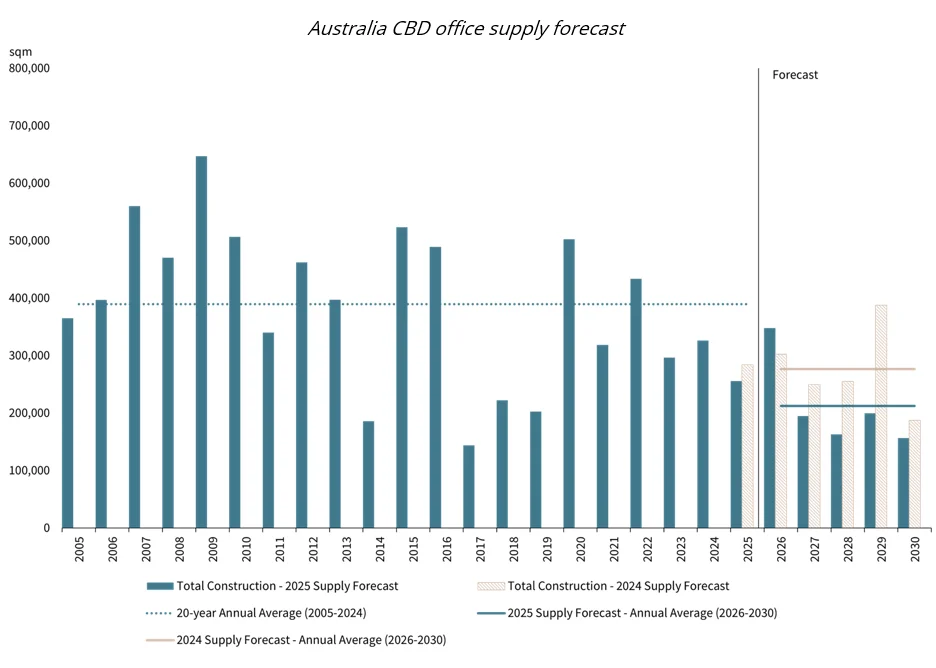
Source: JLL, Q3 2025
Australia’s population is also expanding at around 1.5% per annum, supported, in part, by net overseas immigration. In addition, many businesses are increasingly encouraging greater in-office attendance within hybrid working models. Against a backdrop of constrained supply, this normalisation in demand is likely to drive vacancy rates lower and place upward pressure on rents, potentially providing a tailwind for A-REIT performance.
Economic conditions favourable
Valuations across office REITs are closely linked to broader macroeconomic conditions. Periods of strong economic activity, low unemployment and robust population growth have historically been supportive of structurally lower vacancy rates.
Australia has seen a marginal acceleration in GDP growth, supported by improving business investment and consumer spending. Additionally, unemployment is near a historical low and forecast to stay in the 4 per cent range over the medium term.
This backdrop further supports a recovery in CBD office demand.
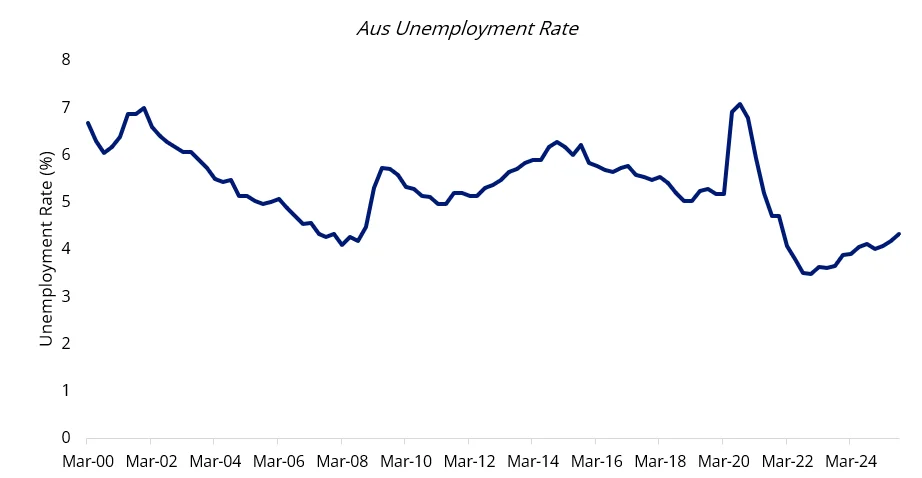
Source: Bloomberg, Q3 2025
10-year yields are elevated
The persistence of services inflation, a resilient labour market, fading energy rebates and elevated household spending have resulted in bond markets pricing in rate hikes this year.
However, given the extent of the rise in long-dated yields over the past year, there is scope for the long end of the curve to retrace lower should near-term macro conditions soften. A surprise increase in unemployment or spill-over effects from global macro shocks could prompt a rally in longer-dated bonds, as seen during previous risk-off episodes, despite a restrictive domestic policy backdrop.
In such an environment, A-REITs’ long-duration characteristics could prove advantageous, possibly supporting performance.
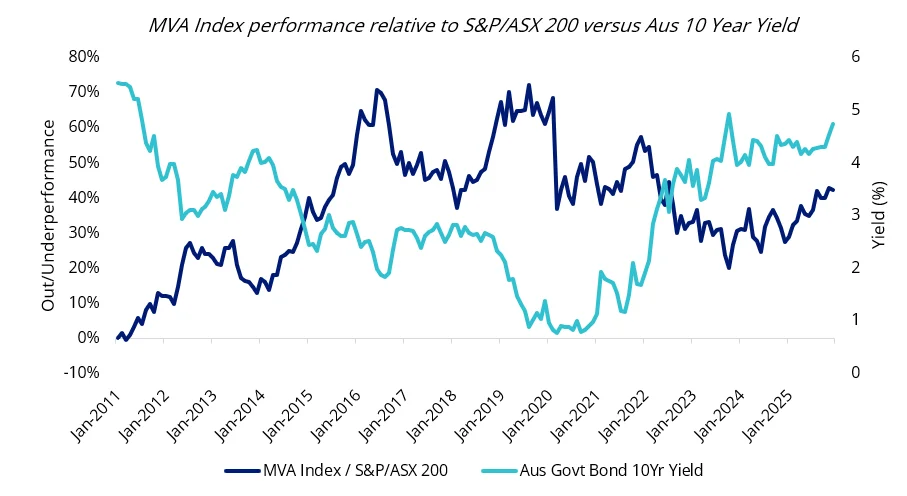
Source: Bloomberg, 31 December 2025, MVA Index is MVIS Australia A-REITs Index , Past performance is not indicative of future performanceof MVA or the index. You cannot invest in an index.
Office REIT valuations compelling
Office and retail REITs are currently offering compelling value, we think. Both sectors are trading at discounts to net tangible assets, suggesting scope for a re-rating toward more normalised valuation levels. This potential mean reversion could act as a catalyst for relative outperformance.
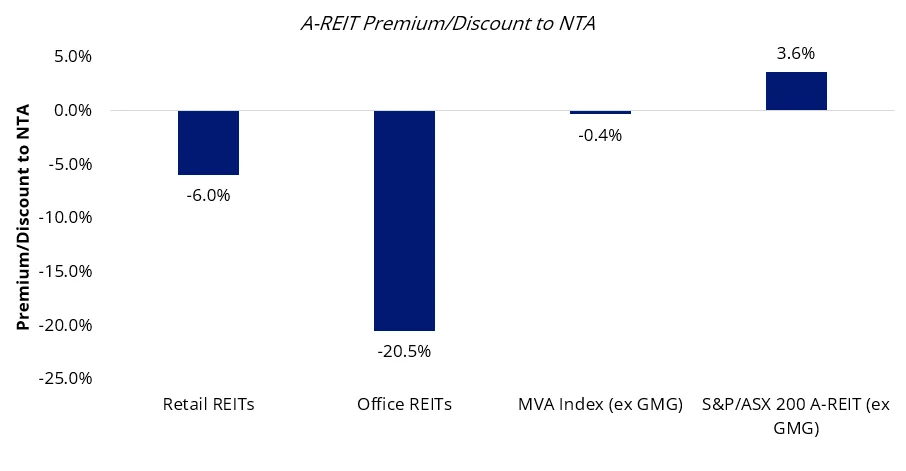
Source: Bloomberg. 31 December 2025. MVA Index is MVIS Australia A-REITs Index Retail REITs include S&P/ASX 200 AREITs in the retail subsector, Office REITs, include S&P/ASX 200 AREITs in the office subsector and GMG is Goodman Past performance is not indicative of future performance. You cannot invest in an index. show less
Access to Office REITs
VanEck’s Australian Property ETF (MVA) provides an overweight exposure to office REITs relative to the broader S&P/ASX 200 A-REIT Index, which only has 4.47% in office REITs.
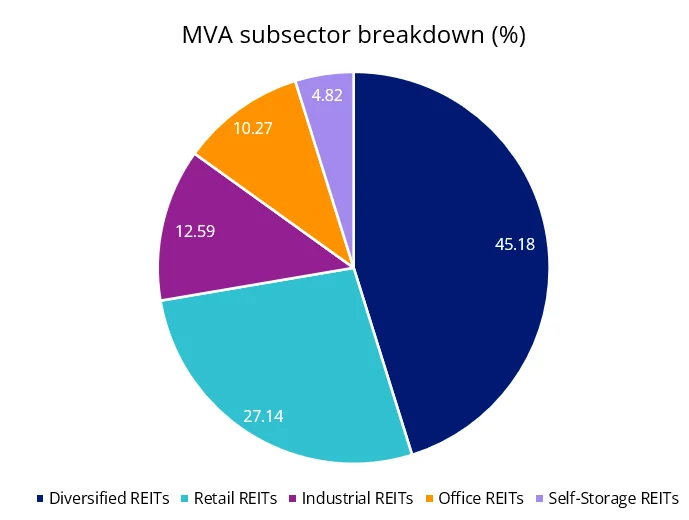
Source: FactSet, 31 December 2025. Diversified REITs primarily include a mix of Industrial, Office and Retail REITs.
Related Insights


Published: 30 January 2026
Any views expressed are opinions of the author at the time of writing and is not a recommendation to act.
VanEck Investments Limited (ACN 146 596 116 AFSL 416755) (VanEck) is the issuer and responsible entity of all VanEck exchange traded funds (Funds) trading on the ASX. This information is general in nature and not personal advice, it does not take into account any person’s financial objectives, situation or needs. You should consider whether or not an investment in any Fund is appropriate for you. Investments in a Fund involve risks associated with financial markets. These risks vary depending on a Fund’s investment objective. Refer to the applicable product disclosure statement (PDS) and target market determination (TMD) available at vaneck.com.au for more details. Investment returns and capital are not guaranteed.