Real opportunities for investors


Infrastructure and global property are proving resilient, offering income stability and diversification as geopolitical risks rise.
From tweet to tweet, or whatever the technical term is for truth social messages, the market is left to make assumptions.
War creates uncertainty, and in uncertain times, assets that retain income flows and are defensive tend to do relatively better than more risk assets.Real assets such as infrastructure and global listed property fit that bill.
Infrastructure is critical for a functioning society, consisting of a diverse range of assets, including transport networks such as roads, railways, airports, canals and ports, and it also includes other networks and facilities necessary for sustaining society, such as utilities, towers and water.
Global listed infrastructure has held up relatively well since the US and Iran tensions flared up.
Global listed property, on the other hand, initially fell, but it has since rallied, and both asset classes are among the few that had posted positive returns year-to-date before last week’s rally (to 9 April 2026).
Recent strength for both is supported by rising inflation expectations following the oil price spike, despite long dated yields also increasing.
Chart 1: Performance year-to-date has been a real asset story
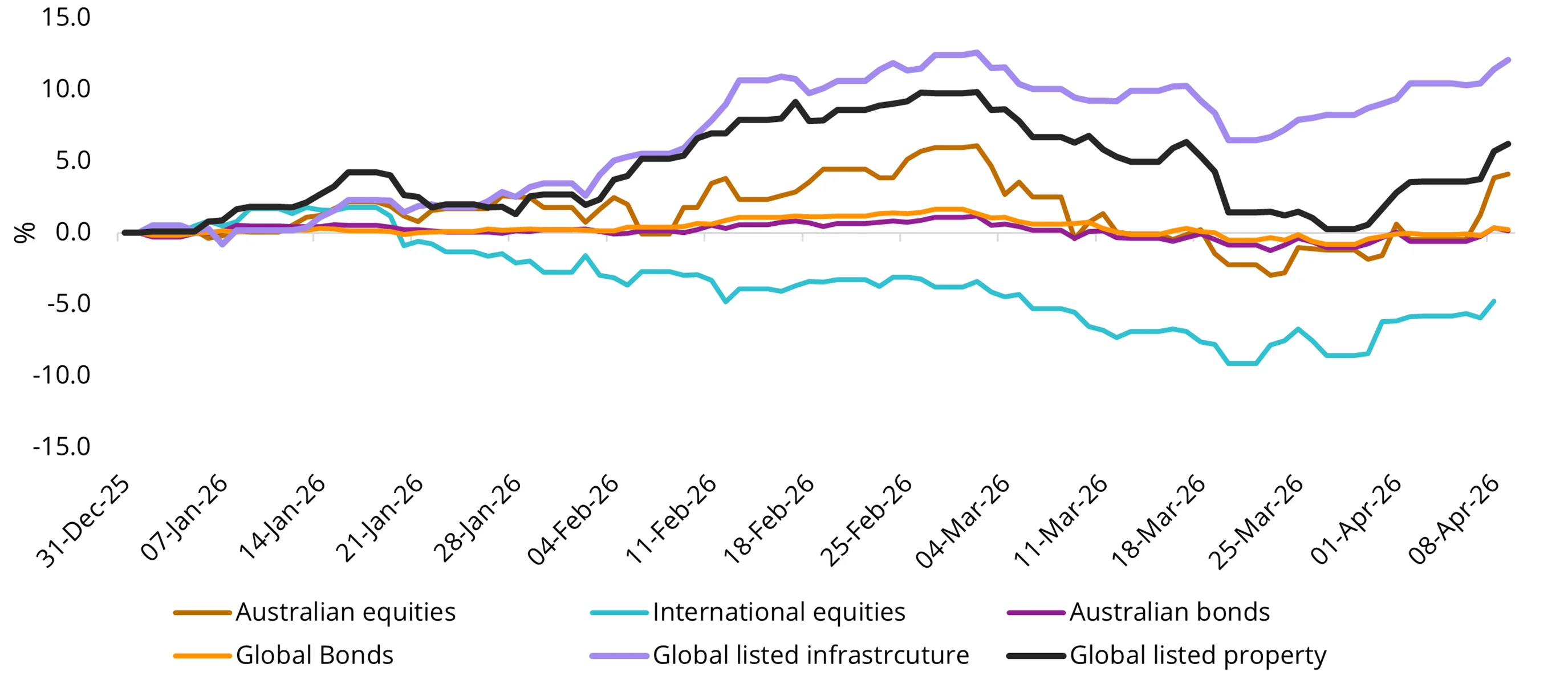
Source: Morningstar Direct, 1 Jan 2026 to 9 April 2026. Australian equities is the S&P/ASX 200 Index, International equities is the MSCI World ex Australia Index, Australian Bonds is the Bloomberg AusBond Composite 0+ Years Index, Global bonds is the Bloomberg Global Aggregate Bond Index Hedged to AUD, Global Infrastructure is the FTSE Developed Core Infrastructure 50/50 Hedged into Australian Dollars Index and Global listed property is FTSE EPRA Nareit Developed ex Australia Rental Index AUD Hedged. You cannot invest in an index. Past performance is not indicative of future performance.
Characteristics of infrastructure and listed property
Global listed real estate beyond Australian shores includes investment opportunities not readily available in Australia, including student housing developments, storage, data warehouses and hotels. Often, rental income is linked to inflation, so it tends to increase with CPI. Australians have had a long affinity with property investing, and the requirement for income is a key driver of its demand.
Investors have also come to recognise that infrastructure assets tend to be linked to steady and reliable income, supported by real assets that tend to be long-lived and that generally retain their value. Local toll road operator Transurban is a good example.
Generally, road tolls increase in line with changes in the Consumer Price Index. Government regulation determines the amount and the frequency of toll price increases each year. And despite these rises, these roads still have traffic jams.
This highlights one of the key drivers of the long-term performance of global infrastructure securities: they exhibit inelastic demand for the services they offer.
These are basic services in people’s lives. The consumption patterns, and therefore the cash flow, vary little in response to price or the economic cycle.
Infrastructure, stagflation and a property recovery
With many investors predicting a high inflation and low growth, stagflationary environment, infrastructure is piquing investor interest. In the past global listed infrastructure has outperformed global equities during recent stagflationary environments, when US inflation was above 2.5%, and US real GDP Growth was below 2.5%, in 3 out of the last 4 periods.
Chart 2: Calendar year performance in stagflation (US inflation > 2.5%; US real GDP Growth < 2.5%)
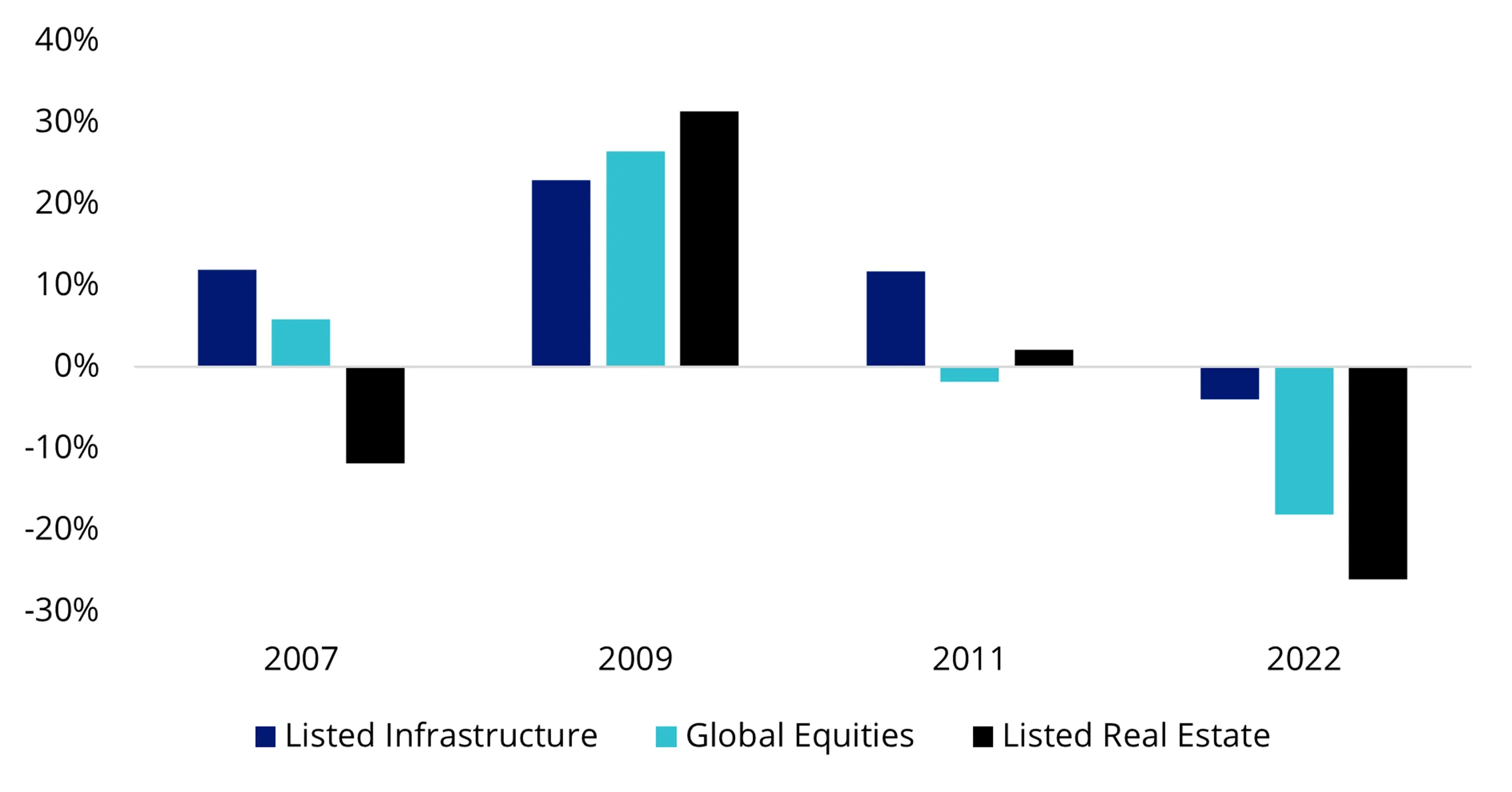
Source: Bloomberg: Listed Infrastructure is FTSE Developed Core Infrastructure 50/50 Hedged into Australian Dollars Index, Global equities is MSCI World ex Australia Index, Listed Real Estate is FTSE EPRA Nareit Developed ex Australia Rental Index AUD Hedged. You cannot invest in an index. Past performance is not indicative of future performance. All returns in Australian dollars.
You’ll note in Chart 2, global listed real estate outperformed in 2009 and 2011. These were periods in which investors sought the valuation recovery potential of the asset class. We think this could be happening (Chart 3) again as commercial real estate fundamentals stabilise in the US, and this has improved the sector’s relative attractiveness.
Chart 3: Office occupancy rates recovering
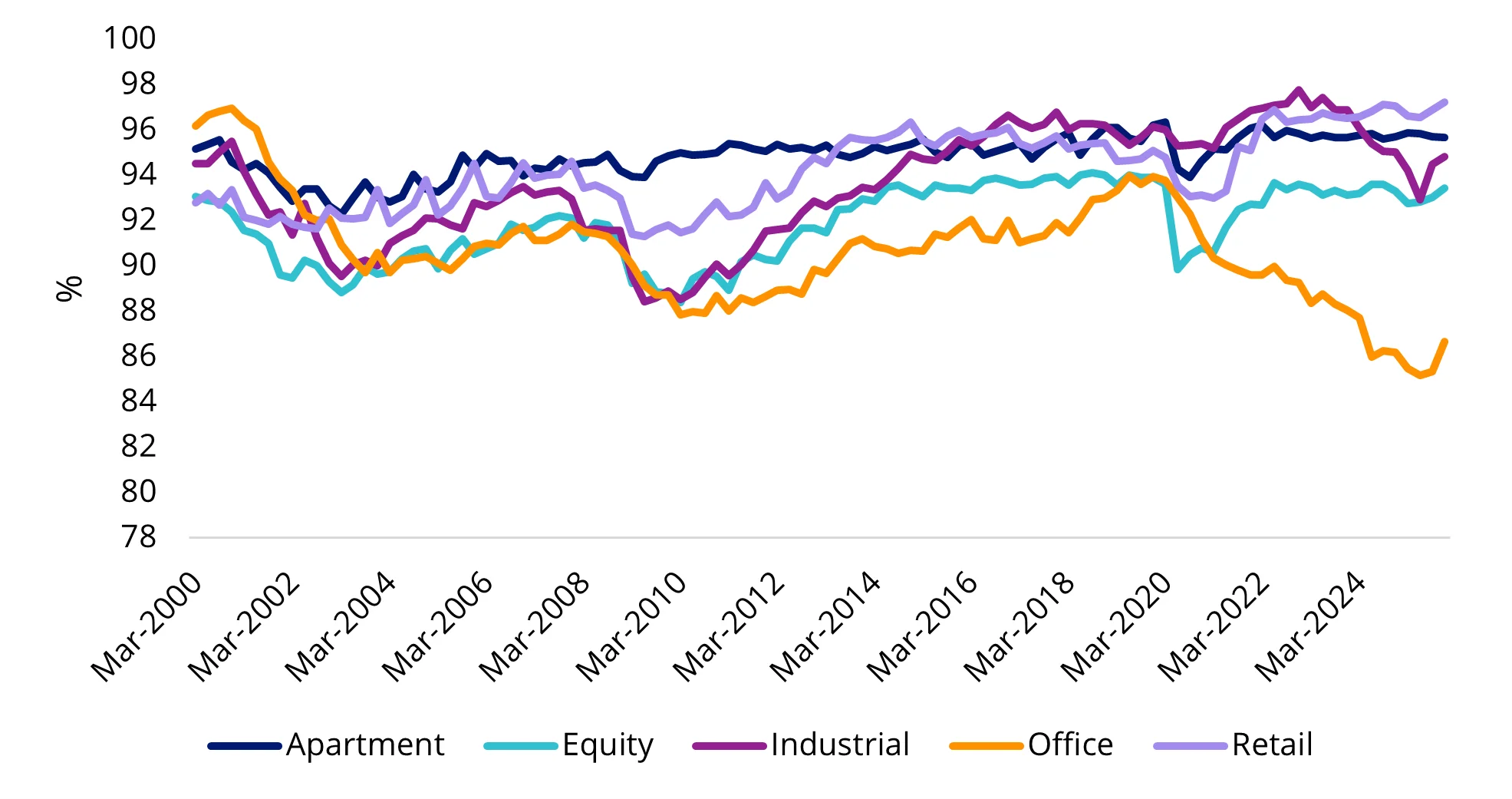
Source: Bloomberg, March 2025.
Before the outbreak of war
Prior to the outbreak of tensions between the US and Iran, the outlook for infrastructure and property was positive. In its 2026 outlook, Nariet indicated that if funding conditions stabilise and property fundamentals continue to improve across selected global sectors, listed real estate has room to recover further. Nareit’s 2026 outlook also argued that global listed real estate can help investors move beyond home bias and gain liquid, transparent exposure to a broader opportunity set.
Infrastructure had been buoyed by the February reporting season. Tailwinds had already started to gather for energy-aligned sectors as accelerating power demand from data centres, the resurgence of geopolitical uncertainty, and mega-scale energy investment deals, including Japan’s $36 billion investment in US oil, gas and critical mineral projects were announced during this earnings season, supporting energy and utilities names. Furthermore, with most reporting companies beating both headline and revenue expectations, it highlighted the underappreciation and strength of these sectors, both of which are included in global listed infrastructure.
You can see in the chart below that energy and utilities experienced the largest 1-day price changes in the most recent reporting period. Real Estate, which came in mostly in line with expectations, also had a price bump.
Chart 4: Q4 2025 aggregate earnings surprise vs 1-day price reaction - by sector
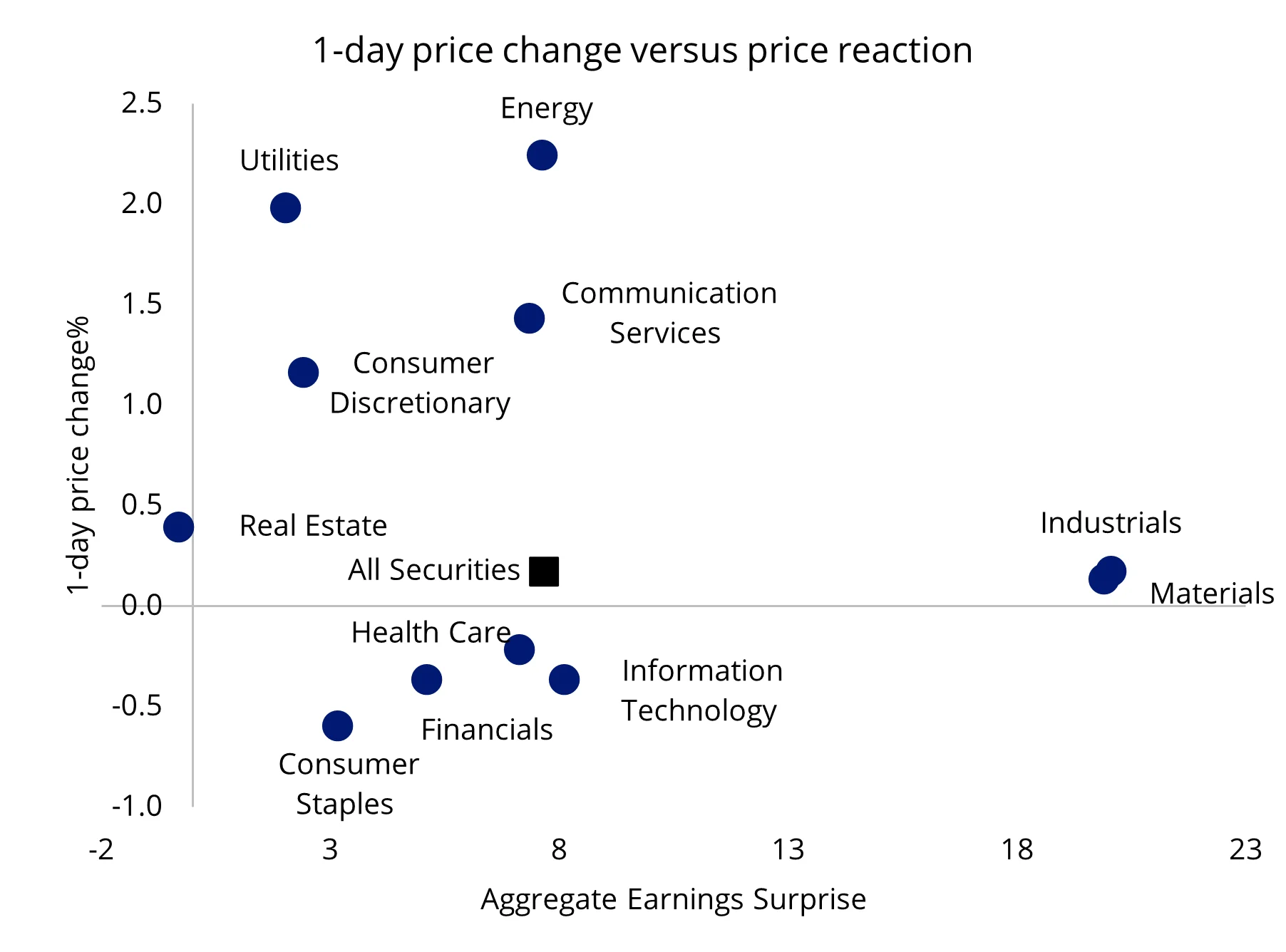
Source: VanEck. Bloomberg. Performance in USD. Data to the end of February 2026. Sectors are represented by S&P 500 sector indices. You cannot invest in an index. Past performance is not indicative of future performance.
Unloved sectors were the most rewarded, as investors sought value in what was an expensive market.
Despite their outperformance since the outbreak of war, global listed infrastructure and global listed property are still trading below historic highs.
Valuations
For investors seeking value, the relative value of the global infrastructure index, on an enterprise value (EV) to EBITDA valuation, does not look as stretched relative to its historical average.
Chart 5: EV to EBITDA of FTSE Developed Core Infrastructure 50/50 Index
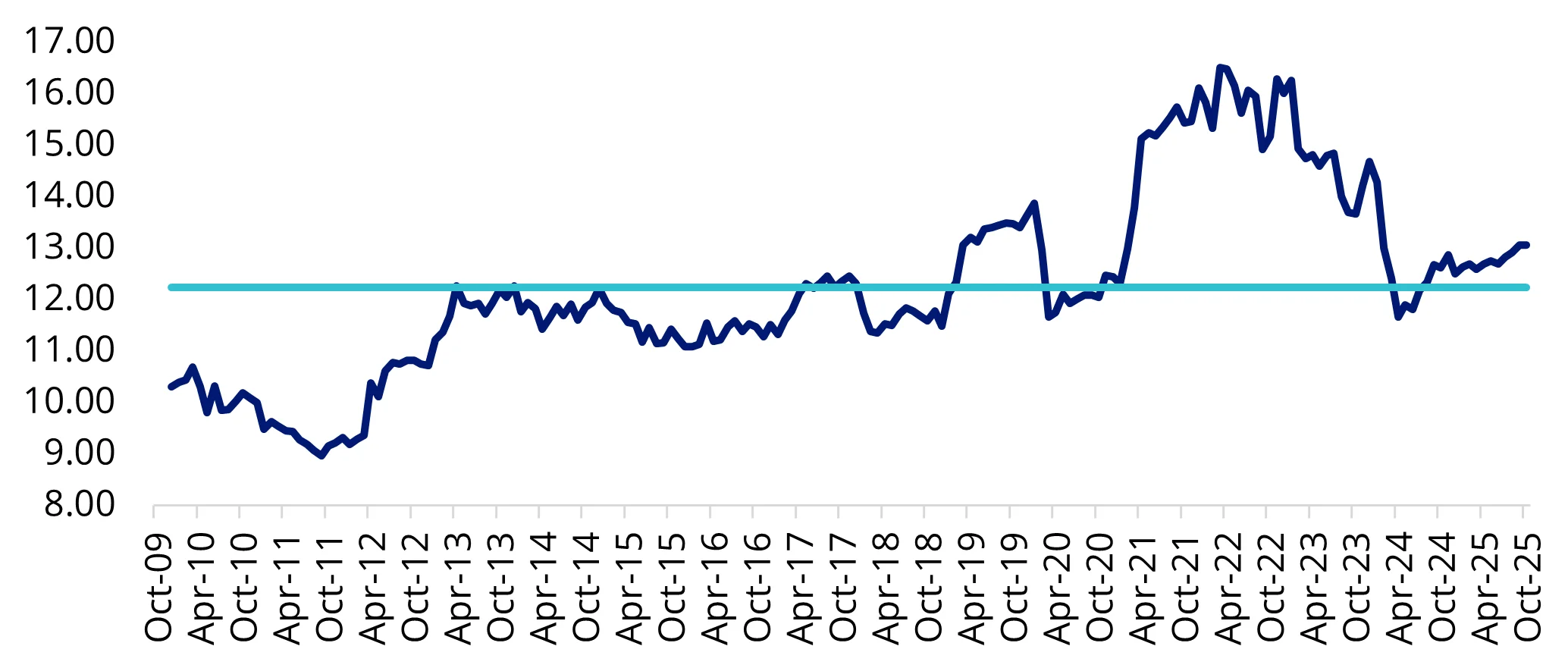
Source: FTSE, December 2009 (Index base date) to 31 March 2026.
This means that should global equity valuations start to move back in line with historical averages, global infrastructure has the potential to maintain its resilience. Similarly, global listed property is trading below its historic highs, close to its long-term average.
Chart 6: Premium to discount NTA of FTSE EPRA Nareit Developed ex Australia Rental Index AUD Hedged index
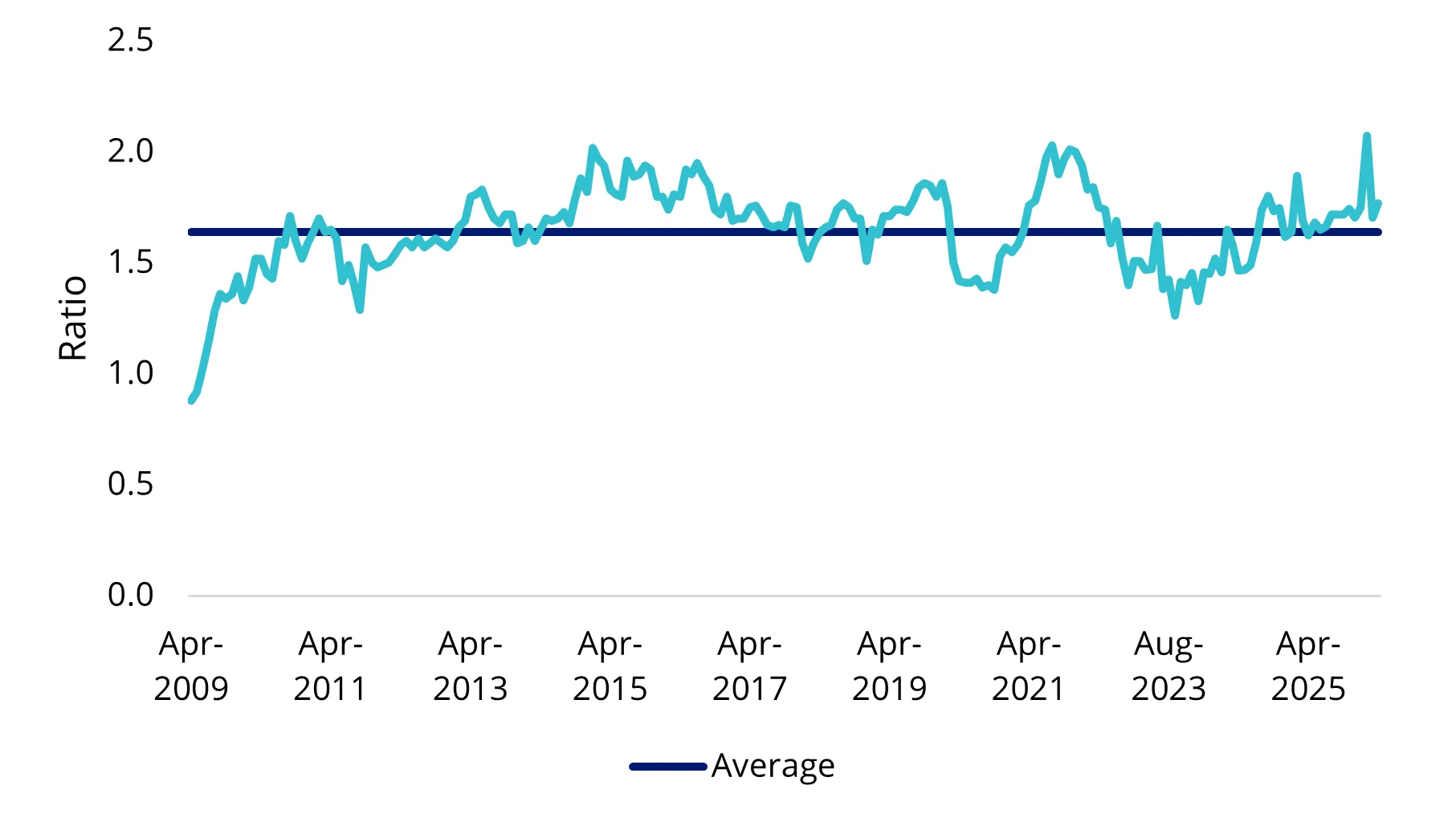
Source: FTSE, April 2009 (Index base date) to 31 March 2026.
The portfolio case: same theme, different drivers
The VanEck FTSE Global Infrastructure (AUD Hedged) ETF (IFRA) tracks the FTSE Developed Core Infrastructure 50/50 Hedged into Australian Dollars Index and gives exposure to listed infrastructure companies across developed markets. The underlying index framework is designed around infrastructure sub-sectors, with target exposures of roughly 50% utilities, 30% transportation and 20% other infrastructure. In practice, that means investors are buying into assets such as regulated utilities, toll roads, airports, pipelines, towers and related essential-service businesses. That is a compelling setup when markets are rewarding resilient cashflows and businesses with pricing power or long-duration demand.
VanEck FTSE International Property (AUD Hedged) ETF (REIT) gives investors exposure to roughly 300 international property securities / REITs across countries and sectors not easily accessed through the local market. REIT tends to be a more rate-sensitive and valuation-sensitive expression, with upside tied more directly to property-market sentiment and cap-rate stabilisation.
That contrast makes the pairing useful: both sit in the “real assets/income” bucket, but they respond differently to the macro backdrop.
We think the bullish case is that elevated cash yields, stable income demand, a recovering property sector and ongoing infrastructure investment keep supporting listed real assets. The main risks are a renewed rise in long bond yields, slower-than-expected rate cuts, and sector-specific weakness in parts of the property or infrastructure markets.
Both IFRA and REIT benefit from low 0.20% p.a. management fees.
While we believe that long-run return expectations for global listed infrastructure and global listed property are attractive, this environment still has significant risks for individual assets. As such, being diversified across a range of underlying sectors and stocks is key.
With one trade on ASX IFRA gives investors access to:
- a portfolio of 136 of the world’s largest infrastructure securities providing international diversification that replicates the well-regarded market benchmark for global listed infrastructure, the FTSE Developed Core Infrastructure 50/50 Hedged into Australian Dollars Index;
- stable income paid quarterly harnessing VanEck’s tax expertise;
- a cost-effective strategy with a management fee of 0.20% p.a.; and
With one trade on ASX, REIT gives investors:
- a portfolio of over 300 of the world’s largest listed real estate companies providing international diversification and defence;
- stable income paid quarterly harnessing VanEck’s tax expertise;
- a cost-effective strategy with a management fee of 0.20% p.a.; and
- a strategy with strong Research support – REIT has been awarded ratings of:
Key risks: An investment in our global infrastructure and international property ETFs carry risks associated with: ASX trading time differences, financial markets generally, individual company management, industry sectors, foreign currency, currency hedging, country or sector concentration, political, regulatory and tax risks, fund operations, liquidity and tracking an index. See the relevant PDS and TMD for more details.
IFRA and REIT are likely to be appropriate for a consumer who is seeking capital growth and a regular income distribution, is intending to use the product as a minor or satellite allocation within a portfolio, has an investment timeframe of at least 5 years, and has a high to very high risk/return profile.


Published: 16 April 2026
Any views expressed are opinions of the author at the time of writing and is not a recommendation to act.
VanEck Investments Limited (ACN 146 596 116 AFSL 416755) (VanEck) is the issuer and responsible entity of all VanEck exchange traded funds (Funds) trading on the ASX. This information is general in nature and not personal advice, it does not take into account any person’s financial objectives, situation or needs. You should consider whether or not an investment in any Fund is appropriate for you. Investments in a Fund involve risks associated with financial markets. These risks vary depending on a Fund’s investment objective. Refer to the applicable product disclosure statement (PDS) and target market determination (TMD) available at vaneck.com.au for more details. Investment returns and capital are not guaranteed.