From uranium to fusion: Investing in nuclear’s next chapter


As the world demands ever greater supplies of low-carbon electricity, driven by trends including artificial intelligence, cloud computing and electrification, attention is turning to technologies capable of delivering reliable power at scale. Nuclear energy is once again at the centre of that conversation.
While today's nuclear renaissance is being driven by advances in conventional nuclear fission, another technology is quietly gathering momentum. Nuclear fusion, the process by which the sun generates its energy, has long been regarded as the ultimate goal of clean energy research. Today, record levels of private investment and significant engineering progress suggest it may be moving from scientific ambition towards commercial reality.
For investors, the story extends beyond fusion to the broader evolution of the nuclear industry.
A quiet evolution: from fission to fusion
As the global economy demands vast new supplies of carbon-free electricity, investment and innovation are beginning to transform the nuclear power industry. It is a quiet evolution, with advances in nuclear fission increasingly likely to be followed by the development of commercial nuclear fusion, although considerable challenges remain.
Nuclear fission has generated electricity since the 1950s by splitting heavy uranium atoms to release energy. By contrast, nuclear fusion combines light atoms, releasing energy through the same reaction that powers the sun and the stars.
When the US Commonwealth Fusion Systems (CFS) received almost US$900 million in new funding in August 2025, it moved a step closer to building what it hopes will be the world's first large-scale commercial nuclear fusion power plant. Its success would mark an important step towards commercial fusion, with the potential to usher in an era of abundant, carbon-free nuclear power providing clean, virtually limitless energy.
While significant engineering hurdles remain, fusion generators could begin producing energy in the 2030s and, by the second half of this century, contribute a material share of the world's energy mix.
Chart 1: Fusion’s extraordinary energy potential
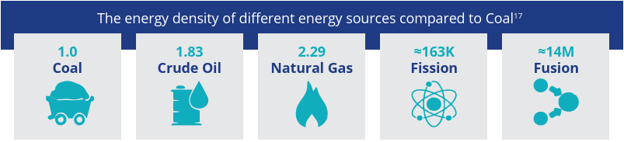
Sources: Energy density. (2026). Energy Education. https://energyeducation.ca/encyclopedia/Energy_density, Max-Planck-Gesellschaft. (2025). Nuclear fusion: European joint experiment achieves energy record. Max-Planck-Gesellschaft. https://www.mpg.de/21522737/0208-plas-jet-rekord-2024-151590-x
While fusion remains a longer-term prospect, innovation across today's nuclear industry is continuing at pace. One example is Small Modular Reactors (SMRs), which can be built in factories and transported to site, potentially reducing costs and construction time.
Meanwhile, investment in fusion continues to gather momentum. According to the chart below from the European Union's Fusion for Energy organisation, cumulative private sector funding has increased by almost ten-fold in the last five years to €13 billion. Private investment in fusion continues to accelerate, while more than 160 fusion facilities are planned, under construction or already operating worldwide.
Chart 2: Growth of global investments in fusion companies – from 2000 to 2025 (in millions of euros)
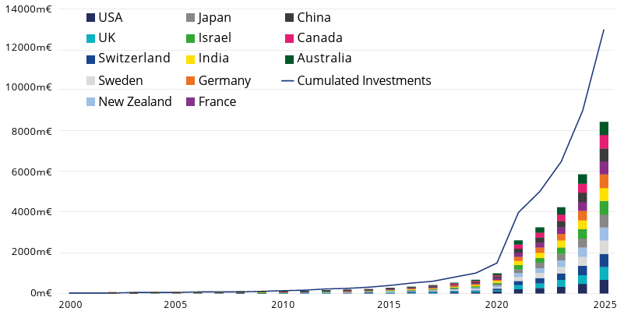
Source: Fusion for Energy. (2025). Global investment in the private fusion sector: F4E Observatory 2025. https://fusionforenergy.europa.eu/wp-content/ uploads/2025/11/F4E_Observatory_2025_digital.pdf
AI is accelerating demand for carbon-free energy
Despite fusion's remaining engineering hurdles, there is already a strong commercial interest in the power it could one day generate. In 2025, Google and CFS signed the world's first agreement to purchase future fusion-generated electricity, securing 200 megawatts of power to help meet the growing energy demands of AI data centres and cloud computing.
That demand is also driving renewed interest in today's nuclear power generation, with technology giants including Microsoft, Amazon and Google announcing agreements to secure nuclear energy as they look for reliable, carbon-free electricity.
Investing in nuclear's evolution
While commercial fusion remains years away, today's investment opportunity lies across the broader nuclear ecosystem.
The VanEck Uranium and Energy Innovation ETF (URAN) provides targeted exposure to 25 global companies at the forefront of the uranium and nuclear energy value chain, across mining and infrastructure. As governments increasingly look to nuclear energy to support decarbonisation and the transition to clean energy, URAN is also designed to provide exposure to companies involved in advanced nuclear technologies. As those technologies evolve, companies that develop and commercialise nuclear fusion may also become eligible for inclusion.
Positioned for today and tomorrow
This is an exciting moment for the evolution of nuclear energy. Fusion has the potential to fundamentally reshape the global energy landscape and is perhaps the ultimate illustration of the evolution already underway across the sector. While commercial fusion remains at an early stage, investment in nuclear energy is accelerating as governments, utilities and technology companies seek reliable, carbon-free electricity to meet growing demand. A diversified approach provides exposure to the sector's evolution while spreading risk across the broader nuclear value chain.
Key risks
An investment in the ETF carries risks associated with: ASX trading time differences, financial markets generally, individual company management, industry sectors, foreign currency, country or sector concentration, political, regulatory and tax risks, fund operations and tracking an index. See the PDS and TMD for more details.
URAN is likely to be appropriate for a consumer who is seeking capital growth, is intending to use the product as a minor or satellite allocation within a portfolio, has an investment timeframe of at least 5 years, and has a very high risk/return profile.

Published: 08 July 2026
Any views expressed are opinions of the author at the time of writing and is not a recommendation to act.
VanEck Investments Limited (ACN 146 596 116 AFSL 416755) (VanEck) is the issuer and responsible entity of all VanEck exchange traded funds (Funds) trading on the ASX. This information is general in nature and not personal advice, it does not take into account any person’s financial objectives, situation or needs. You should consider whether or not an investment in any Fund is appropriate for you. Investments in a Fund involve risks associated with financial markets. These risks vary depending on a Fund’s investment objective. Refer to the applicable product disclosure statement (PDS) and target market determination (TMD) available at vaneck.com.au for more details. Investment returns and capital are not guaranteed.