Exercising judgement


Last month, the World Bank released its 2026 Global Economic Prospects report. It predicts that global GDP growth will fall from 2.7% in 2025 to 2.6% in 2026. Emerging markets were resilient last year, but the World Bank thinks prospects across regions remain uneven.
Chart 1: Global Growth output
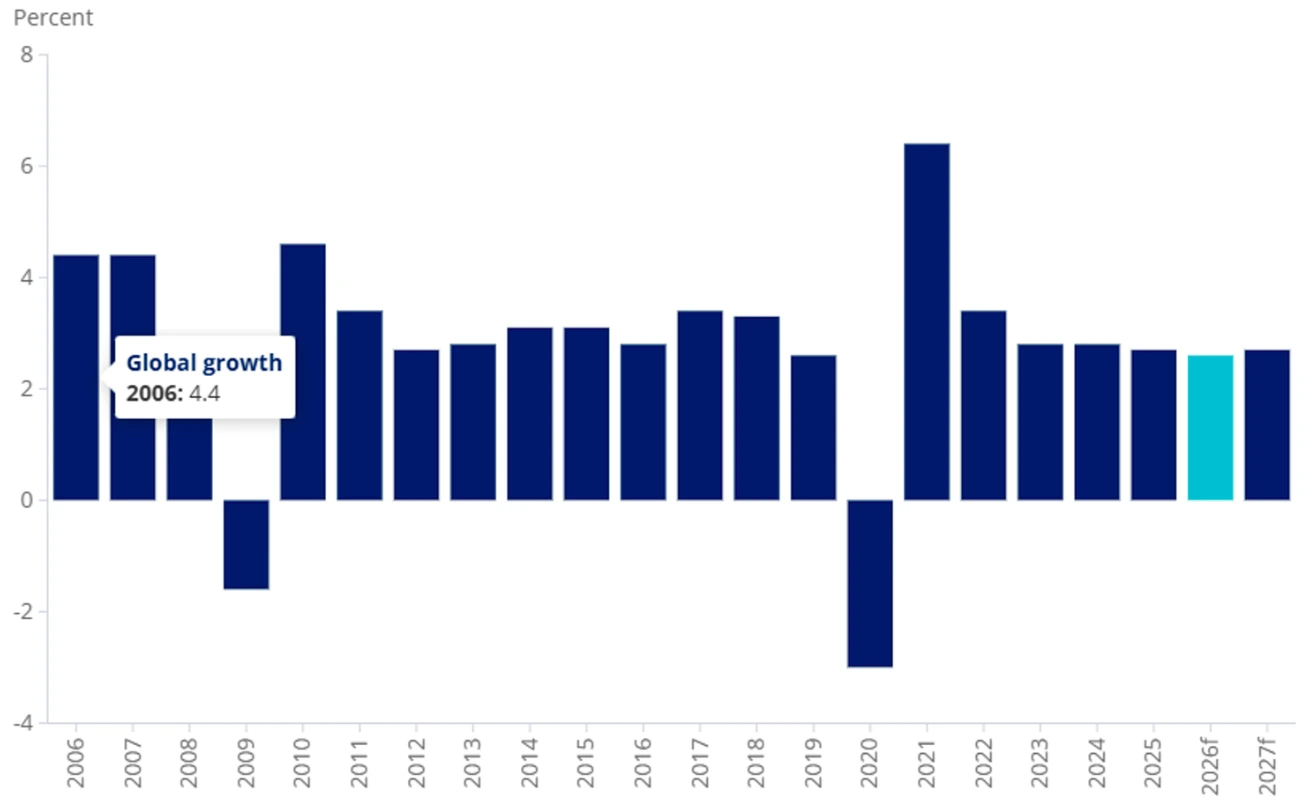
Source: World Bank Group
Note: f = forecast. Data for 2025 are estimates. GDP aggregates calculated using real U.S. dollar GDP weights at average 2010-19 prices and market exchange rates.
The US dollar’s strength is being tested, and investors seeking value are turning to emerging markets. Emerging market economies were resilient, as represented by GDP growth; their bond and equity markets also defied expectations.
As shown in the table below, emerging market bonds outperformed global developed market bonds by 5.19% in 2025 and Australian bonds by 6.44%.
Table 1: 2025 calendar year bond market returns
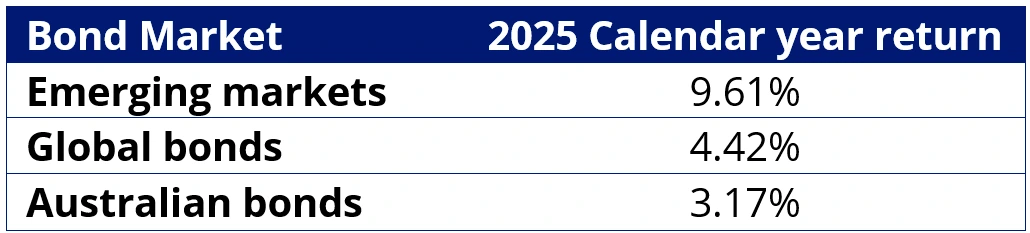
Source: Bloomberg, Emerging markets is the 50% J.P. Morgan Emerging Market Bond Index Global Diversified Hedged AUD and 50% J.P. Morgan Government Bond-Emerging Market Index Global Diversified, Global Bonds is the Bloomberg Global Aggregate Bond Index hedged into AUD, Australian Bonds is the Bloomberg AusBond Composite 0+ Yr Index. All returns in Australian dollars. Past performance is not indicative of future performance. You cannot invest in an index.
Not to be outdone, emerging market equities also exhibited resilience in 2025. Emerging Market equities outperformed the broad developed markets by 11.48% and the US and our own bourse.
Table 2: 2025 calendar year equity market returns
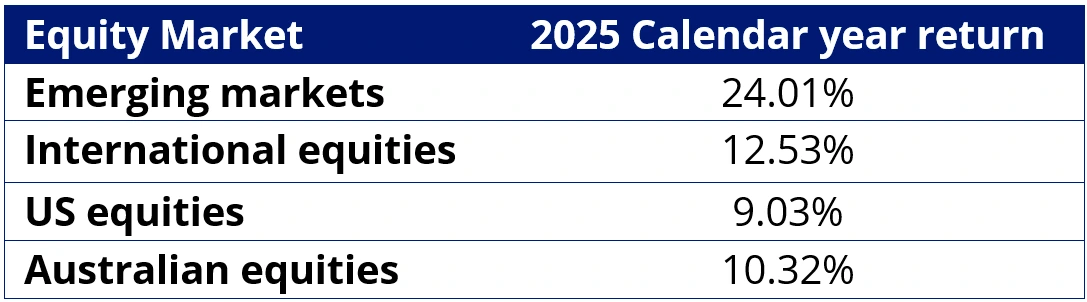
Source: Bloomberg, Emerging markets is the MSCI Emerging Markets Index, International equities is MSCI World ex Australia Index, US equities is S&P 500 Index, Australian equites is S&P/ASX 200 Index. All returns in Australian dollars. Past performance is not indicative of future performance. You cannot invest in an index.
On paper, what should have been a tough year for emerging markets appears to have been more difficult for developed market bond and equity markets.
In 2025, emerging markets were faced with the challenges of the Trump administration’s tariff policy, which was predicted to negatively affect emerging market economies, as well as consumer and corporate weakness in China, which was predicted to have a contagion to other parts of Asia.
Instead, emerging markets thrived, challenging outdated perceptions of political and economic instability. Asian bond and equity markets were among the best performing in 2025. South Korea and Thailand stand out. Mexico’s equity market, heavily reliant on US trade, had a stellar 2025. Its bond market also did well.
We have said before that emerging markets are not a monolith, and some emerging market economies have reformed fiscal and monetary policies, have deep capital markets and comprise favourable demographics that are reshaping the global investment opportunity set.
These large and dynamic economies offer a compelling mix of growth potential, sector and geographic diversification, and potentially attractive valuations. Common ways to assess valuations are price to earnings (P/E) and price to book (P/B).
The P/E ratio measures how much investors are paying for a company’s earnings. The P/B ratio is generally used for balance sheet strength and capital intensity. This is more suited for asset-heavy sectors like financials and industrials. In both instances, the lower the ratio, the better ‘value’.
Both measures are showing that emerging market companies are still offering attractive valuations, with a multi-factor strategy showing an edge.
Charts 2 and 3: Emerging markets equity valuations are compelling
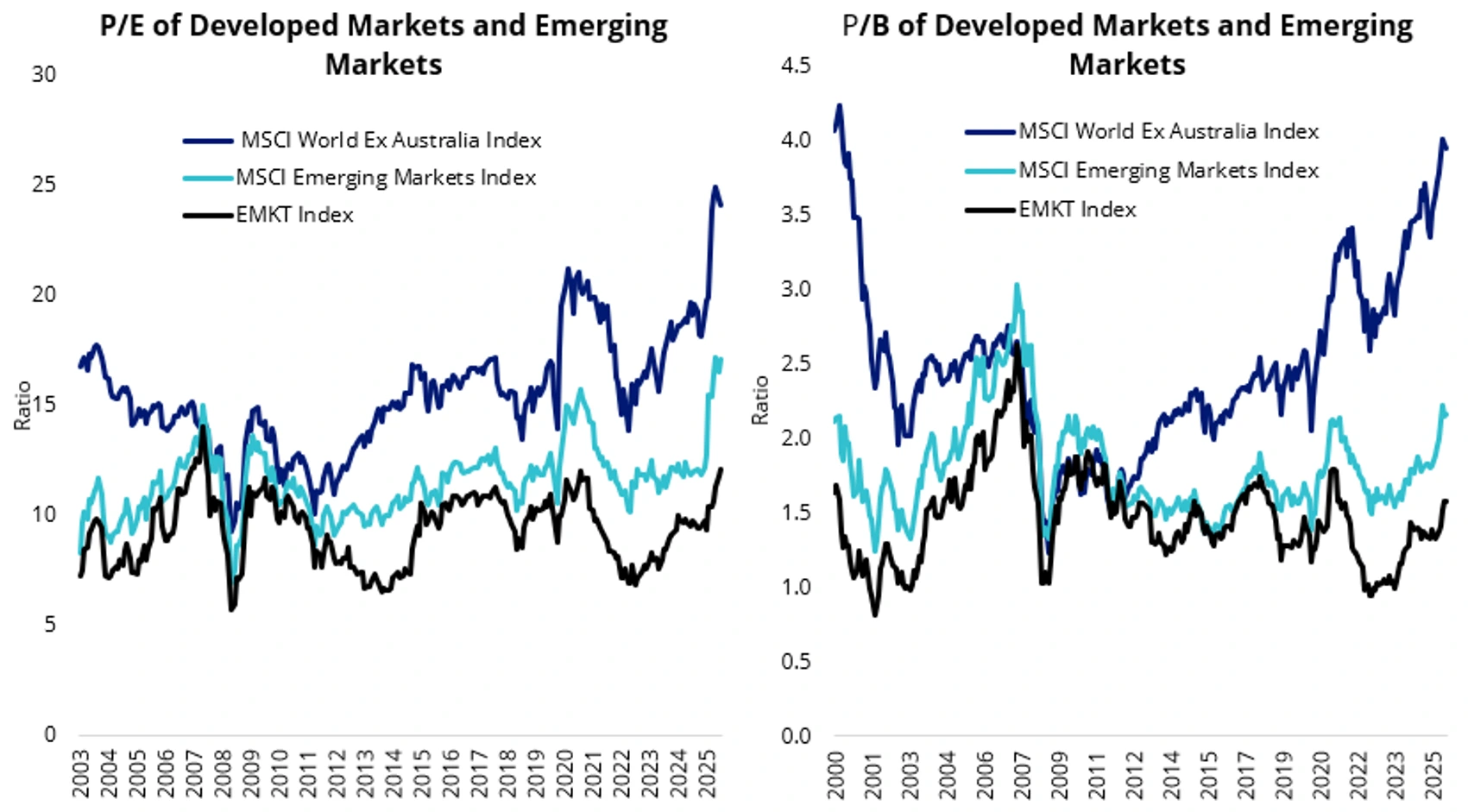
Source: MSCI, FactSet, Chart 2: January 2004 to December 2025, Chart 3: January 2001 to December 2025. You cannot invest in an index. EMKT index is MSCI Emerging Markets Multi-Factor Select Index (AUD)
But as the World Bank cautions, within emerging market economies, there has been and will continue to be uneven recovery and income divergence.
According to the World Bank, globally risks remain tilted to the downside, “Heightened trade policy uncertainty amid a further proliferation of trade restrictions could weigh on trade, prospects, business confidence, and investment.” The report goes on, “In a scenario where equity valuations decline sharply, leading to a plunge in risk appetite and consumer and business confidence, global growth could be up to 0.3 percentage point below baseline projections this year.” With much of that GDP pain borne in advanced economies.
Chart 4: Change in GDP growth in downside scenario
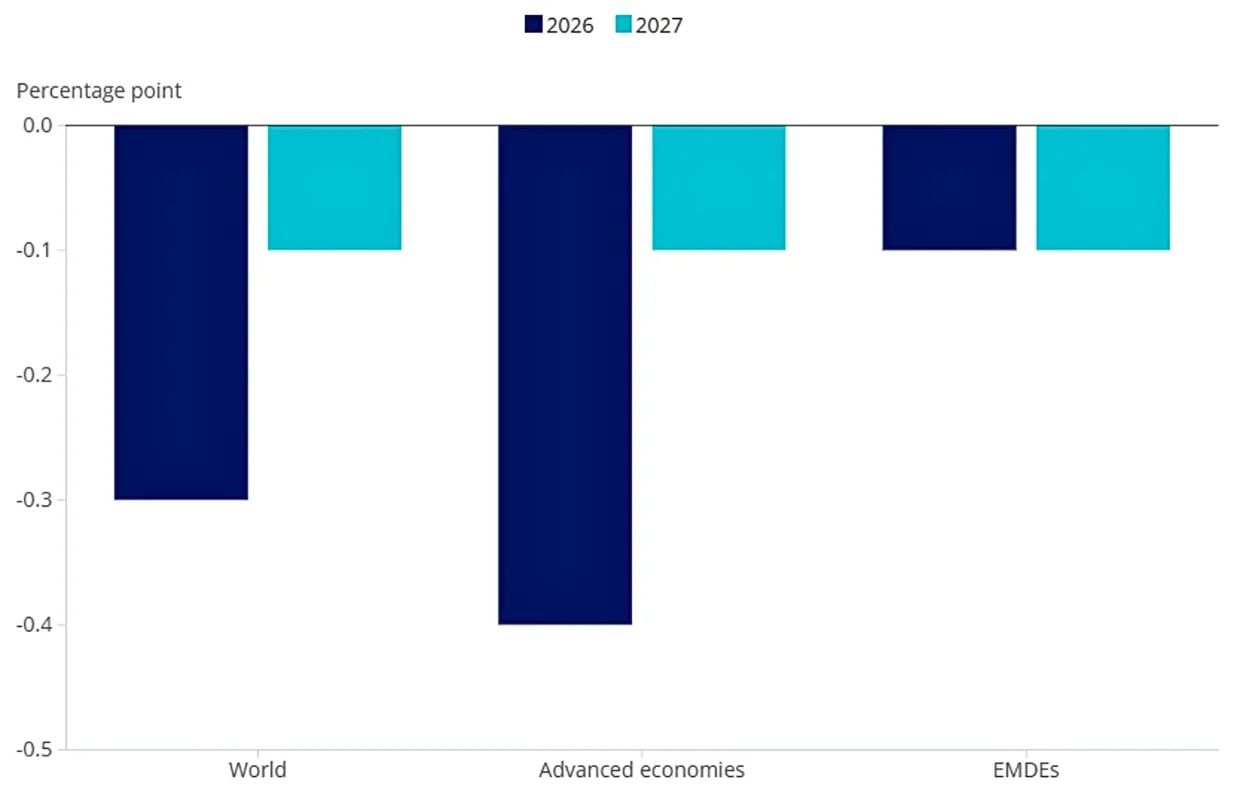
Sources: Oxford Economics; World Bank. Chart shows the deviation of growth from the baseline.
Note: EMDEs = emerging market and developing economies.
Against such a backdrop, emerging markets that rely on developed markets for trade would face a challenge. The World Bank is unusually blunt; policy choices will matter more than bad luck.
A takeaway of the report is that emerging markets that are better placed:
- Have fiscal credibility;
- Strong monetary policy frameworks;
- Diversified trade partnerships;
- Have invested in foundational physical and digital infrastructure;
- Have invested in education and upskilling to build human capital, thus improving the business environment through effective governance; and
- Encourage and cater to private investment.
The economies can help catalyse growth by boosting investment and creating conditions for people and firms to thrive. Many emerging market economies are better able to implement counter-cyclical fiscal expansion to reignite domestic growth because of their growing foreign reserves, strong budgets and robust balance of payments.
Macro stability, fiscal rules, and reform momentum will increasingly differentiate winners from laggards.
Selectivity is therefore the key when investing in emerging markets. And that characterizes the approach we take to these markets.
VanEck’s EMKT tracks the MSCI Emerging Markets Multi-Factor Select Index (EMKT Index). The Index selects companies based on four factors: Value, Momentum, Low Size and Quality. The efficacy of this approach was supported by the 2024 research paper, titled Factor-in emerging markets.
VanEck’s EBND is an active, high conviction approach to investing across the emerging market bond spectrum.
Emerging market bonds and equities offer investors diversification and resilience beyond developed markets. They also allow investors to access structural growth trends shaping the global economy. With stronger fiscal frameworks, deeper local markets, and sector leaders in domains like technology and healthcare, emerging markets are an often overlooked long-term opportunity.
The challenge for investors is being able to distinguish between those countries and companies that are genuinely reforming, innovating and strengthening and those that are not. This is where being selective in emerging markets equities can come to the fore.
Key risks:
An investment in our Emerging Markets ETFs involves risks common to both funds, including: ASX trading time differences, emerging markets exposure, country and sector concentration, foreign currency risks, political, regulatory and tax risks, liquidity, and fund operations.
For EBND: Additional risks include those associated with bond markets, interest rate movements, issuer default, currency hedging, credit ratings, and active fund management.
For EMKT: Additional risks include equity market volatility, individual company performance, industry sector risks, and the risk of tracking an index.
Please refer to the relevant PDS and TMD for EBND and EMKT for full details.


Published: 13 February 2026
Any views expressed are opinions of the author at the time of writing and is not a recommendation to act.
VanEck Investments Limited (ACN 146 596 116 AFSL 416755) (VanEck) is the issuer and responsible entity of all VanEck exchange traded funds (Funds) trading on the ASX. This information is general in nature and not personal advice, it does not take into account any person’s financial objectives, situation or needs. You should consider whether or not an investment in any Fund is appropriate for you. Investments in a Fund involve risks associated with financial markets. These risks vary depending on a Fund’s investment objective. Refer to the applicable product disclosure statement (PDS) and target market determination (TMD) available at vaneck.com.au for more details. Investment returns and capital are not guaranteed.
EMKT is likely to be appropriate for a consumer who is seeking capital growth, is intending to use the product as a core, minor or satellite allocation within a portfolio, has an investment timeframe of at least 5 years, and has a high risk/return profile.
EBND is likely to be appropriate for a consumer who is seeking capital growth and a regular income distribution, is intending to use the product as a minor or satellite allocation within a portfolio, has an investment timeframe of at least 5 years, and has a very high risk/return profile.