Many missed this boat


Benjamin Graham is the second most famous investor ever, surpassed only by his pupil Warren Buffett.
Such was his influence on Buffett that Buffett named his son, Howard Graham, after his mentor. Benjamin Graham is best known for his book on value investing, ‘The Intelligent Investor’. In his preface to the fourth edition, Buffett calls the book “the best book about investing ever written.”
The book details how investors can avoid the trappings of becoming speculators. Graham defines investors as those who seek the preservation of the principal of their investment and an adequate return. Investment decisions not having these objectives, Graham says, are made by speculators and are exposed to higher risks and costs. Investors invest through the market cycle.
According to the book, the term long-term investor is redundant. There is only one kind of investor. “Someone who can’t hold their investment for more than a few months at a time is doomed to end up not as a victor but as a victim.” That is speculating.
The book is littered with examples of the shortfalls of attempting to time the market. If the Intelligent Investor were being written now, we think the last few years could be a lesson.
The story of value and growth since the turn of the century
Over the long term, the relative returns of value and growth companies are negatively correlated. In other words, in the past, when value has outperformed, it probably has coincided with a period in which growth underperformed and vice versa. From the turn of the century, before the GFC, value outperformed growth. However, since the GFC, growth companies, identified as those that generate significant positive sales or earnings, have outperformed value, despite a value resurgence in 2022.
You can see this in the chart below. When the aqua line is moving up toward the right, value is outperforming growth. When it is moving down, growth is outperforming value.
Chart 1 – Cumulative performance of MSCI World Value Index relative to MSCI World Growth Index since Jan 2000 (%)
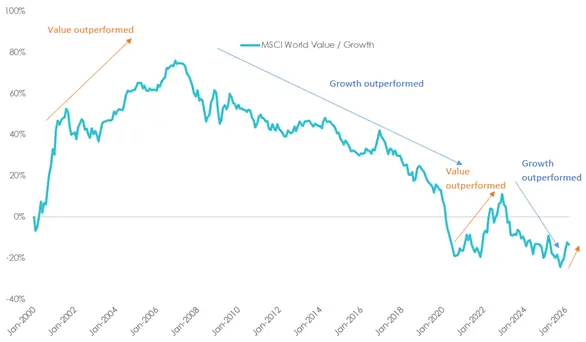
Source: Bloomberg, MSCI 1 January 2000 to 28 February 2026. The above graph is a comparison of the performance of the MSCI World Value Index and the MSCI World Growth Index. Results are calculated to the last business day of the month and assume immediate reinvestment of all dividends and exclude fees and costs associated with investing. You cannot invest in an Index. Past performance is not indicative of future performance of the indices or VLUE. VLUE does not track the MSCI World Value Index.
Before the 2022 value rally, many financial industry pundits were calling the end of value investing. Here are some headlines of the time (Value’s death was a popular theme):
Is Value Investing Dead? Morningstar, September 6, 2018.
Has Value Investing Stopped Working? Forbes, November 25, 2019.
Is value investing dead? The Business Times February 24, 2021.
And when Value did come back in 2022, there was scepticism:
Value Investing Is Back. But for How Long? The Wall Street Journal (2022).
At the end of 2022, OpenAI released ChatGPT to the world, and many speculators jumped aboard the AI bandwagon, which did well for a couple of years.
In the last 18 months, however, the value boat has been sailing, and many have been left moored.
It is worth understanding why many people missed the boat and why we think value should be part of an investor's portfolio.
Value investing
First, it’s worthwhile to understand how the ‘value’ of a company is measured. Common valuation metrics, such as earnings or price-to-book value ratios, have traditionally been used to measure value. Those with low metrics are considered ‘value’.
The concept of value was developed by economists Benjamin Graham and David Dodd in the 1920s. Their book Security Analysis (1934) and Graham’s The Intelligent Investor (1949) introduced methods that could be used to identify ‘value’.
Graham and Dodd developed a methodology to identify and buy securities priced well below their intrinsic value. Behind this concept of value investing is the belief that “cheaply” valued assets tend to outperform more expensive stocks over a long horizon.
Over the very long term, this has proven to be true. One of the world’s most successful investors, Warren Buffett, made his fortune by using the principles of Graham and Dodd as the CEO and shareholder in Berkshire Hathaway Inc. Buffett has made a career identifying value when others have been selling. Key to his success has been identifying real value stocks and avoiding the cheap and nasty. A low price alone does not indicate good value, and those who pursue a low price alone can easily fall into ‘value traps’.
Overcoming value problems
‘Value traps’ are one of the criticisms of value. According to a paper written by MSCI in 2015[1], a big part of the value factor’s underperformance since the GFC had been its mis-definition, which relied on price-to-book in a world where intangibles had become prominent.
To overcome this, greater emphasis was placed on enterprise value, a measure of the company’s total value (typically based on debt plus equity market cap less cash). It also serves as the basis for many financial ratios that measure the performance of a company. Firms with high enterprise multiples have high expected cash flows relative to operating income, implying high growth opportunities and a relatively lower discount rate than firms with low multiples.
MSCI found that considering whole-firm valuation measures, such as enterprise value, can reduce concentration in leveraged companies, while using forward earnings could protect against ‘value traps’.
Therefore, MSCI developed its Enhanced Value Indices, which apply three valuation ratio descriptors on a sector-relative basis:
- price-to-book value - Ratio of the price to the company’s book value or what is on the balance sheet. The lower the price to book, the cheaper the company;
- price-to-forward earnings - A version of the ratio of price-to-earnings (P/E) that uses forecasted earnings for the P/E calculation. The forward earnings are the weighted average of the consensus of analysts’ predicted earnings. The lower the Forward P/E, the cheaper the company; and
- enterprise value-to-cash flow from operations - The ratio of the entire economic value of a company to the cash it produces. When you divide EV by CFO, you're essentially calculating the number of years it would take to buy the entire business if you were able to use all the company's operating cash flow to buy all the outstanding stock and pay off all the outstanding debt. The lower the ratio the faster a company can pay back the cost of its acquisition, or generate cash to reinvest in its business.
The value factor was not dead. It had evolved.
The Value Factor, from the Factor Specialists
In March 2021, we launched the VanEck MSCI International Value ETF (VLUE), which tracks the MSCI World ex Australia Enhanced Value Top 250 Select Index. VLUE was an expansion of our factor suite of ETFs, which at the time included our popular MSCI International Quality ETF (QUAL). We have since added our MSCI International Growth ETF (GWTH) to this stable, thus giving investors tools to access the opportunities via factors in changing markets.
We wrote about using factors in different economic regimes and blending factors here.
Value’s current tailwinds
In the past, we have explained how individual factors have been shown to outperform during different macroeconomic environments. Value is “pro-cyclical”, meaning that this type of strategy historically outperforms during rising market conditions.
In the past twelve months, changes in macroeconomic indicators have potentially boded well for a value rotation, and inflation, now being driven by supply shocks from the crisis in the Gulf, could propel value’s recent relative outperformance further.
Many speculators missed this boat. Some may have started or continued to style drift by taking on growth companies or investing down the market capitalisation spectrum and investing in small-sized companies. Some traded on momentum, FOMO, without consideration for fundamentals.
The value boat, we think, is sailing, and it has tailwinds. If inflation proves persistent, market leadership continues to broaden beyond US mega caps, or global manufacturing conditions improve, we believe the case for the value factor remains as compelling as ever.
The right value approach is paramount. The index VLUE tracks, we think, is the most representative expression of the value factor available on ASX. It does not include small caps, which have diluted the returns of some other value exposures, and with only 250 high-conviction holdings, it avoids the watered-down approach of broader value indices that hold hundreds of stocks with varying degrees of value characteristics. Because it is rules-based, it does not drift from its style.
Five years ago, when we launched a value-factor fund, investing in international value required patience and a willingness to look different from the crowd. Many had declared value investing dead.
It wasn't. VLUE's five-year track record, built through a pandemic, a rate shock and an AI-driven market, reflects exactly what a disciplined investor seeks.
Source:
[1] MSCI, Finding Value: Understanding Factor Investing (2015)


Published: 27 March 2026
Any views expressed are opinions of the author at the time of writing and is not a recommendation to act.
VanEck Investments Limited (ACN 146 596 116 AFSL 416755) (VanEck) is the issuer and responsible entity of all VanEck exchange traded funds (Funds) trading on the ASX. This information is general in nature and not personal advice, it does not take into account any person’s financial objectives, situation or needs. You should consider whether or not an investment in any Fund is appropriate for you. Investments in a Fund involve risks associated with financial markets. These risks vary depending on a Fund’s investment objective. Refer to the applicable product disclosure statement (PDS) and target market determination (TMD) available at vaneck.com.au for more details. Investment returns and capital are not guaranteed.
An investment in our international value ETF carries risks associated with: ASX trading time differences, financial markets generally, individual company management, industry sectors, foreign currency, country or sector concentration, political, regulatory and tax risks, fund operations, liquidity and tracking an index. See the VanEck MSCI International Value ETF PDS and TMD for more details. show less
VLUE is indexed to a MSCI index. VLUE is not sponsored, endorsed or promoted by MSCI, and MSCI bears no liability with respect to VLUE or the MSCI World ex Australia Enhanced Value Top 250 Select Index. The PDS contains a more detailed description of the limited relationship MSCI has with VanEck and VLUE.
VLUE is likely to be appropriate for a consumer who is seeking capital growth, is intending to use the product as a major, core, minor or satellite allocation within a portfolio, has an investment timeframe of at least 5 years, and has a high risk/return profile.