The fog of war


Carl von Clausewitz was a Prussian general who fought in the French Revolutionary and Napoleonic Wars, and the phrase “fog of war” is often attributed to him. What he actually said was, “war is the realm of uncertainty; three-quarters of the factors on which action in war is based are wrapped in a fog of greater or lesser uncertainty.” The phrase has now become a cliché, used to describe the complexity of military conflicts, capturing the uncertainty of outcomes. Uncertain outcomes even for those not involved in the war, but potentially affected, like global markets and, therefore, investors.
There is no doubt that the flare-up of tension in the Middle East will have a short-term impact on markets. The price of energy, it has been noted, will rise and has risen. In a global economic environment already facing inflationary pressures, the impact will likely influence the price of goods and services and supply issues are likely to mount.
As one would expect, historically, wars and conflicts create uncertainty for markets. You can see the impact of select geopolitical events on global stock markets below:
Table 1: Geopolitical events and stock market shocks (1969 to current)
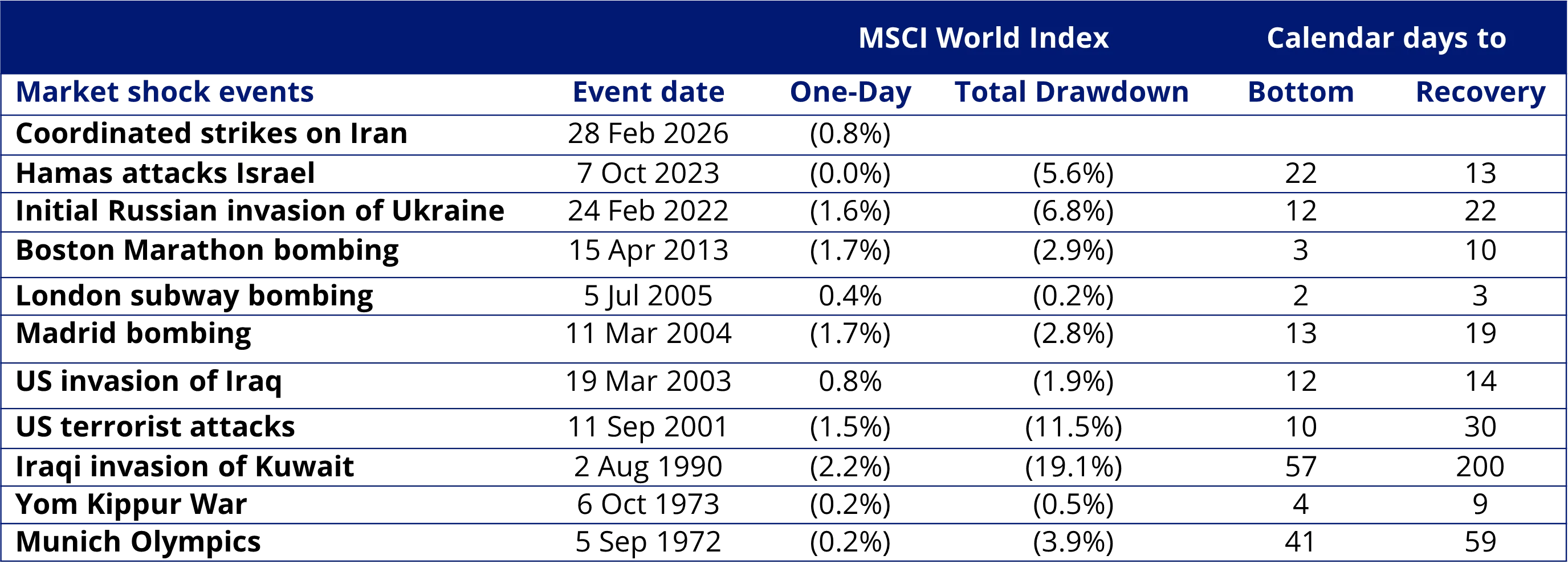
Source: VanEck, MSCI, Bloomberg, Morningstar Direct. All returns in Australian dollars. You cannot invest in an index. Past performance is not indicative of future performance.
Looking back further to the S&P 500, which has a longer history than the MSCI World Index:
Table 2: Geopolitical events and stock market shocks (1940 to 1969)
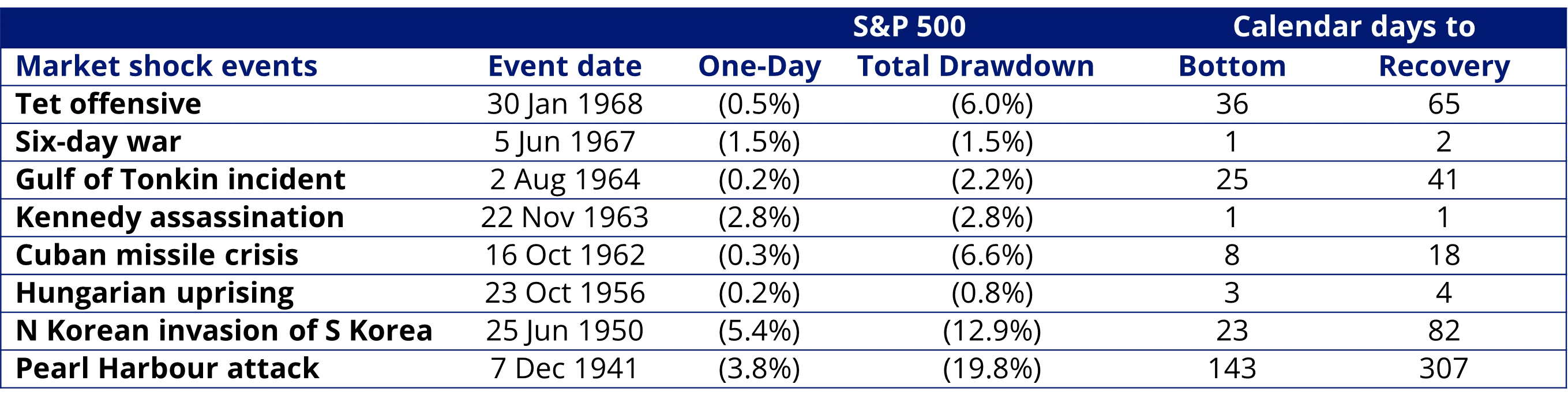
Source: LPL Research, S&P Dow Jones Indices. All returns in US dollars. You cannot invest in an index. Past performance is not indicative of future performance.
From a market's perspective, the impact of the COVID shutdowns was much worse (Maximum drawdown of MSCI World ex Australia Index: -23.7%*).
Thinking about liquidity and credit crises, such as the 1987 stock market crash (Maximum drawdown on MSCI World ex Australia Index -28.2%*) and the GFC (Maximum drawdown on MSCI World ex Australia Index -31.6%*), these had a much greater impact on investments.
We have said this before, through all these events, from an investing perspective, it is important to concentrate on long-term goals.
Successful long-term investors survive short-term falls by sticking to investment principles that have withstood the tests of time. For portfolios, this may include better diversification. For equities, investing in profitable companies with strong balance sheets and stable earnings has historically given resilience to portfolios.
As you can see above, stock markets tend to recover from geopolitical events. The fog of war for investors is that they do not know how bad the impact will be and how long it will take the market to recover. Should they be lucky enough to have their lives and good health, it is important then to remember the fog of war for those directly affected by the war, and recognise how lucky we truly are in Australia.
Source:
* VanEck, MSCI, Morningstar Direct. Returns in Australian dollars. You cannot invest in an index. Past performance is not indicative of future performance
Published: 12 March 2026
Any views expressed are opinions of the author at the time of writing and is not a recommendation to act.
VanEck Investments Limited (ACN 146 596 116 AFSL 416755) (VanEck) is the issuer and responsible entity of all VanEck exchange traded funds (Funds) trading on the ASX. This information is general in nature and not personal advice, it does not take into account any person’s financial objectives, situation or needs. You should consider whether or not an investment in any Fund is appropriate for you. Investments in a Fund involve risks associated with financial markets. These risks vary depending on a Fund’s investment objective. Refer to the applicable product disclosure statement (PDS) and target market determination (TMD) available at vaneck.com.au for more details. Investment returns and capital are not guaranteed.