Investors are rethinking portfolio allocations as private markets face challenging headwinds, according to VanEck
September 2026


The survey with 938 responses from financial professionals, included a segment focusing on private market exposures, which showed that allocations to private assets have fallen with around 50 per cent of respondents currently invested in private market assets, a decrease on the 60 per cent from 2025. Active allocations to private market assets have also declined by 15 per cent from 2025, and opportunistic allocations have fallen by 17 per cent, signalling a strong sentiment shift in the market.
Respondents are also less inclined to consider an allocation to private assets, with 14 per cent considering an allocation, a decrease on the 18 per cent in 2025, and 35 per cent of respondents noting they have no plans to allocate client funds to private market assets, an increase on the 22 per cent in 2025.
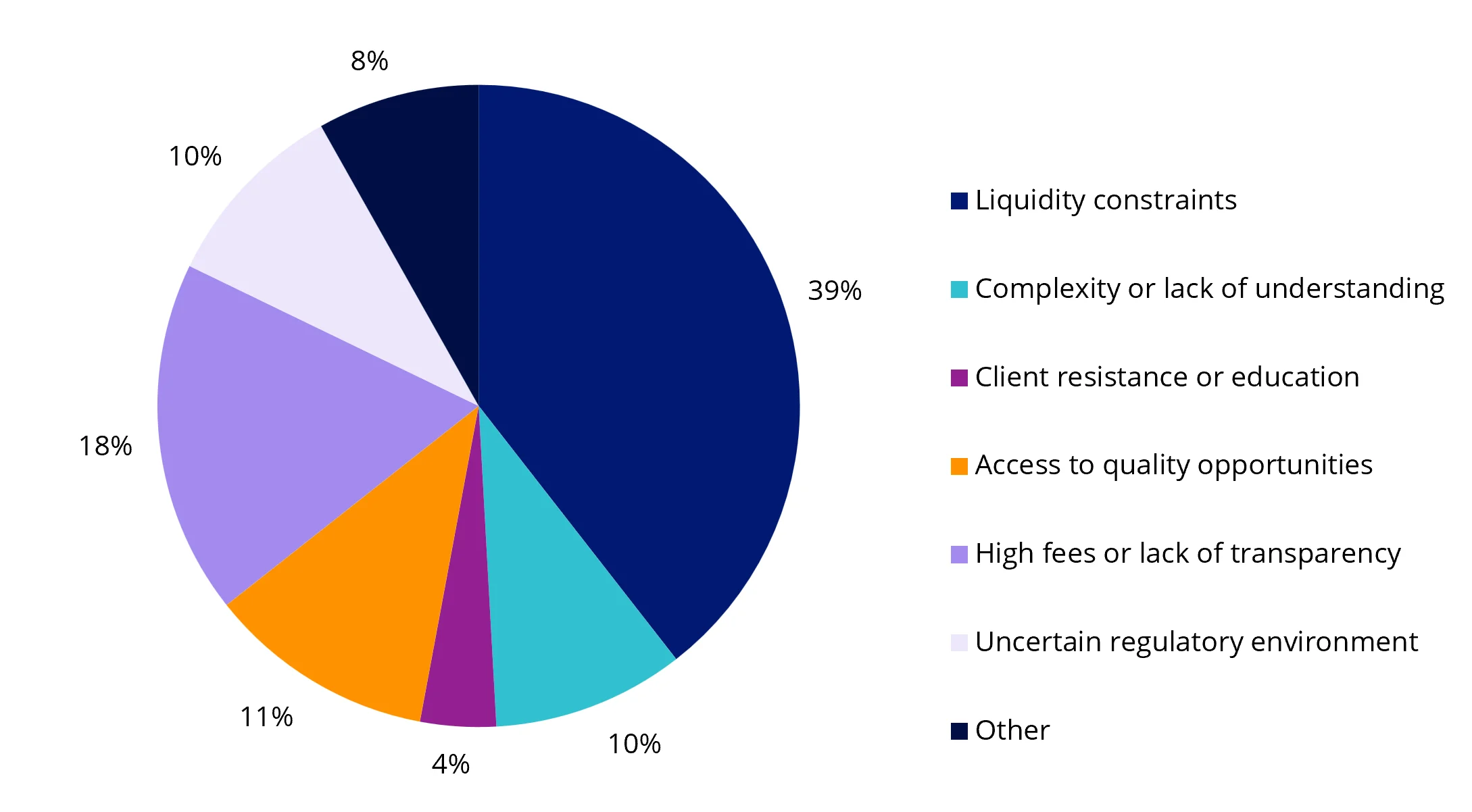
Of those surveyed, the top concerns were about liquidity constraints, at 39 per cent, followed by high fees or lack of transparency at 18 per cent. Around 10 per cent of respondents noted the uncertain regulatory environment as a concern.
Chart 1: What is the biggest barrier to increasing your allocation to private markets?
Source: 2026 VanEck Smart Beta Survey
Nearly 40 per cent of respondents have a nil allocation to private market investments, with the remaining third having between 5 to 10 per cent, and approximately 2 per cent with over 20 per cent.
Single private market funds still remain the top choice for exposure among advisers, followed by listed vehicles and fund-of-funds structures.
VanEck CEO and Managing Director – Asia Pacific, Arian Neiron said the private market’s short-term appeal is deteriorating and financial advisers are shifting towards fixed and floating rate income opportunities that are offering high nominal yields with greater liquidity, valuation and transparency.
“Private assets are struggling to attract investor capital today compared to a year ago,” said Neiron.
“With bond yields sitting at around 5 to 7 per cent return for fixed income products such as subordinated debt and floating-rate strategies, investors are questioning whether the risk premium on offer is adequately compensating for the additional risk that comes from investing in private credit.
“In our view the premium on offer is becoming harder to justify with so many headwinds. This is strengthening the case for advisers and investors to move their allocations away from private credit and into public markets, particularly income-oriented exposures. And we saw this happen in the August ETF inflows, with 14 per cent allocated to Australian bonds and 5 per cent to global bonds, both above their share of industry assets.
“Our discussions with advisers point to a challenging environment and headwinds for private markets. Appetite is weakening and these concerns are driving portfolio allocation decisions, with ETFs emerging as a direct beneficiary of this shift.
“Looking ahead, we expect fixed income to remain a strong contender for investor capital, but selectivity will be essential with persistent inflation and interest rate uncertainty keeping credit quality and duration in focus,” said Neiron.
VanEck Investments Limited (ACN 146 596 116 AFSL 416755) (VanEck) is the issuer and responsible entity of all VanEck exchange traded funds (Funds) trading on the ASX. This information is general in nature and not personal advice, it does not take into account any person’s financial objectives, situation or needs. You should consider whether or not an investment in any Fund is appropriate for you. Investments in a Fund involve risks associated with financial markets. These risks vary depending on a Fund’s investment objective. Refer to the applicable product disclosure statement (PDS) and target market determination (TMD) available at vaneck.com.au for more details. Investment returns and capital are not guaranteed.