

What are megatrends?
Megatrends are those trends that tap into structural changes rather than investing in themes or fads which may evaporate. They tend to be long lasting and fundamentally change society and/or industry.
Sometimes, rather than accessing companies that operate in a megatrend, ETFs allow investors the ability to access those companies that supply the megatrend. For example, in the same way that ‘picks and shovels’ experienced a boom during the gold rush, uranium and semiconductor companies are facilitating the AI boom.
Many investors use ETFs (Exchange Traded Funds) to access companies and sectors that tap into these long-term, significant structural changes.
Explore some of our megatrend ETFs here.
What are examples of megatrends and why are they megatrends?
The best way to think about megatrends are examples. We think the examples below are long-lasting investment themes that have the potential to fundamentally change the way we live or impact industries they supply or operate in.
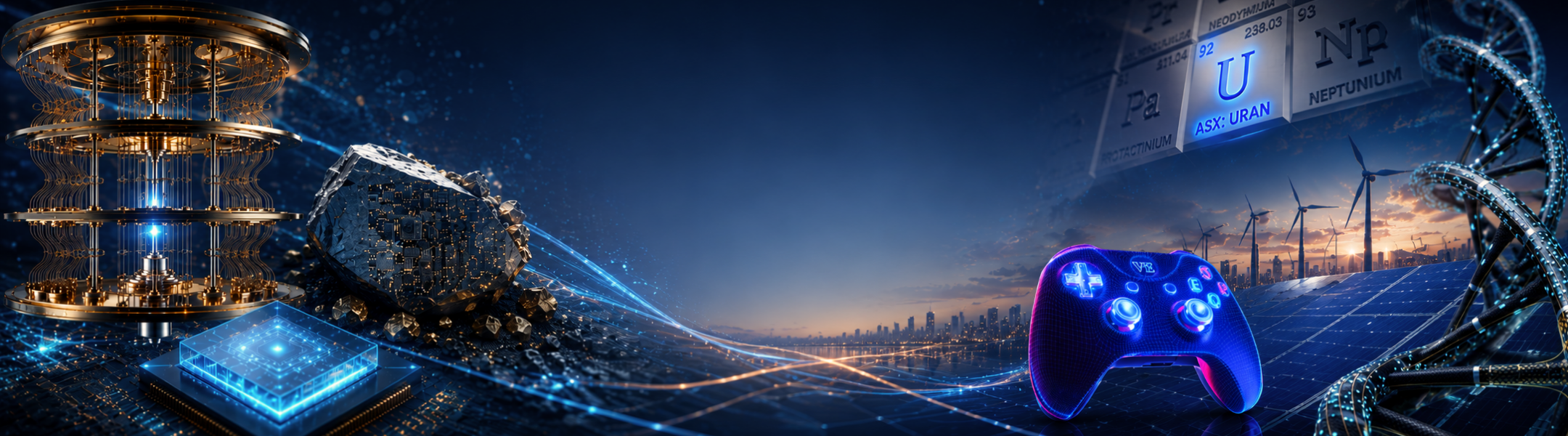
AI - Artificial intelligence is as much a software revolution as it is a vast industrial build-out. As that build-out gathers pace, demand spreads well beyond software and semiconductors into the infrastructure needed to manufacture chips, power data centres and expand electricity networks. Rare earths and strategic metals sit throughout that ecosystem, becoming more important as each stage of the build-out unfolds.
The AI investment cycle is also well underway. The world's largest technology companies are collectively investing hundreds of billions of dollars in new AI infrastructure, while the global semiconductor market is projected to almost double to US$1.5 trillion in 20261. As that infrastructure expands, so too does demand for electricity, manufacturing capacity and the specialised materials supporting both.
Quantum Computing - AI is not the end of the story. Quantum computing is starting to attract attention because its different approach means it may be better suited to solving certain complex problems. And its applications are starting to add up beyond the theoretical foundation for quantum computing which Alan Turing introduced in 1936.
There are now practical applications, and as a result, opportunities for investors. Quantum computing may help tackle parts of drug discovery, materials science, financial risk modelling, supply chain optimisation and energy systems. These are specialist problems, and the type of issues where a different computing model may matter, helping to transform industries in ways we cannot imagine.
Healthcare – There are three long term structural drivers pushing global health care expenditures higher.
- The combination of global population growth and ageing demographics.
- The prevalence of chronic diseases will continue to drive up the demand for healthcare.
- Emerging economies will require substantial increases in healthcare spending to close the gap with developed countries.
Together, these three forces have the potential to fundamentally change the way we live, be it through longer life expectancy or improved technologies. As global healthcare spending rises to more sustainable levels, companies at the forefront of this industry stand to benefit.
Clean energy - The transition to clean energy and focus on climate change is one of the world’s most important global megatrends and presents a long-term growth opportunity. There are four key drivers accelerating the mass adoption of clean energy:
- Economic - The cost of renewable power has seen a rapid reduction over the last decade, driven by economies of scale, technological improvements and increasingly competitive supply chains
- Regulatory - Almost 200 countries have ratified the Paris Agreement with the aim of net zero emissions by 2050.
- Societal - Demand for action on climate change and access to clean energy has surged in the last few years, buoyed by increasingly extreme weather patterns.
- Inevitability - There is a finite amount of fossil fuels and current estimates show these will be depleted within 140 years1
Esports and video gaming - There are more than three billion gamers globally, more than Facebook users or Netflix subscribers. But most people are underexposed to this sector. Long-term growth is expected to be driven by a generational shift towards online gaming over traditional forms of entertainment, alongside continued technological innovation. Advances in artificial intelligence have also accelerated the evolution of gaming, further disrupting traditional entertainment channels.
How to invest in megatrends
Investing in global megatrends is a way for investors to access what they think are the opportunities of the future. It also allows investors to diversify into companies and sectors that could be underrepresented in portfolios.
We believe megatrends will continue to emerge as humans innovate and adapt to the world and industries around them.
However, taking the right approach to access global megatrends is important. A megatrend should not be confused with a fad. Fads come and go but megatrends tend to be long-lasting and fundamentally change society and/or industry.
It is also important that you understand the companies within the ETF you invest because some so-called thematic ETFs may track indices that do not in fact properly target the megatrend. For example, if your clean energy ETF includes companies from sectors like IT and the consumer sectors, it should give you a moment to pause and question if it is a pure exposure to the megatrend.
Some ETFs offer access to those companies and industries that are providing the ‘picks and shovels’ of a megatrend. For example, demand for energy, including nuclear and other types of clean energy, has increased due to the need for power from AI.
VanEck has a number of well-thought-out, thoroughly researched ETFs we think investors can use to access the long-term, structural changes that will change the way we live and invest: