Financial advisers embrace ETFs in record numbers; Smart beta takes the spotlight
October 2026


Chart 1: ETF industry and smart beta assets as at 30 September (A$billion)
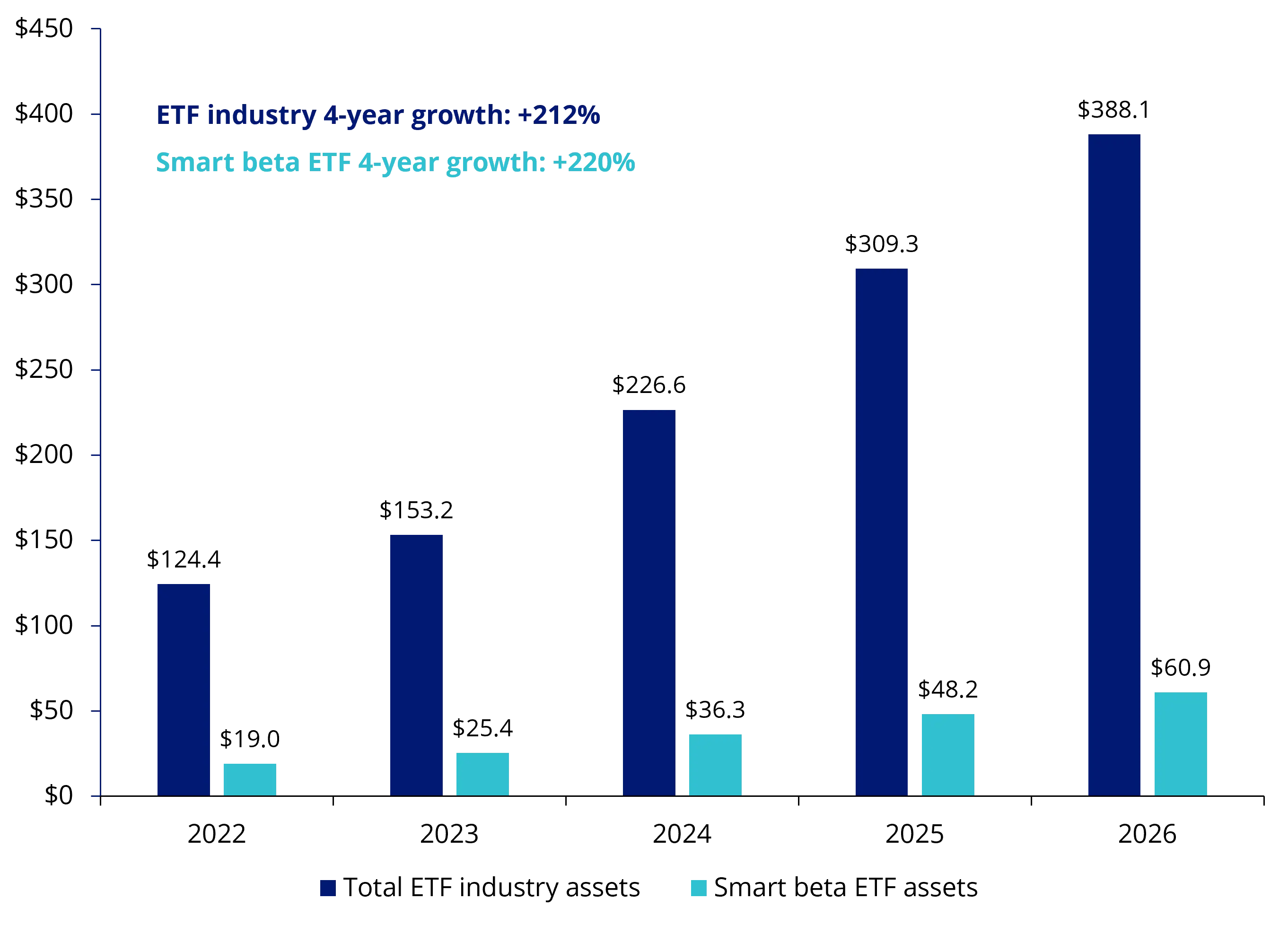
Source: VanEck analysis of ASX and TMX data. Assets as at 30 September of each year.
Over the past year 73 per cent of financial advisers have increased their usage of ETFs. The top three drivers for investing in ETFs were reduced total portfolio costs (49 per cent), a change in portfolio strategy (42 per cent) and long-term active manager underperformance at 33 per cent.
Smart beta index strategies, which are the intersection between market cap and active strategies, have also seen a pickup in usage since 2025. Overall around 80 per cent of respondents are using one or more smart beta ETFs, up from 72 per cent in 2025. The use of 2 or more smart beta ETFs increased from 2025 to 2026 by 15 per cent, with fewer respondents using only one or none.
These strategies are also increasingly being used to replace market cap and active strategies, with 50 per cent of respondents using these strategies to replace market cap (on par with 2025), and more using smart beta strategies to replace active strategies (64 per cent up from 61 per cent in 2025).
Half of the respondents are also looking to increase allocations to smart beta strategies over the next 12 months and 77 per cent of respondents agree that smart beta strategies will become more prevalent in portfolios. 80 per cent of respondents noted these strategies represent good value for money, an increase from 74 per cent in 2025.
VanEck CEO and Managing Director - Asia-Pacific, Arian Neiron, said the ETF industry was entering its next phase of growth, with smart beta ETFs set to play an increasingly dominating role in the Australian investment landscape and the construction of investment portfolios.
“Advisers and investors are looking for more cost-effective and tax-efficient ways to invest. The shift from traditional unlisted managed funds towards managed accounts is accelerating, and ETFs are a key beneficiary.
“The active versus passive debate is gathering pace, especially with active management strategies being challenged with underperformance for some time. More advisers are turning to systematic ETF strategies to target investment outcomes at a lower cost.
“One of the clearest shifts over the past few years has been the growing use of smart beta as a core portfolio allocation. Smart beta net flows have grown every quarter this year, from $2.38 billion in the first quarter to a record $3.66 billion in the third.
“Now accounting for close to 16 per cent of total industry assets, we think the current $60.9 billion allocated to smart beta index strategies will surpass $100 billion by the end of 2028. The next 25 years won’t be defined by more ETFs, rather by smarter ETFs that investors and advisers can use to build well-diversified investment portfolios,” said Neiron.VanEck Investments Limited (ACN 146 596 116 AFSL 416755) (VanEck) is the issuer and responsible entity of all VanEck exchange traded funds (Funds) trading on the ASX. This information is general in nature and not personal advice, it does not take into account any person’s financial objectives, situation or needs. You should consider whether or not an investment in any Fund is appropriate for you. Investments in a Fund involve risks associated with financial markets. These risks vary depending on a Fund’s investment objective. Refer to the applicable product disclosure statement (PDS) and target market determination (TMD) available at vaneck.com.au for more details. Investment returns and capital are not guaranteed.