Australian Equities: Different times call for different solutions


Australian investors have spent generations relying on the same trade: banks, miners and market concentration. The S&P/ASX 200 remains one of the most concentrated developed market indices, with nearly half the index concentrated in just 10 companies.
While concentration itself is not new, investors should question whether relying on the same approach will continue delivering the outcomes they want.
In contrast to markets like the US, where market leadership tends to rotate every decade or so, Australia’s leadership has remained concentrated in financials and resources for decades.
VanEck’s research into Australian equity factors found many supposedly differentiated approaches were converging on remarkably similar portfolios. We think this environment demands a more intelligent approach to Australian equity investing, including how investors access diversification, quality and alpha generation.
Lazy or easy, the old playbook is likely dead
Australian investors have spent generations relying on the same trade: banks, miners and market concentration. Unlike markets such as the US, where market leadership has tended to rotate every eight to 12 years, Australian market leadership has remained remarkably persistent. In many respects, the same companies have dominated Australian equity portfolios for generations.
Exhibit 1: Australian top 10 market leadership rotation through time
| Rank | 2016 | 2017 | 2018 | 2019 | 2020 | 2021 | 2022 | 2023 | 2024 | 2025 | 2026* |
| 1 | CBA | CBA | CBA | CBA | CBA | CBA | BHP | BHP | CBA | CBA | BHP |
| 2 | WBC | WBC | BHP | CSL | CSL | CSL | CBA | CBA | BHP | BHP | CBA |
| 3 | ANZ | BHP | WBC | BHP | BHP | BHP | CSL | CSL | CSL | WBC | WBC |
| 4 | NAB | ANZ | CSL | WBC | NAB | NAB | NAB | NAB | NAB | NAB | NAB |
| 5 | BHP | NAB | ANZ | ANZ | WBC | WBC | WBC | WBC | WBC | ANZ | ANZ |
| 6 | TLS | CSL | NAB | NAB | ANZ | ANZ | ANZ | ANZ | ANZ | WES | WES |
| 7 | WES | WES | WOW | WOW | WES | MQG | WDS | MQG | WES | CSL | MQG |
| 8 | CSL | TLS | WES | WES | WOW | WES | MQG | WES | MQG | MQG | RIO |
| 9 | RFG | WOW | MQG | MQG | MQG | TLS | WES | WDS | GMG | GMG | GMG |
| 10 | WOW | MQG | TLS | TLS | RIO | WOW | TLS | RIO | WDS | TLS | TLS |
Source: Factset, as at 27 May 2026
This has worked in the past, but investors should now question whether relying on the same concentrated style regime will continue delivering the outcomes they want. Increasingly, the standard benchmark-hugging approach is becoming less effective. In 2025, the S&P/ASX 200 finished near the bottom among major equity indices globally. Our research found many supposedly differentiated Australian equity strategies were still being driven by the same underlying exposures. Whether labelled value, quality, momentum or active, many portfolios remained heavily concentrated in the same benchmark-heavy mega caps.
Exhibit 2: Australian equities finished well behind global peers in 2025
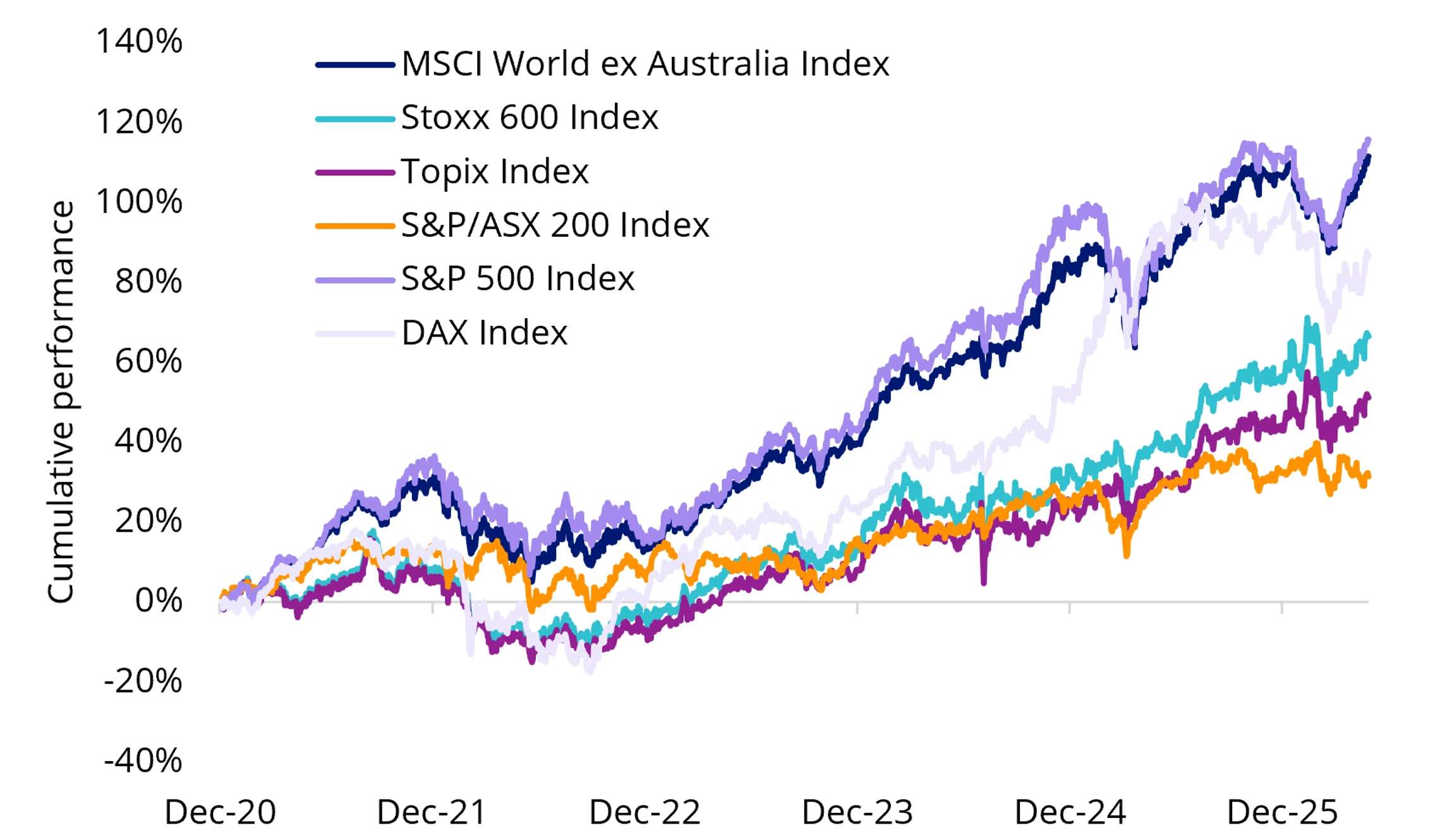
Source: Bloomberg. From 31 December 2020 to 27 May 2026. Currency in AUD. Past performance is not indicative of future performance. You cannot invest in an index.
In Australia, factors are converging on the same constraints rather than offsetting each other. Different strategies are leading investors back to the same trade. This may signal the end of single-style investing in Australia.
When the benchmark becomes the portfolio
Benchmarks were always intended to measure and evaluate how well capital has been allocated, not to drive the capital allocation process itself. Today, the odometer has become the engine thanks in large part to passive flows, benchmark-aware active management and performance frameworks that increasingly reward staying close to the index.
In Australia, staying close to the benchmark has become the defining feature across passive investing, benchmark-aware active management and factor investing. Different strategies are being pulled toward the same narrow group of companies, raising the question of how differentiated many portfolios really are.
Exhibit 3: Active manager performance correlation with S&P/ASX 200
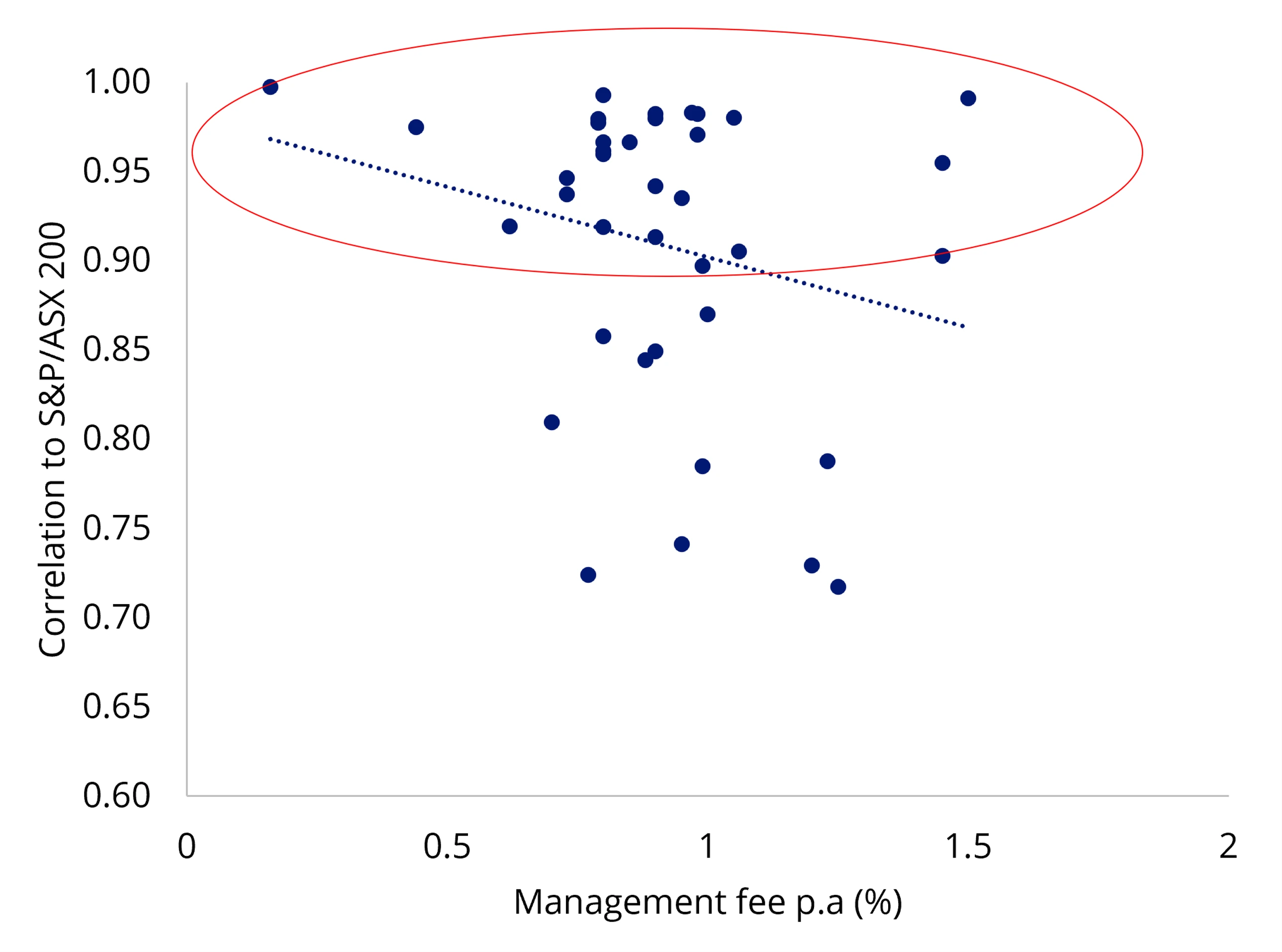
Source: Morningstar, VanEck, 1 April 2023 to 31 March 2026.
Our research has found that many differentiated Australian equity strategies still relied on the same benchmark-heavy mega caps. Whether labelled value, quality, momentum or growth, many portfolios retained exposure to the same underlying risks.
In our view, this is becoming the defining feature of Australian equities:
- benchmark concentration influences portfolio construction,
- portfolio construction reinforces benchmark concentration,
- and increasingly different strategies lead investors back to the same trade.
The irony is that investors may believe they are diversified across managers, factors and styles, while still retaining significant exposure to the same underlying risks.
Different results require different thinking
If increasingly different strategies are leading investors back to the same trade, investors may need to reconsider how Australian equity exposure is constructed.
One approach is rethinking market-cap weighting altogether. Market-cap weighting is not a neutral decision. Equal weighting reduces the dominance of benchmark-heavy mega caps and provides more balanced exposure across Australian equities. Rather than allowing a handful of companies to dominate portfolio outcomes, equal weighting distributes exposure more evenly across the market.
Exhibit 4: S&P/ASX 200 vs smart beta portfolio construction: % to top 20 companies
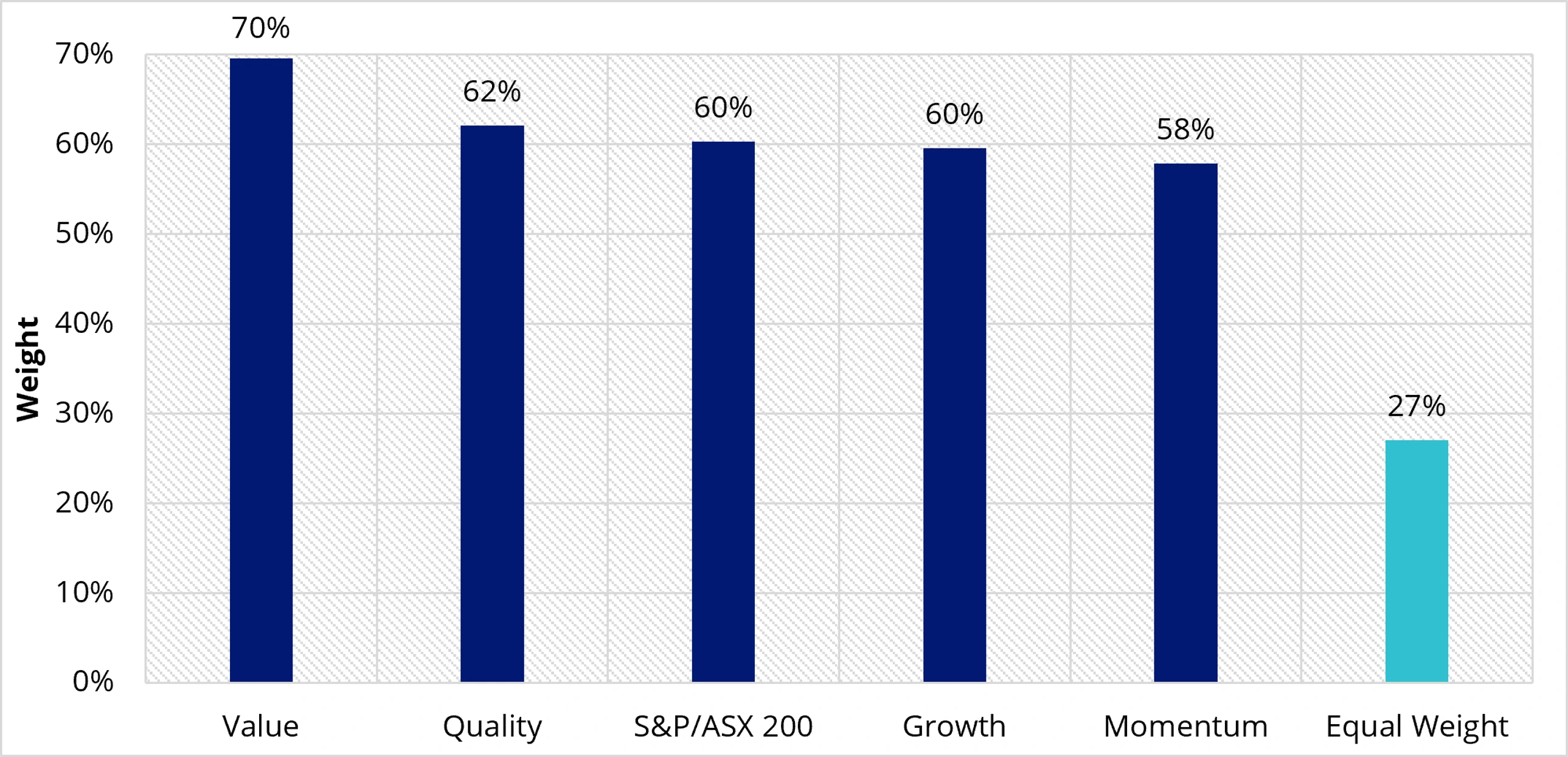
Source: MSCI, S&P, MSCI Australia IMI Factor Indices, Equal Weight as MVIS Australia Equal Weight Index, As at 10 April 2026. Weightings may change in the future.
Equal weighting is a different way of thinking about the Australian market. Rather than allowing a handful of mega caps to dictate portfolio outcomes, it spreads exposure more evenly across the market and broadens the sources of potential return.
Recent market performance has also highlighted how dependent Australian equities have become on a narrow group of benchmark-heavy companies. As concentration intensified, market-capitalisation indices benefited from increasingly narrow leadership. Over longer periods, however, equal weighting has remained competitive. VanEck’s Australian Equal Weight ETF (ASX: MVW) has returned 8.66% p.a. since its inception on ASX on 4 March 2014, outperforming the S&P/ASX 200 (as at 27 May 2026), noting past performance is not indicative of future performance.
The concentration problem does not stop at benchmark construction. It increasingly shapes factor investing in Australia as well. Different single-factor strategies are expected to deliver different exposures. In Australia, they tend to converge on the same concentrated bets.
Exhibit 5: Single factors converge on the same exposures
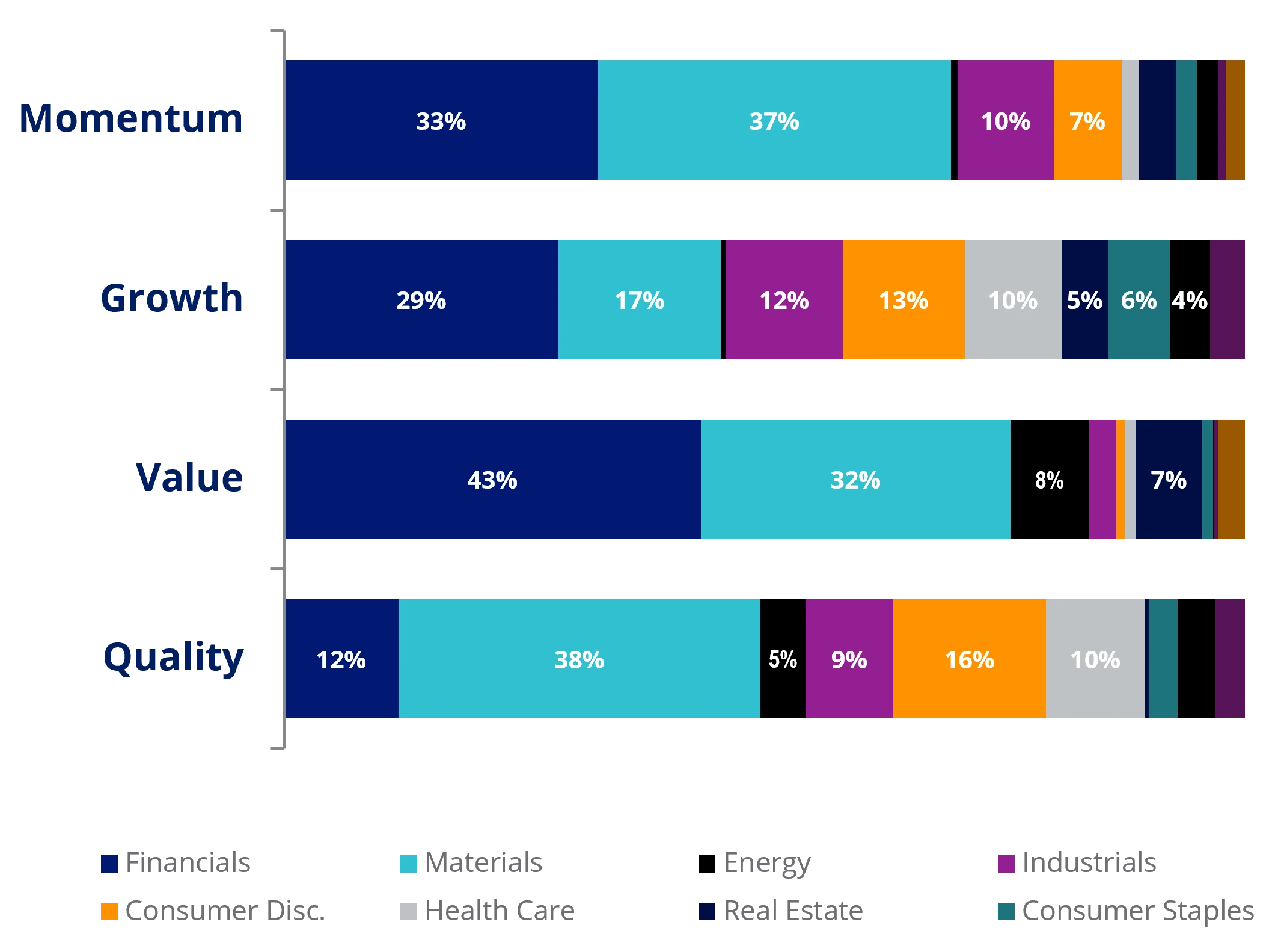
Source: FactSet, MSCI as at 31 March 2026. MSCI Australia IMI Factor Indices.
We think the answer is not more factors. It is better portfolio construction. In Australia, quality investing cannot just mean buying the biggest companies with the strongest balance sheets. It needs to work around the structural realities of the local market: concentration, cyclicality and a limited investable universe.
This thinking sits behind the launch of the VanEck MSCI Australian Quality Plus ETF (ASX: AQTY), which has recently begun trading on the ASX.
AQTY uses a quality-led composite score, where companies are first assessed on quality characteristics such as profitability, earnings stability and leverage. Enhanced value and low volatility are then applied as complementary characteristics. The result is a portfolio construction approach designed to work within the realities of the Australian market rather than inherit its concentration by default.
Inefficiency leads to opportunity
One underappreciated consequence of Australia’s concentrated market structure is that distortions can emerge in individual stocks. When large amounts of capital crowd into the same benchmark-heavy companies, pricing inefficiencies can emerge elsewhere in the market. And where there is inefficiency, we see opportunity.
Unlike benchmark-aware strategies, long/short investing can benefit from identifying companies expected to outperform while also identifying those where prices may have become disconnected from fundamentals. That may become more important if Australia’s economic outlook weakens further, with slower growth, rising unemployment and persistent inflation increasing the importance of pricing power and earnings resilience. VanEck’s Australian Long Short Complex ETF (ASX: ALFA) has recently increased exposure to companies with strong pricing power characteristics as a result.
Exhibit 6: 2026 YTD ALFA performance vs S&P/ASX 200 Index
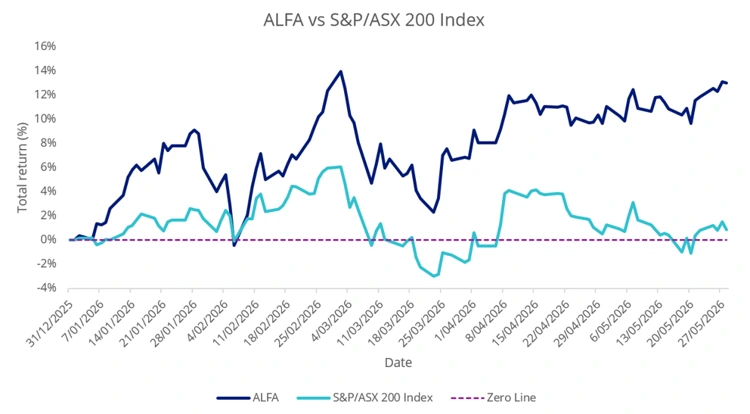
Source: VanEck, 27 May 2026. Past performance is not indicative of future performance. ALFA results shown are net of management fees and costs, but before brokerage fees or bid/ask spreads incurred when investors buy/sell on the ASX.
ALFA takes a systematic approach to Australian equities, seeking to identify both winners and losers across the market. It uses a dynamic quantitative stock selection approach utilising sophisticated computations and programmed learning designed to be agnostic of market cycles and style rotations. The strategy analyses thousands of macro, micro and technical signals to identify where market pricing may be diverging from fundamentals.
Unlike many traditional long-only approaches, ALFA is not constrained to simply owning more of what has already worked. It can position for both winners and losers across sectors, styles and market cycles – a capability that may become increasingly valuable if the era of single-style investing is ending. ALFA has outperformed the S&P/ASX 200 by more than 3% in the past month and by 6.77% since its inception on 21 January 2025 (as at 27 May 2026), noting past performance is not indicative of future performance.
Australia’s market has rewarded the same concentrated style regime for decades. But as benchmark concentration, portfolio convergence and style overlap intensify, relying on the same approach may no longer deliver the outcomes investors expect.
If the era of single-style investing in Australia is ending, differentiated results may increasingly require differentiated approaches.
VanEck offers three differentiated approaches designed to navigate the concentrated and crowded Australian market:
Key risks
An investment in the ETFs carries risks. These include risks associated with financial markets generally, individual company management, industry sectors, fund operations and tracking an index. ALFA is considered to have a higher investment risk than a comparable fund that does not engage in short selling and leverage. Investors should actively monitor their investment as frequently as daily to ensure it continues to meet their investment objectives. Risks associated with an investment in ALFA include those associated with short-selling risk, leverage risk, prime broker risk, counterparties risk, concentration risk, operational risk and material portfolio information risk. See the relevant PDS and TMD for details.
MVW is likely to be appropriate for a consumer who is seeking capital growth and a regular income distribution, is intending to use the product as a core, minor or satellite allocation within a portfolio, has an investment timeframe of at least 5 years, and has a high risk/return profile.
AQTY is likely to be appropriate for a consumer who is seeking capital growth and a regular income distribution, is intending to use the product as a minor or satellite allocation within a portfolio, has an investment timeframe of at least 5 years, and has a high risk/return profile.
ALFA is likely to be appropriate for a consumer who is seeking capital growth, is intending to use the product as a minor or satellite allocation within a portfolio, has an investment timeframe of at least 7 years, and has a very high risk/return profile.


Published: 04 June 2026
Any views expressed are opinions of the author at the time of writing and is not a recommendation to act.
VanEck Investments Limited (ACN 146 596 116 AFSL 416755) (VanEck) is the issuer and responsible entity of all VanEck exchange traded funds (Funds) listed on the ASX. This is general advice only and does not take into account any person’s financial objectives, situation or needs. The product disclosure statement (PDS) and the target market determination (TMD) for all Funds are available at vaneck.com.au. You should consider whether or not any Fund is appropriate for you. Investments in a Fund involve risks associated with financial markets. These risks vary depending on a Fund’s investment objective. Refer to the applicable PDS and TMD for more details on risks. Investment returns and capital are not guaranteed.