Equity leadership is changing


Equity leadership is changing as US growth equities continue to lag in 2026, starting the year how they finished 2025.
Over this period, investors have sought other equity markets beyond the US growth trade. One of the beneficiaries has been emerging markets.
Beyond relative value, emerging markets equities macro and structural tailwinds have supported emerging markets’ equities returns in 2026 so far.
Emerging markets have outperformed developed markets over the past three months, and we think this relative momentum can continue.
However, as with any equity investing, not all emerging market companies are desirable from an investment perspective. As well, timing factors and cycles in emerging markets are nearly impossible.
Macro and structural tailwinds supporting emerging markets
For investors, the recent shifts in equity markets are characterised by fundamentals and the search for value and long-term opportunity. There are a few reasons we believe emerging markets have been identified and remain one of the most mispriced asset classes:
- Many of the mindsets and investor beliefs about emerging markets equities have their foundation on experiences from last century. Many of these economies have adapted, and often policies have been designed to be less reliant on the rest of the globe so they can adapt more quickly to changing logistical needs. Many companies in emerging markets have expanded their customer base, and policies have changed to encourage private capital and enterprise.
- The mismatch between the size of emerging markets’ economies and the size of their capital markets creates a long-term opportunity for investors. In addition, these capital markets are evolving, emerging to become as strong and competitive as developed markets in some instances.
- Emerging markets are responsible for over 50% of the world’s GDP, yet their equity markets only represent less than 15% of the market capitalisation of all international equities.
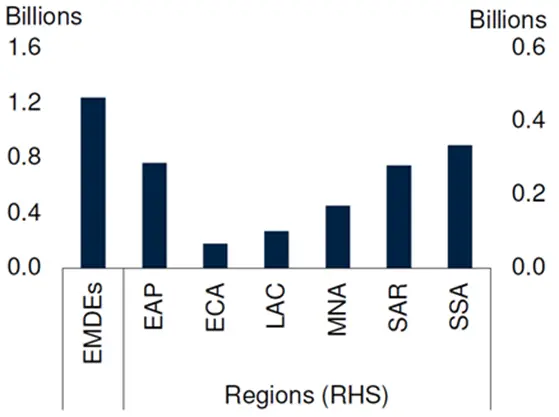
- Demographic and urbanisation trends should provide supportive tailwinds for long-term growth. The World Bank estimates that 1.2 billion young people will reach working age over the next ten years.
- Emerging markets are maturing, from a fiscal and monetary policy standpoint.
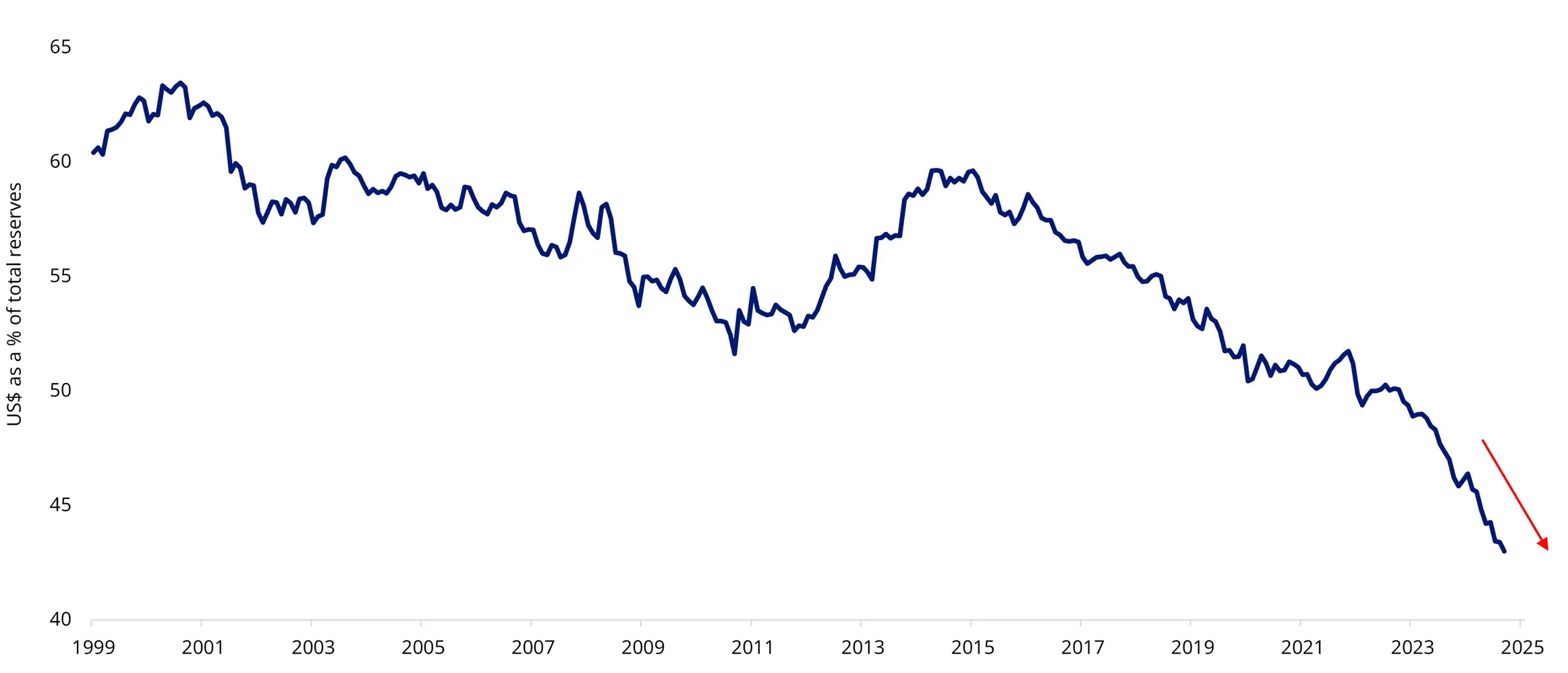
The weaker US dollar remains a key tailwind for emerging markets equities, but we think that demand for the US dollar has been falling in response to fundamental shifts in the way many governments around the world trade.
Chart 1: Developed markets need financing from the surplus-producing emerging markets, which are net US dollar creditors
Source: VanEck Research; International Monetary Fund (IMF); Bloomberg LP. Data as of September 2025.
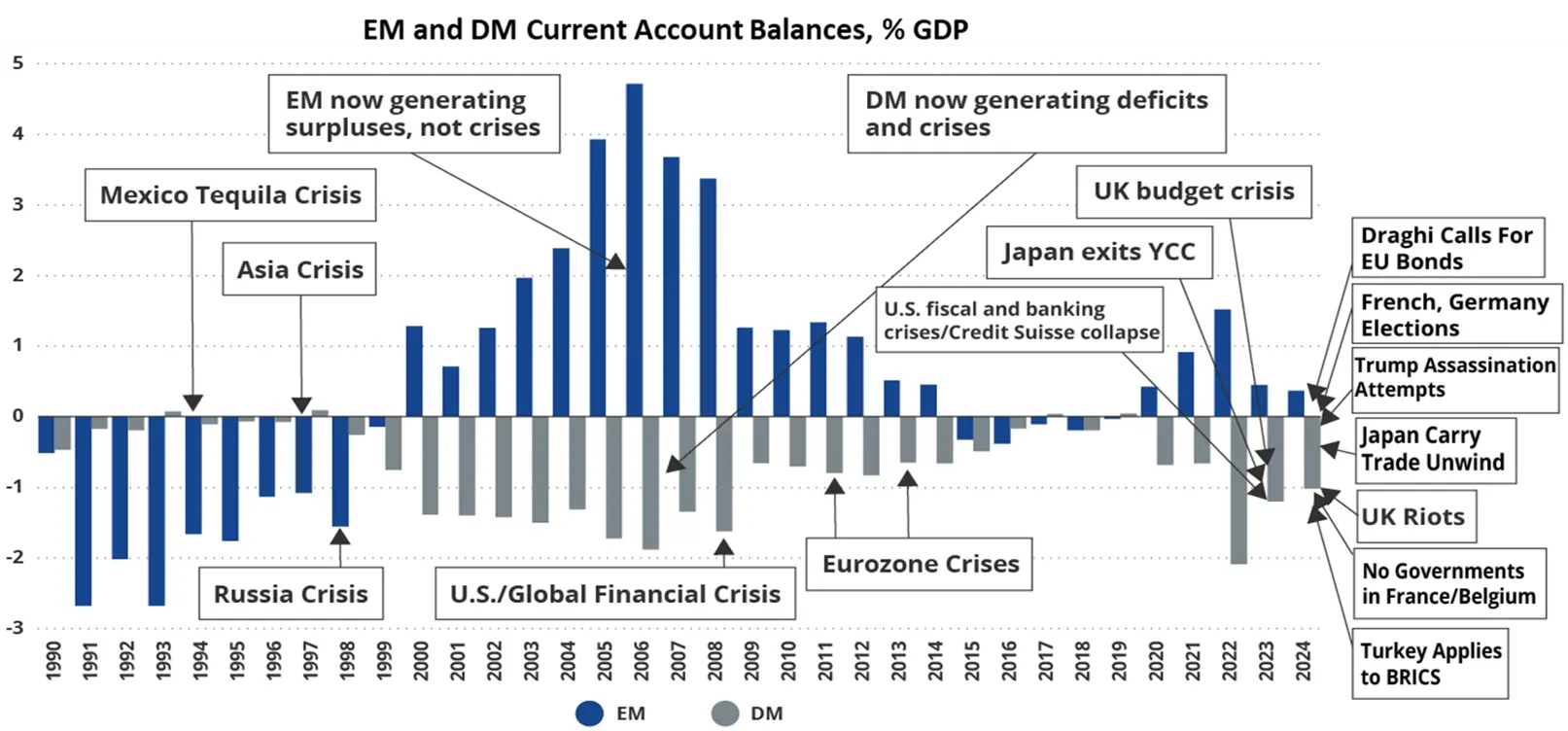
Less reliance on the US dollar and holding less US dollar liabilities are not the only policies that central banks have been implementing to safeguard and strengthen local economies.
Chart 2: Emerging markets have benefited from implementing orthodox economic policies, which have yielded lower inflation, fewer crises and which are politically supported.
Source: VanEck Research; International Monetary Fund (IMF); Bloomberg LP. Data as of September 2025.
In addition to monetary policy, government policies in some emerging market countries have encouraged business environments conducive to capital investment. In January, the World Bank said, while highlighting the demographics of emerging and developing countries, “Three pillars can guide policy responses: investing in foundational infrastructure—both physical and digital—and in education and upskilling to build human capital; improving the business environment through effective governance; and mobilising private investment. Together, these pillars can help catalyse growth by boosting investment and creating conditions for people and firms to thrive, including by enabling effective use of emerging digital technologies.”
Chart 3: Demographics are supportive for growth if emerging governments respond to support jobs: number of young people reaching working age by 2035
Sources: UN World Population Prospects (database); World Bank.
Note: EAP = East Asia and Pacific; ECA = Europe and Central Asia; EMDEs = emerging market and developing economies; LAC = Latin America and the Caribbean; MNA = Middle East, North Africa, Afghanistan and Pakistan; RHS= right-hand side scale; SAR = South Asia; SSA = Sub-Saharan Africa. Bars show the number of young people (aged 15-24) in each region in 2035.
We have said this before, but many emerging markets have matured. Traditionally, the investment returns have been closely correlated to the rise and fall of commodities and global growth expectations. Over the past 20 years, this has been changing. Many of the world’s leading technology, consumer and healthcare companies are listed on emerging markets exchanges.
Emerging markets themselves are not a monolith. Many have learned from the lessons of the past and undertaken economic reforms; as a result, these economies may be able to achieve a more stable and higher level of growth. Many emerging market economies are better able to implement counter-cyclical fiscal expansion to reignite domestic growth because of their growing foreign reserves, strong budgets and robust balance of payments. This helps the companies in these countries. Additionally, many emerging markets hiked interest rates higher and earlier than most developed markets and are not hampered by the after-effects of unorthodox monetary policy, therefore many emerging market companies are sourcing local inputs without the inflationary cost pressures being experienced in developed economies.
This is flowing through to forward earnings estimates.
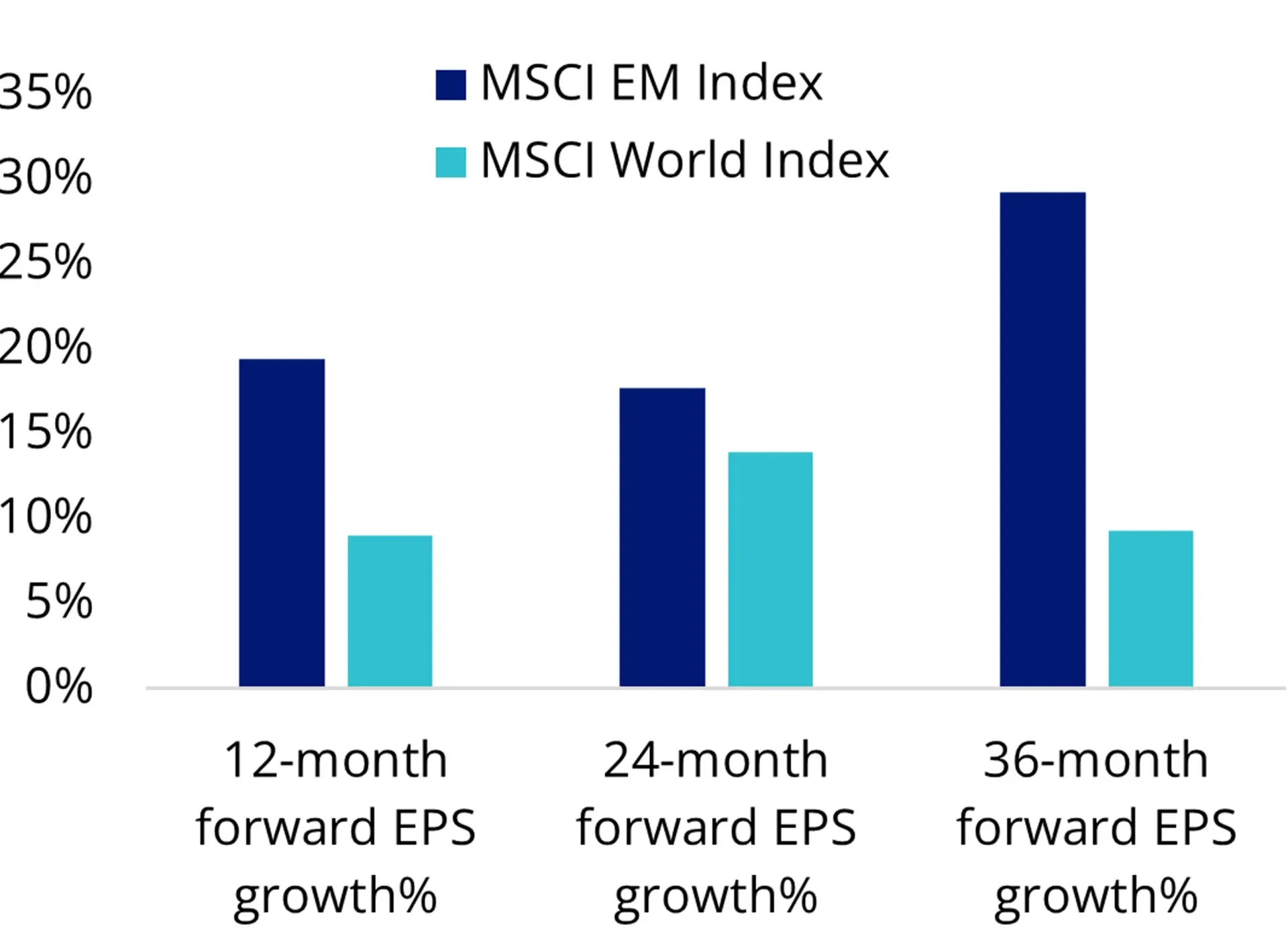
Analysts are pricing in an upbeat earnings outlook for emerging markets companies, circa 20% earnings per share (EPS) growth over the short and medium term. This highlights the upside potential for continued earnings growth. Valuations of emerging market corporates also appear more attractive compared to their developed market peers. As investors globally search for diversification and value beyond US growth, they may consider the relative value of emerging markets equities.
Chart 4 EM vs DM – Forward EPS valuations
Source: VanEck, Bloomberg. Average sell-side forecasts. Data as of 31 January 2026.
However, not all companies in the MSCI Emerging Markets Index are desirable from an investment standpoint.
This is where being selective in emerging markets equities can come to the fore. EMKT tracks the MSCI Emerging Markets Multi-Factor Select Index (EMKT Index). The Index selects companies based on four factors: Value, Momentum, Low Size and Quality.
The efficacy of this approach was supported by the 2024 research paper, titled Factor-in emerging markets. According to the research paper, EMKT’s multi-factor methodology “is an all-seasons approach that has historically outperformed the benchmark over the long term. The bottom-up approach and selection of four factors quality, value, momentum and low size were found to be the most optimal for maximizing Sharpe and information ratios.”
EMKT has delivered long-term historical outperformance
Since its inception on 10 April 2018, EMKT has returned 9.59% p.a., outstripping the standard industry benchmark, the MSCI Emerging Markets Index, by 2.15% p.a. As always, past performance is not indicative of future performance.
Table 1: Performance as at 12 February 2026

Source: VanEck, Morningstar Direct
#EMKT inception date is 10 April 2018 and a copy of the factsheet is here.
Results are calculated to the last business day of the month and assume immediate reinvestment of distributions. EMKT Performance is calculated net of management fees and costs incurred in the fund, calculated daily, but does not include brokerage costs or buy/sell spreads of investing in EMKT. Past performance is not indicative of future performance. Returns longer than one year are annualised.
The MSCI Emerging Markets Index (“MSCI EMI”) is shown for comparison purposes as it is the widely recognised benchmark used to measure the performance of emerging markets large- and mid-cap companies, weighted by market capitalisation. EMKT’s index measures the performance of emerging markets companies selected on the basis of their exposure to value, momentum, low size and quality factors, while maintaining a total risk profile similar to that of the MSCI EMI, at rebalance. EMKT’s index has fewer companies and different country and industry allocations than MSCI EMI. Click here for more details
EMKT’s performance is impressive, relative to the market benchmark, MSCI Emerging Markets Index. It is also worth considering its performance relative to active peers. EMKT’s performance puts it in the top quartile of active peers over 5 years and in the top 5% over 3 years, 7 years and since inception. It is worth noting in Chart 5 below, that the MSCI Emerging Markets index has beaten more than 50% of active emerging market managers in those trailing periods. In other words, over 50% of active managers are not adding value, after fees, despite the ‘inefficiency’ of emerging markets and the opportunities this may present.
Chart 5: Performance relative to active manager peer group
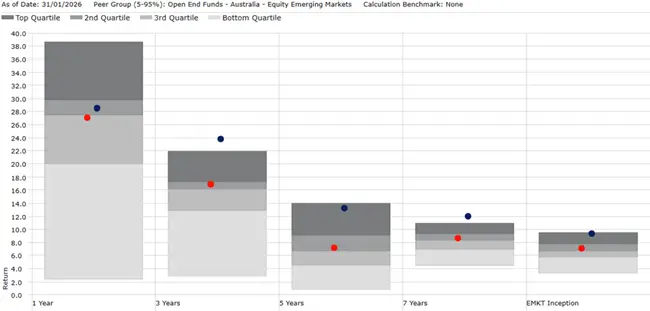
Source: Morningstar Direct. Past performance is not indicative of future performance. Results are calculated to the last business day of the month and assume immediate reinvestment of distributions. Results are net of management fees and other costs incurred in the fund, but before brokerage fees and bid/ask spreads. Returns for periods longer than one year are annualised. Peer group Equity Region Emerging Markets funds invest in companies listed in emerging markets from around the globe. Emerging market securities typically account for at least 75% of the portfolio.
Key points:
- EMKT provides investors with a diversified portfolio of emerging markets equities, included on the basis of:
- value;
- low size;
- momentum; and
- quality.
- EMKT has demonstrated outperformance since its inception against the MSCI Emerging Markets Index, noting as we always do, this is by no means indicative of future performance.
- Access emerging markets equities for a significantly lower cost than comparable active management strategies at a management fee of 0.69% p.a.
- With one trade, EMKT currently provides access to 19 emerging markets countries and is overweight sectors such as healthcare, industrials and information technology.
Key risks:
All investments carry risk. An investment in EMKT carries risks associated with ASX trading time differences, emerging markets, financial markets generally, individual company management, industry sectors, foreign currency, country or sector concentration, political, regulatory and tax risks, fund operations, liquidity and tracking an index. See the PDS and TMD for details.
EMKT is likely to be appropriate for a consumer who is seeking capital growth, is intending to use the product as a core, minor or satellite allocation within a portfolio, has an investment timeframe of at least 5 years, and has a high risk/return profile.


Published: 19 February 2026
Any views expressed are opinions of the author at the time of writing and is not a recommendation to act.
VanEck Investments Limited (ACN 146 596 116 AFSL 416755) (VanEck) is the issuer and responsible entity of all VanEck exchange traded funds (Funds) trading on the ASX. This information is general in nature and not personal advice, it does not take into account any person’s financial objectives, situation or needs. You should consider whether or not an investment in any Fund is appropriate for you. Investments in a Fund involve risks associated with financial markets. These risks vary depending on a Fund’s investment objective. Refer to the applicable product disclosure statement (PDS) and target market determination (TMD) available at vaneck.com.au for more details. Investment returns and capital are not guaranteed.