From emerging to strength – the asset class to watch in 2026


Three tailwinds that could support continued emerging markets performance this year.
In a world where US exceptionalism is being questioned and portfolios are grappling with persistent uncertainty, many investors are increasingly revisiting emerging markets as both a return and diversification lever.
Last year marked the strongest annual performance for emerging market equities since 2017, represented by the MSCI Emerging Markets Index. There are a number of drivers that could support this momentum throughout 2026.
1. The US dollar is positioned for further weakness
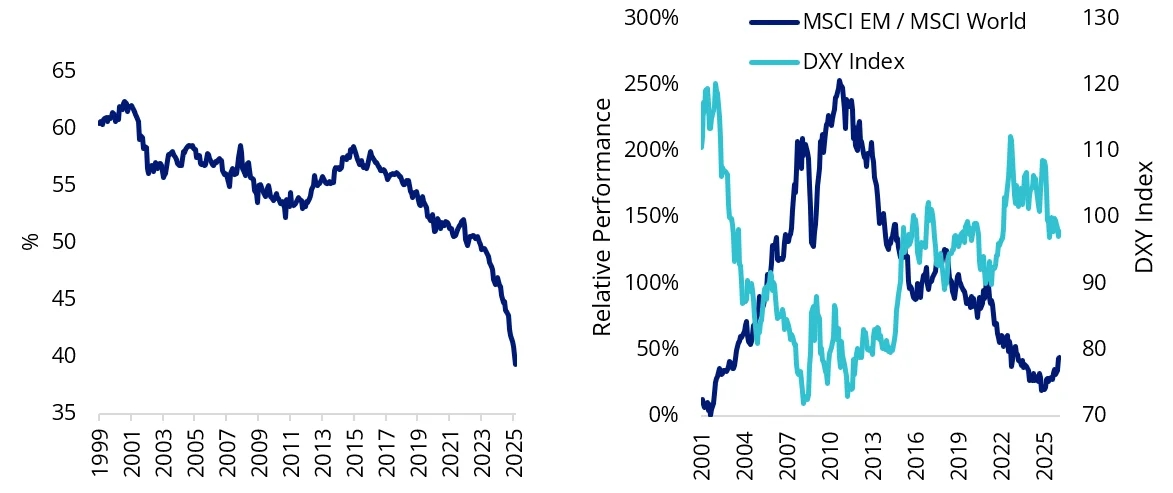
If history is a guide, US dollar down cycles, once underway, tend to last longer than a few months. As 2026 unfolds, concerns surrounding elevated US Government indebtedness, easing monetary policy and moderating US economic growth could see the US dollar weaken further. Furthermore, the US dollar’s share in total allocated international reserves has fallen to the lowest levels since the mid-1990s, reinforcing a broader shift away from dollar dominance.
US dollar weakness can be an enduring tailwind for emerging markets equities. A weaker US dollar typically boosts the strength of emerging markets currencies, making exports cheaper, improving revenues and contributing to outperformance in this environment.
Chart 1 & 2: Global FX Reserves USD share % & EM relative performance versus US dollar
Source: VanEck. Bloomberg. Performance in AUD. Data as of 31 January 2026. Add: Past performance is not a reliable indicator of future performance. You cannot invest in an index.
2. A deeper easing cycle in emerging markets is positive for both equities and bonds
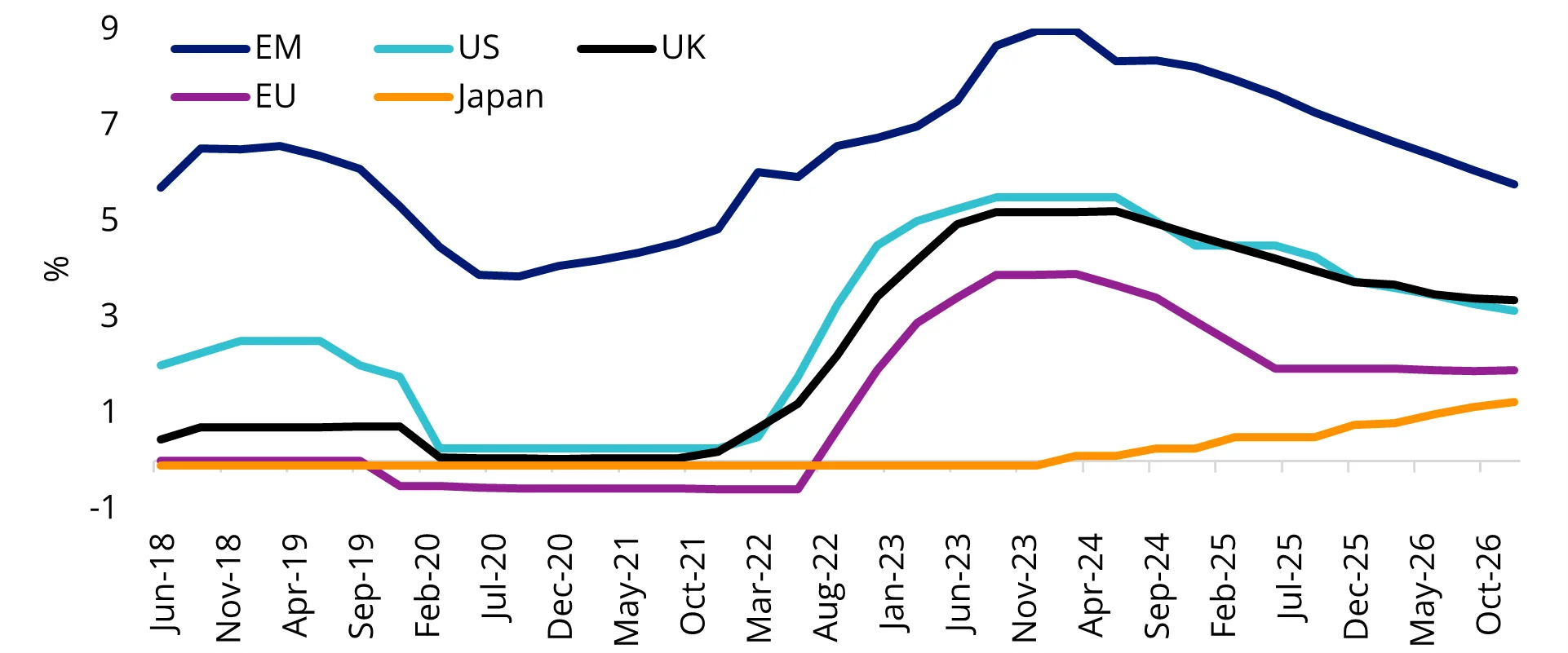
Market forecasts show emerging market policy rates remaining meaningfully above developed market levels, keeping real rates positive. This can provide a cushion for local currencies and a magnet for capital inflows. At the same time, a deeper easing cycle expected in the coming months could push local currency government bond yields lower, supporting emerging markets equities via lower capital costs and improved growth momentum.
Chart 3: Global central bank policy rates
Source: VanEck Australia, Bloomberg. EM refers to Bloomberg Economics’ policy rate estimate for Emerging Markets. US is the Effective Federal Funds Rate. UK is the SONIA Benchmark Interest Rate. EU is the ESTR Volume-Weighted Trimmed Mean Rate. The US forecast is based on futures market pricing, while forecasts for other regions are based on OIS market pricing. Forecast as of 5 February 2026.
3. Emerging markets equities positioned to enjoy better growth tailwinds
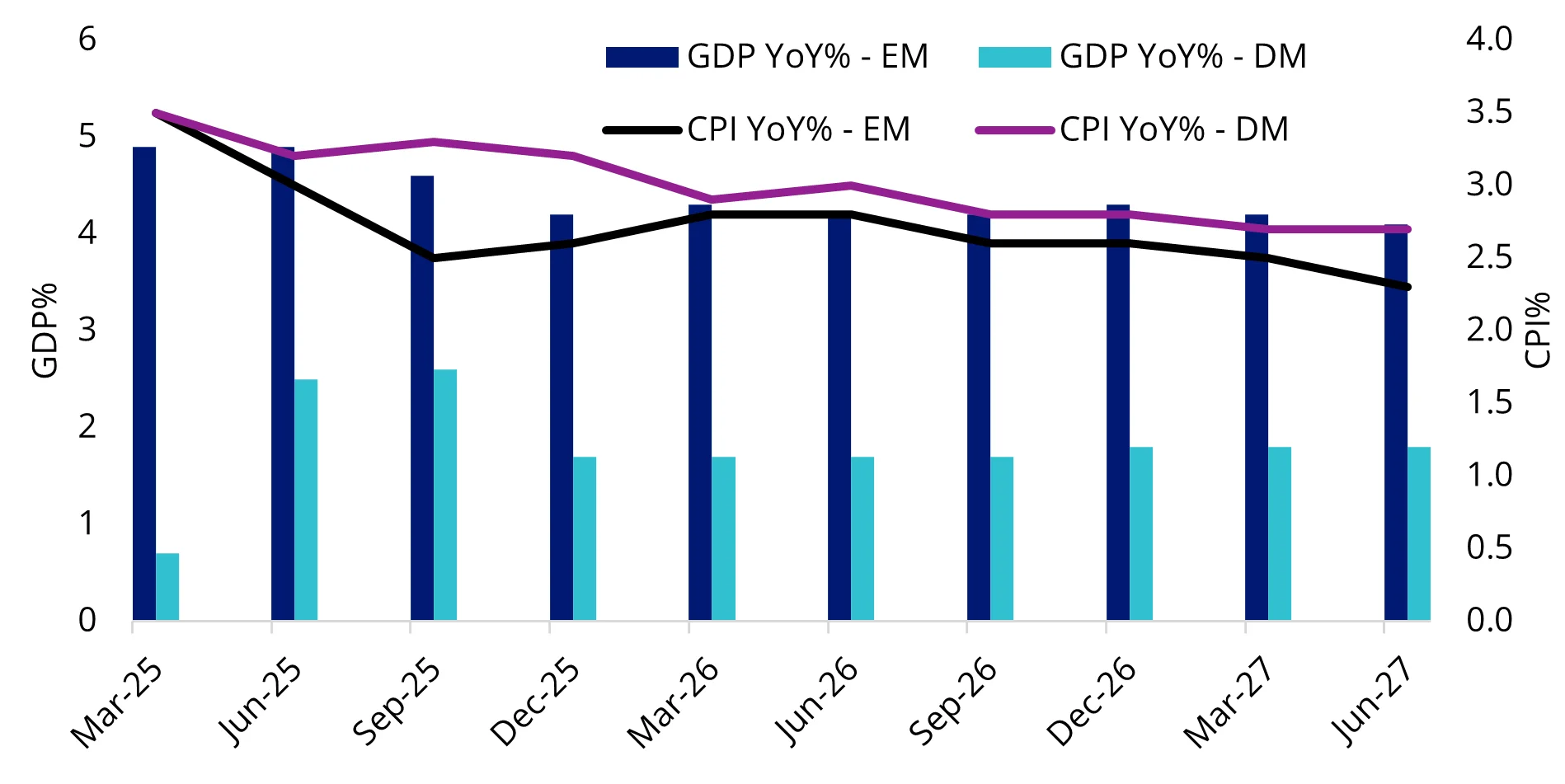
Despite global volatility, emerging economies continue to grow at nearly double the pace of their developed market peers with more ‘supportive’ inflation levels. This reinforces their role as the world’s growth engine for the coming years, especially amid a consensus of a broader slowdown in developed economies driven by mounting fiscal pressure and tariff impacts.
Chart 4: GDP and CPI % - DM vs EM
Source: VanEck, Bloomberg. Average sell-side forecasts. Data as of 31 December 2025.
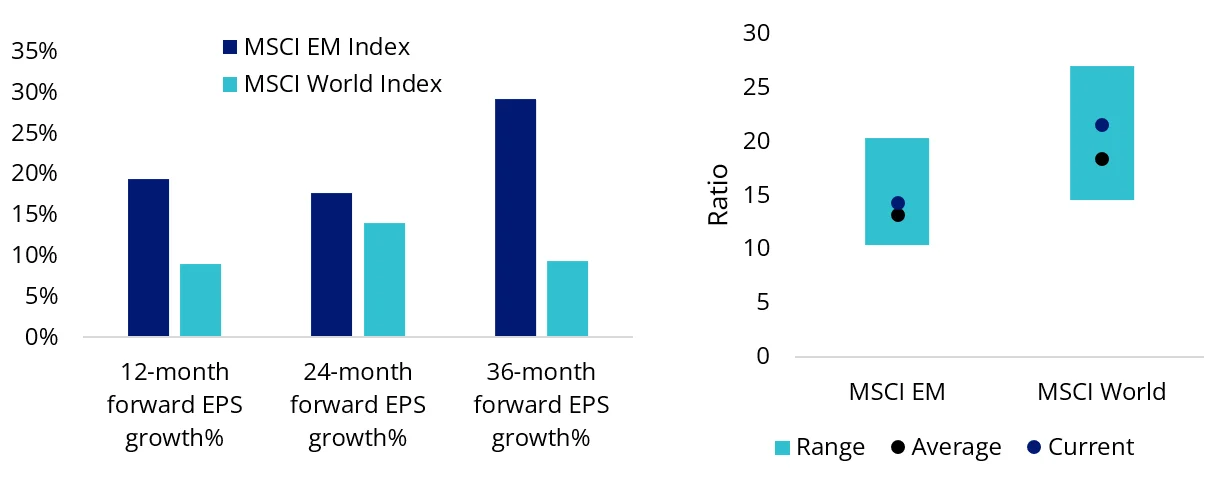
On a corporate level, street analysts are pricing in an upbeat earnings outlook for emerging markets companies, circa 20% EPS growth over the short and medium term. This highlights the upside potential for continued earnings growth. Valuations of emerging markets corporates also appear more attractive compared to their developed markets peers, at a 25% relative discount and at an absolute level closer to the historical average. This suggests that investors could potentially get more value for their money by investing in emerging markets equities.
Chart 5 & 6: EM vs DM - EPS growth outlook & valuations
Source: VanEck, Bloomberg. Average sell-side forecasts. EM is the MSCI EM Index. DM is MSCI World Index. Data as of 31 January 2026.
Key markets to watch in 2026
Proxies for the ‘picks and shovels’ AI trade – South Korea and Taiwan
South Korea and Taiwan led equity market strength for emerging markets over the last year. Investors have been chasing exposure to the AI ‘picks and shovels’ trade, the companies that supply the core building blocks of artificial intelligence rather than end-use applications. These markets are among the world’s top providers of semiconductors. Over the past twelve months to 31 January 2026, South Korean equities delivered the strongest returns across emerging markets, outperforming the MSCI Emerging Markets Index by approximately 80%. Key contributors were SK Hynix, up 312%, and Samsung Electronics, up 182%, YoY. Taiwan, a more matured semiconductor provider, has also outperformed the MSCI Emerging Markets Index by approximately 8%, Taiwan Semiconductor Manufacturing Company has been a key contributor, rising 43% over the period.
It’s worth noting that valuation concerns, mounting AI capex by US hyperscalers and intensifying competition could increase the vulnerability of global tech companies to downside shocks, as seen in the recent software selloff following Anthropic’s claimed agentic AI breakthrough.
While near-term volatility may remain elevated, particularly within the software segment, hardware-focused players, which dominate these two regions, appear better positioned to deliver more consistent performance on a relative basis.
The next potential growth driver in emerging markets – India
Punitive US tariffs and an escalation of geopolitical tensions sent Indian equities on a wild ride in 2025, with the MSCI India Index falling 7.7% in the last 12 months to 31 January 2026, underperforming the broader market (MSCI Emerging Markets Index) by ~36.6%. This selloff appeared to be driven predominantly by weak sentiment rather than a structural fundamental deterioration. With the US and India announcing a historic trade deal on 9 February, which includes lowering the reciprocal tariff on Indian exports from 50% to 18%, the deeper economic cooperation may add to India’s growth prospects.
India’s strong GDP and earnings growth, coupled with easing policy and strong corporate earnings growth, reinforces its potential to return as a key emerging market outperformer this year. Additionally, the country could be a beneficiary of the global AI infrastructure buildout, with US tech giants such as Google and Microsoft continuing to increase capital expenditure (CAPEX) commitments in the country.
Chart 7 & 8: India GDP growth & EPS growth
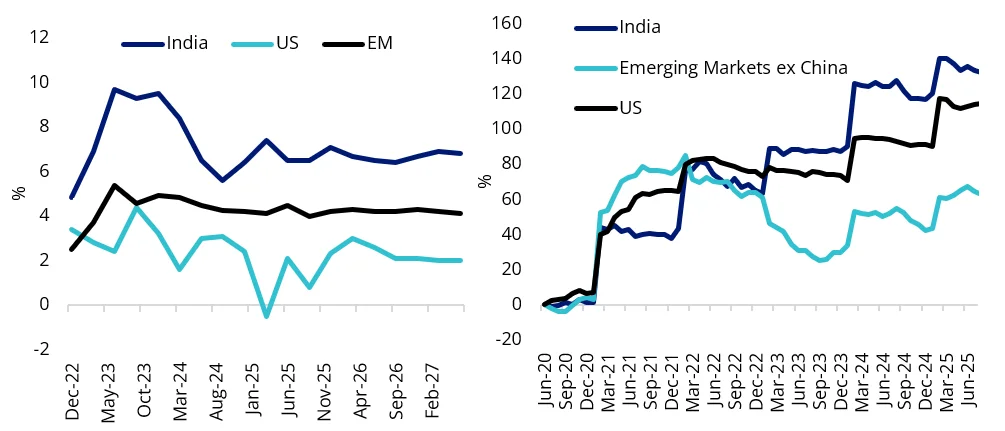
Source: VanEck. Bloomberg. Data as of 31 December 2025. GDP YoY% change data was sourced from Bloomberg. 12-month forward EPS growth (%) data was sourced from Bloomberg. India is MSCI India Index. Emerging Markets ex China is MSCI Emerging Markets ex China Index. US is S&P 500 Index.
Access to emerging markets
The VanEck MSCI Multifactor Emerging Markets Equity ETF (ASX: EMKT) tracks the MSCI Emerging Markets Multi-Factor Select Index (EMKT Index) which includes companies on the basis of four factors: Value, Momentum, Low Size and Quality.
The four factors combined have demonstrated long term outperformance relative to the MSCI Emerging Markets Index. EMKT has outperformed since it launched on ASX in 2018. As always noting, past performance is not indicative of future performance.
The VanEck India Growth Leaders ETF (GRIN) offers exposure to the top 50 most fundamentally sound Indian companies exhibiting attractive growth at a reasonable price characteristics.
Key risks:
An investment in EMKT and GRIN carries risks associated with: ASX trading time differences, India (GRIN), emerging markets (EMKT), financial markets generally, individual company management, industry sectors, foreign currency, sector concentration, political, regulatory and tax risks, market access, fund operations, liquidity and tracking an index. See the relevant PDS and TMD for more details.
EMKT is likely to be appropriate for a consumer who is seeking capital growth, is intending to use the product as a core, minor or satellite allocation within a portfolio, has an investment timeframe of at least 5 years, and has a high risk/return profile.
GRIN is likely to be appropriate for a consumer who is seeking capital growth, is intending to use the product as a minor or satellite allocation within a portfolio, has an investment timeframe of at least 5 years, and has a very high risk/return profile.


Published: 11 February 2026
Any views expressed are opinions of the author at the time of writing and is not a recommendation to act.
VanEck Investments Limited (ACN 146 596 116 AFSL 416755) (VanEck) is the issuer and responsible entity of all VanEck exchange traded funds (Funds) trading on the ASX. This information is general in nature and not personal advice, it does not take into account any person’s financial objectives, situation or needs. The product disclosure statement (PDS) and the target market determination (TMD) for all Funds are available at vaneck.com.au. You should consider whether or not an investment in any Fund is appropriate for you. Investments in a Fund involve risks associated with financial markets. These risks vary depending on a Fund’s investment objective. Refer to the applicable PDS and TMD for more details on risks. Investment returns and capital are not guaranteed.