“Green is good”: Why ESG investing still matters


In 2021, when UK Prime Minister Boris Johnson proclaimed that "green is good, green is right, green works", he was expressing a view that had become close to consensus in financial markets.
Morningstar estimates that sustainable investment funds attracted a record US$645bn in net inflows globally in 2021. Asset managers rushed to wrap products in ESG language. Ahead of the COP26 climate summit, governments competed to announce increasingly ambitious net-zero commitments. For a moment, sustainability looked less like an investment theme than the future of finance itself.
The mood has since changed.
ESG investing has become heavily scrutinised and politicised. Fund inflows quickly turned into outflows as greenwashing claims multiplied, and the acronym itself became a liability for some money managers.
Yet the investment questions ESG was designed to answer have not disappeared. Despite all the back and forth, ESG investing still offers investors a useful framework for understanding risk, governance and long-term business quality.
What is ESG investing?
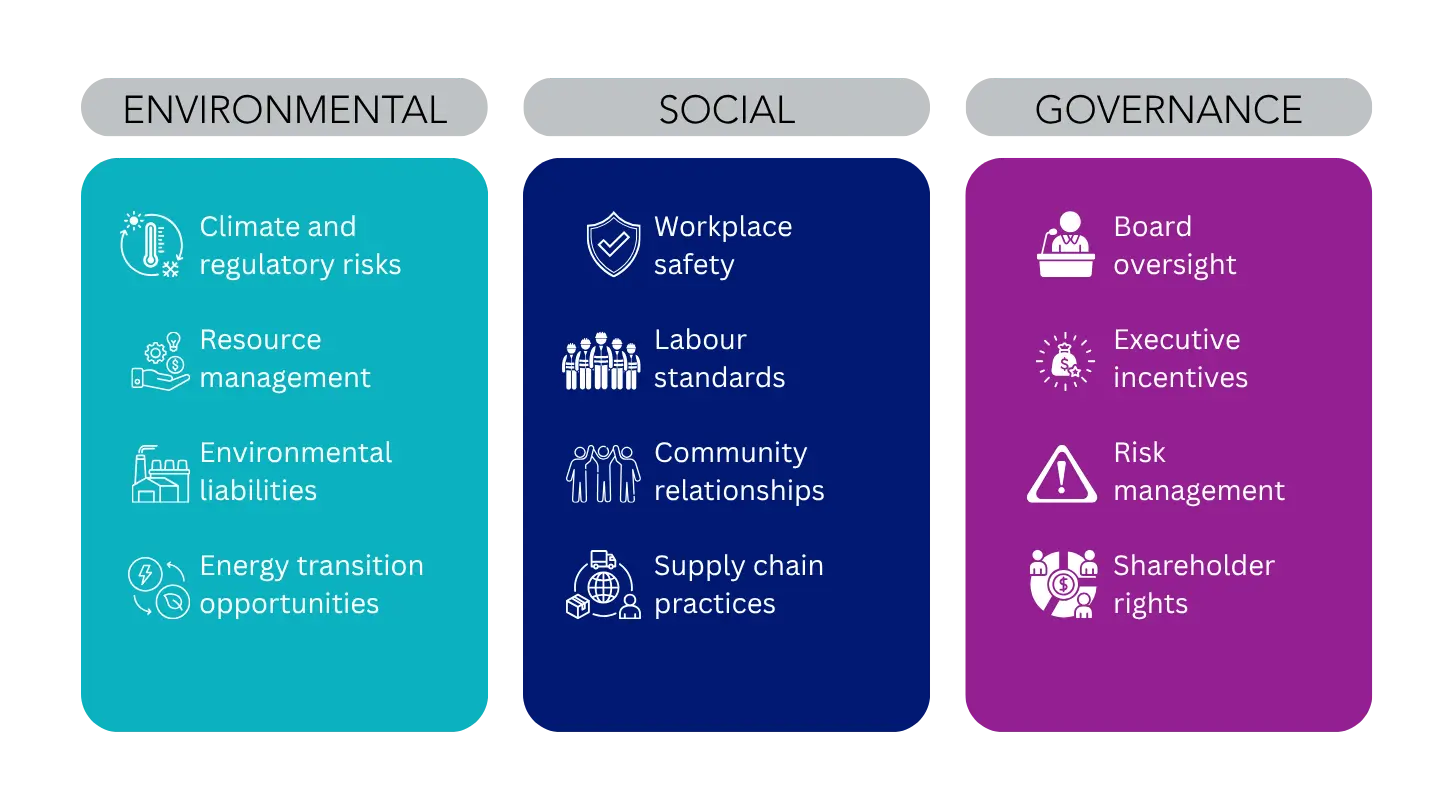
ESG investing incorporates environmental, social and governance considerations alongside traditional financial analysis.
The rationale is simple. Some of the biggest risks facing a business do not always appear in a set of accounts.
For illustrative purposes only.
In 2015, the US Environmental Protection Agency accused Volkswagen of using software to cheat emissions tests in millions of diesel vehicles. The fallout ultimately cost the company more than €30bn in fines, settlements and compensation.
Closer to home, Crown Resorts was one of Australia's most successful casino operators until a series of inquiries uncovered governance failures, anti-money laundering breaches and weak oversight. The company lost its licence to operate its flagship Sydney casino and was eventually acquired by Blackstone in 2022.
Investors spend plenty of time analysing income statements and balance sheets. Volkswagen and Crown are reminders that not every risk can be found there.
The cost of ignoring ESG risks
The challenge is that these risks are often easy to overlook until they become impossible to ignore. A governance issue may begin with weak oversight and end with regulatory scrutiny. An environmental liability can sit on a balance sheet for years before remediation costs become unavoidable. Social issues – be it labour disputes, safety failures or community opposition – can delay projects, disrupt operations and damage a company's ability to grow.
Research has increasingly suggested that these risks matter. A landmark 2015 meta-study by Friede, Busch and Bassen looked at more than 2,000 studies examining the relationship between ESG factors and company performance. Most found that paying attention to ESG either had a positive effect on financial performance or made no meaningful difference. Very few found that ESG had a negative impact.
While investors do not need to agree with every aspect of ESG investing, ignoring risks simply because they fall outside traditional financial metrics can turn out to be an expensive mistake.
Does ESG investing improve returns?
A common criticism of ESG investing is that investors must give up returns to invest sustainably. But like all investment styles, the reality is more complicated.
For much of the decade following the Global Financial Crisis, many ESG strategies benefited from a market environment that rewarded growth-oriented sectors such as technology and healthcare. At the same time, environmentally conscious companies became highly correlated with momentum-oriented investments. Since 2022, however, performance has been more mixed as higher interest rates and a rebound in traditional energy stocks worked against many ESG portfolios. The debate that followed often said as much about market conditions as it did about ESG investing.
Thus, the more relevant question is not whether ESG guarantees better returns. Rather, it is whether environmental, social and governance factors can help identify businesses that are better managed, more resilient and better prepared for long-term change.
Investing in long-term change
ESG investing is often associated with managing risk. But it can also help investors identify opportunities.
Consider the energy transition - according to the International Energy Agency, global investment in clean energy technologies and infrastructure now exceeds US$2 trillion annually. Whatever one's views on ESG, that is a significant flow of capital and investors pay attention when capital is moving at that scale.
For investors, the question is how to gain exposure.
Not all ESG strategies look alike. Some focus on building diversified equity portfolios. Others target specific opportunities, such as the energy transition.
ETFs can provide access to both approaches. VanEck's sustainable equity ETFs take this approach. The VanEck MSCI Australian Sustainable Equity ETF (ASX: GRNV) and VanEck MSCI International Sustainable Equity ETF (ASX: ESGI) use MSCI’s ESG Research to screen out companies involved in certain activities while favouring businesses with stronger ESG characteristics relative to their sector peers. The result is a diversified portfolio that seeks to incorporate sustainability considerations without abandoning broad market exposure.
Investors seeking more targeted exposure to the energy transition may instead consider the VanEck Global Clean Energy ETF (ASX: CLNE), which focuses on companies involved in clean energy production and related technologies.
Beyond the ESG debate
ESG investing is ultimately about understanding businesses. Financial statements remain essential, but they do not always capture every factor that can influence a company's long-term prospects. ESG analysis is one way investors can broaden the lens through which they assess risk, opportunity and business quality.
Key risks
An investment in our sustainable equity and clean energy ETFs carries risks associated with: financial markets generally, individual company management, industry sectors, fund operations, ASX trading time differences (ESGI and CLNE), foreign currency(ESGI and CLNE), country or sector concentration (ESGI and CLNE), political, regulatory and tax risks (ESGI and CLNE), and tracking an index. See the relevant PDS and TMD for more details.
ESGI is likely to be appropriate for a consumer who is seeking capital growth, is intending to use the product as a major, core, minor or satellite allocation within a portfolio, has an investment timeframe of at least 5 years, and has a high risk/return profile.
GRNV is likely to be appropriate for a consumer who is seeking capital growth and a regular income distribution, is intending to use the product as a core, minor or satellite allocation within a portfolio, has an investment timeframe of at least 5 years, and has a high risk/return profile.
CLNE is likely to be appropriate for a consumer who is seeking capital growth, is intending to use the product as a minor or satellite allocation within a portfolio, has an investment timeframe of at least 5 years, and has a very high risk/return profile.
Related Insights


Published: 04 June 2026
Any views expressed are opinions of the author at the time of writing and is not a recommendation to act.
VanEck Investments Limited (ACN 146 596 116 AFSL 416755) (VanEck) is the issuer and responsible entity of all VanEck exchange traded funds (Funds) trading on the ASX. This information is general in nature and not personal advice, it does not take into account any person’s financial objectives, situation or needs. You should consider whether or not an investment in any Fund is appropriate for you. Investments in a Fund involve risks associated with financial markets. These risks vary depending on a Fund’s investment objective. Refer to the applicable product disclosure statement (PDS) and target market determination (TMD) available at vaneck.com.au for more details. Investment returns and capital are not guaranteed.The effectiveness of an exclusionary screen is limited by the accuracy, completeness and accessibility of information and disclosure the relevant entity makes available or is willing to make available. There may be instances where screens may not exclude a company if data about the company is incomplete, inaccurate or unavailable. You may have differing views, opinions and understanding of the meaning of the terminology used and therefore your expectations of permitted investments may be different to the actual investments of the Funds.
ESG (Environmental, Social, and Governance) investing is receiving an increasing amount of attention from investors. The problem for ASX investors is that it is difficult to know how ‘green’ their investment is. You may have heard the term “greenwashing”, which was coined in the 1980s to describe outrageous corporate claims. Four decades later the phrase is having a renaissance, now used to describe mislabelled managed funds. Here we provide some insightful analysis of our popular of VanEck MSCI International Sustainable Equity ETF (ESGI) which tracks an innovative index that, in addition to screening out companies, also targets the leading ESG performers in each sector.