Why quantum computing is getting harder to ignore


We are pleased to announce that we have launched the first quantum computing ETF on ASX. VanEck Quantum ETF (ASX: QNTM) is designed to provide Australian investors with targeted exposure to companies advancing quantum computing, a young field that may change how some of the world’s hardest problems are approached.
Quantum technologies are still in their infancy. That matters. But this is no longer just a research story. Governments, large technology companies and early customers are starting to commit real money and real resources to the field. We are excited to be bringing the opportunity to Australian investors.
There is no evidence Henry Ford said or wrote, "If I had asked people what they wanted, they would have said faster horses."1
In regard to AI, Henry Ford definitely did not say, “If I had asked what people wanted, they would have said faster 0s and 1s.”
But the sentiment, when thinking about Quantum computing is the same.
As the 1800s ended, Henry Ford fundamentally changed how we move around. Quantum computing, we think, is going to radically shift industries too.
While today, people want faster processors, more RAM, more GHz, quantum computing doesn't give you a quicker binary computer; it gives you a machine that solves problems through superposition and entanglement in ways a binary computer fundamentally cannot, no matter how fast you clock it.
The irony captured by Ford's oft-quoted non-quote is the same: the constraint wasn't the horse's speed. It was the horse.
Quantum computing isn’t faster bits – it’s a fundamentally different machine.
Thinking beyond AI
Investors have spent the past few years talking about artificial intelligence. AI has changed the market and made computing power, chips, data centres and software infrastructure more important to investors.
But AI is not the end of the story.
Quantum computing is starting to attract attention because it approaches information in a different way. It is a different model that may be better suited to certain complex problems. And its applications are starting to add up beyond the theoretical foundation for quantum computing Alan Turing created in 1936 with the Universal Turing Machine.
There is now practical applications, and for investors this presents an opportunity.
Traditional computing versus quantum computing
Traditional computers use bits, represented as 0s and 1s. Every app, website, bank transfer and AI model ultimately relies on this kind of logic.
Quantum computers use qubits. Qubits behave differently, allowing quantum systems to approach some problems in ways classical computers cannot. The physics is complex. The investment point is simpler: quantum computing may be useful for problems where there are too many possible outcomes for classical systems to handle efficiently.
That distinction is important. Quantum computing is not designed to replace laptops, email, streaming or everyday computing. It is more likely to work alongside classical computers, cloud infrastructure and AI, tackling the parts of a problem that today’s systems still struggle with.
Chart 1: Traditional computing versus quantum computing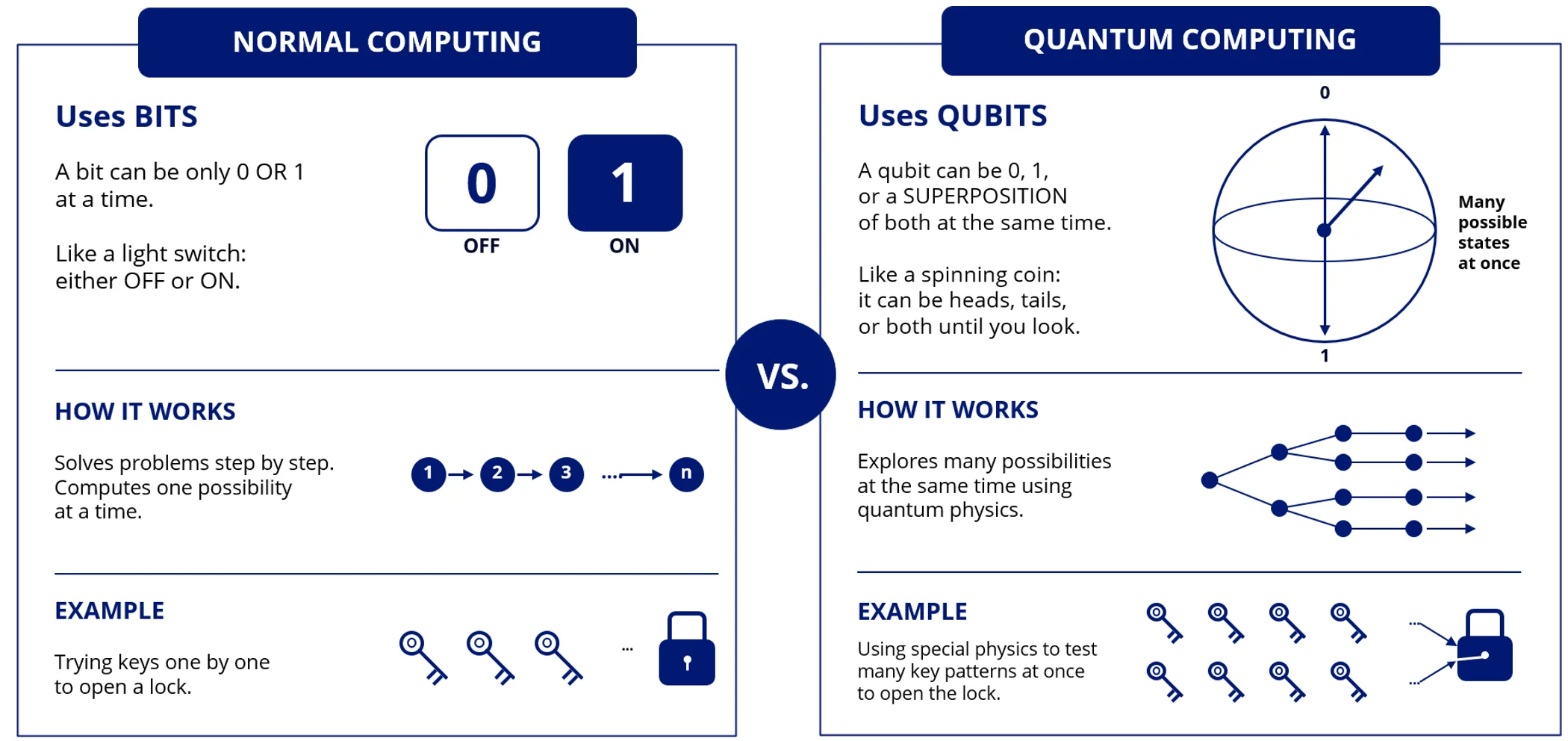
Source: VanEck.
Why computing power matters
The need for faster, smarter and more efficient computing is increasing across industries. More data, larger models and more complex systems require more processing power. But adding more classical computing power may not solve every problem.
Some problems become too large, too quickly. A portfolio can be tested across thousands of possible combinations. A molecule can behave across many possible states. A power grid or supply chain can have too many moving parts to model neatly.
This is where quantum computing is drawing attention. It may help tackle parts of drug discovery, materials science, financial risk modelling, supply chain optimisation and energy systems. These are not everyday computing tasks. They are specialist problems, and they are exactly the type of problems where a different computing model may matter.
What is the research showing?
The most useful data points tell the same story from different angles.
- Capital is moving in: McKinsey says investment in quantum technology start-ups reached US$12.6 billion in 2025, 6.3 times higher than in 2024. Around 90% of this investment went to quantum computing start-ups.2
- Customers are starting to test it: McKinsey says more than 300 organisations are actively collaborating with quantum technology companies, with early activity across life sciences, logistics and financial services.3
- Revenue is starting to show up: McKinsey estimates quantum computing companies generated more than US$1 billion of revenue worldwide in 2025, potentially rising to as much as US$4.4 billion by 2028.4
- Governments are taking it seriously: In May 2026, the US Department of Commerce announced nine letters of intent for US$2.013 billion in proposed CHIPS and Science Act incentives to support quantum foundries and quantum computing companies.5
- Cybersecurity is already moving: In August 2024, NIST finalised its first three post-quantum encryption standards, designed to withstand attacks from a quantum computer.6
What is the long-term outlook?
Long-term forecasts should always be treated as forecasts, not guarantees. But the direction is worth watching.
BCG estimates quantum computing could create US$450 billion to US$850 billion of economic value globally by 2040. It also estimates the market for quantum hardware and software providers could reach US$90 billion to US$170 billion by 2040.7
Australia has a local angle too. The Australian Government’s National Quantum Strategy says the sector could grow towards $5.9 billion in industry revenue, contribute $6.1 billion to GDP, and support 19,400 direct jobs by 2045.8
Where could quantum computing be used?
The practical use cases are broad, but they tend to share one thing: complexity. Quantum computing may be useful where there are many possible outcomes to test, model or optimise.
Chart 2: Industries that may benefit from quantum computing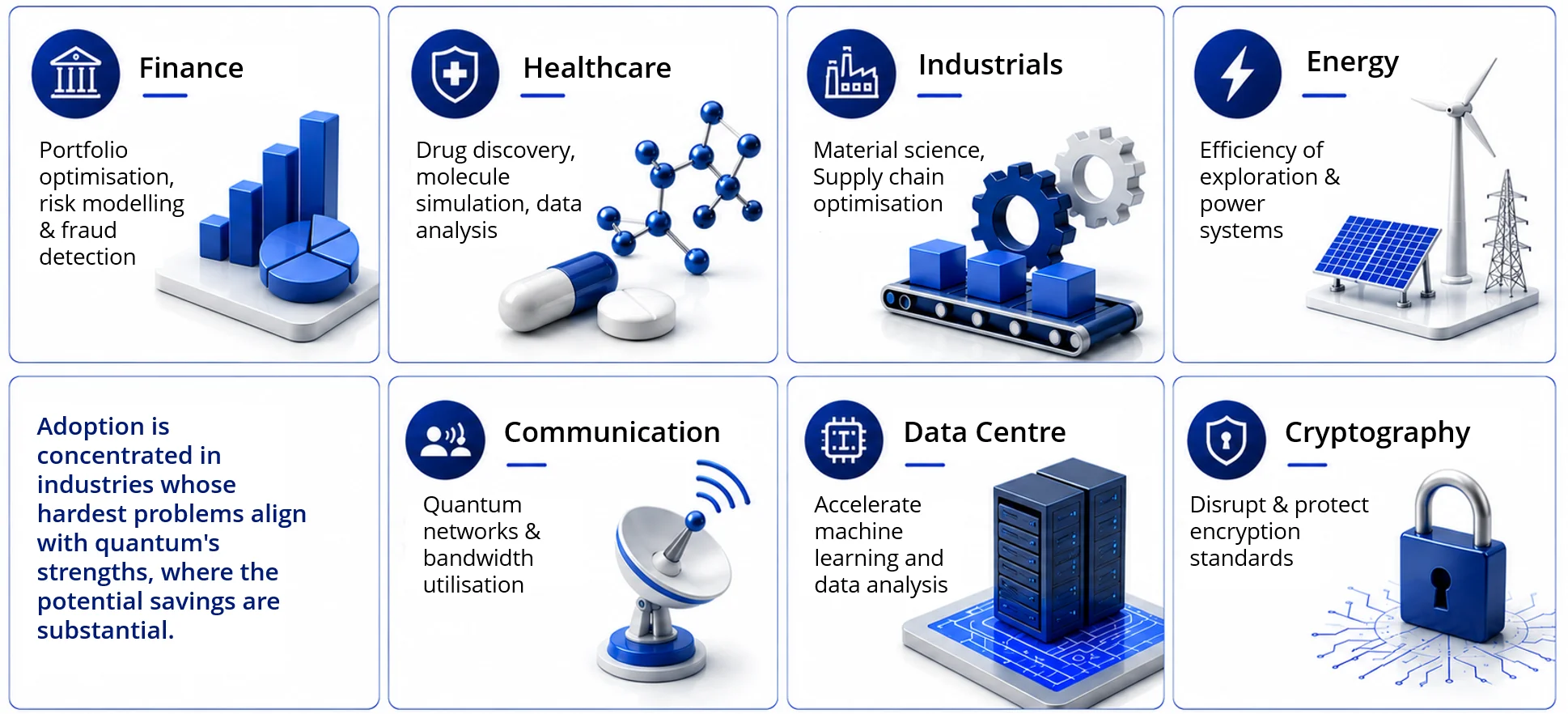
Sources: McKinsey & Company, Quantum Technology Monitor 2026; BCG; NIST.
The Quantum opportunity
VanEck Quantum ETF (ASX: QNTM) is the first of its kind on ASX, designed to give investors a targeted way to access companies involved in quantum computing.
Key points of QNTM
Untapped potential of computing power
Quantum technologies are still in their infancy with the potential to transform computing.
The next frontier
Invest in companies at the forefront of a field with the potential to rival the impact of the internet and artificial intelligence.
Diversified exposure across a rapidly evolving field
Access a portfolio of companies advancing quantum computing.
Key risks
An investment in our ETF carries risks associated with: Quantum computing industry, ASX trading time differences, financial markets generally, individual company management, industry sectors, foreign currency, country or sector concentration, political, regulatory and tax risks, fund operations and tracking an index. See the PDS and TMD at vaneck.com.au.
Sources and data notes- Patrick Vlaskovits, “Henry Ford, innovation, and that ‘faster horse’ quote,” Harvard Business Review, August 29, 2011, hbr.org.
- McKinsey & Company, Quantum Technology Monitor 2026: A commercial tipping point, April 2026.
- Ibid.
- Ibid
- US Department of Commerce/NIST, Department of Commerce Announces Letters of Intent With 9 Companies for $2 Billion to Accelerate U.S. Leadership in Quantum Computing, May 2026.
- NIST, NIST Releases First 3 Finalized Post-Quantum Encryption Standards, August 2024.
- Boston Consulting Group, The Long-Term Forecast for Quantum Computing Still Looks Bright, July 2024.
- Australian Government Department of Industry, Science and Resources, National Quantum Strategy, May 2023
Related Insights


Published: 05 August 2026
Any views expressed are opinions of the author at the time of writing and is not a recommendation to act.
VVanEck Investments Limited (ACN 146 596 116 AFSL 416755) (VanEck) is the issuer and responsible entity of all VanEck exchange traded funds (Funds) trading on the ASX. This information is general in nature and not personal advice, it does not take into account any person’s financial objectives, situation or needs. You should consider whether or not an investment in any Fund is appropriate for you. Investments in a Fund involve risks associated with financial markets. These risks vary depending on a Fund’s investment objective. Refer to the applicable product disclosure statement (PDS) and target market determination (TMD) available at vaneck.com.au for more details. Investment returns and capital are not guaranteed.
© 2026 VanEck Investments Limited. All rights reserved.