Expert’s choice: An investment to keep society moving.


A ‘real’ asset class that can potentially act as an inflation hedge.
The crisis in the Gulf has given rise to a number of outcomes, and heightened inflation is one of them. As investors consider their portfolios in the wake of the conflict, many have been gravitating toward the perceived safety of real assets, i.e. assets that are physical. Many have also been looking to assets that can potentially act as a hedge against rising inflation. One such asset satisfies both criteria.
According to the Online Etymology Dictionary, the word ‘infrastructure’ has been used in English since 1887 and is derived from the addition of the Latin prefix ’infra’, meaning ’below’, to ’structure’. The European Union says that Infrastructure is the backbone of development and social welfare. Roads and railways allow workers and goods to move faster and enable people to get access to public services; telecommunications allow them to communicate and learn; water supply systems enable drinking water and sanitation.
Throughout history, infrastructure has been the foundation of economic growth, and the complexities and demand for infrastructure are increasing. Since the Industrial Revolution, humans have migrated from rural to urban areas. Our population is growing fast, especially in cities. According to the UN in 1979, there were only three cities with a population over 10 million; in 2014, that number had grown to 23, in 2025, there were 33.
The integration of AI continues to drive demand for infrastructure as it is energy dependant and relies on grids and other network assets, while demand for mobile telecommunications, lightning-quick internet speeds, airports and transport also continues to grow.
Investors are attracted to infrastructure because it benefits from three key investment advantages:
- High barriers to entry: There are limited places where rail lines can be laid or a bridge can be built. The benefit of low competition, even if pricing is regulated, is significant as it results in a more stable income stream for investors compared to the earnings volatility of other equity investments.
- Protection from inflation: Unlike other income-generating investments, such as fixed income, investors in infrastructure securities also benefit from the link to inflation, which is derived from:
- Regulated income, which has annual CPI-based adjustments, as is often the case with airports or toll roads, or
- CPI-based increases on consumer prices, such as with utility companies.
- Low correlation to other asset classes: Infrastructure securities have demonstrated a low correlation to other asset classes, providing diversification benefits for investors wishing to complement their existing asset classes. The table below shows the correlation of global infrastructure compared to other asset classes. In the table, a 1 is perfectly correlated. The lower the number, the lower the correlation.
Table 1: Correlation of infrastructure to other asset classes
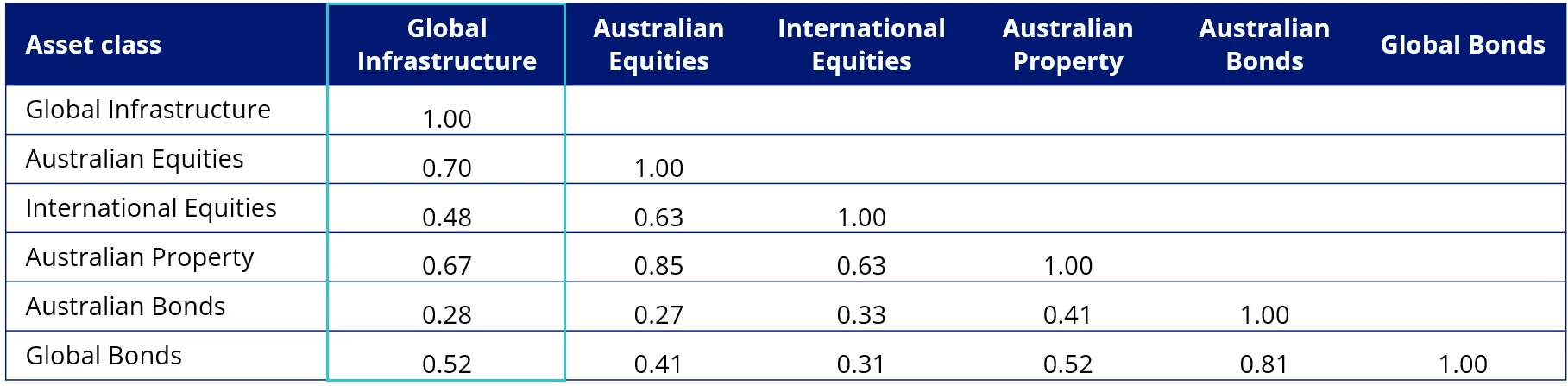
Source: Morningstar Direct, Ten year correlation 1 March 2016 – 28 February 2026. Results are calculated monthly and assume immediate reinvestment of all dividends. You cannot invest in an index. Past performance is not a reliable indicator of future performance.
Indices used Global Bonds – Barclays Global Aggregate Bond Index A$ Hedged, Australian Bonds - Bloomberg AusBond Composite 0+ years, Global Infrastructure – FTSE Developed Core Infrastructure 50/50 Hedged into Australian Dollars Index, International Equities – MSCI World ex Australia Index, Australian Equities – S&P/ASX 200 Accumulation Index, Australian property – S&P/ASX 200 A-REIT Index.
Many infrastructure assets, such as utility companies providing electricity, gas, and water, have earnings that are regulated based on their cost of capital. As the cost of capital rises (or falls), so do their revenues. As a result, the earnings performance of these companies should be largely unaffected by rising rates. Some infrastructure assets, such as roads, are also often linked to inflation.
The first infrastructure ETF on ASX was the VanEck FTSE Global Infrastructure (AUD Hedged) ETF (ASX code: IFRA). It invests in global listed infrastructure securities around the world, with the additional benefits of ETFs, which are transparency, liquidity and cost effectiveness.
The global listed infrastructure securities that are included in IFRA encompass the builders of roads, railways and bridges, toll road operators, telecommunication providers, satellite operators, companies involved in the storage and transportation of oil and gas reserves and airport operators, to name just a few.
Infrastructure, as represented by its index FTSE Developed Core Infrastructure 50/50 Hedged into Australian Dollars Index, has been one of the better-performing asset classes so far in 2026. Noting, of course that this is a short time period and that past performance is not indicative of future performance.
Chart 1: 2026 performance year-to- date. 1 January 2026 to 15 March 2026
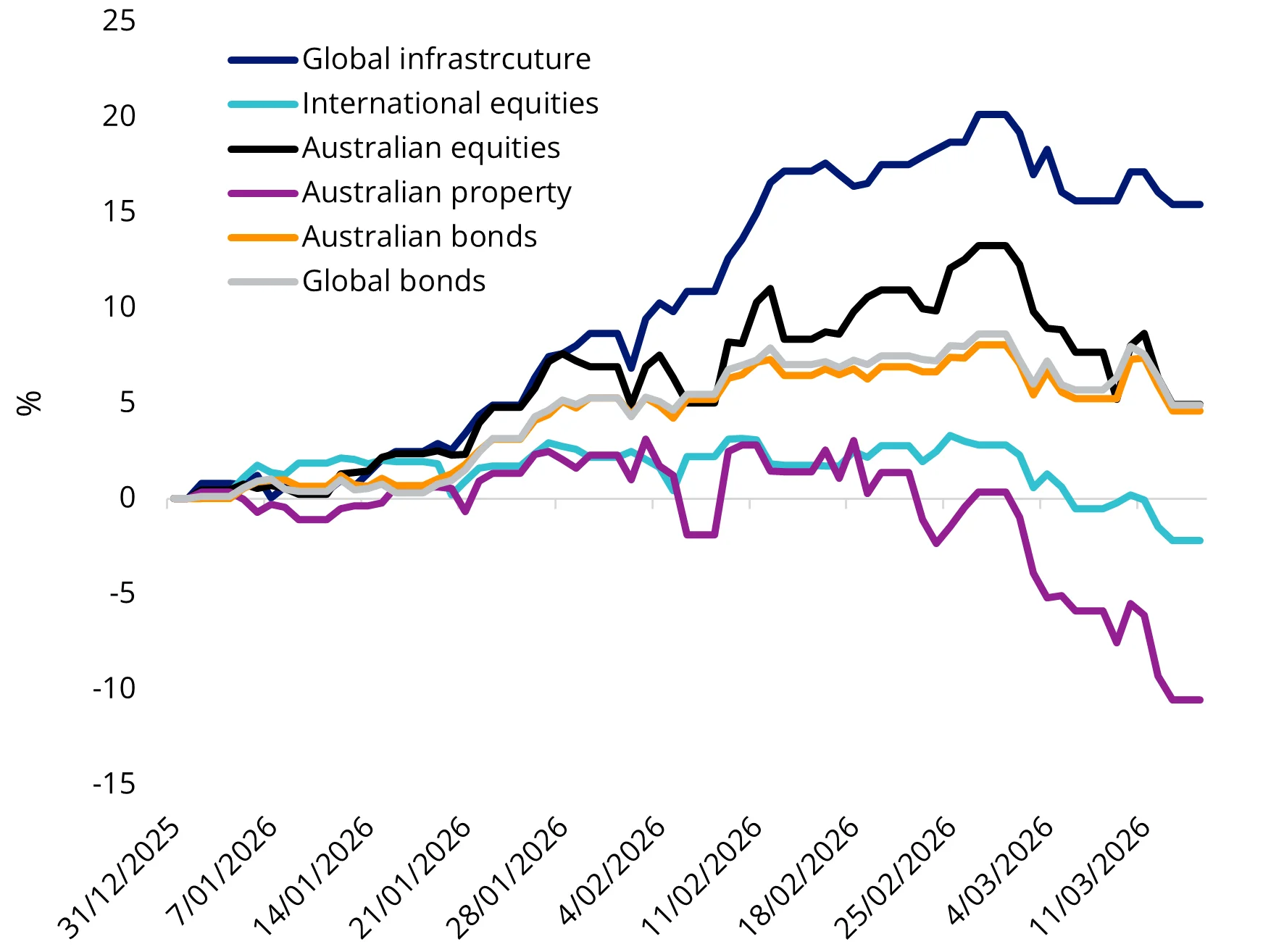
Source: Morningstar Direct, Results are calculated daily and assume immediate reinvestment of all dividends. You cannot invest in an index. Past performance is not indicative of future performance.
Indices used Global Bonds – Barclays Global Aggregate Bond Index A$ Hedged, Australian Bonds - Bloomberg AusBond Composite 0+ years, Global Infrastructure – FTSE Developed Core Infrastructure 50/50 Hedged into Australian Dollars Index, International Equities – MSCI World ex Australia Index , Australian Equities – S&P/ASX 200 Accumulation Index; Australian property – S&P/ASX 200 A-REIT Index.
Infrastructure is performing well in 2026 because it is benefiting from both defensive demand and structural growth.
In terms of the defensive demand, energy security remains a priority, lifting the importance of domestic energy, pipelines and resilient transmission infrastructure. While the rest of the equity market is being disrupted, infrastructure assets such as utilities and energy are being well supported. In addition, assets such as satellites and communications potentially benefit from increased defence spending and strategic prioritisation.
The structural growth is rising power demand from AI and data centres, which is supporting utilities, grids and other essential network assets. The sector is also being supported by long-term spending on decarbonisation, digitalisation and system upgrades. These are capital-heavy trends, and infrastructure assets sit at the centre of them.
In 2026, infrastructure is doing relatively well because it offers both resilience and relevance, defensive qualities backed by powerful long-term growth drivers.
An additional benefit of IFRA is how it utilises tax rules to smooth income, with income being one of the reasons many investors consider global listed infrastructure. Not many fund managers utilise this strategy and are unable to pay income every period, consistently. We discuss this here. IFRA has maintained a steady quarterly income since inception - https://www.vaneck.com.au/etf/equity/ifra/dividends/.
IFRA tracks the FTSE Developed Core Infrastructure 50/50 Hedged into Australian Dollars Index and provides investors with access to a portfolio of 134 of the world’s largest infrastructure securities in a single trade on ASX.
Key risks: An investment in our global infrastructure ETF carries risks associated with: ASX trading time differences, financial markets generally, individual company management, industry sectors, foreign currency, currency hedging, country or sector concentration, political, regulatory and tax risks, fund operations, liquidity and tracking an index. See the VanEck FTSE Global Infrastructure (AUD Hedged) ETF PDS and TMD for more details
IFRA is likely to be appropriate for a consumer who is seeking capital growth and a regular income distribution, is intending to use the product as a minor or satellite allocation within a portfolio, has an investment timeframe of at least 5 years, and has a high to very high risk/return profile.
As always, if you are considering an investment in infrastructure, we recommend that you speak to your financial adviser or stockbroker.


Published: 18 March 2026
Any views expressed are opinions of the author at the time of writing and is not a recommendation to act.
VanEck Investments Limited (ACN 146 596 116 AFSL 416755) (VanEck) is the issuer and responsible entity of all VanEck exchange trades funds (Funds) listed on the ASX. This is general advice only and does not take into account any person’s financial objectives, situation or needs. The product disclosure statement (PDS) and the target market determination (TMD) for all Funds are available at vaneck.com.au. You should consider whether or not an investment in any Fund is appropriate for you. Investments in a Fund involve risks associated with financial markets. These risks vary depending on a Fund’s investment objective. Refer to the applicable PDS and TMD for more details on risks. Investment returns and capital are not guaranteed.
The Fund is not in any way sponsored, endorsed, sold or promoted by FTSE International Limited or the London Stock Exchange Group companies (‘LSEG’) (together the ‘Licensor Parties’) and none of the Licensor Parties make any claim, prediction, warranty or representation whatsoever, expressly or impliedly, either as to (i) the results to be obtained from the use of the FTSE Developed Core Infrastructure 50/50 Hedged into Australian Dollars Index (with net dividends reinvested) (‘Index’) upon which the Fund is based, (ii) the figure at which the Index is said to stand at any particular time on any particular day or otherwise, or (iii) the suitability of the Index for the purpose to which it is being put in connection with the Fund. None of the Licensor Parties have provided or will provide any financial or investment advice or recommendation in relation to the Reference Index to VanEck or to its clients. The Reference Index is calculated by FTSE or its agent. None of the Licensor Parties shall be (a) liable (whether in negligence or otherwise) to any person for any error in the Reference Index or (b) under any obligation to advise any person of any error therein. All rights in the Reference Index vest in FTSE. “FTSE®” is a trade mark of LSEG and is used by FTSE and VanEck under licence.