The opportunity with a US$2 trillion+ tailwind behind it


The defence spending headlines tell only half the story. What governments buy next could broaden the opportunity for investors.
Australia’s geography has long shaped how we think about national security. But distance offers little protection against cyberattacks or disruption to the shipping routes on which our economy depends.
Ships, aircraft and submarines remain essential, while defence investment also extends to combat drones, autonomous systems and technology that can disrupt an adversary’s communications. For investors, this creates opportunities beyond the familiar manufacturers of military hardware.
These developments are creating opportunities for companies around the world as well as its investors.
What bigger budgets mean
Global military spending reached US$2.89 trillion in 2025, according to the Stockholm International Peace Research Institute. After adjusting for inflation, spending was 41% higher than a decade ago.
Chart 1: Global defence spending hit a record high in 2025
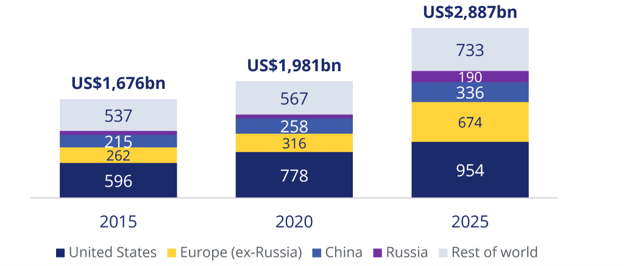
Source: SIPRI Military Expenditure Database, April 2026. Chart uses current US$. Europe excludes Russia. The 41% increase cited above is inflation-adjusted growth over 2016–25.
Russia’s invasion of Ukraine has prompted European governments to rebuild military capabilities that received less funding after the Cold War.
All NATO allies met the target of spending at least 2% of GDP on defence in 2025, marking a shift in priorities after decades of restrained spending. NATO allies have committed to spending up to 5% of GDP on defence and security-related investment. Closer to home, the Australian Government’s defence funding plan totals A$887 billion over the decade to 2035–36.
Governments need to replenish weapons stockpiles and equip armed forces for threats ranging from drones to cyberattacks. But years can pass between a government awarding a contract and the equipment entering service, as manufacturers expand production and armed forces train personnel to use it. Unforeseen setbacks can stretch those timelines further, helping explain why the investment cycle extends well beyond the conflicts that prompted it.
Demand may also continue after equipment is delivered. For instance, while an aircraft may remain in service for decades, it would require frequent software upgrades throughout its life as threats evolve. This creates opportunities for defence software companies alongside the manufacturers of military hardware.
More capability from the equipment we have
A company supplying electronics or software may serve several manufacturers and defence programmes, giving it opportunities beyond the success of one aircraft or ship design. Those opportunities depend on winning contracts and delivering technology that works under demanding conditions.
Figure 1: Where global defence spending is going next
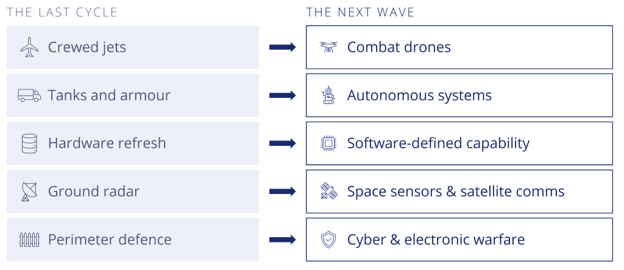
Source: VanEck, NATO investment plans and Australia’s 2026 National Defence Strategy and Integrated Investment Program. Emerging capabilities complement conventional equipment.
Companies such as Thales (EPA: HO) and AeroVironment (NASDAQ: AVAV) show how this spending translates into an investable opportunity. Thales supplies radar capable of detecting small airborne threats, alongside sensors and electronic warfare equipment for drones. AeroVironment’s Switchblade systems combine surveillance and precision strike capabilities in an uncrewed aircraft. These businesses supply technology that helps armed forces respond to changes in how conflicts are fought.
For investors, this makes the composition of a defence portfolio important. Exposure to aircraft and shipbuilders captures part of the spending cycle. Including the companies developing unmanned systems and defence electronics provides access to other areas of modernisation, without depending on a single technology or procurement programme.
How we approach the opportunity
The VanEck Global Defence ETF (DFND) provides exposure across these areas, investing in equipment manufacturers and companies supplying defence electronics, software and services around the world. Both Thales and AeroVironment were holdings as at 25 September 2026.
DFND’s approach also reflects what its index excludes. While DFND does not have an ESG investment objective, it screens out companies with verified involvement in certain controversial weapons, including biological and chemical weapons, cluster munitions and anti-personnel mines, subject to defined involvement and ownership criteria. We believe an investment in defence companies should satisfy these minimum safeguards.1
This exclusion has not affected its investment outcome however. From its inception on 10 September 2024 to 31 August 2026, DFND returned 33.19% p.a., outperforming the two other ASX-listed defence ETFs (although we caution this remains a short record and past performance is not indicative of future performance).
At the pace recorded in 2025, the world spent about US$55 million on defence every ten minutes. For investors, the opportunity involves looking beyond the hardware and taking a closer look at the companies developing the technology that modern defence forces need.
Key risks
An investment in the ETF carries risks associated with: ASX trading time differences, financial markets generally, individual company management, industry sectors, foreign currency, country or sector concentration, political, regulatory and tax risks, fund operations, liquidity and tracking an index. See the PDS for more details on risk.
DFND is likely to be appropriate for a consumer who is seeking capital growth, is intending to use the product as a satellite allocation within a portfolio, has an investment timeframe of at least 5 years, and has a very high risk/return profile.
1- For more information on the criteria, read the PDS. The effectiveness of an exclusionary screen is limited by the accuracy, completeness and accessibility of information and disclosure the relevant entity makes available or is willing to make available. There may be instances where the above screens may not exclude a company if data about the company is incomplete, inaccurate or unavailable.
Published: 01 October 2026
Any views expressed are opinions of the author at the time of writing and is not a recommendation to act.
VanEck Investments Limited (ACN 146 596 116 AFSL 416755) (VanEck) is the issuer and responsible entity of all VanEck exchange traded funds (Funds) trading on the ASX. This information is general in nature and not personal advice, it does not take into account any person’s financial objectives, situation or needs. You should consider whether or not an investment in any Fund is appropriate for you. Investments in a Fund involve risks associated with financial markets. These risks vary depending on a Fund’s investment objective. Refer to the applicable product disclosure statement (PDS) and target market determination (TMD) available at vaneck.com.au for more details. Investment returns and capital are not guaranteed.