Using the latest technology matters


We don’t use rotary telephones anymore, but some diversified funds reflect that era. If phones can be smarter, so can diversified ETFs.
Portfolio diversification beyond a single asset class has been a cornerstone of investing for as long as there has been investing. It moved beyond practice and into academia when Modern Portfolio Theory (MPT) and the 60/40 portfolio emerged from Harry Markowitz’s seminal 1952 work, Portfolio Selection. Back then, the two investment options considered were shares and bonds.
The world of investing has changed since 1952. Bond markets have become more complex with a broader range of issuers beyond developed market governments. At the time, it was illegal for US citizens to own significant amounts of monetary gold; that ban was lifted in 1974. Other trends, such as privatisation, have led to private investors owning and operating infrastructure such as roads and utilities.
As portfolios and investing evolved and markets globalised, the standard 60/40 portfolios expanded to include global and domestic shares (growth) and global and domestic bonds (defence). In Australia, the Superannuation Guarantee made all Australian employees investors, and the industry responded with diversified funds being the default option.
Today, investors have better tools available to them than when MPT was born. The advent of new technologies enables investors to leverage financial reports and performance data points more effectively. The development of larger and more powerful semiconductors and computers to run complex mathematical algorithms, thereby optimising the risk-return computations, is also driving portfolio construction today.
Our biggest superannuation and sovereign wealth funds invest in these disparate asset classes, including infrastructure and real estate. They are also being included as part of diversified portfolios being recommended by financial advisers.
Australia’s financial adviser community has also been utilising managed accounts, including separately managed accounts and managed discretionary accounts, which offer financial advisers a scalable framework for delivering advice with institutional-grade portfolio governance, access to a vast array of investment manager expertise, real-time transparency and operational efficiency.
Coinciding with the growth of the superannuation industry and the growth in managed accounts has been the rise of ETFs.
ETF issuers, responding to investor demand, started to create versions of these balanced and growth funds. These ETFs were simply ETFs of ETFs, and they tended to include only splits between equity and bond allocations, ignoring asset classes like gold and infrastructure.
But some ETFs invest in many of these ‘newer’ uncorrelated asset classes, and these feature in many of the managed accounts advisers use.
We think that the tenets of MPT are as strong as ever and believe a diversified approach to portfolio construction is critical to achieving investment objectives.
Additionally, we believe that investment strategies such as targeting ‘value’ (an investment strategy that focuses on buying companies that are cheaply priced) or ‘quality’ (an investment strategy that focuses on financially sound companies that have a history of solid earnings) and equal weight have the potential to provide investors with outcomes beyond traditional market capitalisation approaches and we think that active management, especially in certain asset classes in which market inefficiencies persist, like emerging markets fixed income, can add value to diversified portfolios.
Avid readers of Vector Insights may recall that VanEck has created a series of notional model portfolios, which are split between growth and defensive assets across a range of ETFs that give exposure to many asset classes and smart beta.
We created these hypothetical portfolios using well-established research and portfolio construction expertise, considering risk and return.
An informed understanding of the risk and return profile of the various asset classes is important to the portfolio construction process.
The Australian Government, via its moneysmart.gov.au has provided Australian investors with a practical guide to investing, and the website highlights typical investment portfolios including ‘balanced’ and ‘growth’ mixes.
Today, we released a paper that compared portfolios using MoneySmart’s balanced and growth profiles made up of market capitalisation approaches to a hypothetical portfolio model made up of smart beta, active and select market capitalisation approaches, considering a wider range of asset classes.* In the paper, these portfolios are referred to as “VE Hypothetical”.
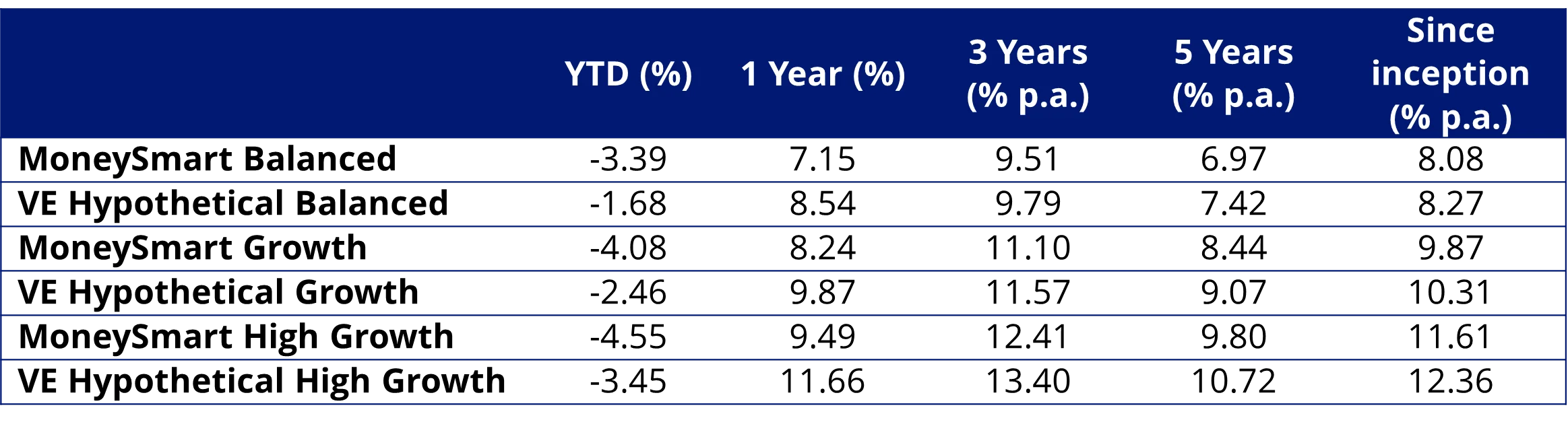
The results are unambiguous. Across balanced, growth, and high growth risk profiles, portfolios constructed from smart beta and selective active ETFs have historically outperformed conventional market-capitalisation equivalents on every meaningful metric: higher returns, lower volatility, and superior Sharpe ratios over the medium and long term.
Figure 1: Hypothetical returns by portfolio to 31 March 2026
Source: Morningstar Direct, VanEck. Common inception date 30 June 2020. Results calculated monthly, assuming immediate reinvestment of all dividends. Index returns only, no fees or transaction costs. Past performance is not indicative of future performance. You cannot invest directly in an index. A breakdown of the holdings of each of the above portfolios is included in the appendix of the paper – click here.
The relative outperformance of the VE Hypothetical portfolios across every risk tier and every past time period is not marginal. Perhaps most notable is the Balanced comparison. VE Hypothetical Balanced carries a more conservative asset allocation than MoneySmart Balanced, 60% growth versus 70%*, and yet it outperformed in absolute return terms. The smart beta exposures in the equity portion are doing sufficient work to overcome the structural disadvantage of holding more defensive assets.
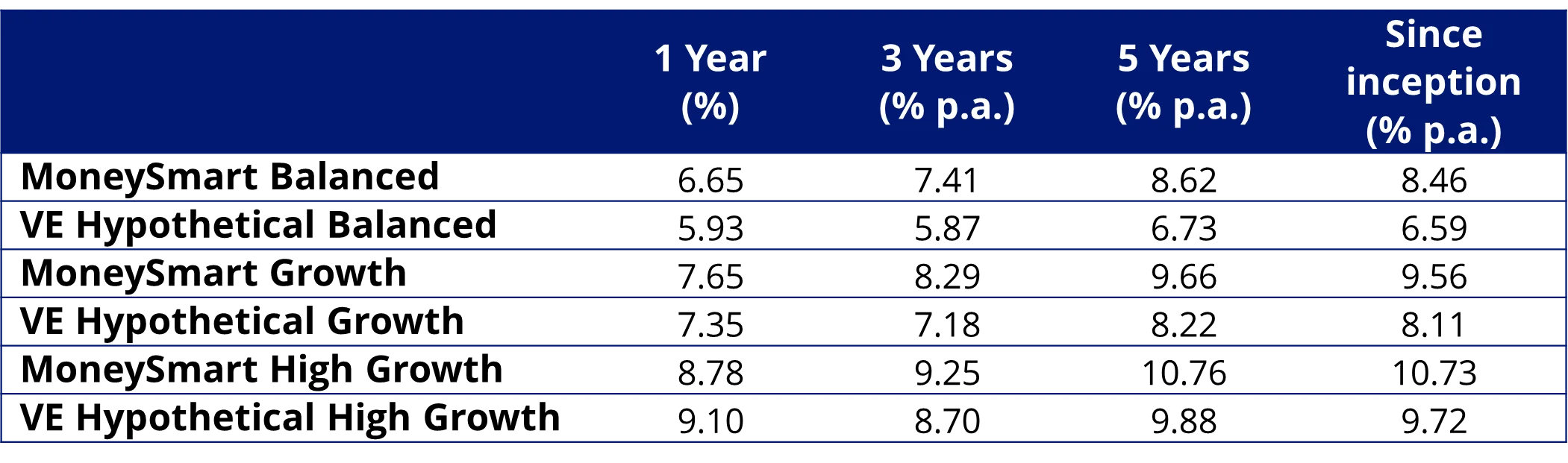
Figure 2: Hypothetical volatility (standard deviation of returns) to 31 March 2026
Source: Morningstar Direct, VanEck. Common start date 30 June 2020. Results calculated monthly, assuming immediate reinvestment of all dividends. Index returns only, no fees or transaction costs. Past performance is not indicative of future performance. You cannot invest directly in an index. A breakdown of the holdings of each of the above portfolios is included in the appendix of the paper – click here.
The volatility data resolves the central question: VE Hypothetical portfolios delivered higher returns at lower or comparable volatility over three and five years, and since inception. This is the definition of portfolio efficiency. The outperformance documented in Figure 1 was not achieved by taking more risk, it was achieved, in our opinion, by constructing better portfolios.
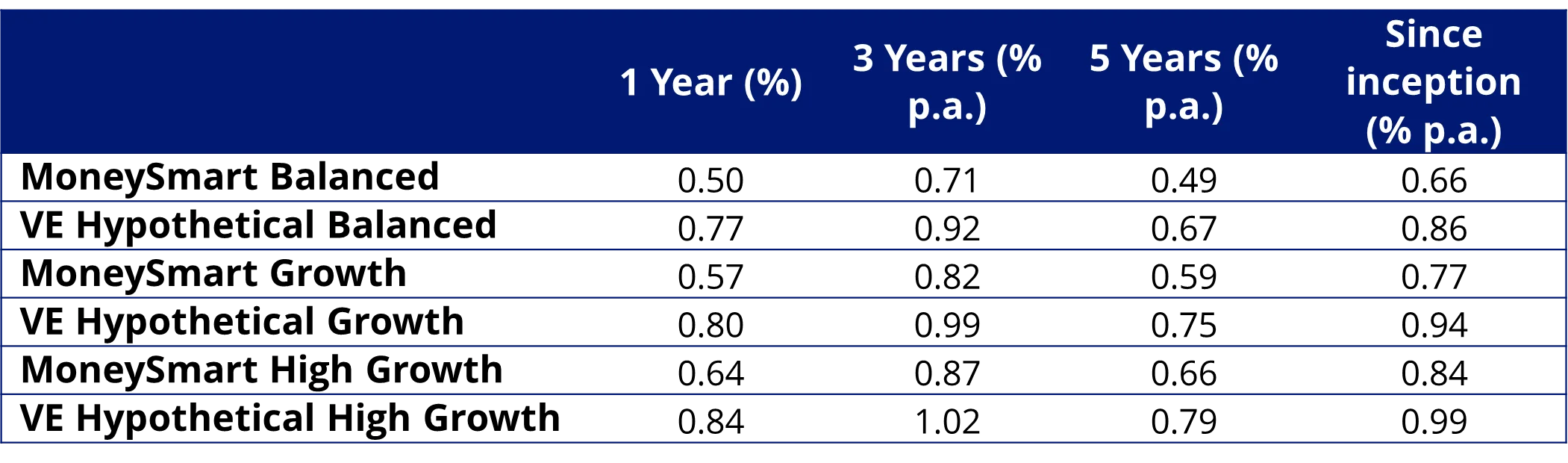
Unsurprisingly, this is reflected in the Sharpe ratios. The Sharpe ratio combines the return measure with the volatility measure to quantify the relationship between the returns and risk. It provides a measure of risk-adjusted performance.
Figure 3: Hypothetical Sharpe ratios to 31 March 2026
Source: Morningstar Direct, VanEck. Common start date 30 June 2020. Results calculated monthly, assuming immediate reinvestment of all dividends. Index returns only, no fees or transaction costs. Past performance is not indicative of future performance. You cannot invest directly in an index. A breakdown of the holdings of each of the above portfolios is included in the appendix of the paper – click here.
We think Sharpe ratios tell the most important story. In every instance, across every time horizon, the VE Hypothetical portfolios exhibited materially superior risk-adjusted performance. This is a structural advantage, not a cyclical one.
Making smart-er portfolios a reality
ASX investors will soon be able to access Diversified Active ETFs, constructed like the VE Hypothetical portfolios noted above. On Thursday, we will be listing three ETFs across three risk categories: Balanced (VBAL), Growth (VGRO) and High Growth (VHGR).
Each has been carefully designed using the same institutional asset allocation frameworks that underpin large-scale portfolios.
Each strategy is calibrated to a different risk-return objective:
| ASX: VBAL | VanEck Core+ Diversified Balanced Active ETF | Aims to provide a steady core for long-term investors who value resilience as much as return. |
| ASX: VGRO | VanEck Core+ Diversified Growth Active ETF | A higher allocation to growth assets with modest defensive allocation providing ballast during market stress. |
| ASX: VHGR | VanEck Core+ Diversified High Growth Active ETF | Maximum exposure to growth assets for long-term capital accumulation, while accepting a higher degree of market variability |
Maximum exposure to growth assets for long-term capital accumulation, while accepting a higher degree of market variability
Investing has come a long way since 1952; we think diversified ETFs should reflect this reality.
* A breakdown of the holdings of each portfolio is included in the appendix of the paper – click here.
Key risks
An investment in our Core+ Diversified Active ETFs carry risks. These risks vary depending on the underlying funds and asset classes to which they are exposed. Risks include those associated with: financial markets generally, asset allocation risks, underlying fund risks, investment management risks, ASX trading time differences, industry sectors, foreign currency, country or sector concentration, political, regulatory and tax risks, and fund operations. See the respective PDS and TMD for more details.

Published: 24 April 2026
Any views expressed are opinions of the author at the time of writing and is not a recommendation to act.
VanEck Investments Limited ACN 146 596 116 AFSL 416755 (VanEck) is the responsible entity and issuer of VanEck Core+ Diversified Balanced Active ETF (VBAL), VanEck Core+ Diversified Growth Active ETF (VGRO) and VanEck Core+ Diversified High Growth Active ETF (VHGR). Units in VBAL, VGRO, and VHGR are not currently available. VBAL, VGRO and VHGR have been registered by ASIC and VanEck has lodged an application with ASX for units in the fund to be admitted to trading status on ASX. You should read the respective product disclosure statement (PDS) and target market determination (TMD), which will be available at vaneck.com.au, before considering whether or not any VanEck fund is appropriate for you. Investing in ETFs has risks, including possible loss of capital invested. No member of the VanEck group guarantees the repayment of capital, the payment of income, performance, or any particular rate of return from any fund.
© 2026 Van Eck Associates Corporation. All rights reserved.