Value's long road home: why investors drifted, and the map for the journey back


After years in the wilderness, value is reasserting itself. Here’s why investors drifted, what broke, and how a modern approach is reshaping outcomes.
The relative outperformance of so-called ‘value’ companies over ‘growth’ companies has received publicity of late. But some international equity investors may be wondering if their patience has been fully rewarded. Markets had changed. Investing had changed. Had they drifted from the value map?
Untangling skill from luck
In his 2013 CFA Institute paper, The Success Equation: Untangling Skill and Luck in Business, Sports, and Investing, Morgan Stanley’s Michael J Mauboussin concludes: “A lot of investing success falls more toward the luck side of the continuum.”
Citing this article in the Australian Financial Review five years ago, I argued that for decades, what active managers charged a premium for, identifying cheap stocks, finding quality businesses, spotting momentum, turned out to be something far more systematic than skill. Active managers, I argued, were harnessing factors.
Once academic and commercial research identified those factors as persistent, rules-based drivers of return, ETF issuers were able to provide low-cost, rules-based access to these factors. Active managers, I argued, need to be able to demonstrate their individual skill beyond the factor that their process harnesses to justify their fees.
At the time of writing, the low growth and low inflation macro environment suited the growth and quality factors. Value managers were having a tough time trying to match performance with these types of managers. More recently, as inflation returned, the value factor has come to the fore.
To untangle skill from luck in value, let’s first understand the value factor.
A history of value up until the GFC
Value is the oldest and most empirically grounded of investment factors; it was documented by Graham and Dodd in 1934, in their book Security Analysis. Graham and Dodd believed that the true value of a stock could be determined based on its assets, future earnings, dividends and prospects. The lower the price of the security relative to this intrinsic value, the higher the ‘margin of safety’. Graham and Dodd developed value investing - a methodology to identify and buy securities priced well below their intrinsic value. Behind this concept of value investing is the belief that “cheaply” valued assets tend to outperform more expensive stocks over a long horizon.
Almost a century later, the principles have not changed. The market's relationship with them has.
Graham's most famous student, Warren Buffett, compounded one of the great fortunes in history on the basic insight that price and value are not the same thing.
Eugene Fama and Kenneth French formalised the academic case in 1992, identifying value as a persistent factor explaining share market returns. The empirical record was uncontroversial: cheap stocks, on average, beat expensive ones over long time horizons, and they did so more noticeably during inflationary periods: the 1970s, the early 1980s, the years following the dot-com bust.
Then, the GFC occurred, and in the subsequent fifteen years, the value factor seemed to have stopped working. Or so it appeared.
Drifting from the map
The decade and a half that followed the GFC was unkind to anyone holding a price-to-book filter. As central banks sent interest rates to zero and held them there, the discount rate (a method used to value a company) applied to far-future cash flows collapsed. Growth companies, such as the Magnificent Seven before they had a name, drove the market’s returns. The companies could not be described as “value”.
By 2020, Morningstar, Forbes and the Business Times were all running variants of the same headline: Is value investing dead?
The answer was no, but the textbook value playbook had three problems, we think.
A new map was needed
First, price-to-book (P/B) broke down. Book value made sense in a world of factories and inventory; it made less sense in a world in which Microsoft's most valuable assets are its brand and its codebase. Intangibles, which barely register on a balance sheet, became the largest store of corporate value in modern markets. A P/B filter was now systematically biased toward businesses, like factories, with declining returns on capital.
Second, dividend yield as a value proxy created traps. Dividend yield is backward-looking by design, and it concentrates portfolios in mature, often levered, and sometimes structurally challenged businesses. Yield is not the same as value. Think about a bond; a higher yield indicates a fall in value. In other words, high yield could be the opposite of value.
Third, traditional value approaches made unintended sector bets; as a result, they were overweight financials and energy companies and underweight technology and healthcare stocks. When sector returns were so dispersed, the "value premium" was sometimes nothing more than sector bets.
Investors, including many that described themselves as seeking value, understandably, drifted. They drifted into growth, into thematics, into private markets, into anything that wasn't sitting on a screen of dusty stocks waiting for a mean reversion that didn’t look like it would arrive.
Value didn't change. Investing did.
This is where an academic hat may help. The value factor itself, the tendency for cheaper assets to outperform relatively more expensive ones over time, had not been disproven. What was disproven was the 1934 approach to it.
The modern systematic value strategy is to keep Graham and Dodd’s discipline but update the tools to reflect a world in which intangibles must be a consideration, and portfolios reflect current investment opportunities.
First, reducing the reliance on P/B. In a 2015 MSCI paper1, the authors proposed that value managers should now place greater emphasis on enterprise value, a measure of the company’s total value (typically based on debt plus equity market capitalisation less cash). Enterprise Value also serves as the basis for many financial ratios that measure the performance of a company. Firms with high enterprise multiples have high expected cash flows relative to operating income, implying high growth opportunities and a relatively lower discount rate than firms with low multiples. Further, MSCI’s analysis also found that forward earnings have helped protect against value traps, and that whole-firm valuation measures, such as enterprise value, have reduced concentration in highly leveraged companies, meaning those that have borrowed heavily.
Secondly, looking beyond income. In today’s investing world, value investors should consider what a company’s potential is, so forward earnings may be a better guide.
The use of forward earnings estimates can help mitigate the potential for investing in “value traps”, those companies whose valuation might appear favourable, but where earnings growth is low or even negative, causing book value to stagnate.
Third, assess and consider sectors so that there are no unintended sector bets.
These were considerations when we launched VanEck's MSCI International Value ETF (ASX: VLUE) in 2021, about the time I wrote about luck and skill in the AFR. Since its launch, it has outperformed over every trailing time period, most noticeably in the last few years when inflation returned, and the value factor came to the fore.
Table 1: VLUE performance as at 30 April 2026
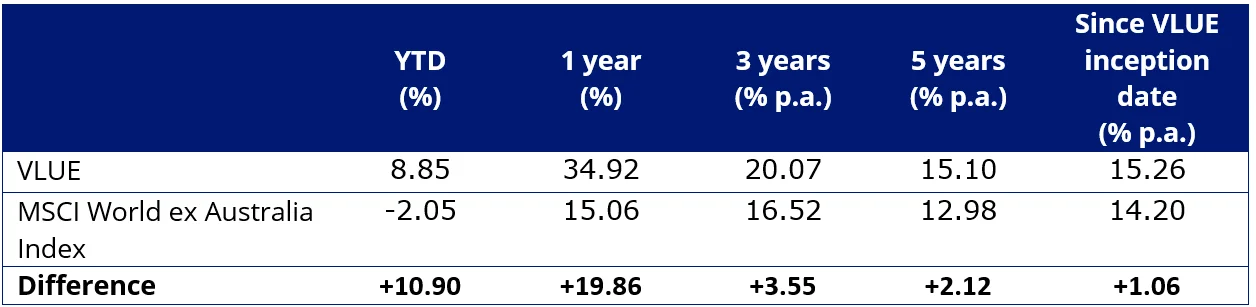
Source: VanEck, Morningstar, Bloomberg. Results assume immediate reinvestment of all dividends and include management fees but exclude brokerage costs and taxes. Past performance is not indicative of future performance.
VLUE inception date is 8 March 2021, and a copy of the factsheet is here.
The MSCI World ex Australia Index (“MSCI World ex Aus”) is shown for comparison purposes as it is the widely recognised benchmark used to measure the performance of developed market large- and mid-cap companies, weighted by market capitalisation. VLUE’s index measures the performance of 250 international large- and mid-cap companies selected from the MSCI World ex Australia Index with high value scores relative to their peers at rebalance. Exclusions apply for weapons and tobacco. Consequently, VLUE’s index has fewer companies and different country and industry allocations than MSCI World ex Aus. Click here for more details.
We launched a hedged version of VLUE, the VanEck MSCI International Value (AUD Hedged) ETF (HVLU), in 2023, to allow investors to manage their desired currency exposure.
The new value map
Value is often described as pro-cyclical and inflation-sensitive. In an environment in which the RBA has lifted the cash rate to 4.35%, US 30-year yields have risen to above 5%, and where the market is pricing higher-for-longer, the macroeconomic regime potentially favours the value factor more than at any point since the early 2000s.
We are not in the business of timing factors, but we are in the business of making sure that when investors choose to express a view, they could not have done so with tools designed for the investing world of 1934.
Value has not died. It has matured. And the approach embedded in VLUE is, in our view, a far more credible vehicle for the journey ahead than the price-to-book portfolios of investing's first century. We think it is the benchmark for international value investing.
Key risks
An investment in our international value ETF carries risks associated with: ASX trading time differences, financial markets generally, individual company management, industry sectors, foreign currency, country or sector concentration, political, regulatory and tax risks, fund operations, liquidity and tracking an index. See the VanEck MSCI International Value ETF PDS and TMD for more details.
VLUE is likely to be appropriate for a consumer who is seeking capital growth, is intending to use the product as a major, core, minor or satellite allocation within a portfolio, has an investment timeframe of at least 5 years, and has a high risk/return profile.

Published: 08 May 2026
1MSCI, Finding Value: Understanding Factor Investing (2015)
Any views expressed are opinions of the author at the time of writing and is not a recommendation to act.
VanEck Investments Limited (ACN 146 596 116 AFSL 416755) (VanEck) is the issuer and responsible entity of all VanEck exchange traded funds (Funds) trading on the ASX. This information is general in nature and not personal advice, it does not take into account any person’s financial objectives, situation or needs. You should consider whether or not an investment in any Fund is appropriate for you. Investments in a Fund involve risks associated with financial markets. These risks vary depending on a Fund’s investment objective. Refer to the applicable product disclosure statement (PDS) and target market determination (TMD) available at vaneck.com.au for more details. Investment returns and capital are not guaranteed.