Access the new resource race


We are delighted to share that we have launched the VanEck Rare Earth and Strategic Metals ex China ETF (RESM), providing Australian investors with targeted exposure to the companies mining and refining the metals which underpin some of the most consequential megatrends of our time.
VanEck, known for its innovation and intelligent investing, launched the first and largest rare earth and strategic metals ETF in the United States (NYSE: REMX). That fund has accumulated more than US$2 billion in assets under management and a 15 year-plus track record. Now, Australian investors have the chance to access our experience as well as this investment opportunity on our own bourse.
What are rare earth and strategic metals?
Rare earth elements (REEs) are a group of 17 elements composed of scandium, yttrium, and the 15 lanthanides. In addition to these, many investors are interested in other strategic or critical metals such as lithium, cobalt and molybdenum. These REEs and strategic metals have been used in many of the technological innovations of the past several decades and are expected to contribute to the innovations of tomorrow.
Although the name implies scarcity, many aren’t all that rare. Cerium, for example, is more common than copper. However, many rare earth and strategic metals do not always occur in quantities that are commercially viable to mine.
MarketVector Indexes GmbH, the index company that calculates the index that RESM tracks, currently defines rare earth and strategic metals as follows:
|
Strategic Metals |
Rare Earth Elements |
||
|
Antimony |
Manganese |
Cerium |
Terbium |
|
Arsenic |
Molybdenum |
Dysprosium |
Thulium |
|
Beryllium |
Niobium = Columbium |
Erbium |
Ytterbium |
|
Bismuth |
Rhenium |
Europium |
Yttrium |
|
Cadmium |
Selenium |
Gadolinium |
|
|
Chromium |
Strontium |
Holmium |
|
|
Cobalt |
Tantalum |
Lanthanum |
|
|
Gallium |
Tellurium |
Lutetium |
|
|
Germanium |
Thallium |
Neodymium |
|
|
Hafnium |
Titanium |
Praseodymium |
|
|
Indium |
Tungsten |
Promethium |
|
|
Lithium |
Vanadium |
Samarium |
|
|
Magnesium |
Zircon and Zirconium |
Scandium |
|
Source: MarketVector Indexes GmbH
How are rare earths and strategic metals used?
Rare earth and strategic metals have been increasingly used in high tech applications linked to AI, defence or the transition to a low carbon world among others. These uses have pushed demand for many of these metals higher in recent years and current trends indicate that demand may only increase.
Common uses for rare earth and strategic metals
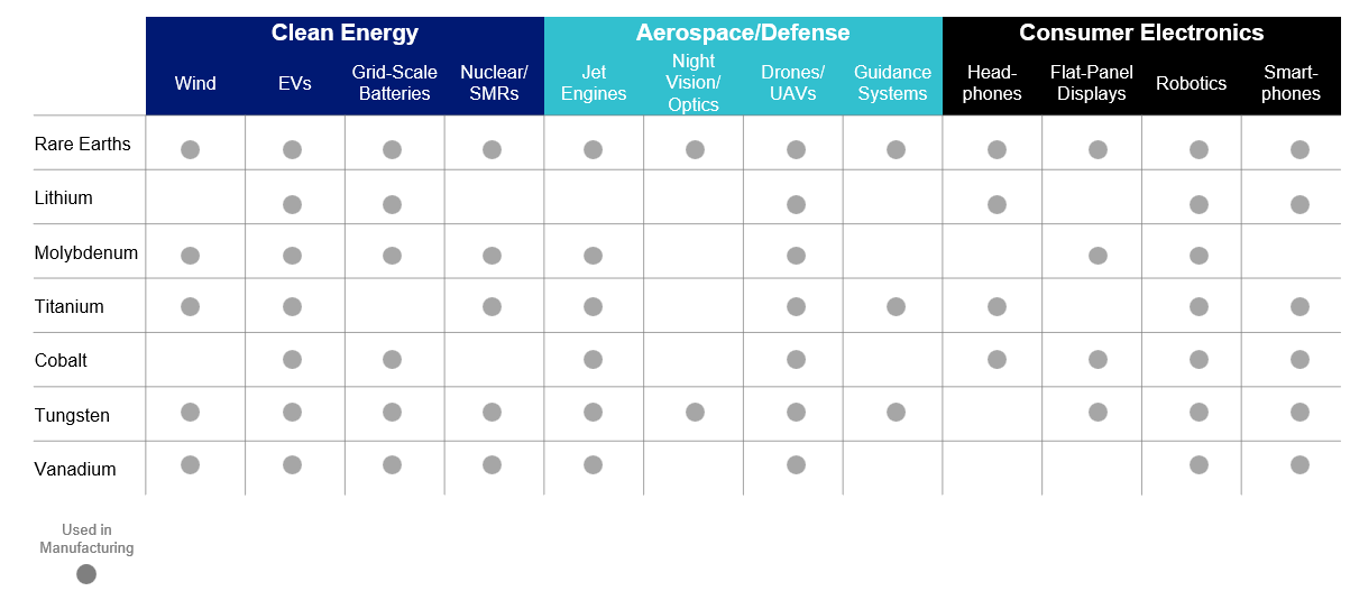
Source: VanEck. For illustrative purposes only.
Why invest in rare earths and strategic metals?
Rare earths and strategic metals sit at the centre of several of the world’s most urgent structural themes: AI infrastructure, defence modernisation, grid expansion and supply chain security.
- Supply chain vulnerabilities are being exposed: Recent geopolitical events have again highlighted how fragile commodity supply chains can be. While energy markets often receive the most attention, the impact has extended into metals, mining inputs and critical materials. The result may be continued pressure on both volumes and production costs, creating a more supportive environment for select commodities.
- Rare earth prices reflect geopolitical scarcity: Neodymium-praseodymium, often used as a proxy for rare earth pricing, has experienced significant volatility driven by export controls and geopolitical tension. China controls the dominant share of rare earth supply and has restricted exports of both rare earth materials and magnet-making equipment. With limited near-term relief, rare earth prices may remain supported.
- Rare earths have an outsized economic impact: Rare earths represent a small physical market, but they play an essential role in aerospace, defence, electronics, communications and transportation. Substitution is difficult in many of these applications, especially where high-strength, high-heat permanent magnets are required.
- Defence and robotics may drive magnet demand: Permanent magnets vary by strength and heat tolerance. Defence applications typically require some of the highest-performance magnets, while robotics demand very strong magnets as automation expands. Across transportation, defence, robotics and communications, permanent magnet demand could rise meaningfully over the next decade.
- Increased government spending is a key tailwind: In late 2025, the United States signed separate critical minerals partnerships with Australia and Japan to help finance and accelerate new mining, refining and downstream processing projects outside China. More recently, the United States and the European Union formalised a strategic partnership and action plan to strengthen critical mineral supply chains, paving the way for more initiatives such as offtake agreements and standards-based markets. These are just a few examples of governments treating critical minerals as strategic assets rather than ordinary commodities, and they are unlikely to be the last.
How is AI driving demand for rare earths?
Artificial intelligence is as much a software revolution as it is a vast industrial build-out. As that build-out gathers pace, demand spreads well beyond software and semiconductors into the infrastructure needed to manufacture chips, power data centres and expand electricity networks. Rare earths and strategic metals sit throughout that ecosystem, becoming more important as each stage of the build-out unfolds.
The AI investment cycle is also well underway. The world's largest technology companies are collectively investing hundreds of billions of dollars in new AI infrastructure, while the global semiconductor market is projected to almost double to US$1.5 trillion in 20261. As that infrastructure expands, so too does demand for electricity, manufacturing capacity and the specialised materials supporting both. The International Energy Agency estimates AI data centres alone could account for around 3% of global rare earth demand by 2030.
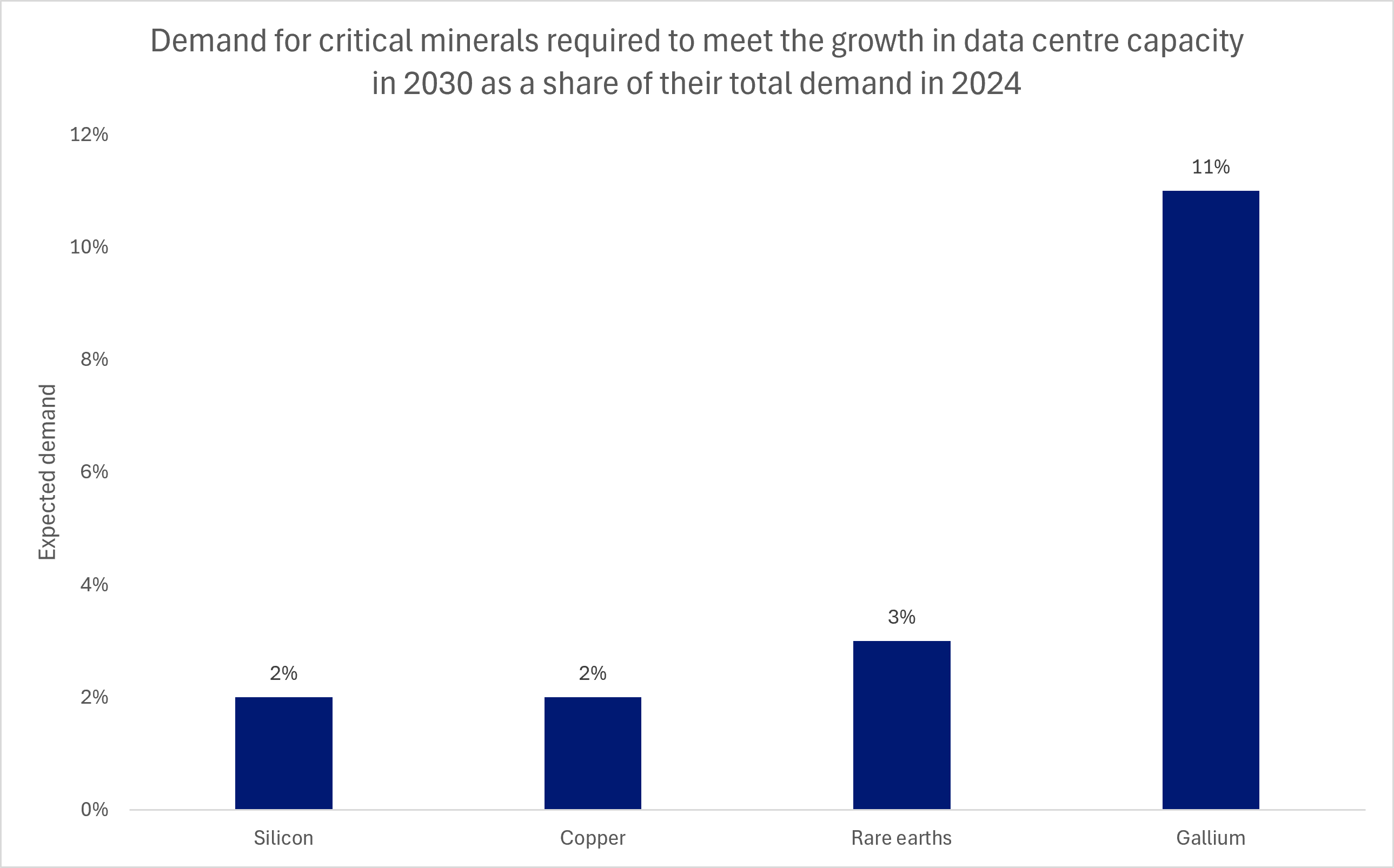
Source: EIA, Energy and AI: Energy and AI – Analysis – IEA. For illustrative purposes only. Not intended as a forecast or prediction of future results.
What is the role of rare earths in defence?
The world is entering a new defence spending cycle. Rising geopolitical tensions have prompted governments to commit significantly more capital to defence, while NATO members have agreed to increase defence spending to 5% of GDP by 2035.
Yet the significance of that spending lies not simply in its size, but in where it is being directed.
Modern defence increasingly relies on technologies rather than traditional hardware alone. Precision-guided weapons, drones, advanced radar systems, fighter aircraft and submarines all depend on specialised materials that are difficult to substitute. Rare earths such as neodymium, praseodymium, dysprosium and samarium are used throughout these systems because of their unique magnetic and electrical properties, making them essential to many next-generation defence capabilities.
|
Defence platform |
Rare earth applications |
Key rare earth elements used |
|
F-35 Fighter Jet |
Guided missiles, targeting lasers, drive motors |
Neodymium (Nd), Praseodymium (Pr), Samarium (Sm), Dysprosium (Dy), Terbium (Tb), Europium (Eu), Yttrium (Y) |
|
Arleigh Burke DDG-51 Destroyer |
Advanced radar systems, missile guidance systems, propulsion, drive motors |
Neodymium (Nd), Praseodymium (Pr), Samarium (Sm), Dysprosium (Dy), Terbium (Tb), Lanthanum (La), Gadolinium (Gd), Yttrium (Y) |
|
Virginia-class Submarine |
Tomahawk missiles, radar systems, drive motors |
Neodymium (Nd), Praseodymium (Pr), Samarium (Sm), Dysprosium (Dy), Terbium (Tb), Lanthanum (La), Gadolinium (Gd), Yttrium (Y) |
Are rare earths involved in the energy transition?
The transition to cleaner energy is often thought of as a shift from fossil fuels to renewables. It is also a shift towards a far more mineral-intensive economy. Electric vehicles, battery storage systems, wind turbines and modern electricity networks all require significantly larger quantities of specialised metals than the technologies they are replacing.
Rare earths are particularly important because they are used in the permanent magnets that power electric vehicles and many modern wind turbines, while other strategic metals underpin batteries, electricity transmission and grid-scale storage. As countries continue investing in electrification and energy security, demand for these materials is expected to grow alongside them. The table below shows just some of the applications of rare earths in this particular megatrend:
|
Technology |
Applications |
Representative metals |
|
Electric vehicles |
Permanent magnet motors and lithium-ion batteries |
Nd, Pr, Dy, Tb, Sm, Li, Co, Mn |
|
Wind turbines |
Direct-drive permanent magnet generators |
Nd, Pr, Dy, Tb |
|
Grid-scale battery storage |
Lithium-ion and vanadium flow batteries |
Li, Co, Mn, V |
Sources: IRENA (2022); IEA; Adamas Intelligence; Benchmark Mineral Intelligence. For illustrative purposes and may vary by motor type, generator design (direct-drive vs geared) and battery chemistry.
Why choose VanEck's RESM?
The VanEck Rare Earth and Strategic Metals ex China ETF (RESM) provides diversified exposure across companies involved in the mining, refining and recycling of rare earths and strategic metals.
The fund focuses on businesses deriving at least 50% of their revenues from these activities, providing targeted exposure to the parts of the value chain most directly leveraged to growing demand.
Some of these companies will be household names to Australian investors, including PLS Group and Liontown while others are global behemoths such as Albemarle.
Unlike many broader mining ETFs, RESM excludes diversified miners whose revenues are dominated by non-rare earth commodities such as iron ore or copper. It also excludes miners and refiners incorporated in China.
Leverage a proven global provider
VanEck has been investing in this theme for more than a decade through the VanEck Rare Earth and Strategic Metals ETF (NYSE: REMX), the largest ETF of its kind in the United States.
REMX launched in October 2010, making it one of the world's longest running and most established rare earth investment strategies. Australian investors can now access a strategy built on that same global experience. As global industry leaders in semiconductor investing, we are excited to bring this opportunity to Australian investors.
Why does RESM exclude Chinese companies?
As a recent case concerning Northern Minerals demonstrates, a secure supply chain for rare earths outside China is now a strategic priority. Western governments are investing billions of dollars across the entire critical minerals value chain including new mines, refineries and downstream manufacturing. Building an alternative supply chain, according to EY-Parthenon, will take another US$23 trillion and 25 more years, creating a long runway for companies positioned to participate in that expansion.
The urgency is not just economic. Recent export restrictions have reinforced how quickly critical minerals can become geopolitical tools, accelerating efforts to develop alternative supply chains outside China. The investment opportunity lies not in the mature supply chain that already exists, but in the capacity now being built around it.
The RESM opportunity
Raw materials underpinning technology
Rare earth and strategic metals are the irreplaceable inputs behind the technologies transforming the world.
Position for the global race to secure rare earths
As the foundation of defence, AI, semiconductors and the energy transition, rare earths have become a national priority for developed nations worldwide.
Diversified across critical minerals
Access a portfolio of producers across the rare earth and strategic metals complex.
Related Insights


Published: 05 August 2026
1– World Semiconductor Trade Statistics - https://www.wsts.org/76/103/Global-Semiconductor-Market-Surges-Beyond-15T-2026
Any views expressed are opinions of the author at the time of writing and is not a recommendation to act.
VanEck Investments Limited (ACN 146 596 116 AFSL 416755) (VanEck) is the issuer and responsible entity of all VanEck exchange traded funds (Funds) trading on the ASX. This information is general in nature and not personal advice, it does not take into account any person’s financial objectives, situation or needs. You should consider whether or not an investment in any Fund is appropriate for you. Investments in a Fund involve risks associated with financial markets. These risks vary depending on a Fund’s investment objective. Refer to the applicable product disclosure statement (PDS) and target market determination (TMD) available at vaneck.com.au for more details. Investment returns and capital are not guaranteed.