A blockbuster that investors can participate in


When Grand Theft Auto V launched in 2013, players spent more than US$1 billion in three days. Its players have had to wait more than 13 years for its successor. But the wait will finally end this week when the game is released to the world.
One report suggests the game has already sold more than seven million units in preorders, which would imply more than US$750 million in revenue for its publisher Take Two Interactive (NASDAQ: TTWO).
Those preorder figures offer a glimpse of the spending that makes gaming an investment opportunity. But the investment opportunity extends well beyond blockbuster releases. The wider video gaming industry has evolved from a niche concept into a multibillion-dollar business that reaches people across the world on many devices and in more ways than ever.
The spending after the sale
Just as Super Mario Bros and the Legend of Zelda are synonymous with Nintendo, the GTA franchise is indelibly linked to Take-Two.
By 30 September 2026, the company reported that GTA V had sold more than 235 million units into retail and digital distribution channels. GTA VI may well exceed this figure.
But the real jewel in the crown may not be the initial game purchase but its online multiplayer experience, GTA Online. That platform has reportedly generated more than US$5 billion in revenue for its parent company since it was launched over a decade ago.
Early on, the relationship between video game companies and their customers ended at the point of sale. Now, they can continue to generate income from their customers through mobile and internet apps, membership tiers, additional content or virtual currency.
In the June 2026 quarter, recurrent consumer spending accounted for 81% of Take-Two’s revenue.
The revenue surge is industry-wide
Take Two Interactive is far from the only publisher benefitting from this theme.
Statista forecasts global esports revenue of US$4.9 billion in 2026, rising to US$6.1 billion by 2031, with income coming from a range of sources.
Moreover, Newzoo forecasts global video gaming revenue of nearly US$214 billion in 2026, up more than 6% on the previous year. Most of that revenue is projected to come from mobile games with consoles and PC games expected to make up the remainder.
Table 1: Mobile accounts for more than half of forecast gaming revenue
|
Platform |
Forecast 2026 revenue |
Share |
|
Mobile |
US$121.1 billion |
57% |
|
Console |
US$46.9 billion |
22% |
|
PC |
US$45.9 billion |
21% |
Source: Newzoo, Global Games Market Report 2026. Forecasts.
Mobile gaming is a global phenomenon with mass participation in both emerging and developed markets. Free games can earn through advertising and optional purchases, giving publishers access to people who may never buy a console or a full-priced game.
Familiar characters, different businesses
Gaming has become a pastime that people carry into adulthood. In Australia, the average player is 35 years old and adults account for 81% of players, according to the 2025 Australia Plays report. For investors, that creates an audience extending well beyond each new generation of children picking up a controller.
That audience supports substantial businesses, from Nintendo’s familiar characters to Tencent’s mobile and PC games and Roblox’s platform of games and virtual experiences.
Table 2: The growing business behind the games
|
Company |
Annual revenue in 2020 |
Latest full-year revenue |
Total growth |
|
Nintendo |
¥1.31 trillion |
¥2.31 trillion (2026) |
77% |
|
Tencent’s gaming business |
RMB156.1 billion |
RMB241.6 billion (2025) |
55% |
|
Roblox |
US$924 million |
US$4.89 billion (2025) |
429% |
Sources: Company financial results; VanEck calculations. Nintendo’s financial year ends on 31 March; Tencent and Roblox report calendar years. Tencent figures cover gaming revenue; Nintendo and Roblox figures represent total company revenue. Growth is cumulative, includes acquisitions where applicable and has not been consistent each year.
Together, these figures point to an industry attracting new audiences while retaining relevance across generations, giving gaming businesses more opportunities to earn throughout a player’s life.
More than a game
People don’t have to play a game to become part of its audience. According to its organisers, the 2026 Esports World Cup recorded two million visits across its competition venues, fan festival and associated events, while global broadcasts generated 440 million hours watched.
An audience of that size creates opportunities for ticketing, sponsorship and advertising, extending the business of gaming beyond the people holding the controllers. Partners included Sony, Lenovo, Allianz and Hilton.
Even the sovereign wealth fund of Saudi Arabia is now an esports investor following its acquisition of two businesses in 2022.
Nintendo’s characters also earn beyond the console through films, merchandise and theme park attractions. Its broader business covering films, mobile content, royalties and official-store merchandise (so-called “IP-related content”) generated ¥62.7 billion in the six months to September 2026, accounting for around 6.5% of the company’s total revenue.
AI is changing the economics of development too. As we have explored in previous commentary, it could help publishers produce new games and content faster, reducing some development costs.
Roblox’s Cube system provides a practical example, allowing creators to generate three-dimensional objects from written prompts. Less time spent building individual objects can leave more time for testing ideas and improving the game people will play.
Getting a share of the action
Investors who invest in the Nasdaq 100 may not own a large video gaming exposure. Nintendo and Tencent are listed outside the US, while publishers such as Take-Two account for only a small part of that index. A specialised ETF gives these businesses a more meaningful place in a portfolio, providing targeted exposure to an industry that broad technology investments tend to overlook.
Esports companies can also help investors diversify beyond the largest US technology stocks. As the below chart shows, the relationship between weekly returns from ESPO’s index and the Magnificent Seven has broadly weakened since 2020 even if their returns remain positively correlated (meaning the performance of these two assets move in the same direction).
Chart: Esports stocks vs Magnificent Seven, weekly return rolling correlation
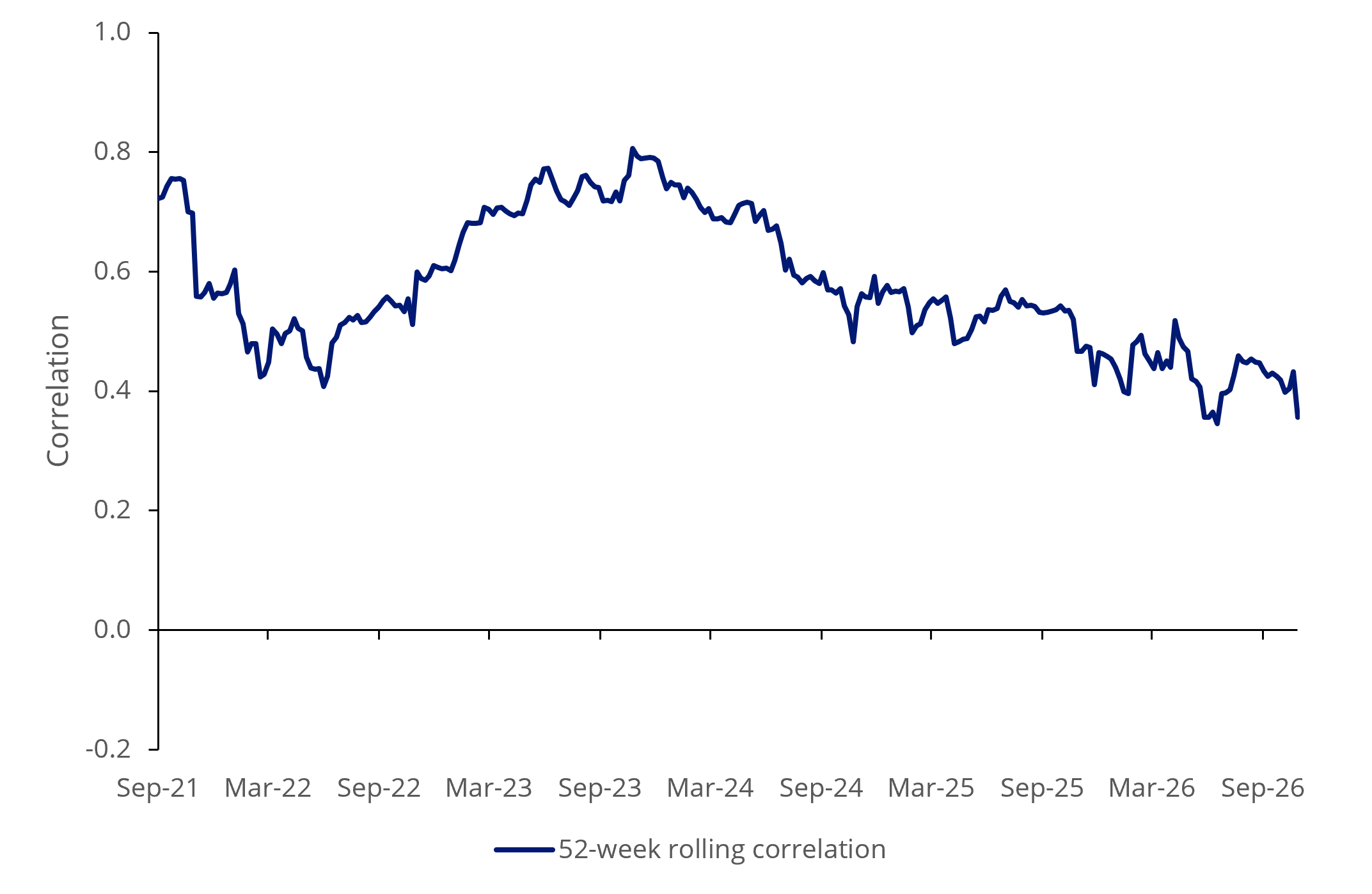
Source: Bloomberg as at 6 November 2026. Esports stocks is MVIS Global Video Gaming and eSports Index (AUD) (TR Net). Mag 7 Index is Bloomberg Magnificent 7 Total Return Index.
The VanEck Video Gaming and Esports ETF (ESPO) brings these opportunities together in one ASX trade. It tracks the MVIS Global Video Gaming & Esports Index, providing access to pure-play companies involved in developing games, esports and associated hardware and software around the world. Pure play is defined as companies that generate at least 50% of their revenue from video gaming and/or esports or 25% applying to existing constituents.
Through ESPO, investors gain exposure to different franchises, platforms and markets. And with each stock capped at an 8% weighting (on rebalance), helping limit the portfolio’s exposure to any one company.
GTA VI will give millions of people another reason to spend money on gaming. ESPO offers investors a way to own a share of the businesses behind that spending, long after the excitement of launch day.
Key risks
An investment in our video gaming and esports ETF carries risks associated with: ASX trading time differences, emerging markets, financial markets generally, individual company management, industry sectors, foreign currency, country or sector concentration, political, regulatory and tax risks, fund operations, liquidity and tracking an index. See the VanEck Video Gaming and Esports ETF PDS and TMD for more details.
ESPO is likely to be appropriate for a consumer who is seeking capital growth, is intending to use the product as a satellite allocation within a portfolio, has an investment timeframe of at least 5 years, and has a very high risk/return profile.


Published: 12 November 2026
Any views expressed are opinions of the author at the time of writing and is not a recommendation to act.
VanEck Investments Limited (ACN 146 596 116 AFSL 416755) (VanEck) is the issuer and responsible entity of all VanEck exchange traded funds (Funds) trading on the ASX. This information is general in nature and not personal advice, it does not take into account any person’s financial objectives, situation or needs. You should consider whether or not an investment in any Fund is appropriate for you. Investments in a Fund involve risks associated with financial markets. These risks vary depending on a Fund’s investment objective. Refer to the applicable product disclosure statement (PDS) and target market determination (TMD) available at vaneck.com.au for more details. Investment returns and capital are not guaranteed.