The ETFs more financial advisers are choosing


Toothbrush maker Oral-B’s advertisements frequently claim that its toothbrush is the one most dentists recommend.
Anyone old enough may even remember the TV ads featuring Rob, the dentist whose face they could not show on camera. He was a dentist brushing his teeth in front of the mirror, and we were prompted to wonder which toothbrush he used. “Show them Rob,” the voice over said before Rob revealed an Oral-B branded toothbrush.
Oral-B was not claiming that no other toothbrush could not clean teeth. The implication was that when professionals make a recommendation, design and outcomes matter. Financial advisers make a similar judgement when selecting ETFs for client portfolios.
Oral health has come a long way since Rob graced our TV. So too has investing. When ETFs were first offered to investors over 25 years ago the ETF structure itself was the innovation. Now, more than 500 funds are listed on the ASX, together managing more than $380 billion in assets.
And, just as toothbrush design has moved beyond the basic manual brush, ETF design has moved beyond providing market access. Advisers are looking more closely at the smarts inside the fund.
Access won the first era
The first Australian ETFs tracked the S&P/ASX 200. They offered a new investment vehicle that would be more transparent, tradeable and accessible – but no new view about which companies would prosper.
Nevertheless, the innovation worked and today, financial advisers are among the biggest users of ETFs.
ETF use among financial advisers has reached 96%, according to the 2026 VanEck Smart Beta Survey. That’s up 13 percentage points on the first survey’s results in 2016. Given this near-ubiquity, adoption is no longer the issue. Rather, it gives us clues as to why advisers keep using and adding more ETFs to their portfolio.
When we asked that question, one-third cited the long-term underperformance of active managers. This makes sense to us. As we noted in our recent analysis of the SPIVA Australia Scorecard, 89% of active Australian large-cap funds underperformed the S&P/ASX 200 over the 15 years to June 2026. When disappointment persists for that long, advisers reconsider which investment decisions are worth paying someone to make.
Chart 1: What drives adviser use of ETFs
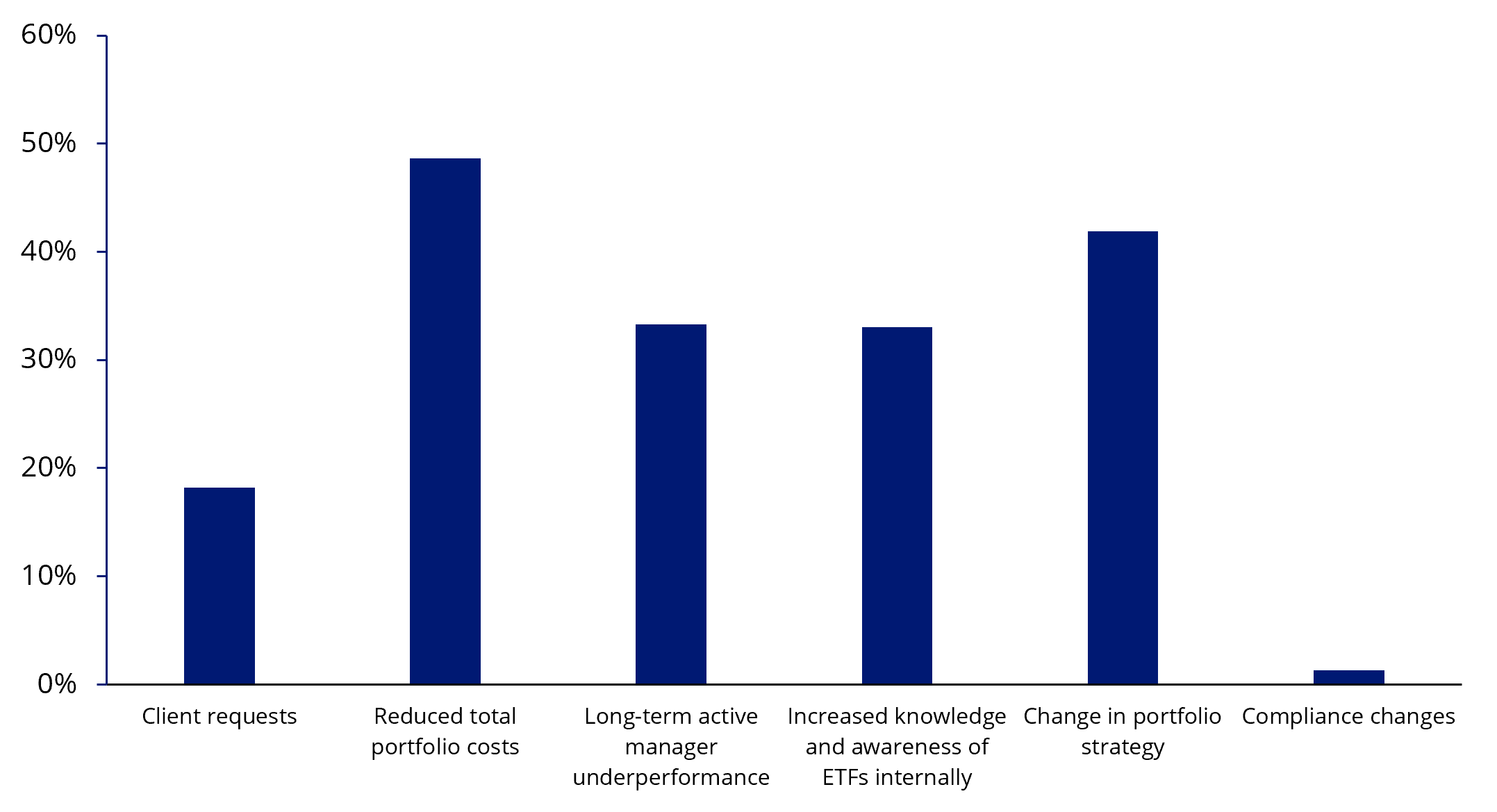
Source: VanEck 2026 Smart Beta Survey. “Other” and “Not applicable” responses were excluded from this chart. Responses will not sum to 100% as multiple responses were permitted.
That raises the standard for the next generation of ETFs. 25 years ago, the structure was the innovation. But just as technology changed oral care, so too has ETFs and it is this technology that advisers are considering in greater numbers.
The survey suggests financial professionals are using smart beta ETFs in greater numbers. Smart beta adoption reached a record 55% in 2026, up from 48% last year and 37% ten years ago.
Smart beta is the term given to ETFs which track an index that differs from the traditional market capitalisation approach of giving the largest weights to companies with the greatest market value. It can be thought of as an additional, more considered layer or filter that helps decide what goes into a fund and what gets left out. Examples include factors such as quality and value, as well as alternative weighting methods such as equal weighting.
Among advisers already using smart beta, almost two-thirds employ at least two strategies while half of respondents say they are evaluating another allocation. Those responses are not contradictory. They show advisers are choosing which portfolio decisions they want a strategy to make.
The active-passive debate may no longer be useful
The old active-passive divide is also becoming less useful. Smart beta has emerged as the third option. 64% say they use smart beta as a substitute for active management, while 50% use it as a substitute for market capitalisation passive management.
Chart 2: How do you use smart beta ETFs?
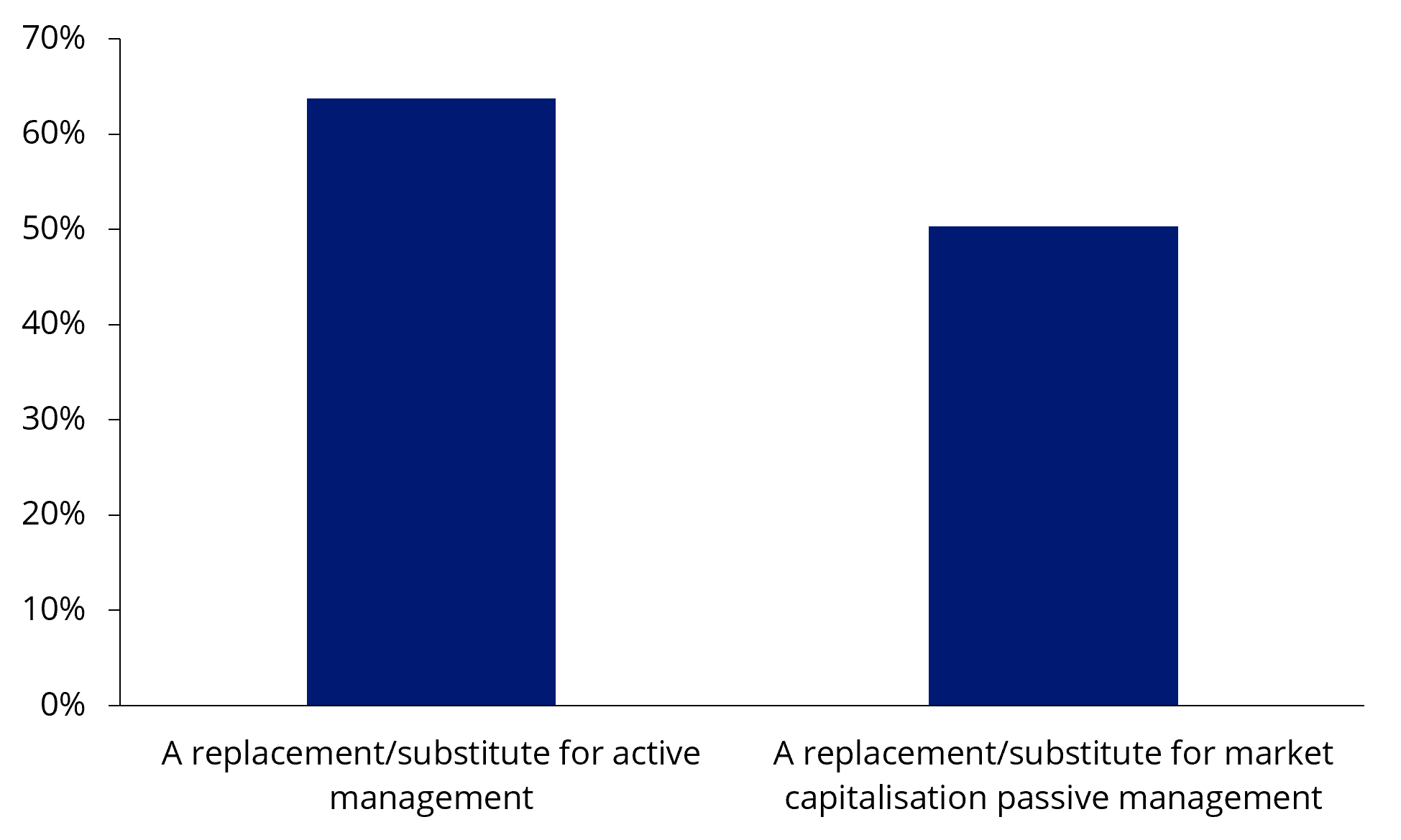
Source: VanEck 2026 Smart Beta Survey. “Other” and “Not applicable” responses were excluded from this chart.
Smart beta product selection echoes ETF use. Increased performance ranked highest when respondents assessed smart beta products, followed by performance through up and down markets and improved diversification. Reducing costs compared with active management mattered, but it ranked below all three.
Chart 3: What matters when choosing a smart beta product
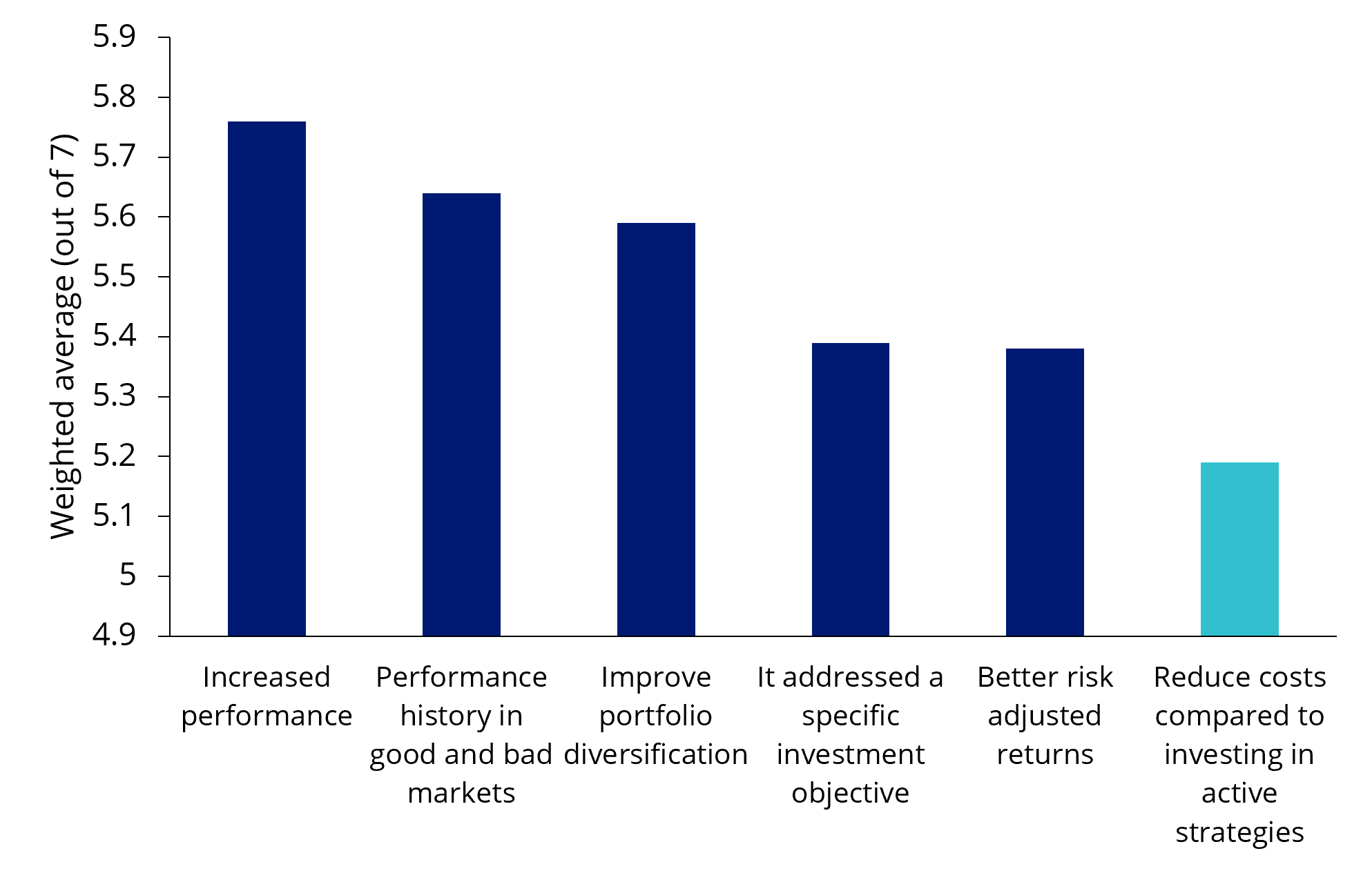
Source: VanEck 2026 Smart Beta Survey.
That ranking points to an important distinction. Advisers are not ignoring cost; they are judging it against the result a strategy is designed to deliver.
Four in five respondents agree that smart beta investments represent good value for money. A low fee is easy to compare, but it says little about whether an exposure improves diversification, behaves as intended across markets or gives an adviser greater control over portfolio outcomes.
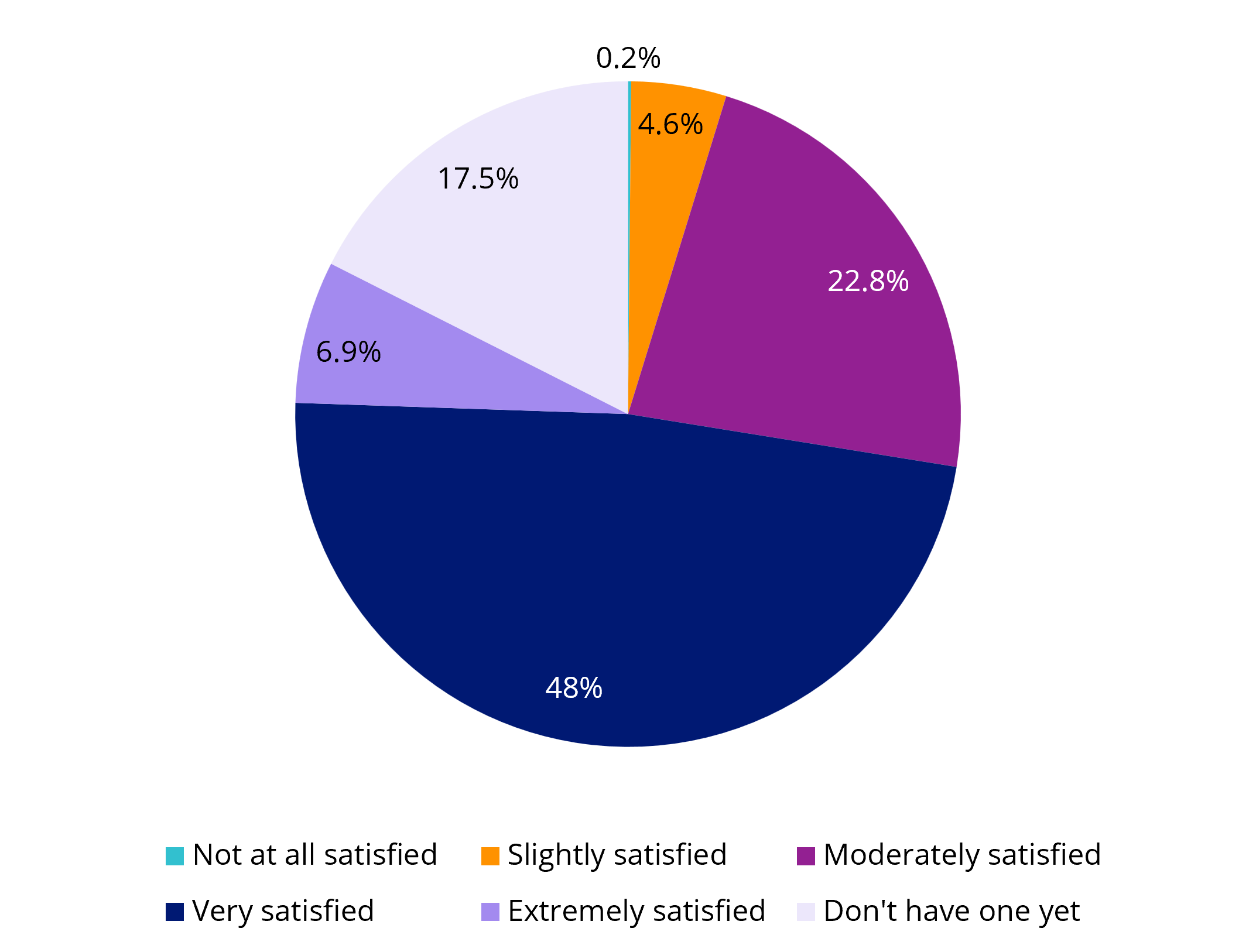
More broadly, nearly all advisers who use smart beta investments say they are satisfied with them, including more than half who are very or extremely satisfied.
Chart 4: 99.8% of respondents with an allocation are at least slightly satisfied with their smart beta investments
Source: VanEck 2026 Smart Beta Survey.
The satisfaction result matters because it is influencing what advisers intend to do next. Almost none of the advisers who responded to the survey expect to reduce their exposure to smart beta.
That is the behaviour of an approach moving to portfolio staple. Advisers are not only retaining smart beta; many are preparing to give it more responsibility inside portfolios.
The remaining obstacle appears to be understanding. Among advisers not yet using smart beta, limited knowledge is the leading barrier to use by a wide margin. That suggests the next stage of growth will depend less on winning the active-passive argument and more on explaining what each strategy does, when it may help and how it fits alongside existing allocations.
Advisers are assembling ideas, not buying labels
The growing use of several smart beta strategies in the same portfolio points to another change. Advisers appear less interested in finding one permanent winner and more so in combining different ways of finding opportunity.
Quality remains the leading equity approach, while value and multi-factor strategies have gained ground.
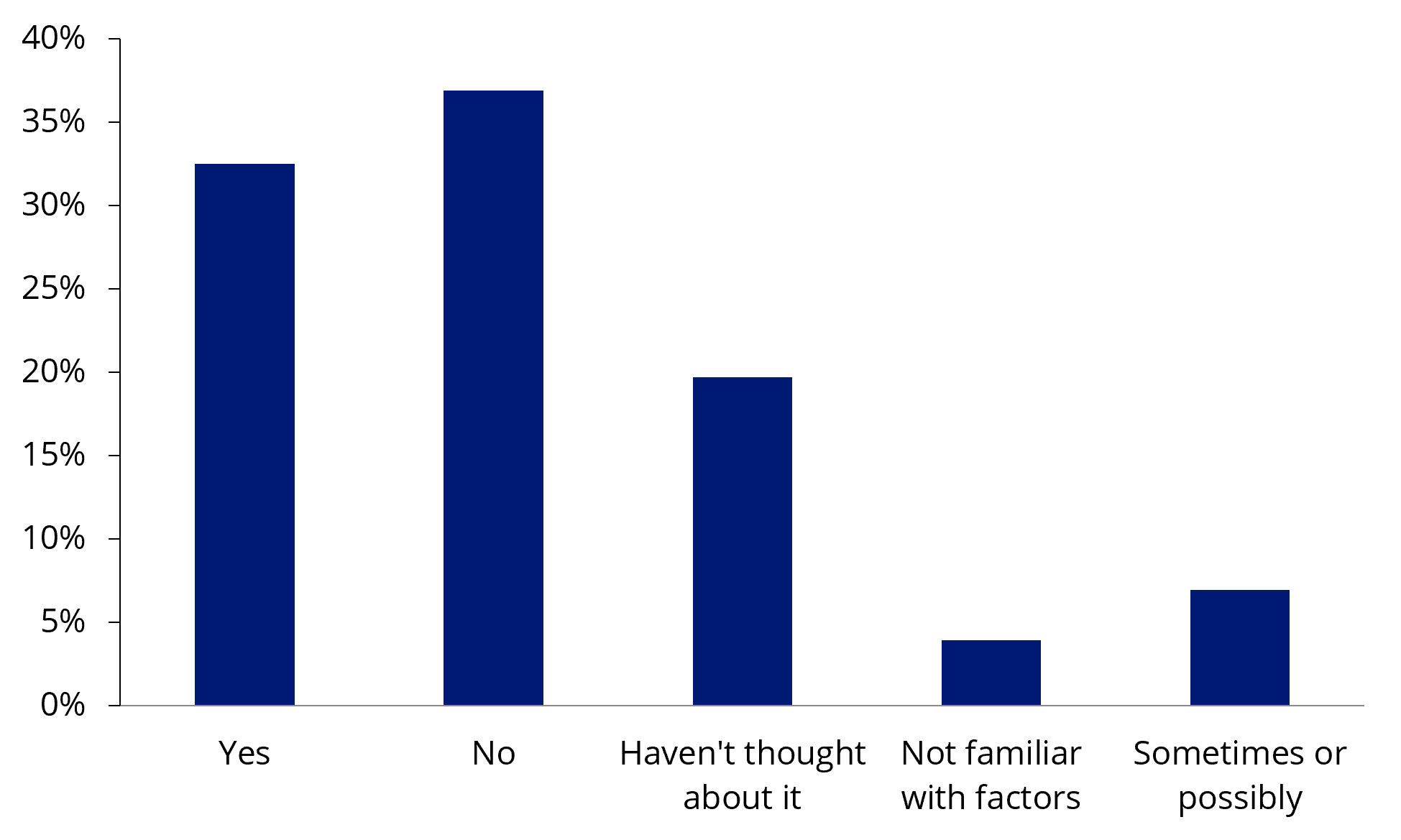
Respondents remain divided over whether factor rotations can be timed with success. Building a portfolio with several distinct sources of return may be more durable than trying to predict which factor will lead next.
Chart 5: Do advisers think it is possible to successfully time factors?
Source: VanEck 2026 Smart Beta Survey.
Better choice, not endless choice
The Australian ETF market does not lack products. The results of the 2026 VanEck Smart Beta Survey, the world’s largest of its kind, show that advisers now expect more. To justify its place in a portfolio, each new strategy must improve an existing exposure or replace one that is not delivering the intended outcome.
Oral-B understood that professional recommendation is earned through design and results. The next era of ETFs will be won on the same terms: not by giving advisers more to choose from, but by giving them better reasons to choose.
Related Insights


Published: 08 October 2026
Any views expressed are opinions of the author at the time of writing and is not a recommendation to act.
VanEck Investments Limited (ACN 146 596 116 AFSL 416755) (VanEck) is the issuer and responsible entity of all VanEck exchange traded funds (Funds) trading on the ASX. This information is general in nature and not personal advice, it does not take into account any person’s financial objectives, situation or needs. The product disclosure statement (PDS) and the target market determination (TMD) for all Funds are available at vaneck.com.au. You should consider whether or not an investment in any Fund is appropriate for you. Investments in a Fund involve risks associated with financial markets. These risks vary depending on a Fund’s investment objective. Refer to the applicable PDS and TMD for more details on risks. Investment returns and capital are not guaranteed.