Chokepoints and market risk, why quality may be key


As the US-Iran war drags on, now in its seventh week, the economic fallout is broadening: US consumer sentiment has plunged to a record low, inflation expectations have spiked, and global growth forecasts are being revised down.
And yet, equity markets continue to rally on any signs of a deal between the US and Iran, the S&P 500 has climbed to reach an all-time high, despite oil prices remaining elevated above US$90/barrel, the Strait of Hormuz remaining disrupted, and a US naval blockade on Iranian ports now in effect.
We think markets may be underestimating the risk of lower growth and when it eventuates it may drive market volatility, particularly if the conflict persists and energy-driven inflation continues to erode purchasing power and weigh on consumption.
Last week, the IMF downgraded its 2026 global growth forecast to 3.1% (from 3.3% in January), and the market didn’t blink, but we think this reinforces the case for strengthening defensive positioning in investors' portfolios.
Quality companies due to their defensive characteristics typically outperform during periods of weaker growth and heightened market volatility, we also think valuations present a compelling entry point.
Chokepoints
In his book, Chokepoints, Edward Fishman detailed tariffs and economic warfare, as the new weapons in geopolitical battles. Iran is one of Fishman’s case studies. Iran wasn't just sanctioned, it was effectively cut off from the developed world by being excluded from the US dollar based financial system and its access to systems like SWIFT was restricted. Pressure was put on global banks to prevent them from doing business with the Gulf state.
The chokepoint, the US could influence in its battle with Iran were financial and technological.
Iran, of course, has its own chokepoint. A geographical one, the Strait of Hormuz. As we all know now, this is one of the world’s most critical oil transit routes, with a huge share of global energy supply passing through it.
In an effort to negate Iran’s chokepoint, the US has implemented a blockade of the Strait of Hormuz.
The standoff has spilled over to the rest of the world, impacting the global economy.
The spillover
The evidence of the economic impact of the war in the Middle East is starting to be felt. Consumer sentiment in the US is at its lowest level ever.
Chart 1: University of Michigan’s Consumer Sentiment Index plunged to a historic low
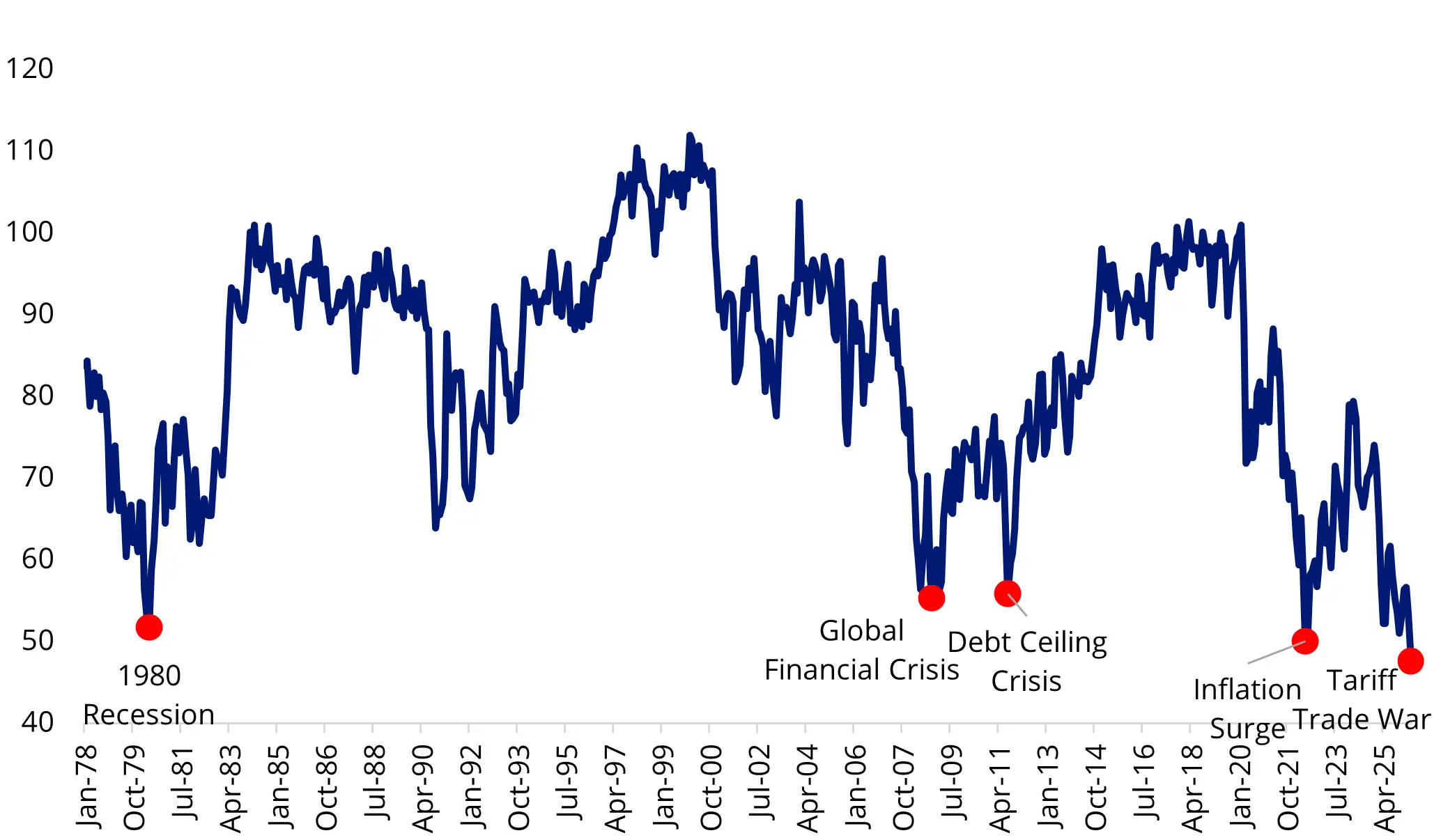
Source: University of Michigan, Bloomberg. Latest data March 2026.
At the same time, we’ve seen US job openings and quit rates gradually slow, reflecting labour market weakness, particularly in the private sector.
Chart 2: US unemployment rise amid recessions
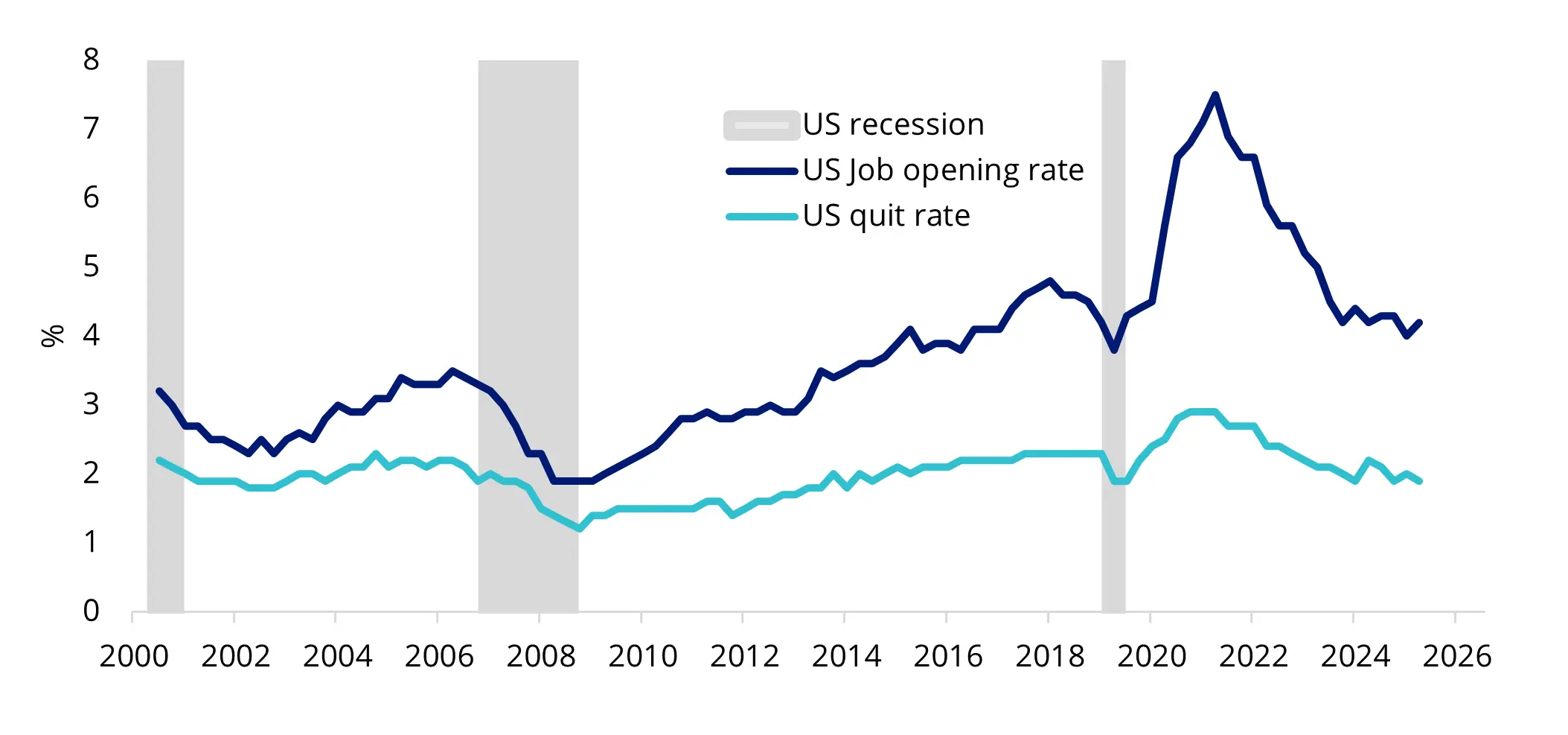
Source: US Bureau of Labor Statistics, Bloomberg. Latest data February 2026.
Despite this, equity markets, after an initial decline, have bounced back with many, including the US, reaching new highs.
We think the market is underestimating the risks of a slowdown.
This past week, the IMF downgraded its 2026 global growth forecast to 3.1% (from 3.3% in January), with a warning that an adverse scenario could see growth fall to just 2.5%. We think this reinforces the case for strengthening defensive positioning in investors' portfolios.
The case for quality now
History suggests that quality companies outperform during economic slowdowns, experiencing smaller declines during market downturns, and recovering more swiftly to previous levels. In our view, looking ahead, should risk sentiment roll back, or if the war continues for longer than expected it could spark economic growth concerns, increasing market volatility, and a ‘flight to quality’ could be triggered.
Chart 3: The volatility Index (VIX Index) vs Quality factor relative performance
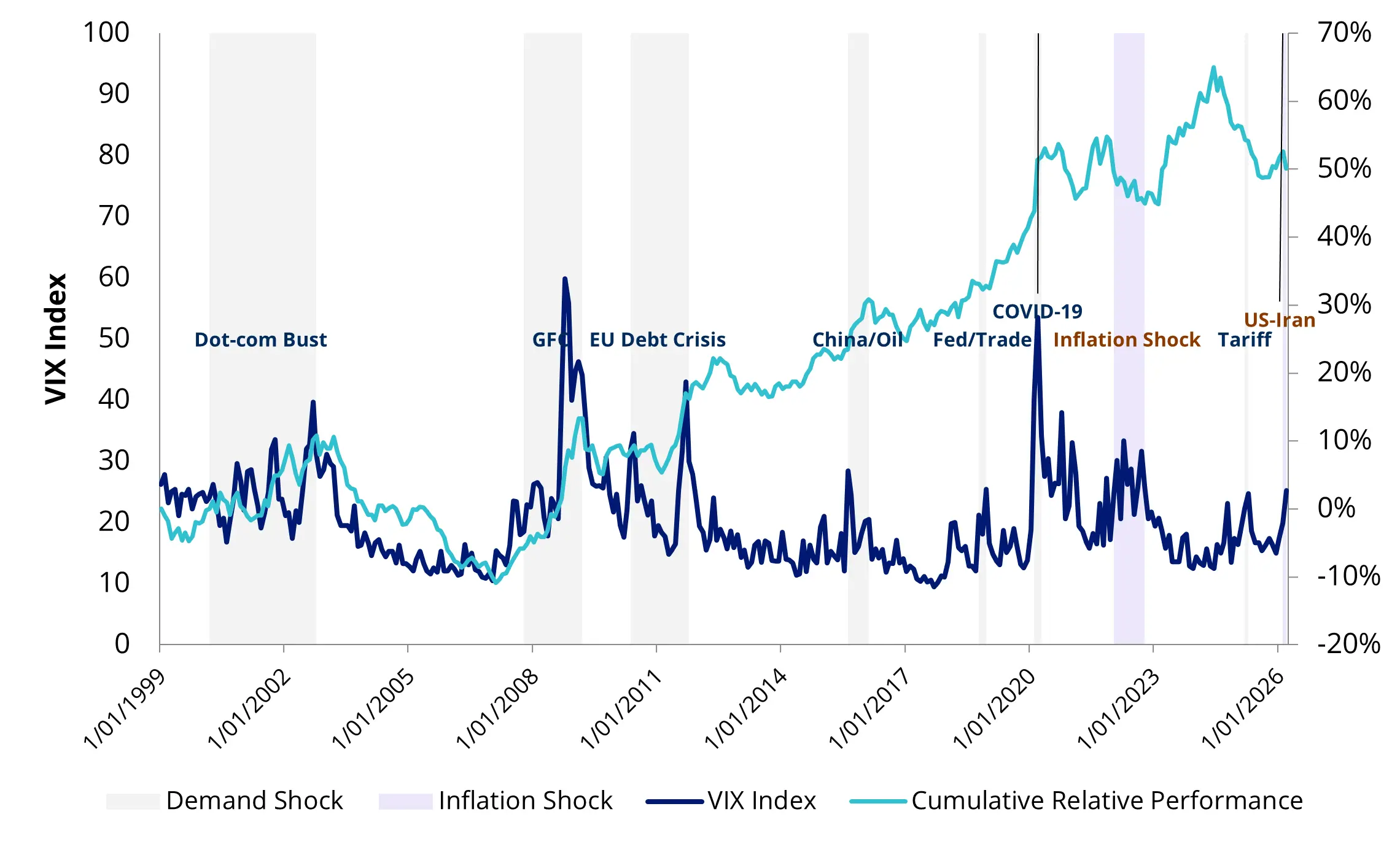
Source: CBOE, MSCI, Bloomberg. Cumulative relative return performance is represented by MSCI World Index and MSCI Quality Index. You cannot invest in an index. Past performance is not indicative of future performance.
Valuations-wise, while quality companies typically trade at a premium to the broader market due to their defensive characteristics, the valuation differential has narrowed toward the 10-year average. This makes for a potentially compelling entry point for quality companies, we think.
Chart 4: Valuations comparison
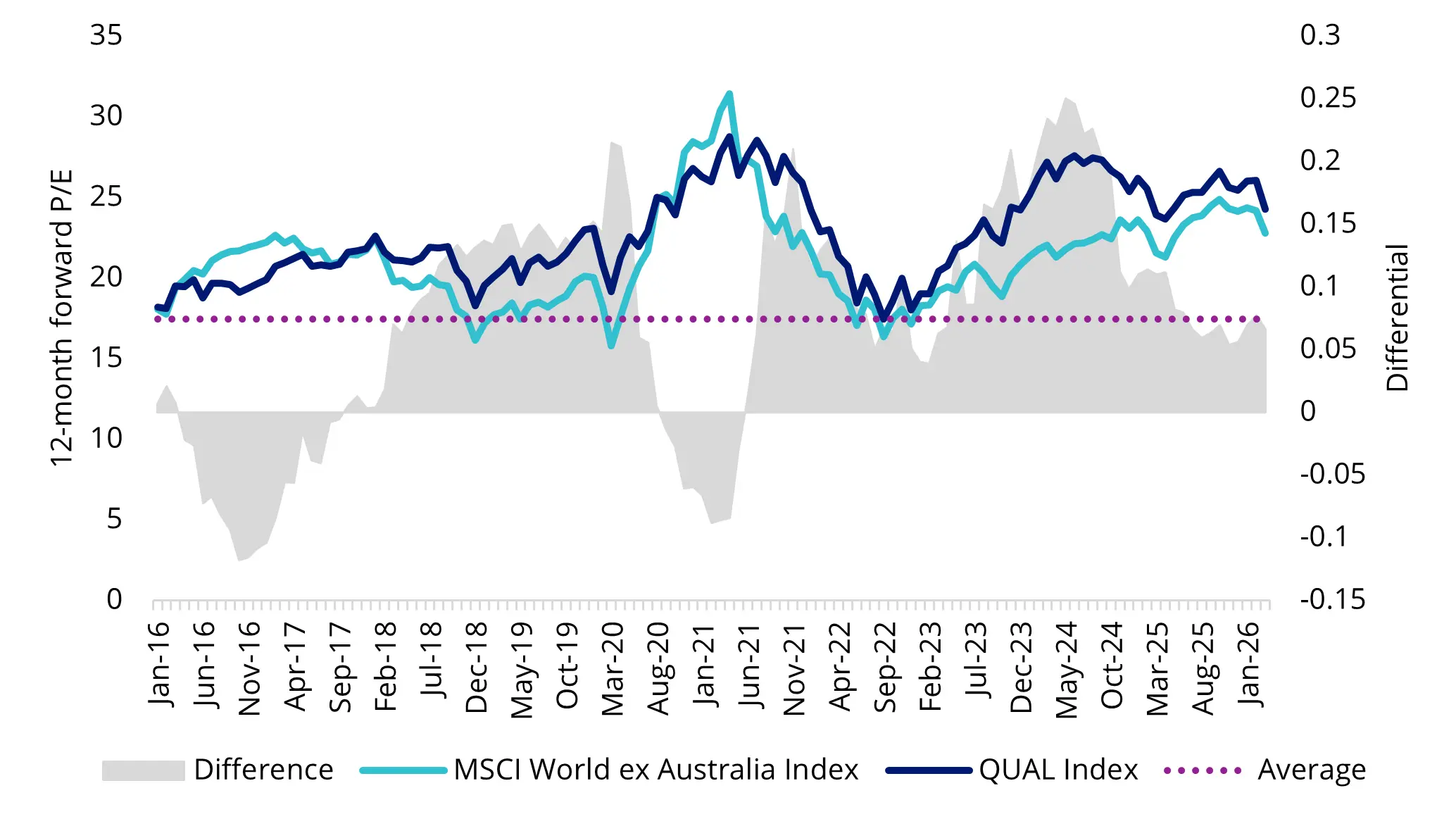
Source: MSCI, Bloomberg. QUAL Index is MSCI World ex Australia Quality Index. You cannot invest in an index. Past performance is not indicative of future performance.
Key points:
- QUAL is an ASX traded ETF that, via a single ASX trade, provides investors with an international equity portfolio of 300 companies with fundamentals that satisfy principles of quality investing advocated by investment greats Benjamin Graham and Warren Buffett, namely:
- High ROE;
- Stable year-on-year earnings growth; and
- Low financial leverage.
- Quality companies have historically demonstrated outperformance during periods of economic slowdown and over the long term.
- With one trade, QUAL provides access to 20 developed countries and is overweight sectors such as healthcare and information technology which are underrepresented in Australia.
- QHAL is an Australian dollar hedged version of QUAL so you can now also manage your desired currency exposure.
Key risks: An investment in the QUAL and QHAL carries risks associated with ASX trading time differences, financial markets generally, individual company management, industry sectors, foreign currency, currency hedging (QHAL), country or sector concentration, political, regulatory and tax risks, fund operations and tracking an index. See the PDS and TMD for details.
QUAL and QHAL are likely to be appropriate for a consumer who is seeking capital growth, is intending to use the product as a major, core, minor or satellite allocation within a portfolio, has an investment timeframe of at least 5 years, and has a high risk/return profile.

Published: 20 April 2026
Any views expressed are opinions of the author at the time of writing and is not a recommendation to act.
VanEck Investments Limited (ACN 146 596 116 AFSL 416755) (VanEck) is the issuer and responsible entity of all VanEck exchange traded funds (Funds) trading on the ASX. This information is general in nature and not personal advice, it does not take into account any person’s financial objectives, situation or needs. The product disclosure statement (PDS) and the target market determination (TMD) for all Funds are available at vaneck.com.au. You should consider whether or not an investment in any Fund is appropriate for you. Investments in a Fund involve risks associated with financial markets. These risks vary depending on a Fund’s investment objective. Refer to the applicable PDS and TMD for more details on risks. Investment returns and capital are not guaranteed.
QUAL and QHAL are indexed to a MSCI index. QUAL and QHAL are not sponsored, endorsed or promoted by MSCI, and MSCI bears no liability with respect to QUAL, QHAL or the MSCI Index. The PDS contains a more detailed description of the limited relationship MSCI has with VanEck and QUAL and QHAL.