A magnetic opportunity


Electric vehicles, wind turbines and advanced defence systems all depend on powerful magnets made with rare earths. As governments and manufacturers invest in securing supplies outside China, more moderate company valuations could give investors a fresh opportunity to participate.
One of those magnet-making materials, neodymium-praseodymium (NdPr), has recovered in price from its late-October lows. Meanwhile, the companies in an index consisting of rare earths and strategic metals companies trade at around 25 times forecast earnings, down from their August peak.
Chart 1: Rare earths prices vs rare earths companies’ 12-month forward price-to-earnings valuations
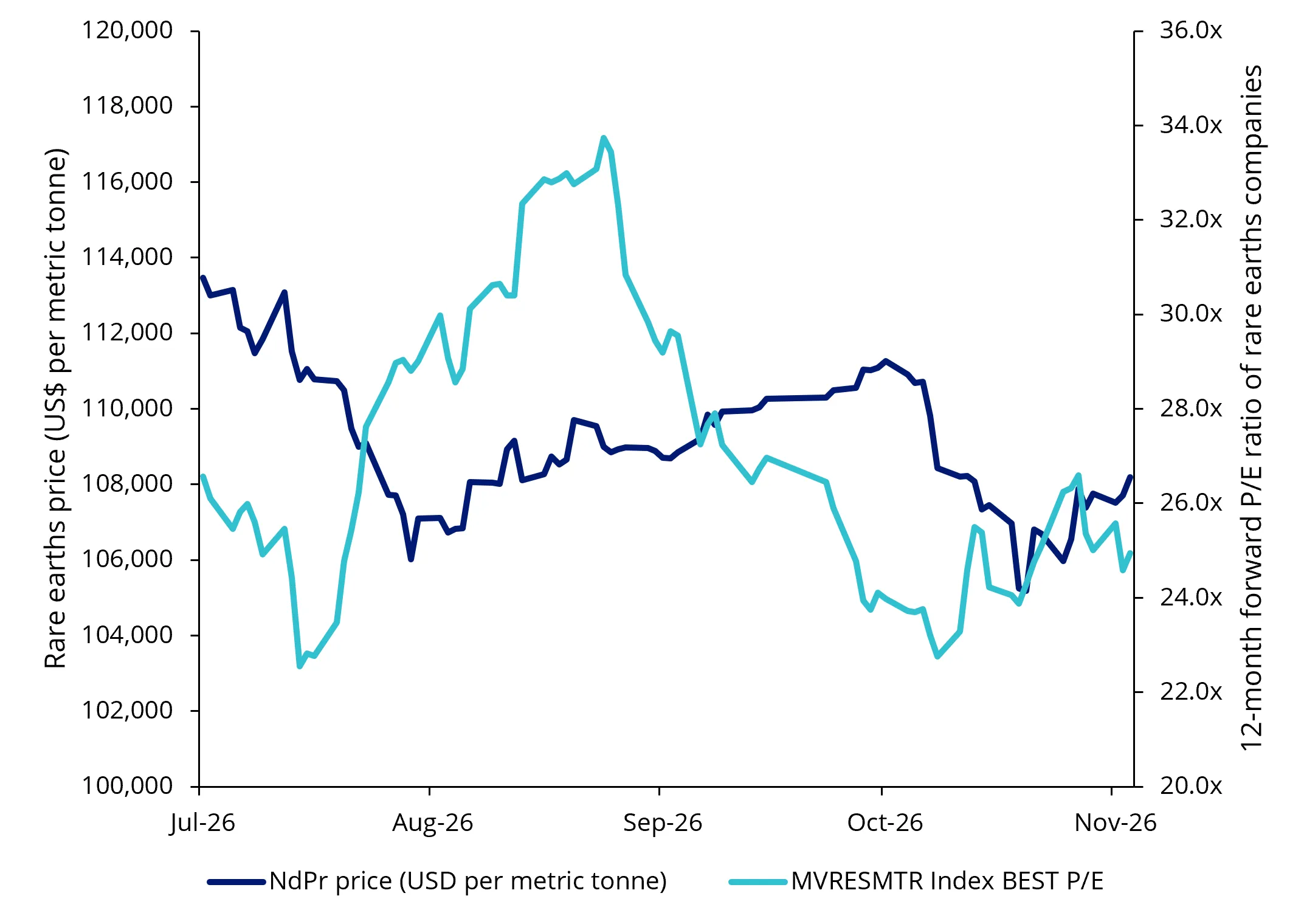
Source: Bloomberg, China Praseodymium-Neodymium Oxide Market Price Shanghai (SHRAPNOX Index), USD per metric tonne; MarketVector Global Rare Earth/ Strategic Metals Ex-China (AUD) Index (TR Net) (MVRESMTR Index), BEst P/E.
For investors, we see the sell-off as a reset in what investors pay, while the underlying investment case remains intact. The demand drivers remain in place, while a US defence sourcing deadline is bringing the need for alternative supplies into sharper focus.
Small materials, massive impact
Rare earth elements are a group of 17 chemically similar elements used in many of today’s most advanced technologies. Despite the name, many rare earths are abundant. The challenge is more around discovering deposits that are economically viable to mine and refining them into the high-purity materials required by advanced technologies.
Alongside these are a broader group of strategic metals such as lithium and tungsten that are increasingly critical to modern industry. Below is a table of where these elements and metals are used:
Table: Metals critical to digitisation, electrification and security
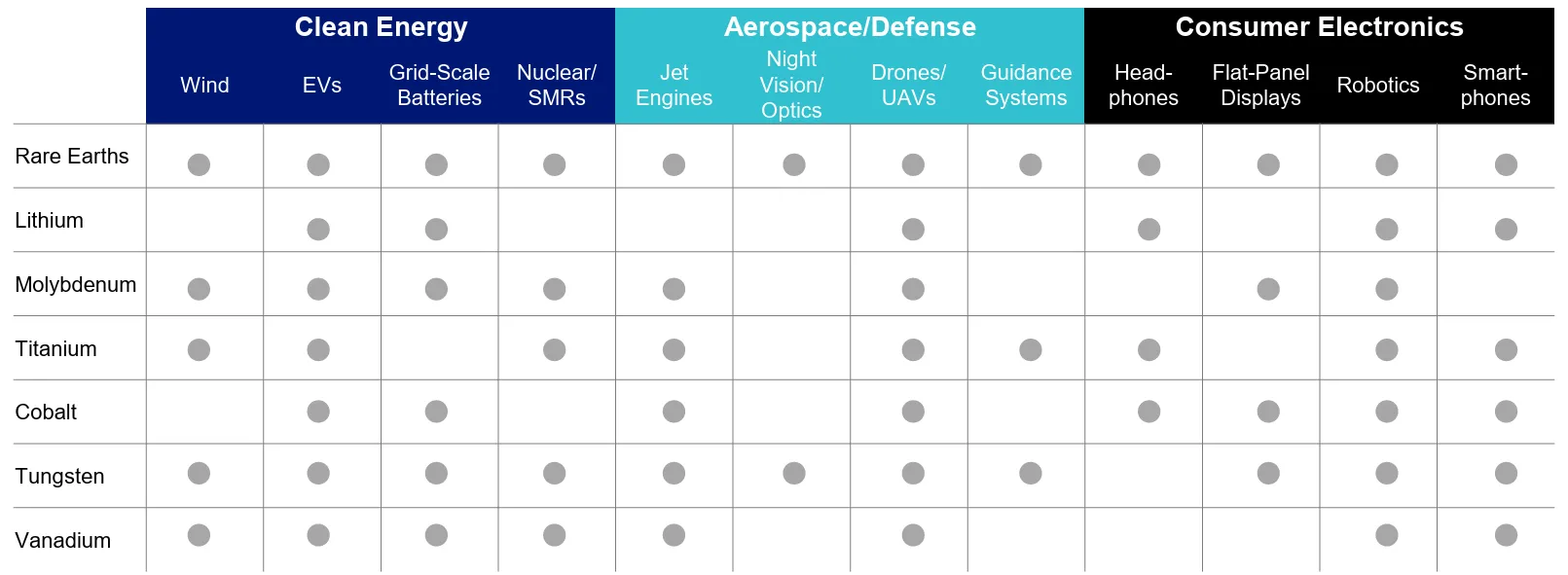
Source: VanEck, for illustrative purposes only
Rare earths and strategic metals are used in relatively small quantities, but they often perform functions that few other materials can replicate. Their unique magnetic, electrical and heat-resistant properties make them essential to technologies requiring exceptional performance, precision and reliability.
From electric motors and advanced radar systems to semiconductors and wind turbines, many of today’s fastest growing industries rely on these specialised materials.
AI is driving unprecedented investment in semiconductor fabrication, data centres and electricity infrastructure, all of which depend on strategic metals throughout the supply chain.
Electric vehicles, wind turbines, batteries and modern electricity grids require significantly more critical minerals than the technologies they are replacing.
But mining more rare earths and strategic metals addresses only part of the challenge. The materials must also be separated, refined and manufactured into components that meet customers’ requirements. China controls a significant share, estimated to be over 90%, of production and refining capacity, with a similar dominance in strategic metals like lithium and cobalt.
Why would a rare earths ETF exclude Chinese companies?
As a recent case concerning Northern Minerals demonstrates, a secure supply chain for rare earths outside China is now a strategic priority.
Western governments are investing billions of dollars across the entire critical minerals value chain including new mines, refineries and downstream manufacturing. Building an alternative supply chain, according to EY-Parthenon, will take another US$23 trillion and 25 more years, creating a long runway for companies positioned to participate in that expansion.
Recent export restrictions have reinforced how quickly critical minerals can become geopolitical tools, accelerating efforts to develop alternative supply chains outside China.
Nations and corporations are taking notice
From January 2027, previous restrictions imposed by the US Department of Defense on specific permanent magnets will expand to cover the entire supply chain from mining to final fabrication. This is despite the fact experts believe the US magnet sector is still many years away from achieving the scale required to replace Chinese involvement in this process.
The International Energy Agency (IEA) projects demand for magnet rare earths outside China will rise by around 50% by 2035 under current policy settings. Existing capacity and planned expansions would meet around half of mining requirements, a quarter of refining needs and less than a fifth of magnet requirements.
Chart 2: Rare earth demand outside China is set to grow by 50% by 2035
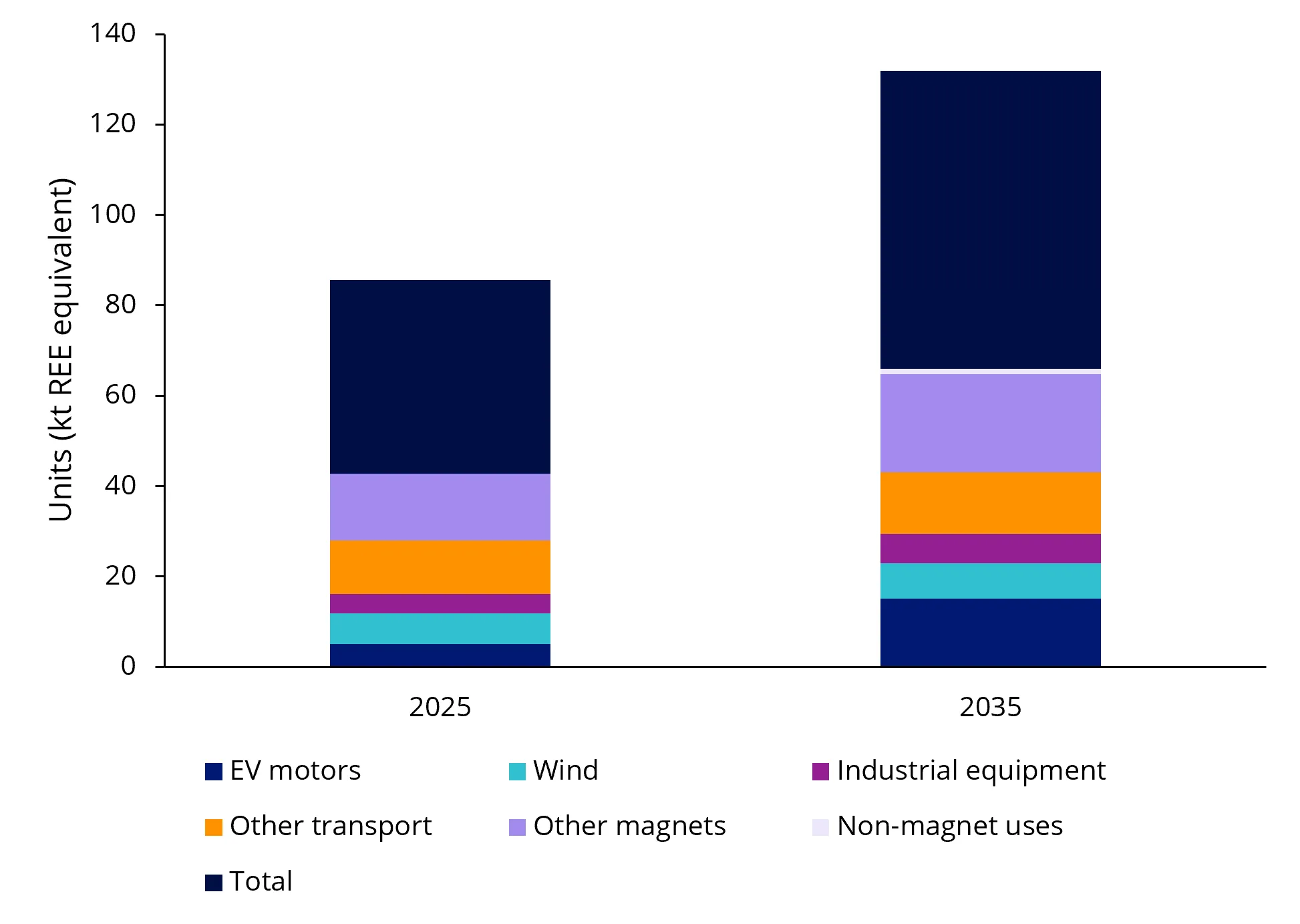
Source: International Energy Agency (IEA)
Companies are also committing capital and securing future customers to do the same.
In October, Lynas Rare Earths (ASX: LYC) proposed to acquire Meteoric Resources (ASX: MEI), whose Caldeira project in Brazil contains light and heavy rare earths. The proposed transaction would bring those resources together with Lynas’ processing capabilities and operating experience.
Elsewhere, Arafura Rare Earths (ASX: ARU) expanded its five-year supply agreement with Traxys North America from 500 to 850 tonnes a year of materials used in high performance magnets, with deliveries building to that level as its Nolans project in the Northern Territory reaches full production capacity.
An opportunity beyond the headlines
Rare earth shares in Australia have fallen around a quarter on average this year, while prices for rare earth materials used in high performance magnets have risen around 17%.
For investors who see the pullback as an opportunity to participate in the sector’s long-term growth, the VanEck Rare Earth and Strategic Metals ex China ETF (RESM) provides diversified exposure to companies mining, refining and recycling the materials underpinning that growth. Lynas Rare Earths and Arafura Resources are both currently major holdings in RESM.
RESM builds on VanEck’s experience in rare earths and strategic metals through its US-listed ETF, REMX, which launched in 2010. REMX is the largest rare earths ETF in the world.
Key risks
An investment in the ETF carries risks associated with: ASX trading time differences, financial markets generally, individual company management, industry sectors, foreign currency, country or sector concentration, political, regulatory and tax risks, fund operations and tracking an index. See the PDS and TMD for more details.
RESM is likely to be appropriate for a consumer who is seeking capital growth, is intending to use the product as a satellite allocation within a portfolio, has an investment timeframe of at least 7 years, and has an extremely high risk/return profile.
Related Insights


Published: 26 November 2026
Any views expressed are opinions of the author at the time of writing and is not a recommendation to act.
VanEck Investments Limited (ACN 146 596 116 AFSL 416755) (VanEck) is the issuer and responsible entity of all VanEck exchange traded funds (Funds) trading on the ASX. This information is general in nature and not personal advice, it does not take into account any person’s financial objectives, situation or needs. The product disclosure statement (PDS) and the target market determination (TMD) for all Funds are available at vaneck.com.au. You should consider whether or not an investment in any Fund is appropriate for you. Investments in a Fund involve risks associated with financial markets. These risks vary depending on a Fund’s investment objective. Refer to the applicable PDS and TMD for more details on risks. Investment returns and capital are not guaranteed.