For your interest only


1. Coupon: What the bond pays you
When you buy a bond, you lend money to a government or company. In return, the borrower promises to pay back the bond’s face value on the day the bond matures (a subject we will get to later) as well as interest at regular intervals. That interest payment is called the coupon.
A coupon is not the same thing as a share dividend. The biggest difference is that while companies can reduce or cancel dividends at a moment’s notice, coupons from a bond are a contractual obligation.
Consider a bond with a $1,000 face value, meaning the amount the borrower promises to repay. If its annual coupon rate is 5%, it pays $50 a year. Those payments might arrive in one $50 instalment or multiple, smaller instalments.
Not all bonds are the same either. Much like deciding between a fixed or variable mortgage, a coupon from a fixed rate bond will be different from the coupon of a floating rate bond.
For a fixed-rate bond, that payment will stay the same throughout the bond’s life. Market interest rates could rise to 6% or fall to 3%, but the bond would still pay $50 a year, provided the borrower is able to meet its obligations. Floating-rate bonds are different. Their interest payments are based on a reference interest rate. When the reference rate rises, these coupons will increase (all else being equal). When it falls, the coupons decrease.
Floating-rate bonds are different. Their interest payments are based on a reference interest rate. When the reference rate rises, these coupons will increase (all else being equal). When it falls, the coupons decrease.
If interest rates are rising, floating rate bonds are better positioned to deliver higher returns than a fixed rate bond (again all else being equal).
2. Yield: What you get for the price you pay
While the coupon tells you the payment, the yield helps you assess that payment against the price of the investment.
Let’s use the fixed rate bond with a $1,000 face value as an example again. Investors can buy or sell this bond before repayment is due. Its market price can move above or below $1,000, and this changes in response to current interest rates.
If the bond’s price were to fall to $900, the same payment of $50 per year represents a yield of about 5.56%. This would happen if interest rates had risen to this level while you were holding the bond. Conversely, if interest rates have fallen then the existing bond’s price may appreciate. In a scenario like this, the investor may pay $1,100 for the same bond, meaning that same payment would lead to a yield of about 4.55%.
This is an essential principle of fixed income investing: price and yield tend to move in opposite directions.
Interest rates help explain why a bond’s price can change while its payments stay the same. Suppose you own a fixed-rate bond paying 4%. If a new, comparable bond offered 5%, a rational investor would want to see a lower price for the first bond to compensate for its smaller payments.
3. Duration: How much the price might move
How much you could gain or lose from a change in a bond’s price depends in part on how long it has left to run. A fixed-rate bond that repays you next year will tend to move less in price when yields change than a similar bond that repays you in 20 years.
Duration helps estimate how much a bond’s price could rise or fall when yields change. For example, a duration of five means a one-percentage-point rise in yield would cause about a 5% fall in price, with other factors unchanged. As the below table demonstrates, the higher the duration, the bigger the potential price movement.
Table: How rate changes impact bonds with different durations
| 1% drop in rates | 1% rise in rates | ||||
| Duration | % NAV change | Resulting value | Duration | % NAV change | Resulting value |
| 1 year | +1% | $1,010 | 1 year | -1% | $990 |
| 5 years | +5% | $1,050 | 5 years | -5% | $950 |
| 10 years | +10% | $1,100 | 10 years | -10% | $900 |
Source: VanEck. For illustrative purposes only.
But unlike a Bond film, duration is not simply a measure of running time. It measures price sensitivity, and a bond fund or ETF also has a duration based on its holdings.
An investor should expect that the duration of the VanEck 1-5 Year Australian Government Bond ETF (1GOV) would be less than that of the VanEck 5-10 Year Australian Government Bond ETF (5GOV), and 5GOV’s duration should be less than that of the VanEck 10+ Year Australian Government Bond ETF (XGOV). In other words, XGOV is more sensitive to a change in interest rates (i.e. its price will fall and rise more) to changes in interest rates that 5GOV and 1GOV.
Duration helps explain why investments described as defensive may produce different results. Rising borrowing costs can also make businesses that rely on debt to grow more vulnerable than those that do not.
4. Credit fundamentals: How dependable the borrower is
Before an investor lends money, they want to know whether the borrower can repay it at the end. Credit ratings provide an assessment of that ability.
Agencies such as S&P Global and Fitch assess a borrower’s finances and then assign a rating. A borrower in this context can be anything from a federal government to a publicly listed firm to a private company.
AAA is the highest rating while any issuer rated BBB– or above is termed as “investment grade”, meaning the agency believes that the issuer is at low risk of default.
Any issuer delivered a lower rating than this is termed “high yield” (or sub-investment grade), which means the agency believes that an investor would be taking excess default or repayment risk. In return for this risk, an investor tends to demand more yield and/or a higher coupon. D (for default) is the lowest rating an issuer can receive.
It is important to note that ratings are opinions and not guarantees, and that ratings can change. It is also possible that ratings may differ between agencies.
Credit ratings are one guide, but investors also decide how much extra return they want for lending to a company rather than a government.
The credit spread measures that extra yield above a comparable government bond in the same currency and with a similar maturity. For example, if a 10-year corporate bond yields 6% and a comparable government bond yields 5%, the credit spread is one percentage point. If the spread between the two increases, that’s called a “widening” and if the opposite occurs, it’s called a “narrowing”.
Spreads tend to widen when investors become more concerned about repayment and narrow when confidence improves. Over the last few years, credit spreads have declined in some higher-yielding markets while remaining in a tight range in investment grade markets. All else being equal, narrower spreads mean higher prices for the bonds concerned. Conversely, when spreads widen, bond prices fall because investors demand a higher yield from the “riskier” issuer.
Chart: Credit spreads around the world
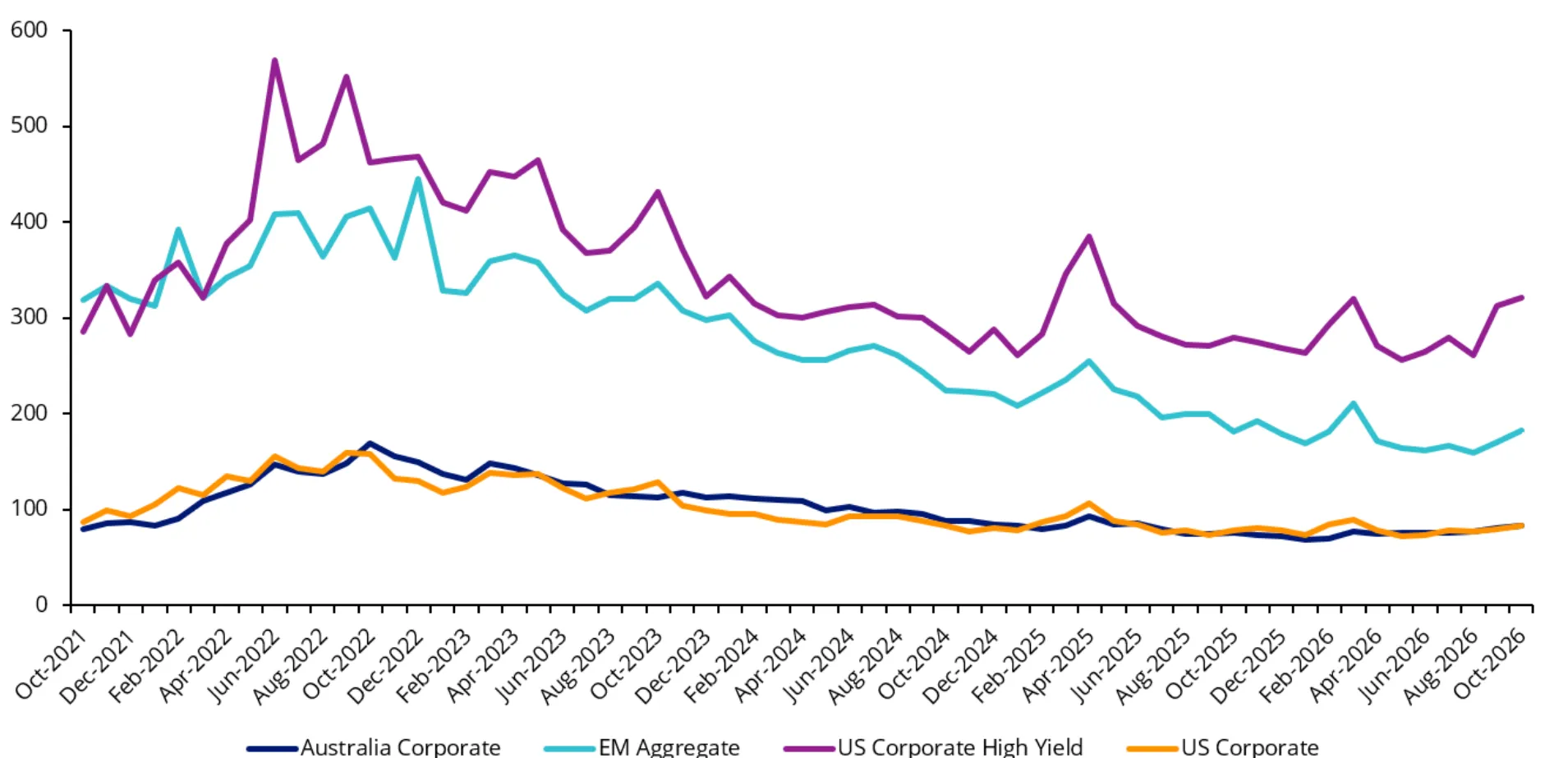
Source: Bloomberg, VanEck. Data covers 14 October 2021 to 14 October 2026. Australia Corporate is Bloomberg AusBond Credit 0+ Yr Index, US Corporate is Bloomberg Barclays US Corporate Index. US Corporate High Yield is Bloomberg Barclays US Corporate High Yield Index. EM Aggregate is Bloomberg Barclays EM Aggregate Index You cannot invest in an index.
5. Maturity: When the money is due back
Diamonds may be forever, but bonds tend to come with a date when their face value is due to be repaid. That date is known as a bond’s maturity.
To illustrate this, let’s return to our fixed-rate bond with a $1,000 face value. Provided the issuer meets its obligations, any investor who holds the bond at maturity will receive $1,000.
The repayment is also separate from any coupons they have received along the way and excludes transaction costs. It also may not be the price the investor paid.
For instance, if the investor bought the bond noted above for $900, the repayment at face value would produce a $100 capital gain. If they bought it for $1,100, they would record a $100 capital loss.
Knowing your bonds
You cannot choose where interest rates go next, but you can understand how your investments might respond. Knowing what is fixed, what can change and when your money is due back puts you in a better position to choose the surprises you are prepared to accept. The martini is a matter of taste, but the portfolio deserves more thought.
Key risks
An investment in fixed income ETFs carry risks associated with: interest rate movements, bond markets generally, issuer default, credit ratings, country and issuer concentration, liquidity, tracking an index and fund operations. See PDS and TMD for more details.
1GOV and 5GOV are likely to be appropriate for a consumer who is seeking capital preservation and a regular income distribution, is intending to use the product as a minor or satellite allocation within a portfolio, has an investment timeframe of at least 3 years, and has a medium risk/return profile.
XGOV is likely to be appropriate for a consumer who is seeking capital growth and a regular income distribution, is intending to use the product as a minor or satellite allocation within a portfolio, has an investment timeframe of at least 3 years, and has a high risk/return profile.


Published: 25 October 2026
Any views expressed are opinions of the author at the time of writing and is not a recommendation to act.
VanEck Investments Limited (ACN 146 596 116 AFSL 416755) (VanEck) is the issuer and responsible entity of all VanEck exchange traded funds (Funds) trading on the ASX. This information is general in nature and not personal advice, it does not take into account any person’s financial objectives, situation or needs. You should consider whether or not an investment in any Fund is appropriate for you. Investments in a Fund involve risks associated with financial markets. These risks vary depending on a Fund’s investment objective. Refer to the applicable product disclosure statement (PDS) and target market determination (TMD) available at vaneck.com.au for more details. Investment returns and capital are not guaranteed.