The new edge in investing is better insight, not more information


Long before artificial intelligence entered everyday vernacular, there was Get Smart.
For the uninitiated, Get Smart was a 1960s sitcom which parodied the secret agent genre at the height of its popularity. Its protagonist, Maxwell Smart, famously carried a miniature telephone in his shoe, which became the show’s most iconic gadget. But it was only one of a smorgasbord of fanciful inventions that included concealed cameras, miniature communications devices and even a talking supercomputer. The joke, of course, was that none of it could possibly exist in real life.
Half a century later, many of those ideas no longer seem quite so improbable.
Many of the technologies that once seemed absurd have entered everyday life. We carry computers in our pockets, navigate unfamiliar cities with little more than a voice prompt and converse with software capable of translating languages and summarising documents. Artificial intelligence is part of that progression, and investing is emerging as one of its most compelling applications.
The influence of AI on investing
The investment world's first encounter with AI came largely through the companies building it. Nvidia has been the posterchild of this megatrend – up more than 900% in the last five years alone. But semiconductor manufacturers, software developers, cloud providers and data centre operators are all now central to the AI investment narrative.
AI is also influential for a different reason: it could improve the way people invest.
Investing has always involved making decisions with imperfect information and uncertain outcomes. While the uncertainty has not changed, the amount of information investors is expected to absorb has. Company announcements, earnings transcripts, analyst revisions, economic releases and market commentary now arrive in a near-constant stream, while the investment universe has expanded to thousands of listed and unlisted opportunities across global markets. The macro and geopolitical environment changes by the moment.
Investors have never had more information available to them, meaning the real challenge is making sense of it all.
For decades, investors sought an informational edge. Those with access to superior research, deeper analysis or proprietary data often enjoyed an advantage over those who relied solely on publicly available information. Today, however, that edge is evolving. In an age when information is abundant and increasingly democratised, the advantage may come less from accessing more data than from processing it more effectively.
One way AI can improve that processing is by making it more consistent. Human judgement is vulnerable to what behavioural researchers call “noise”: two analysts can examine the same company and reach different conclusions, while the same analyst may judge two similar companies differently. As VanEck has previously explored, rules-based and machine-learning approaches can reduce that inconsistency by applying the same scrutiny across far more information than a person could assess alone.
Some platforms can even feed vocal sentiment scores from earnings calls directly into trading systems, combining what executives say with how they say it to identify signals that might otherwise be missed. Investment banks and hedge funds then use these scores alongside traditional financial analysis to help assess potential investments.
This is where AI’s most important strength may lie: it won’t make the investment call for you, but it can analyse information about any investment at a scale no investor could match on their own. Tasks that might occupy an investor for days can now be completed in minutes and even executed on a repeatable basis.
The judgement element
Humans, however, will always be important because they bring the judgement element to investing.
Even the most sophisticated AI models are pattern-recognition engines at heart. They excel at processing vast quantities of information and identifying relationships across datasets. But they cannot exercise judgement informed by context, experience and an understanding of the world beyond the data. No algorithm can fully account for shifts in geopolitics, changes in regulation or the quality of a company's leadership team in the way an experienced investment professional can.
Perhaps this is why investors themselves continue to value human oversight. Recent research by HSBC found that while many investors are comfortable using AI to support investment idea hunting, over 50% say their ideal future decision making approach will involve both AI and human advisers.
Figure 1: AI adoption in investing
- 73% of affluent investors now use AI for finance and investing, making it the most common use case for AI ahead of work and personal development.
- However, only 12% say AI was the most influential factor in their last investment decision.
- 50% say their ideal future approach combines AI and a human adviser.
- 66% use AI primarily for investment research and analysis, while 50% use it to support investment strategy.
Source: HSBC and Ipsos, The Trust Threshold: AI Makes Investors Bolder, But They Want Human Judgement to Make Decisions, 2026.
How AI can help investors find opportunities
The potential benefits AI can bring as an investment idea hunting tool become clearer when investors look beyond Australia. The MSCI World ex Australia universe consists of over 1200 stocks. While some of these are well known (Nvidia, Apple and Microsoft, for instance), many more are not known to Australian investors at all.
This breadth and depth are both the opportunity and the challenge. Few individual investors, or even professional investment teams, have the time to comprehensively assess thousands of companies across global markets using traditional methods alone. This helps explain why investors are often forced to reduce their universe to a more manageable list of companies, sectors or regions.
But with AI, any investor can now evaluate their finances, summarise documents or even set up their own model to evaluate investment opportunities consistently and at scale. Such a model can help identify companies with attractive characteristics that may not be widely discussed, may operate in less familiar markets or may sit outside the usual set of investor watchlists with just a few prompts.
20 years ago, the advantage was having the intellectual property to create the model. Today, anyone can create their own.
Of course, no AI model is infallible. As ChatGPT and Claude are keen to remind us, these are AI models and mistakes can be made. AI also cannot predict the future. It does not know in advance what a company will report next quarter, how interest rates will evolve or when geopolitical events will affect markets, nor can it eliminate market volatility or guarantee investment success. But this is where human judgement, lived experience and a critical eye can separate the good from the great.
From theory to practice
The practical application of AI in investing is already beginning to look different from the way many people imagine it. Rather than attempting to predict markets or identify a single winning stock, AI is increasingly being used to improve the investment process itself.
The new VanEck Dynamic International Equity ETF (GOAT) is the first example of this approach in Australia. GOAT tracks the transparent, trackable index, Akros Enhanced World ex Australia Index (GOAT Index).
The most important thing to understand is that the GOAT Index is not asking a chatbot which stocks to buy, nor is it a fund that only invests in companies leveraged to the AI megatrend.
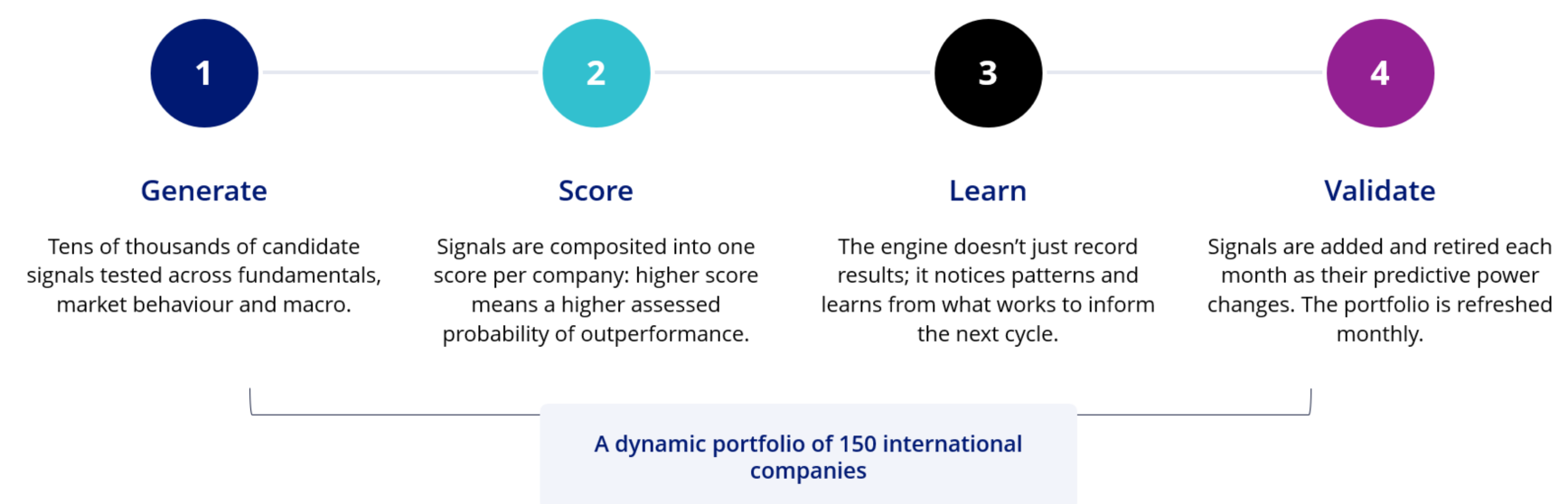
What the GOAT Index is doing is using generative reinforcement learning to evaluate approximately 16,000 investment signals across company fundamentals, technical indicators and macroeconomic data.
Those signals are distilled into a single score for every company in the investment universe, with the 150 highest-scoring companies selected for the portfolio.
Every month, the model reassesses the data, retires signals that have lost predictive power and incorporates new ones as markets evolve. It's a disciplined, transparent and repeatable investment process.
And given this process outlined above repeats every month, GOAT is a truly dynamic ETF.
Figure 2: How the AI investment engine works: Tens of thousands of signals tested, the most predictive kept and refreshed, then scored for every company.
Unlike many traditional investment strategies, the process is not anchored to a fixed set of factors.
This is where AI adds value. Rather than remaining fixed to a set of rules, it enables the investment process to adapt as new information becomes available, and market conditions evolve.
From gadget to investment tool
In many ways, the journey from Get Smart to smart investing is less fanciful than it first appears. The gadgets that once seemed absurd gradually became practical, helping people process information, communicate more effectively and solve problems in ways that were previously unimaginable. Artificial intelligence is beginning to follow the same path.
Investors will not need a shoe phone or the Cone of Silence, but if artificial intelligence can help them "miss it by that much" less often when making investment decisions, it will have more than justified its place in the modern investor's toolkit.
Key risks:
An investment in GOAT carries risks associated with: ASX trading time differences, financial markets generally, individual company management, industry sectors, foreign currency, country or sector concentration, political, regulatory and tax risks, fund operations and tracking an index. See the PDS and TMD for more details.
This product is likely to be appropriate for a consumer who is seeking capital growth, is intending to use the product as a major, core, minor or satellite allocation within a portfolio, has an investment timeframe of at least 5 years, and has a high risk/return profile.


Published: 19 July 2026
Any views expressed are opinions of the author at the time of writing and is not a recommendation to act.
VanEck Investments Limited (ACN 146 596 116 AFSL 416755) (VanEck) is the issuer and responsible entity of all VanEck exchange traded funds (Funds) trading on the ASX. This information is general in nature and not personal advice, it does not take into account any person’s financial objectives, situation or needs. You should consider whether or not an investment in any Fund is appropriate for you. Investments in a Fund involve risks associated with financial markets. These risks vary depending on a Fund’s investment objective. Refer to the applicable product disclosure statement (PDS) and target market determination (TMD) available at vaneck.com.au for more details. Investment returns and capital are not guaranteed.