The highest yields in 15 years are creating an opportunity to generate efficient income


Higher bond yields and a changing economic backdrop are making investment-grade bonds an increasingly attractive source of portfolio income.
Australian government bond yields are still near the upper end of their post-GFC range, trading more than a standard deviation above the 15-year average. This has resulted in elevated all-in yields across investment-grade credit. As a result, investors today can lock in materially higher yields than they could for much of the last decade.
Chart 1: Australian 10-Year bond yield since January 2011
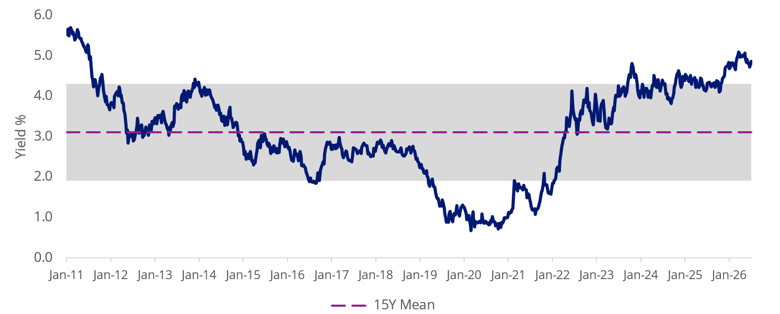
Source: Bloomberg. As at 10 July 2026. Grey shaded area represents the range one standard deviation above and below the 15-year average dividend yield. Purple dashed line represents the 15-year average. Past performance is not an indicator of future performance.
At the same time, the macro backdrop remains uncertain. Consumer confidence has softened and labour market conditions have begun to ease from historically tight levels, contributing to a moderation in bond yields. With downside risks to growth becoming increasingly relevant amid a restrictive RBA policy setting, further downward revisions to growth expectations could see yields fall further, providing an additional tailwind for fixed-rate strategies.
Chart 2 and 3: Australian consumer confidence and unemployment
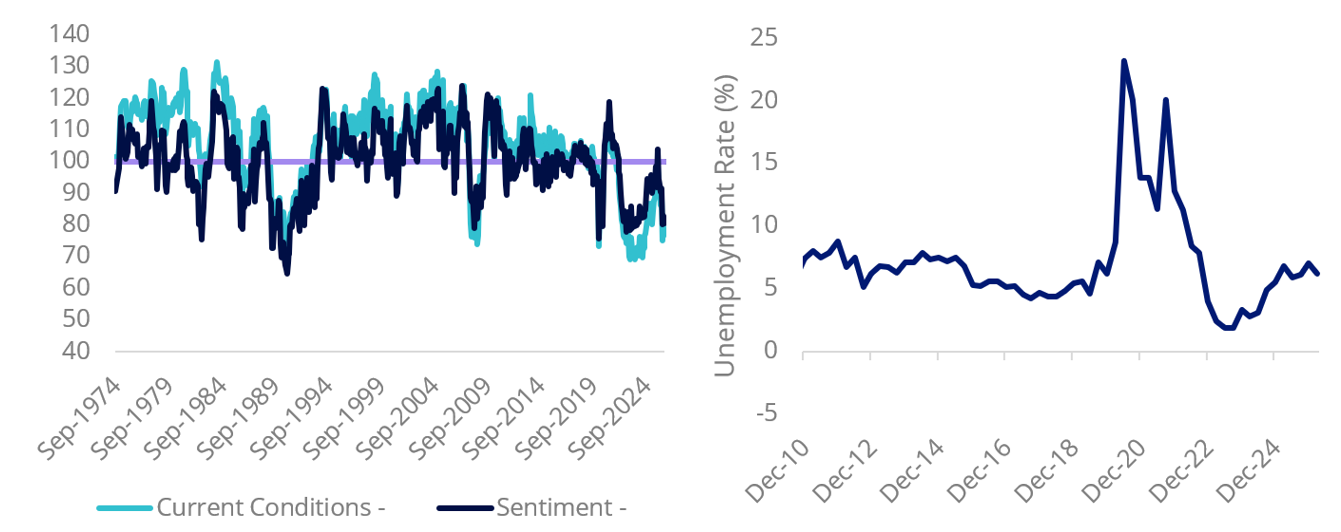
Source: Bloomberg, June 2026 (LHS) and March 2026 (RHS).
Disciplined duration in the belly of the curve
The VanEck Australian Corporate Bond Plus ETF (PLUS) maintains duration broadly in line with the AusBond Composite benchmark at around five years. This is an important feature of the fund’s positioning, as this part of the curve is generally more stable than longer-dated maturities where yields can be more sensitive to shifting macro headlines and changes in rate expectations.
In the current environment, there is merit in maintaining benchmark-like duration rather than taking a more active duration view. This allows investors to retain exposure to attractive carry, given the broad-based rise in yields across the curve, while avoiding the higher volatility typically associated with longer-tenor bonds.
The fund’s moderate duration profile also helps limit drawdowns if yields move higher, while retaining enough interest rate exposure to benefit should yields decline.
Broad diversification across investment-grade credit
PLUS also provides diversified exposure across the Australian investment-grade credit market, holding 171 bonds from more than 100 issuers.
Diversification is particularly important in credit markets, where issuer-specific downside can be asymmetric. By spreading exposure across a broad set of borrowers, sectors and securities, the portfolio is less dependent on any single credit outcome.
Chart 4: PLUS portfolio’s sector allocation
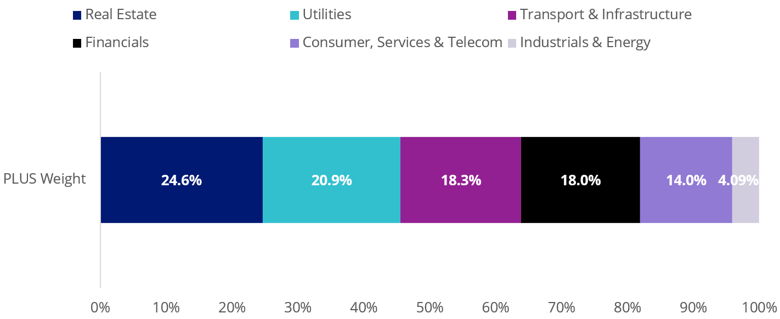
Source: Bloomberg. As at 16 July 2026. Sector allocation is subject to change.
This diversification is particularly relevant in an environment where macroeconomic uncertainty remains elevated. A broader, higher-quality credit portfolio can provide more balanced exposure through the cycle, while helping to manage downside risk during periods of slowing growth or widening credit spreads.
Attractive income without extending duration
PLUS provides attractive income without relying on extended duration. The portfolio’s current yield to maturity of around 5.7% and modified duration of around 4.5 years equates to a yield-to-duration ratio of approximately 1.25.
Put simply, this means investors are receiving around 1.25% of yield for each year of duration risk. That is an important distinction: the portfolio is delivering attractive income from a medium duration profile, rather than relying on longer-dated bonds where interest rate sensitivity is typically higher.
This supports more balanced risk-return, with attractive carry while limiting exposure to the higher volatility typically associated with longer-duration bonds.
Fixed income yield has become more compelling relative to equities
Recent policy changes have strengthened the case for income-oriented exposures. Proposed changes to capital gains tax may reduce the relative after-tax appeal of capital gains, while higher interest rates have placed pressure on long-duration growth assets.
With inflation and unemployment back in focus, markets have increasingly rewarded income and value over growth. This backdrop has been less supportive for rate-sensitive sectors such as technology and earlier-stage companies, where valuations are more dependent on future earnings.
For investors, the comparison between the PLUS yield to maturity and the ASX dividend yield highlights the improved relative appeal of fixed income as a source of portfolio income. Importantly, the yield differential versus equities is at multi-year highs despite senior debt sitting higher in the capital structure and benefiting from lower volatility than equity markets, which have remained susceptible to heightened macro and geopolitical uncertainty throughout this year.
Chart 5: PLUS Index yield to maturity vs S&P/ASX 200 dividend yield
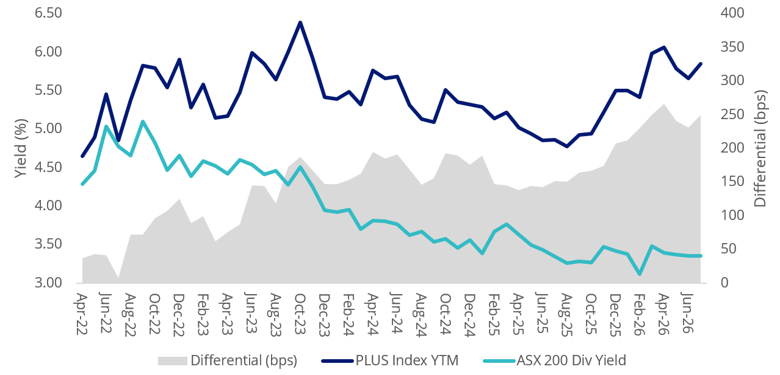
Source: Bloomberg. As at 16 July 2026. This chart is not a total return comparison and is only intended to show the yield differential. Yield measures are not a reliable indicator of future dividend income. Yield to maturity (YTM) is the weighted average of the Fund's underlying bonds' yields to maturity in their own local currencies. A bond's YTM is the annualised total expected return of the bond if it is held to maturity, the bond does not default, and the coupons are reinvested at the YTM.
The investment case for fixed income is evolving. Yields remain near their highest levels in 15 years, while the economic outlook has become less certain. That combination has improved the relative appeal of investment-grade corporate bonds as a source of portfolio income. For investors looking to strengthen the defensive side of their portfolio, PLUS could be worth considering.
Key risks
An investment in our corporate bonds ETF carries risks associated with: bond markets generally, interest rate movements, issuer default, credit ratings, fund operations, liquidity and tracking an index. See the VanEck Australian Corporate Bonds Plus ETF PDS and TMD for more details.
PLUS is likely to be appropriate for a consumer who is seeking regular income distribution, is intending to use the product as a core, minor or satellite allocation within a portfolio, has an investment timeframe of at least 3 years, and has a medium risk/return profile.


Published: 21 July 2026
Any views expressed are opinions of the author at the time of writing and is not a recommendation to act.
VanEck Investments Limited (ACN 146 596 116 AFSL 416755) (VanEck) is the issuer and responsible entity of all VanEck exchange traded funds (Funds) trading on the ASX. This information is general in nature and not personal advice, it does not take into account any person’s financial objectives, situation or needs. You should consider whether or not an investment in any Fund is appropriate for you. Investments in a Fund involve risks associated with financial markets. These risks vary depending on a Fund’s investment objective. Refer to the applicable product disclosure statement (PDS) and target market determination (TMD) available at vaneck.com.au for more details. Investment returns and capital are not guaranteed.