The US$4 billion ripple that could not turn the tide


A US$4 billion intervention from a US Treasury Secretary would ordinarily make a splash. But against an ocean of US government debt that has passed US$40 trillion, Scott Bessent’s decision turned out to be a ripple that only aggravated markets.
After an initial rise in prices (ie a fall in yields), bonds resumed sliding and US dollar-denominated assets weakened. Meanwhile gold and Bitcoin, two assets that governments cannot issue at will, rallied. The implications extend beyond the US bond market and into Australian portfolios.
For investors considering their response, hedge fund founder Ray Dalio has a suggestion. Its logic begins with what the US$4 billion intervention could not change.
America’s problem, Australia’s portfolio
US Treasury yields help set the price of money around the world, influencing valuations across shares, bonds, property and infrastructure. When long-term yields rise, company earnings expected into the future become less valuable today.
That matters to Australians with US equity exposure through super, managed funds and ETFs, as well as rate-sensitive companies on the ASX. Australia’s bond market competes for capital from many of the same global investors, while currency movements can increase or reduce the Australian-dollar value of offshore investments.
The problem a US$4 billion buyback could not solve
Buybacks of these bonds became routine in mid-2024 for good reason. By purchasing older, less liquid bonds, the Treasury makes those securities easier to sell without widening spreads and supporting an orderly market.
What made Bessent’s recent announcement notable was the scale and timing. With long-term yields surging, the Treasury unexpectedly doubled the maximum size of planned buybacks of 10- to-30-year bonds.
Bessent’s move was an expansion of the Treasury’s existing liquidity-support program, not yield curve control, where a central bank targets a particular bond yield and buys whatever amount is needed to defend it. Nevertheless, veteran macro investor Stanley Druckenmiller argues that its timing risked blurring the line between supporting liquidity and influencing prices.
Writing in The Wall Street Journal, he said the market was functioning; investors were simply demanding higher yields to absorb America’s growing debt. As he put it, “you can’t buy your way out of a solvency conversation with liquidity tools.”
Similar pressure was evident beyond America, with long-term yields also rising across major economies. This supports our emerging markets debt team’s view that developed markets have become important generators of global fiscal risk.
Chart 1: Global long-term bond yields have been on the march
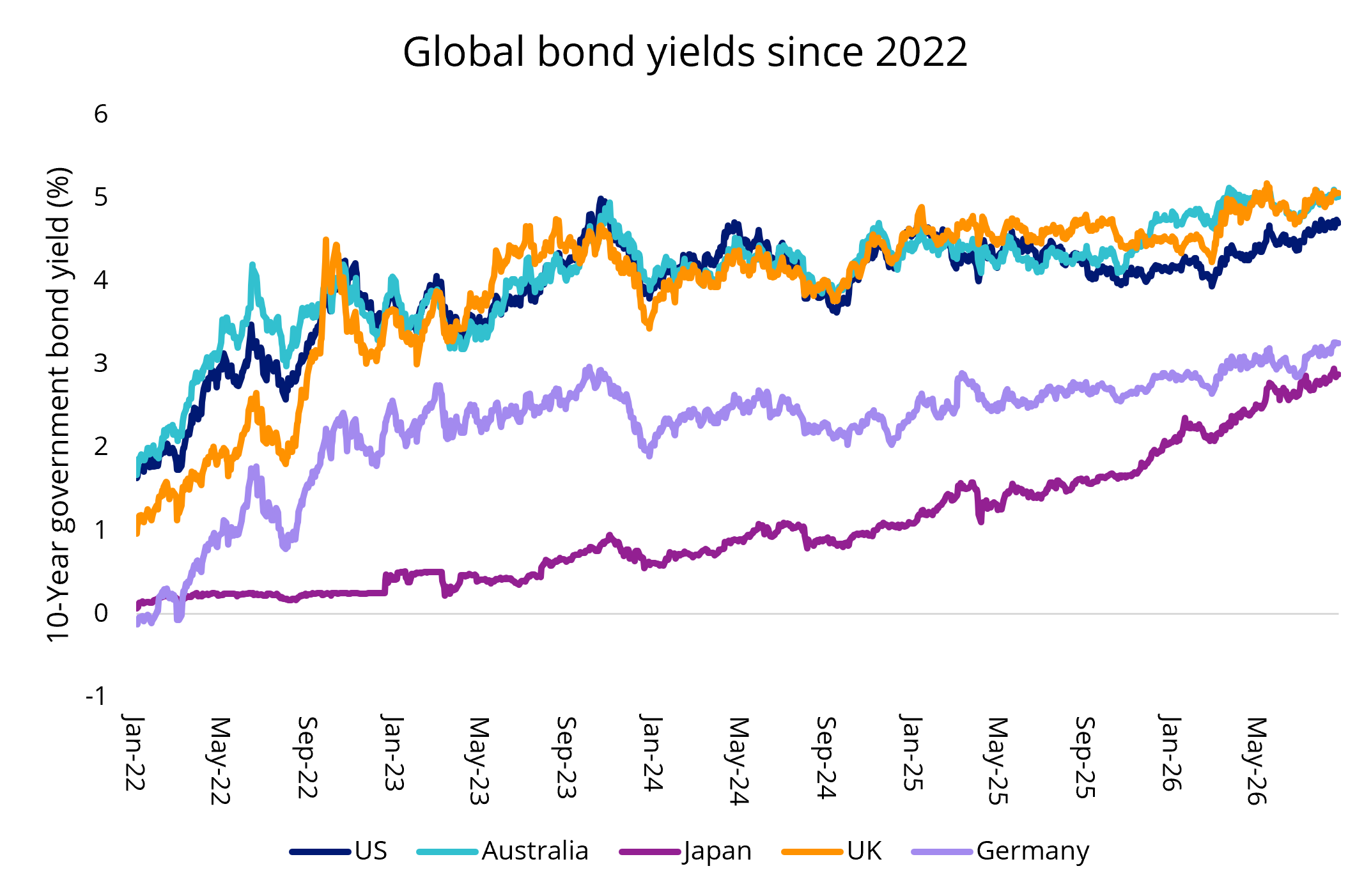
Source: Bloomberg, data from 3 January 2022 to 24 August 2026.
The pattern behind Dalio’s warning
Bridgewater Associates founder Ray Dalio has spent decades studying how debt crises repeat across countries and centuries. He’s even written several books on the subject.
Dalio believes Bessent’s intervention fits a familiar pattern. Imagine running an organisation, in this case the US government, whose spending grows faster than its income. You borrow to cover the difference and again when old debts mature. As the debt and interest bill grow, each round requires still more borrowing.
That cycle can continue while investors keep buying the bonds. If demand weakens, the government must either offer higher yields, adding to its interest bill, or rely on the central bank to buy more debt, risking inflation and a loss of purchasing power. Investors feel either outcome through pressure on bonds, equities and property, or through lower real returns.
Dalio’s portfolio response
Dalio’s suggested response was consistent with a view he has expressed before. He suggested that a 10-15% holding in gold could reduce risk and potentially improve returns. He also favoured holding “a bit of Bitcoin”, alongside greater diversification across asset classes and countries with stronger financial positions.
It’s important to stress those figures are Dalio’s view alone. The appropriate exposure and method of gaining exposure, be it through ETFs or otherwise, will depend on an investor’s objectives, risk tolerance and time horizon.
Gold is not another promise to pay
A government bond is ultimately a promise from an issuer. In contrast, gold bullion has no issuer, produces no income and does not depend on the revenues or solvency of a company or government.
Those characteristics can look unexciting when confidence is abundant, but they become more valuable when investors question the purchasing power of currencies or the ability of bonds to diversify equity risk.
One metal, two portfolio roles
It is also worth stressing that gold bullion and gold miners do not provide the same exposure and that investors can hold both.
Table 1: One metal, two portfolio roles
| Gold miners | Gold bullion | |
| What is owned | Shares in operating mining companies. | Physical gold or units in an investment backed by bullion. |
| Main return drivers | Gold prices plus company performance. | Gold price movements. |
| Income | May pay dividends when earnings and cash flows permit. | Produces no income. |
| Additional variables and risks | Labour and energy costs, reserve quality, capital expenditure, management and political risk. | Price, currency and investment structure risk. |
| Typical behaviour | Often more volatile than bullion and has a high correlation to broader share market conditions, especially in a downturn. One reason investors hold gold miners is that their price typically rises more than the increase in gold prices, as cash flow and margins increase. Naturally, the reverse is true when the price of gold falls. | Reflects the gold price but can still experience substantial price volatility. Low correlation to equity markets. |
| Insurance and storage costs | None. | Gold must be insured as it can be stolen and must be vaulted at a safe location. |
| Regulatory risks | Miners are subject to the rules and regulations of the country of the location of their mines and the country they are listed in. | None. |
| Ways to gain exposure | Individual mining shares, managed funds or a gold miners ETF such as the VanEck Gold Miners ETF (ASX: GDX) | Physical bullion or a bullion-backed ETF such as the VanEck Gold Bullion ETF (ASX: NUGG) |
Source: VanEck. For illustrative purposes only.
And, as the below chart shows, the two ways to invest in gold have had different performances over time.
Chart 2: Gold bullion and miners are related, not interchangeable
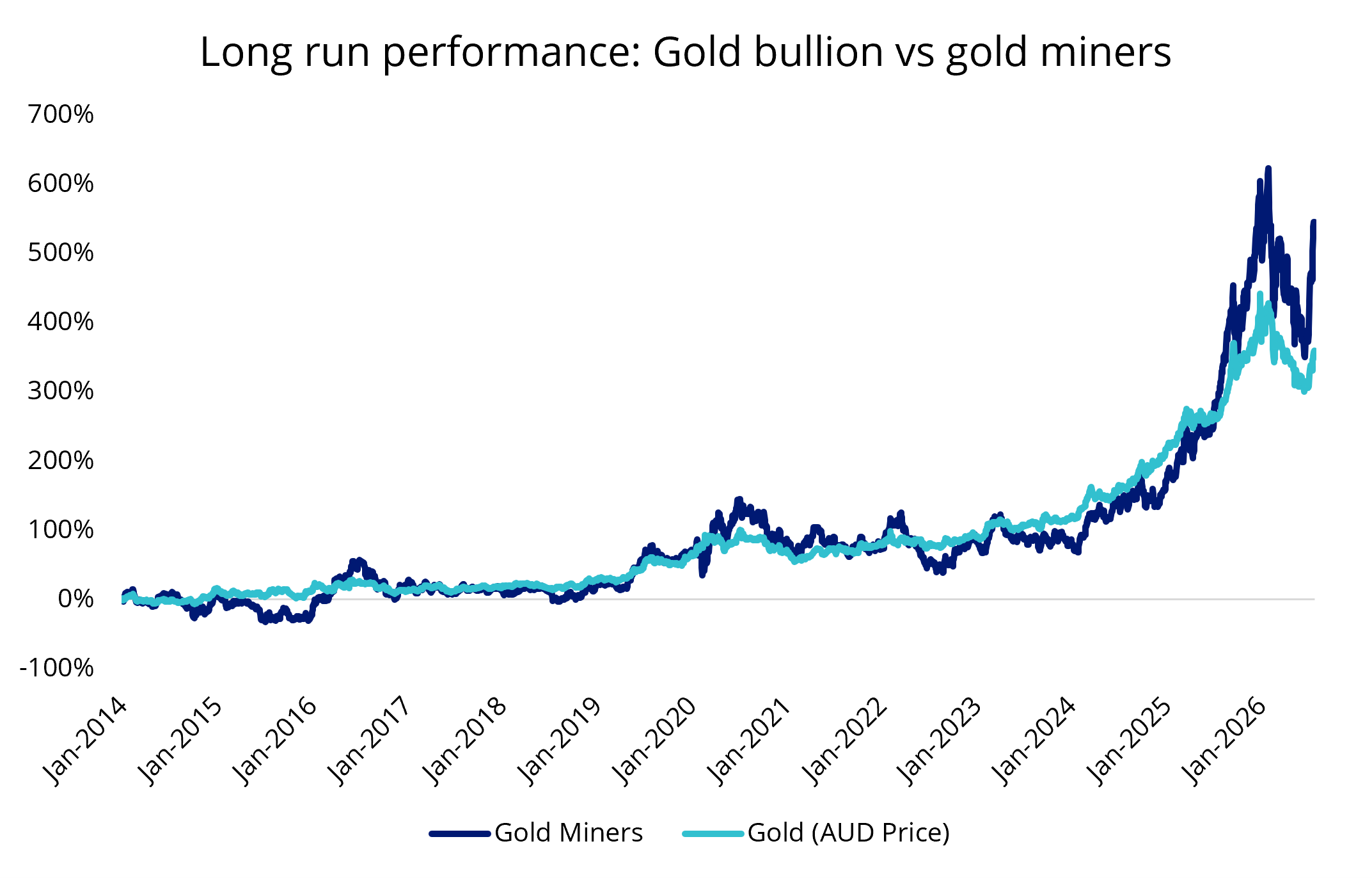
Source: VanEck to 20 August 2026. Gold Miners represented by NYSE Arca Gold Miners Index AUD, the index that VanEck Gold Miners ETF (ASX: GDX) tracks. Gold is LBMA Gold Price PM converted to AUD. Past performance is not an indicator of future performance of the index of GDX. You cannot invest directly in an index. Results are calculated to the last business day of the month and assume the reinvestment of dividends.
“A bit” of Bitcoin
Dalio’s choice of words is deliberate. He views Bitcoin as a form of money that cannot be printed and recently said that it represented about 1% of his portfolio. Although he prefers gold because of its longer history and wider acceptance as a reserve asset, that preference is not a rejection of Bitcoin. It reflects the different role he believes each asset can play.
Satoshi Nakamoto’s 2008 white paper proposed a peer-to-peer electronic payment system that would form the foundations of Bitcoin. The design was envisioned such that no treasury can issue more Bitcoin to finance a deficit and no central bank can change its supply in response to an economic slowdown.
These characteristics create a potentially significant investment proposition. If Bitcoin becomes more widely accepted as a store of value or part of the financial system, its fixed supply could make rising demand particularly powerful. However, its dependence on adoption and investor confidence also contributes to its volatility. Compared with gold, Bitcoin’s market history is short and its performance as a defensive asset during periods of stress is mixed. Even so, their low historical correlations with mainstream assets suggest that both may offer diversification benefits, as the table below shows.
Table 2: Similar scarcity, different portfolio behaviour
| Asset class | Bitcoin | Australian bonds | Global bonds | Cash | Emerging market equities | Global equities | A-REITs | Australian equities | Gold |
| Bitcoin | 1.00 | ||||||||
| Australian bonds | 0.10 | 1.00 | |||||||
| Global bonds | 0.18 | 0.81 | 1.00 | ||||||
| Cash | -0.06 | 0.18 | 0.17 | 1.00 | |||||
| Emerging markets equities | 0.09 | 0.28 | 0.36 | 0.14 | 1.00 | ||||
| Global equities | 0.32 | 0.36 | 0.36 | 0.10 | 0.47 | 1.00 | |||
| A-REITs | 0.30 | 0.41 | 0.53 | 0.05 | 0.38 | 0.66 | 1.00 | ||
| Australian equities | 0.31 | 0.29 | 0.43 | 0.03 | 0.41 | 0.64 | 0.86 | 1.00 | |
| Gold | 0.03 | 0.22 | 0.39 | 0.13 | 0.23 | -0.14 | 0.12 | 0.14 | 1.00 |
Source: Morningstar Direct. 31 July 2026 Ten year correlation. Results are calculated monthly and assume immediate reinvestment of all dividends. Indices used: Australian Bonds is Bloomberg AusBond Composite 0+Y Index, Global bonds is Bloomberg Global Aggregate TR Hdg AUD Index, Bitcoin is MarketVector Bitcoin PR Index, Cash is AusBond Bank Bills Index, EM equities is MSCI Emerging Markets Index, Global equities is MSCI World ex Australia Index, A-REITs is S&P/ASX 200 A-REIT Index, Australian equities is S&P/ASX 200 Index, Gold is LBMA Gold Price PM.
Data crunched by VanEck’s investments team illustrates how that diversification has a positive effect on the total returns of a portfolio. From 3 January 2019 to 24 August 2026, a portfolio comprising 45% shares, 45% bonds and the remaining 10% divided between gold and Bitcoin delivered an annualised return of 11.9%, compared with 9.1% for a traditional 60/40 portfolio, with slightly lower annualised volatility of 8.2% versus 8.4%1.
1Source: VanEck and Bloomberg. Hypothetical backtest from 3 January 2019 to 24 August 2026. The traditional portfolio comprises 60% MSCI ACWI Net Total Return USD Index and 40% Bloomberg Global Aggregate Total Return Index Value Unhedged USD. The diversified portfolio comprises 45% of each index, 5% Bitcoin USD and 5% Gold USD. Both portfolios were rebalanced 22 times over the period. Results are in US dollars and include distributions where applicable. Volatility is annualised from daily returns. Backtested results are hypothetical, are not actual investment results and rely on assumptions and hindsight. They do not reflect management fees, transaction costs or investor-specific taxes. Past performance is not a reliable indicator of future performance. An investment cannot be made directly in an index.
For Australian investors who have the risk tolerance and see a role for Bitcoin, an exchange-traded fund such as the VanEck Bitcoin ETF (ASX: VBTC) provides access through a familiar structure.
When uncertainty comes from the ballast
Bessent’s US$4 billion intervention does not mean a US default is imminent or that bonds have lost their place. It does reveal how difficult it is to calm the world’s most important debt market when borrowing needs keep growing, and why the consequences reach Australian portfolios.
Government bonds have long steadied portfolios when everything else becomes uncertain. Australian investors may now need to consider what can help when some of the uncertainty comes from the ballast itself.
Key risks
An investment in the ETFs carries risks including: financial market and pricing risk, ASX trading risks, concentration risk, regulatory and tax risks, liquidity, fund operational risks, and tracking an index. In addition, NUGG and GDX have risks specific to gold bullion and gold miners. VBTC have risks specific to bitcoin, and involves extremely high risk and the potential loss of all capital invested. See each relevant funds' PDS and TMD for more details.


Published: 27 August 2026
Any views expressed are opinions of the author at the time of writing and is not a recommendation to act.
VanEck Investments Limited (ACN 146 596 116 AFSL 416755) (VanEck) is the issuer and responsible entity of all VanEck exchange traded funds (Funds) trading on the ASX. This information is general in nature and not personal advice, it does not take into account any person’s financial objectives, situation or needs. The product disclosure statement (PDS) and the target market determination (TMD) for all Funds are available at vaneck.com.au. You should consider whether or not an investment in any Fund is appropriate for you. Investments in a Fund involve risks associated with financial markets. These risks vary depending on a Fund’s investment objective. Refer to the applicable PDS and TMD for more details on risks. Investment returns and capital are not guaranteed.
VBTC is likely to be appropriate for a consumer who is seeking capital growth, is intending to use the product as a satellite allocation within a portfolio, has no minimum investment timeframe, and has an extremely high risk/return profile.
GDX is likely to be appropriate for a consumer who is seeking capital growth, is intending to use the product as a satellite allocation within a portfolio, has an investment timeframe of at least 5 years, and has a very high risk/return profile.
NUGG is likely to be appropriate for a consumer who is seeking capital growth, is intending to use the product as a minor or satellite allocation within a portfolio, has no investment timeframe, and has a high or very high risk/return profile.