Keep calm and mine on


Despite structural demand remaining strong, driven by AI infrastructure, electric vehicles (EVs), defence, robotics and advanced manufacturing, the global rare earth sector has declined recently.
We view the sell-off as a correction in sentiment and valuations, rather than a deterioration in the long-term investment case.
Rare earth pullback
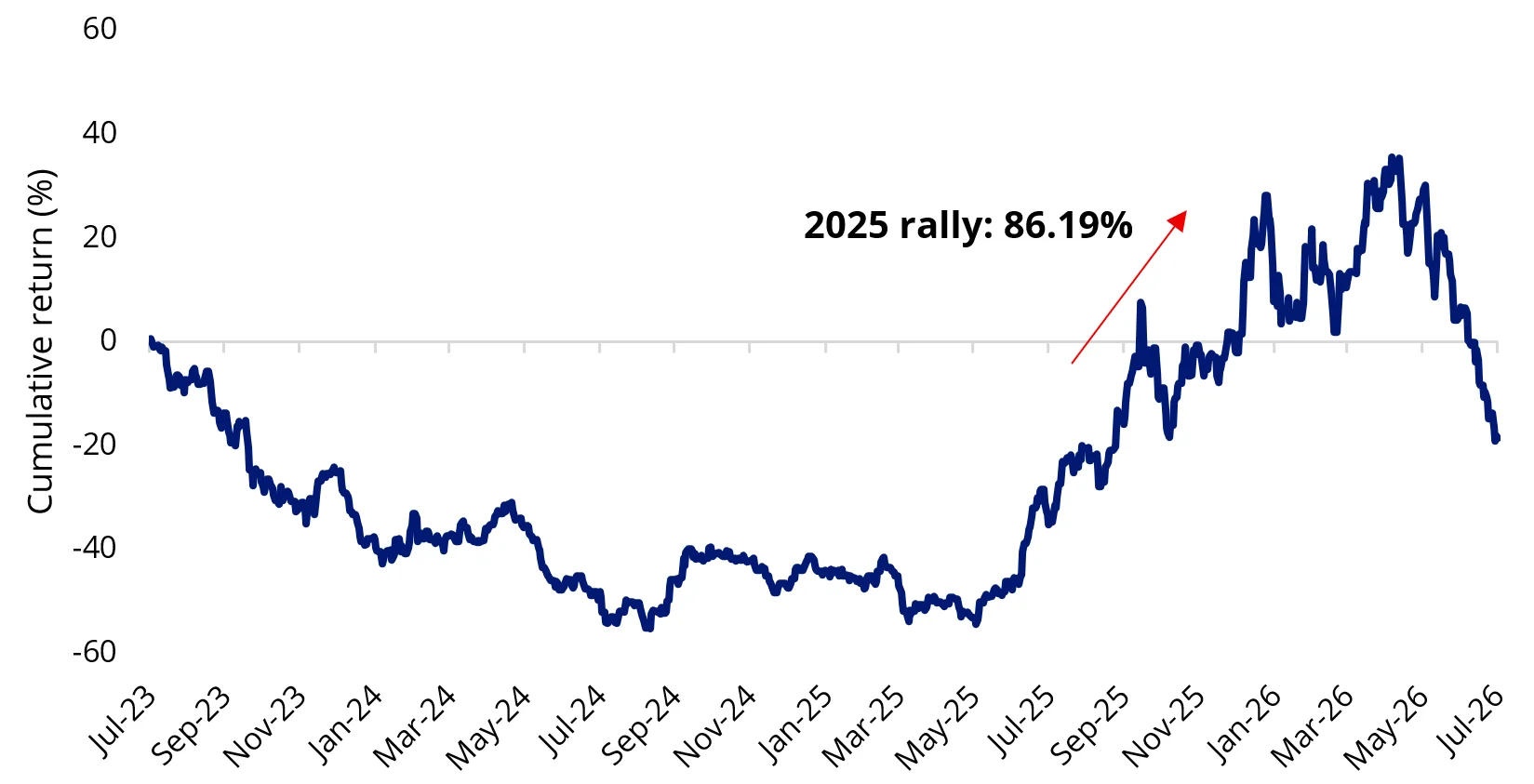
The last few months have been humbling for investors in the rare earth sector, with the index RESM tracks, the MarketVector Global Rare Earth/Strategic Metals ex-China Index (AUD) (RESM Index) declining 38.2% in the last three months.
The pullback follows an exceptional year in 2025, when the sector rallied 86.19%. This was fuelled by China’s rare earth export restrictions, which heightened concerns over global supply and pushed prices higher. In early 2026, geopolitical tensions in the Middle East added a further risk premium as governments and manufacturers reassessed the resilience of critical mineral supply chains.
In our view, the recent decline does not represent a deterioration in the long-term investment case. Rather, it reflects a reset in sentiment, positioning and valuations following an extraordinary rally.
Chart 1: The rare earth pullback - RESM Index cumulative return.
Source: MarketVector Global Rare Earth/Strategic Metals ex-China Index, Three years to 31 July 2026. You cannot invest in an index. Past performance is not indicative of future performance.
Reasons for pullback
The recent correction has been driven primarily by weakness in the lithium complex rather than a broad deterioration across the rare earth sector.
Spot lithium prices have softened on signs of returning supply after nearly doubling earlier this year. The primary catalyst was Jiangxi province’s land-use approval on 17 June 2026 for CATL's Jianxiawo lepidolite mine. This reignited oversupply fears, unwinding a speculative lithium rally and triggering sector-wide selling.
Within rare earths, stock specific developments also weighed on sentiment. China placed MP Materials on its export-control blacklist on 22 June 2026, and signalled willingness to ease rare earth export curbs for chip supply chains. Both actions compressed the geopolitical scarcity premium in rare earth equities.
Meanwhile, Chinese EV sales fell 13% in H1 2026 as subsidies were withdrawn, softening demand expectations across both metal complexes simultaneously. Broad US dollar strength added a further headwind to the overall rare earths and strategic metals sector.
Importantly, these developments have not materially altered the industry's long-term outlook. The pull back is more sentiment and catalyst driven, rather than a change in the structural electrification, defence and AI demand thesis, which supports the production for more rare earths and strategic metals in the future.
Why the structural case still holds
We believe, the fundamental drivers supporting the rare earth sector continue to strengthen.
Western governments continue to accelerate efforts to reduce dependence on Chinese supply chains. The Pentagon's July 2025 deal with MP Materials guaranteed a US$110/kg NdPr floor for ten years, encouraging further investment across the industry. Recently, Trump's 20 July 2026 Executive Order 14415 requires defence contractors to map supply chains back to raw materials and phase out adversary-sourced inputs by January 2027.
The supply gap is nowhere near closed. Even with all announced expansions, ex-China capacity by 2035 is projected to cover only ~50% of mining demand, ~25% of refining, and under 20% of magnet demand. Magnet manufacturing needs to scale roughly 6x to meet ex-China demand in full.
Demand is broadening well beyond EVs and wind. NATO defence spending above US$1.3 trillion (Europe +63% since 2020) embeds rare earths in guidance systems, radar and satellite communications, while AI data centers and robotics are adding a newer, less price-sensitive demand layer alongside the existing electrification thesis.
Ex-China price premiums for dysprosium and terbium also reflect a structural repricing of scarcity that a lithium-driven correction has not undone. Taken together, the magnitude and speed of the drawdown point to a sentiment and catalyst driven correction rather than a deterioration in the structural electrification, defence, and advanced-manufacturing demand case for critical minerals.
The next challenge: Building up an ex-China supply chain for rare earths
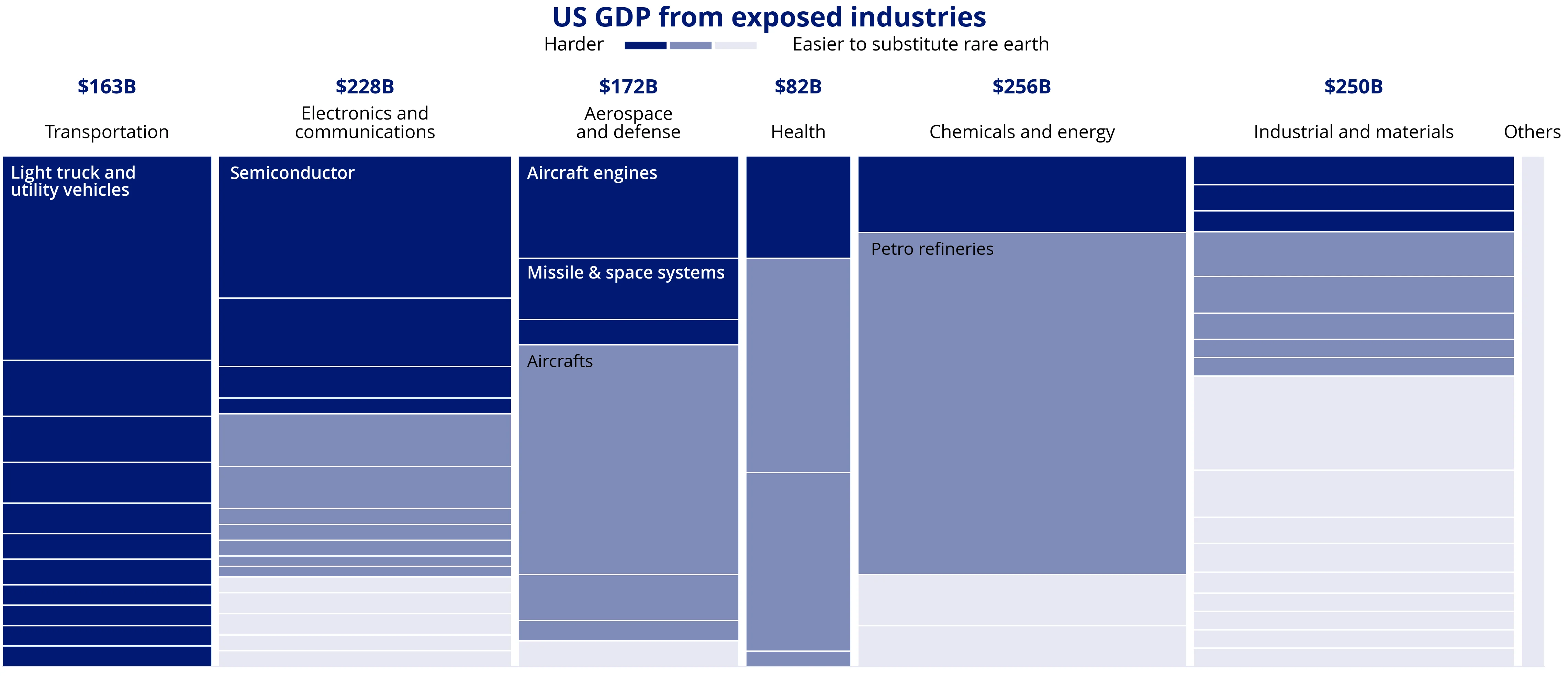
Although Western governments have announced strategic investments and policy support to develop domestic supply chains, creating a competitive "mine-to-magnet" ecosystem will take many years. In the meantime, industries representing approximately US$1.2 trillion of US economic activity remain exposed to potential supply disruptions.
This combination of rising structural demand, concentrated supply and limited substitution continues to underpin a constructive long-term outlook for the sector.
Chart 2: Rare earth dependence exposes US$1.2 trillions of US economic activity
Source: Bloomberg Economics. Data as of May 2026. Past performance is not indicative of future results.
The geopolitical concerns around the rare earths and strategic metals bottlenecks hit our shores last week when the US government committed up to US$400 million in long-term debt financing to Sunrise Energy Metals, via its Pentagon's Office of Strategic Capital.
This is evidence that critical minerals supply chain security has moved beyond rhetoric to capital deployment. At the heart of this particular investment is scandium, a strategic metal in which China currently controls an estimated 80–85% of global supply. In April 2025, Beijing imposed tighter export controls on the metal.
The International Energy Agency (IEA) had warned that full implementation of Chinese export restrictions could potentially cost US$6.5 trillion per year of downstream production across automotive, high-tech, defence and energy sectors.
Against the current geopolitical backdrop, Sunrise's Syerston project in New South Wales, makes sense for the US seeking the metal from a stable, allied jurisdiction. While not currently a holding in RESM, this news represents a theme we expect to play out over coming years as the West seeks to shore up critical minerals infrastructure without the dependency on China.
Valuations: More attractive after the correction
RESM Index's recent pullback has made valuations more attractive on a forward-looking basis relative to other global equities markets. The index trades at 2.77x price-to-book, below the S&P 500 (5.43x). Its underlying companies also carry lower debt levels than the broader market.
Although RESM Index’s trailing P/E remains elevated, this reflects currently depressed earnings following the sharp decline in lithium and rare earth prices rather than expensive valuations. The large gap between its trailing and forward earnings multiples suggests the market is pricing in an earnings recovery.
For investors who expect this cyclical rebound to materialise, we think RESM provides exposure to the long-term structural demand for rare earths and strategic metals at a valuation discount to broad equities.
Table 1: Fundamentals and valuation versus major equity indices
|
Metric |
RESM Index |
S&P 500 |
MSCI ACWI |
|
Long term debt to capital (%) |
22.26 |
34.50 |
31.95 |
|
Dividend yield (%) |
0.37 |
1.03 |
1.48 |
|
Price to earnings (x) |
55.77 |
25.98 |
21.91 |
|
Price to earnings, 12 mth fwd estimate (x) |
21.98 |
21.69 |
18.50 |
|
Price to book (x) |
2.77 |
5.43 |
3.83 |
Source: FactSet, as at 10 August 2026. Past performance is not indicative of future performance. You cannot invest in an index.
Earnings during current reporting season
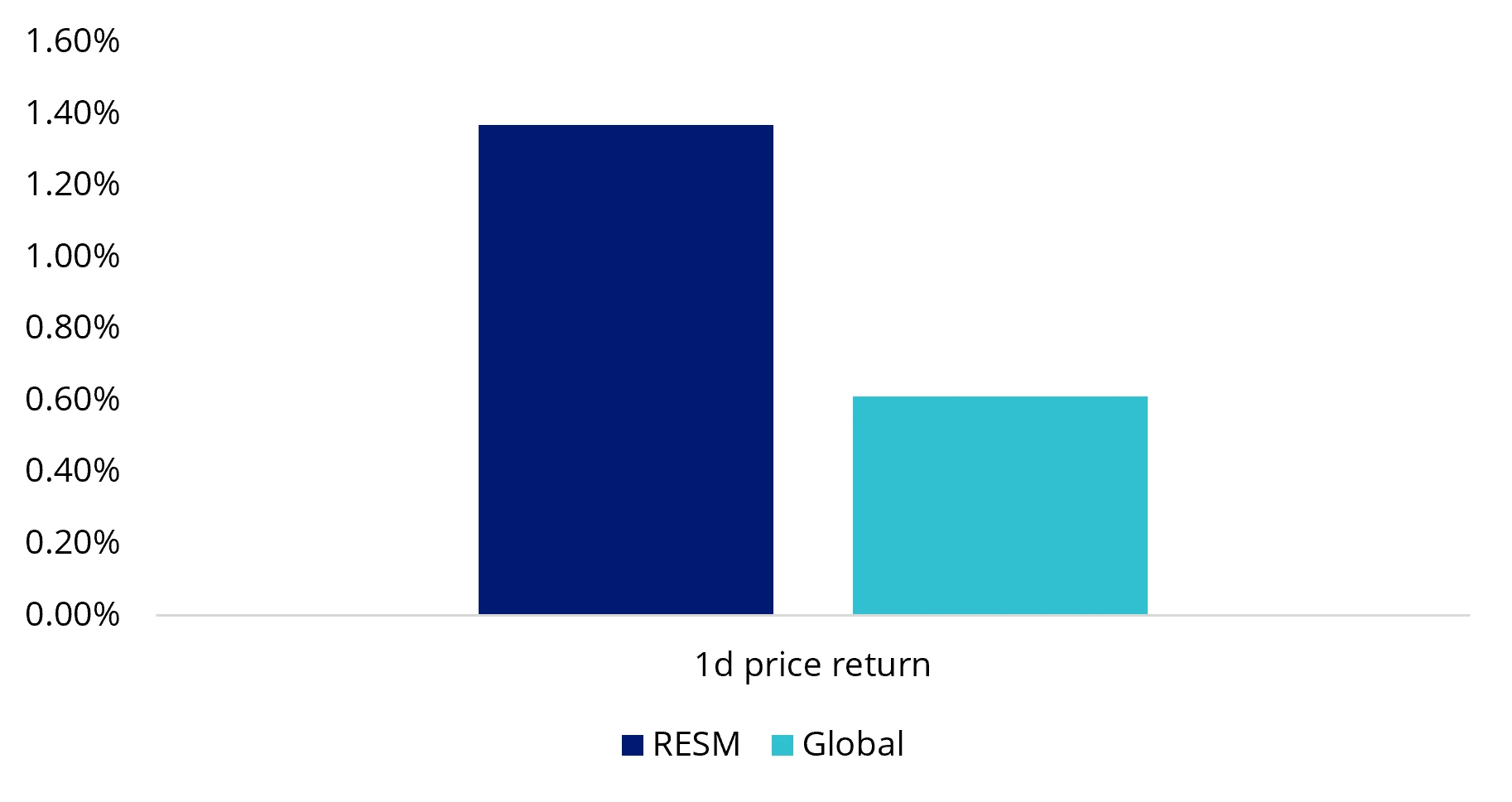
As rare earth companies begin to report earnings, improving company fundamentals are strengthening the case for further share-price appreciation across the sector. The first wave of results has been encouraging, with companies not only delivering positive fundamental outcomes but also receiving strong share-price reactions. This has been reflected across the companies in RESM’s index, which have returned approximately 6.3% in the five days following results, compared with around 1.2% for global equities. As earnings season progresses, further positive results could reinforce this trend, particularly given the structural growth in demand supporting the sector.
Chart 3: Return post results
Source: Bloomberg, VanEck analysis. Data to 12 August 2026. RESM is MarketVector Global Rare Earth/Strategic Metals ex-China Index, Global is MSCI World Index.
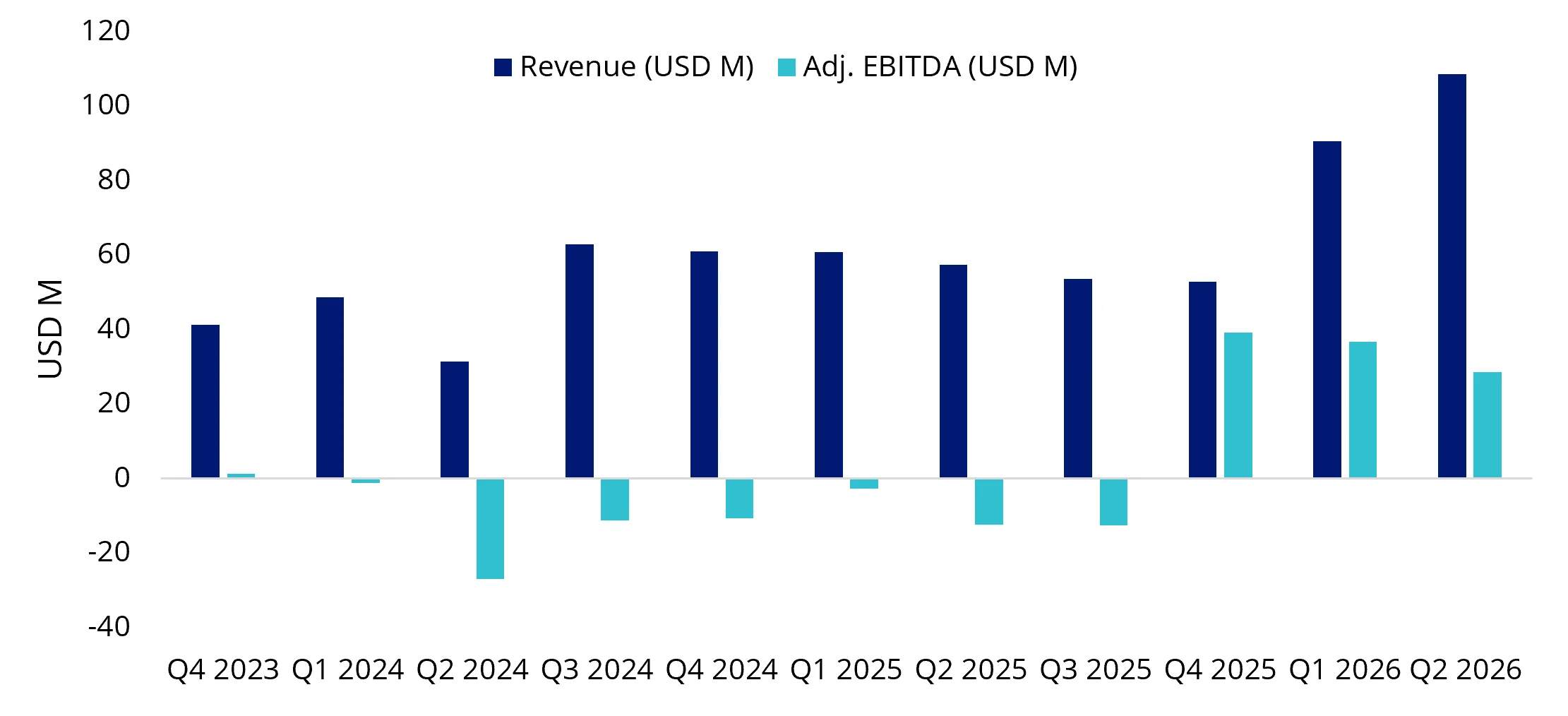
MP Materials (MP), RESM’s largest constituent provides a good example, we think. MP delivered one of the strongest results of the season. Revenue beat consensus by 9.6%, supported by continued growth in neodymium-praseodymium (NdPr) production and sales. Q2 production increased 41% year-on-year and sales volumes rose 127%. The strong result was reflected in the share price, which rose 7.6% following the result and 15.3% over the subsequent five days.
The result, we think, reinforces the improving underlying fundamentals, with growing production volumes, strong customer demand and continued progress towards commercial magnet production supporting the company’s growth outlook.
Chart 4: MP Materials strong revenue and EBITDA
Source: Bloomberg
VanEck Rare Earth and Strategic Metals ex China ETF (RESM)
RESM gives investors access to a portfolio of global strategic metals and rare earth element miners, refiners and recyclers. The types of metals that RESM is exposed to include: rare earth elements, cobalt, lithium, tantalum, tungsten and others.
Key risks
An investment in the ETF carries risks associated with: ASX trading time differences, financial markets generally, individual company management, industry sectors, foreign currency, country or sector concentration, political, regulatory and tax risks, fund operations and tracking an index. See the PDS and TMD for more details.
RESM is likely to be appropriate for a consumer who is seeking capital growth, is intending to use the product as a satellite allocation within a portfolio, has an investment timeframe of at least 7 years, and has an extremely high risk/return profile.


Published: 21 August 2026
IMPORTANT NOTICE
VanEck Investments Limited (ACN 146 596 116 AFSL 416755) (VanEck) is the issuer and responsible entity of all VanEck exchange traded funds (Funds) trading on the ASX. This information is general in nature and not personal advice, it does not take into account any person’s financial objectives, situation or needs. The product disclosure statement (PDS) and the target market determination (TMD) for all Funds are available at vaneck.com.au. You should consider whether or not any Fund is appropriate for you. Investments in a Fund involve risks associated with financial markets. These risks vary depending on a Fund’s investment objective. Refer to the applicable PDS and TMD for more details on risks. Investment returns and capital are not guaranteed.
MarketVector Indexes GmbH (MarketVector), a related body corporate of VanEck Investments Limited, the responsible entity and issuer of VanEck Global Rare Earth and Strategic Metals ex China ETF (Fund).
The MarketVector Global Rare Earth/Strategic Metals ex-China Index (AUD) is created and maintained by MarketVector. MarketVector does not sponsor, endorse, issue, sell, or promote the Fund and makes no representation or warranty, express or implied, to VanEck or any member of the public regarding the advisability of investing in securities generally or in the Fund particularly and bears no liability with respect to the Fund. Read the PDS for the full index disclaimer.