When capital has a cost, quality matters


Recently, the Reserve Bank of Australia reminded investors that the inflation fight is far from over and that officials would not hesitate to tighten policy again if circumstances demanded it.
What's different this time is that Australia is not alone. The Bank of Japan continues its gradual move away from ultra-loose monetary policy, central banks across Europe have resumed raising rates as inflation pressures persist and, overnight, the US Federal Reserve under new Chair Kevin Warsh pushed back against expectations of a rapid return to lower rates.
For investors, the message is becoming increasingly difficult to ignore. The era of ultra-cheap money that defined much of the post-GFC period is over. And with the cost of capital resetting higher, investors may once again have to distinguish between businesses that create value and those that merely consume it.
The investment question that matters
Markets have spent much of the past few years obsessing over the next move of central banks. Every inflation print, employment report and sentiment read is scrutinised for clues about where rates might go next.
Although discerning whether rates move up or down by 25 basis points at the next meeting is valuable, the more important issue is that companies are increasingly operating in a world where financing costs are higher and economic outcomes are less predictable. At the same time, investors are being forced to navigate a market that can move sharply on as little as a social media post from the President of the United States. Market swings have become increasingly common.
The question, then, is not simply where rates go next. It is how to build a portfolio for a world where capital is more expensive and uncertainty is the norm.
Why the cost of capital matters again
One of the most influential investing books of recent times is William Thorndike's The Outsiders. The book profiles eight CEOs who delivered extraordinary long-term shareholder returns by treating capital allocation as their most important responsibility. Rather than focusing solely on operational performance, they distinguished themselves through making intelligent decisions around capital allocation – things like acquisitions, buybacks, debt and reinvestment.
For much of the last two decades, investors were often rewarded regardless of whether they owned these businesses. Easy money rewarded growth almost regardless of how efficiently capital was deployed. Cheap debt, abundant liquidity and historically low interest rates meant many companies could fund growth at almost any cause, regardless of whether that growth generated attractive returns.
Today's environment is different.
As central banks push borrowing costs higher, growth alone is no longer enough. Investors increasingly want to know whether that growth is creating value that shareholders can see. In a world where capital has a cost, the businesses that tend to stand out are those capable of generating attractive returns on the capital already invested in the business.
Consider companies such as Visa, Microsoft or Coca-Cola. The three are very different businesses – one sells software, one runs one of the world’s largest payments networks and one manufactures drinks consumed by just about everyone. But what links them is that they have historically been able to grow without constantly asking lenders or shareholders for more capital.
That is why return on invested capital matters. When borrowing costs are low, investors can be more forgiving of businesses that need large amounts of capital to grow. When rates rise, that tolerance fades. Companies that can generate strong profits from the capital already inside the business tend to stand out.
The lesson is straightforward: when capital has a cost, capital allocation matters.
What history tells us
This isn't simply a theoretical argument. VanEck’s research into factor investing demonstrates that quality has historically demonstrated remarkable consistency across different economic environments.
Analysing more than 25 years of market history, quality was the only factor that never ranked among the bottom two performers in any economic regime examined. It also generated the highest information ratio across the full cycle, suggesting that its excess returns were achieved more consistently than alternative factor approaches.
Chart 1: Quality relative performance versus US manufacturing activity
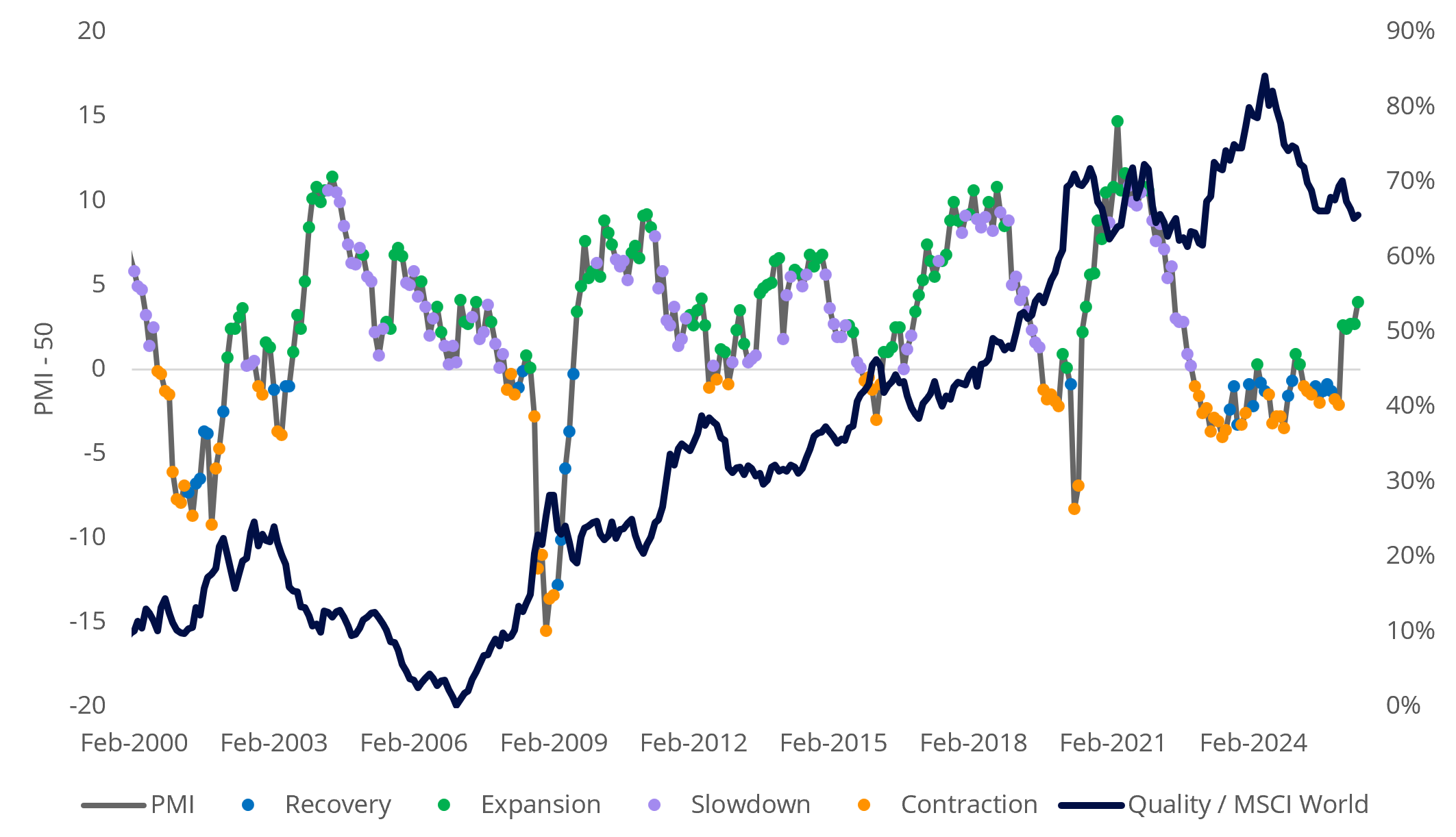
The chart above helps explain why. Historically, quality has delivered its strongest relative performance during periods of recovery and contraction. It has also generated positive excess returns during slowdowns, while only modestly lagging during expansions.
That helps explain why quality has been one of the most consistent factors across economic cycles. Rather than relying on a single macroeconomic outcome, quality has historically performed well in environments where investors place a premium on profitability, earnings resilience and balance sheet strength.
The current environment is difficult to categorise neatly. Growth remains resilient in some economies and sluggish in others. Meanwhile, investors have been grappling with geopolitical tensions, ongoing trade uncertainty and a growing divergence in central bank policy. The current environment may not resemble a traditional recovery, expansion or contraction, but it has reinforced the market's preference for certainty. If history is anything to go by, those have been the conditions in which quality has tended to distinguish itself.
Why quality looks attractive today
This is where quality investing enters the picture.
If the defining feature of the post-GFC era was abundant capital, the defining feature of the current environment may be its rising cost. In that world, investors are increasingly looking for businesses capable of generating attractive returns without relying heavily on debt markets, continual capital raisings or favourable financing conditions.
That is precisely the type of company quality investing seeks to identify.
The MSCI methodology underpinning VanEck MSCI International Quality ETF (QUAL) focuses on three characteristics: high return on equity, stable earnings growth and low financial leverage. Together, these measures help identify businesses such as Microsoft, Visa and Coca-Cola, companies that have historically demonstrated an ability to generate strong returns, maintain profitability across different environments and preserve financial flexibility when conditions become more challenging.
The approach has also translated into strong long-term outcomes. Since its inception on the ASX in October 2014, QUAL has delivered annualised returns of 15.26% per annum to 31 May 2026, outperforming the broader MSCI World ex Australia Index by 1.62% p.a.
The case for quality
For much of the post-GFC era, investors were rewarded for owning businesses that could access capital cheaply. Today's environment looks very different. Policymakers are signalling that borrowing costs may remain structurally higher than investors became accustomed to over the previous decade. If the defining feature of the last cycle was abundant capital, the defining feature of the next may be the efficient use of it.
By focusing on businesses with strong profitability, resilient earnings and conservative balance sheets, QUAL seeks to identify the types of companies that can create value regardless of the economic backdrop. In a world where capital once again has a cost, those characteristics may matter more than they have in years.
Key risks
An investment in our international quality ETF carries risks associated with: ASX trading time differences, financial markets generally, individual company management, industry sectors, foreign currency, country or sector concentration, political, regulatory and tax risks, fund operations and tracking an index. See the VanEck MSCI International Quality ETF PDS and TMD for more details.
QUAL is likely to be appropriate for a consumer who is seeking capital growth, is intending to use the product as a major, core, minor or satellite allocation within a portfolio, has an investment timeframe of at least 5 years, and has a high risk/return profile.


Published: 25 June 2026
Any views expressed are opinions of the author at the time of writing and is not a recommendation to act.
VanEck Investments Limited (ACN 146 596 116 AFSL 416755) (VanEck) is the issuer and responsible entity of all VanEck exchange traded funds (Funds) trading on the ASX. This is general advice only and does not take into account any person’s financial objectives, situation or needs. The product disclosure statement (PDS) and the target market determination (TMD) for all Funds are available at vaneck.com.au. You should consider whether or not any Fund is appropriate for you. Investments in a Fund involve risks associated with financial markets. These risks vary depending on a Fund’s investment objective. Refer to the applicable PDS and TMD for more details on risks. Investment returns and capital are not guaranteed.