True quality is hard to find


The Australian share market is facing a test it has avoided for years. Share prices remain elevated, but the forward earnings expectations supporting them have begun to retreat. As the first chart below shows, the S&P/ASX 200 is trading at around 19-times forward earnings, well above its 20-year average of about 16 times.
Chart 1: S&P/ASX 200 12-month forward price-to-earnings ratio
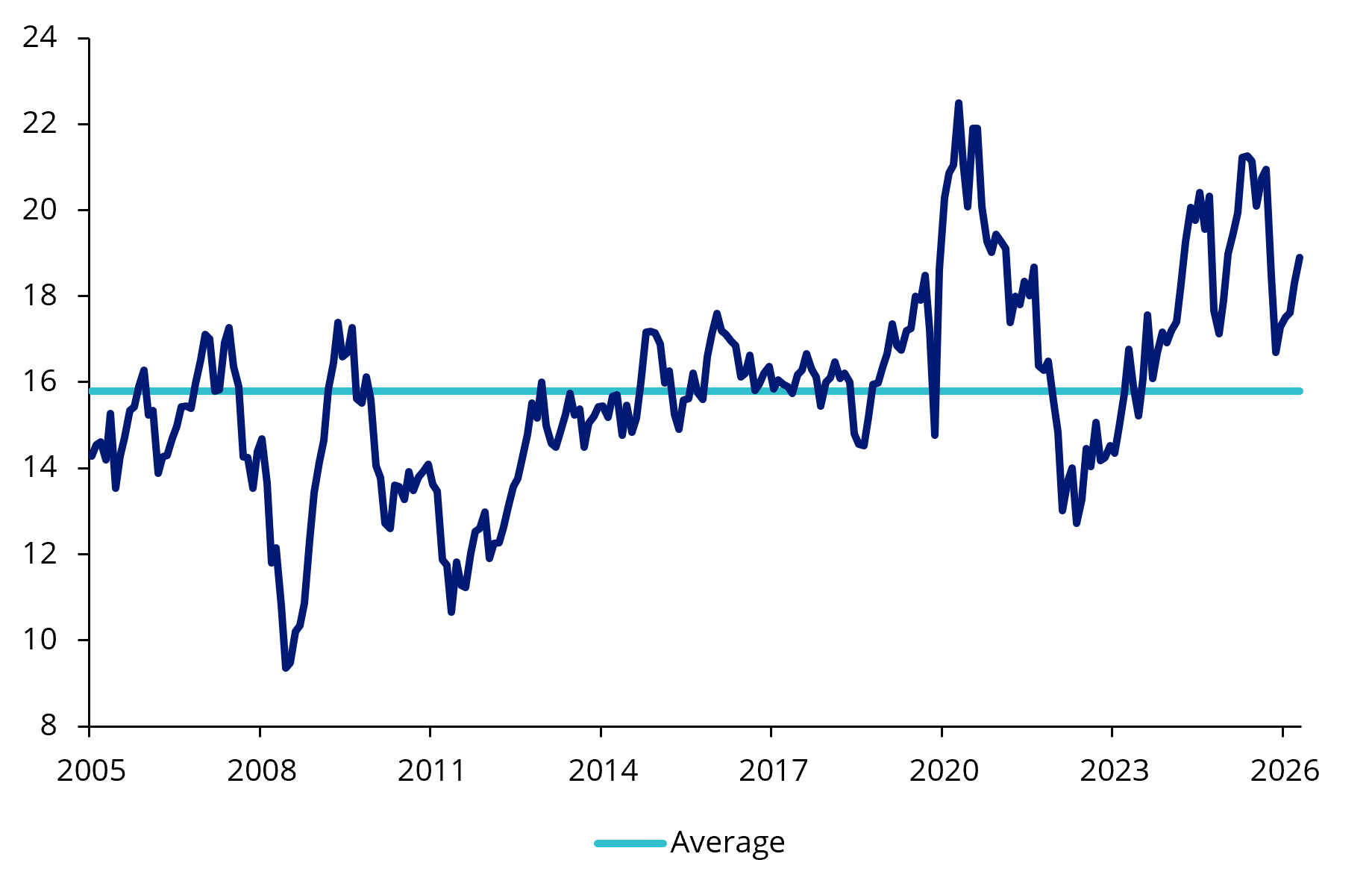
Source: Bloomberg, as at 15 September 2026. You cannot invest directly in an index.
As we highlighted recently, only 24% of companies beat expectations during the August reporting season, while 25% missed and 51% came into line. While the distinction between a small beat and a narrow miss can be debatable, the broader message is that companies have found it difficult to exceed expectations and analysts have begun cutting their forecasts.
Chart 2: Australian share prices have diverged from forward earnings
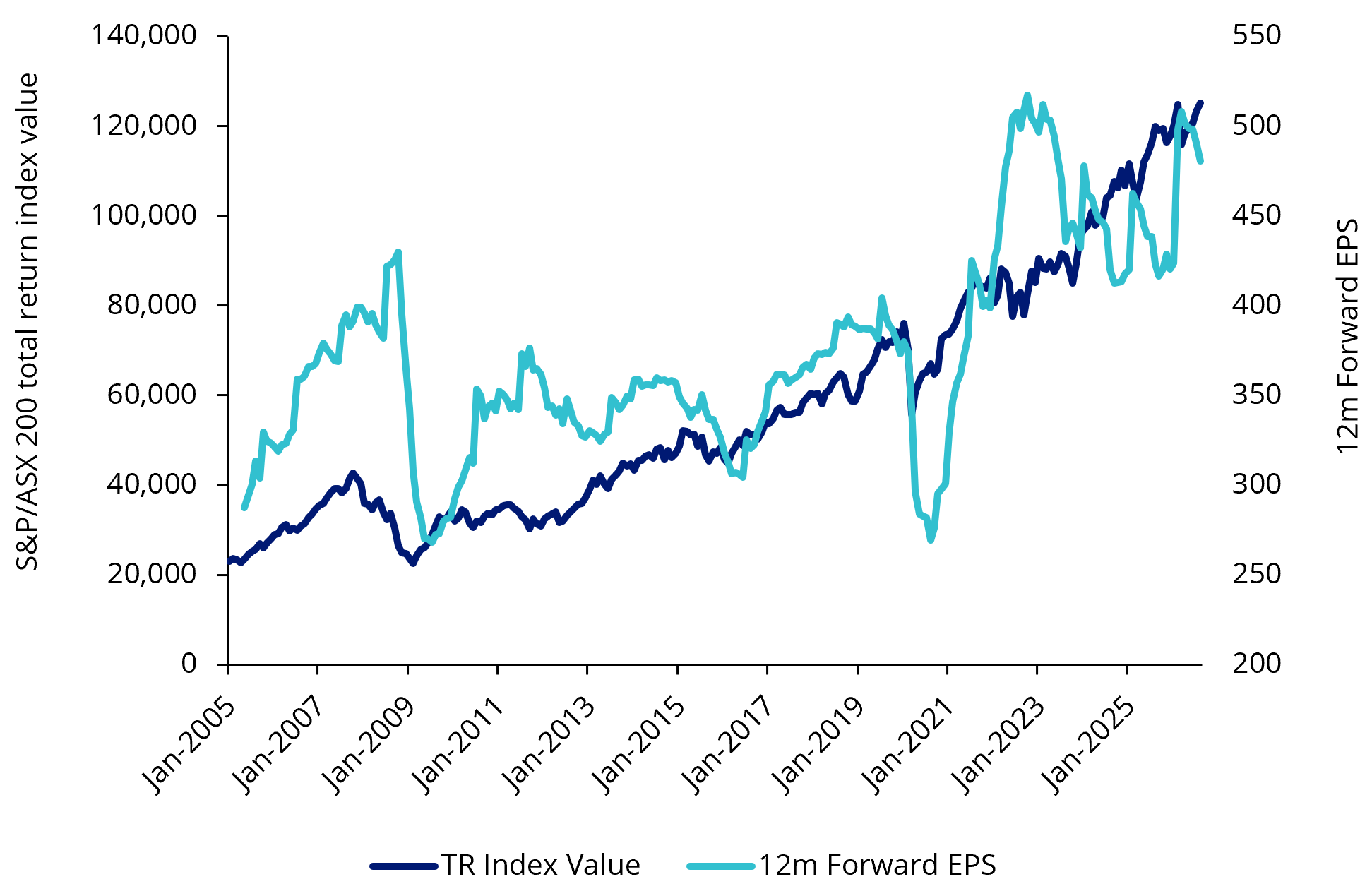
Source: Bloomberg, as at 15 September 2026. Past performance is not indicative of future performance.
Share prices can run ahead of earnings for a time but sustaining that gap becomes harder when the economic backdrop is also weakening.
Higher mortgage repayments can weigh on household spending, while falling house prices may make consumers more cautious. Weak confidence can also cause businesses to delay investment. Higher interest rates add pressure through borrowing costs and the discount rates investors apply to future earnings.
At its interest rate decision last month, the RBA acknowledged that although inflation remains too high, housing momentum has shifted and consumer spending growth is slowing.
Our view is that we have been expecting at least one more cash rate increase in 2026 for a while now, and we continue to think there is a meaningful risk of a second. With the Australian 10-year yield already at a 15-year high, further tightening would raise the hurdle rate for all assets.
This is when true quality could shine
This realisation of a challenging economic environment has contributed to quality companies outperforming recently. As they provide exposure to profitable companies with resilient fundamentals and the financial strength to withstand more difficult conditions. Key drivers of AQTY’s outperformance include overweight exposure to defensive insurance companies and underweight to cyclical sectors including materials which have pulled back. This has also coincided with a spike in the S&P/ASX VIX index, a proxy for market volatility, which has also historically been a period when investors seek a flight to quality. The following chart demonstrates how Australian quality investments have performed during high volatility periods over the last two years.
Chart 3: The S&P/ASX 200 VIX Index vs MSCI Australia IMI Quality Plus Index (AQTY Index) over last 24 months
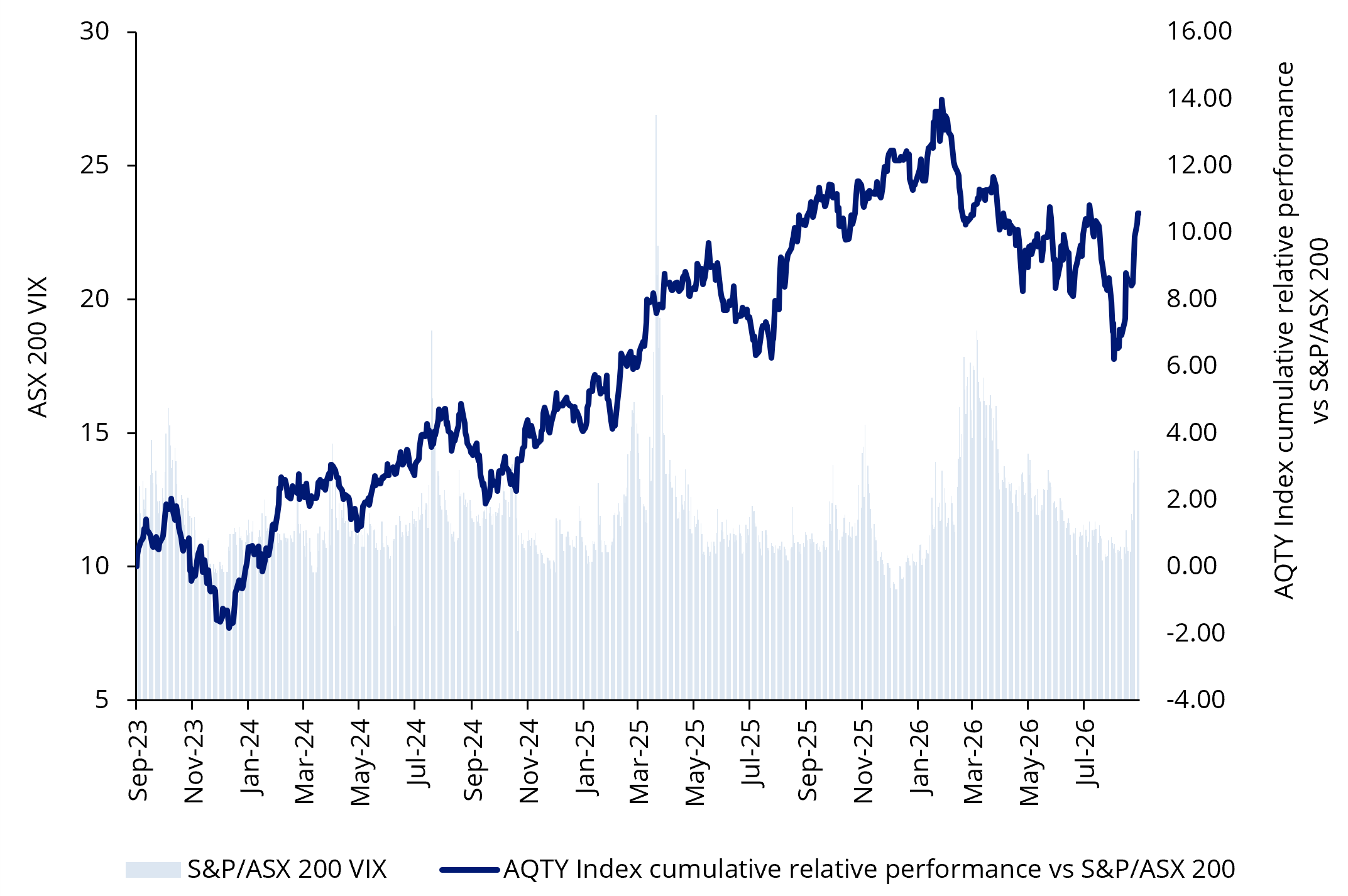
Source: Bloomberg, as at 16 September 2026. You cannot invest directly in an index. AQTY Index performance relative to S&P/ASX 200Index. Performance shown is of the index, not of AQTY. Data prior to the live index launch date, 21 May 2026 is simulated based on the current methodology. Past performance is not indicative of future performance of the index or of AQTY. Results are calculated daily and assume immediate reinvestment of dividends.
Australian history suggests quality’s value is not confined to one economic outcome. Across the 26 calendar years to 2025, the index AQTY tracks, the MSCI Australia IMI Quality Plus Index (AQTY Index) outperformed the S&P/ASX 200 during stagflation, stagnation and reflation, lagging only during the ‘Goldilocks’ years of stronger growth and lower inflation.
Chart 4: Quality delivers resilience during weaker growth regimes
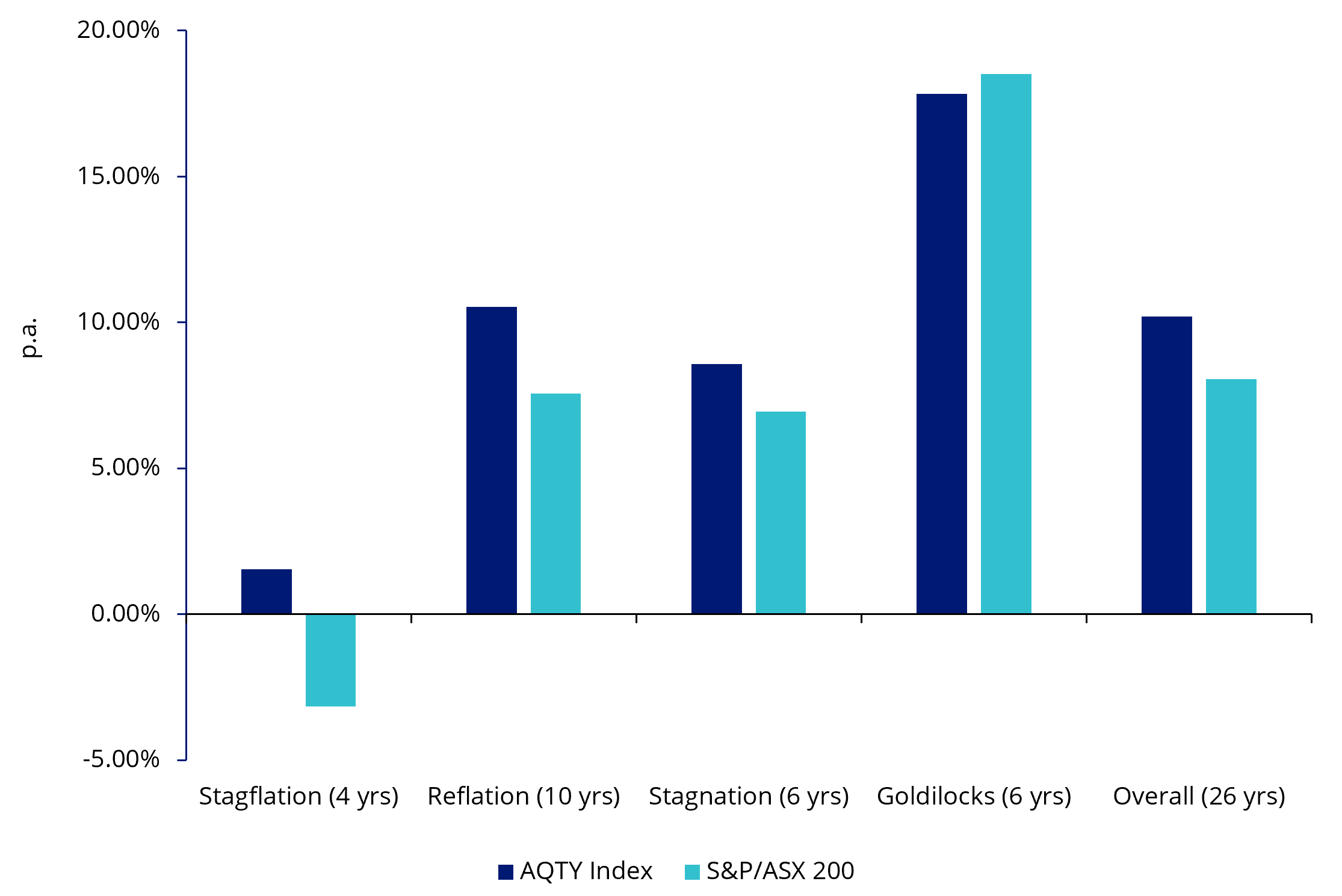
Source: Bloomberg, MSCI. Based on calendar year inflation and economic growth between 2000 and 2025. You cannot invest directly in an index. Performance shown is of the index, not of AQTY. Data prior to the live index launch date, 21 May 2026 is simulated based on the current methodology. Past performance is not indicative of future performance of the index or of AQTY.
The biggest outperformance occurred during stagflation, defined in Chart 4 as economic growth below 2.5% and inflation above 2.5%, which could be the environment the Australian economy is facing. The AQTY Index remained positive while the broader market declined, a result consistent with investors rewarding resilient earnings and stronger balance sheets when growth was weak and cost pressures remained elevated.
While stagflation is not our base case, it is worth considering as our expectation of as many as two further RBA rate hikes in 2026 alongside softer economic conditions could bring it to the fore.
At an international level, quality has historically outperformed in reflationary regimes with higher market volatility. We may be witnessing this in the US now as higher energy prices keep core inflation well above the Fed’s 2% target – a fact that led the Fed to increase its benchmark interest rate by 0.25% last week.
It’s timing, not just time
The timing of this test matters because the economic effects of a hiking cycle do not end with the final increase. This cycle is also unusual because rates began rising again soon after the previous easing cycle ended.
The Australian share market has often ground higher between the RBA’s final rate increase and its first cut. It has finished higher in three of the past five completed cycles, including the most recent one. The S&P/ASX 200 Index, however, fell during the other two periods. The path also varied within each cycle for Australian equities.
Chart 5: How the S&P/ASX 200 performed between the RBA’s final hike and first cut
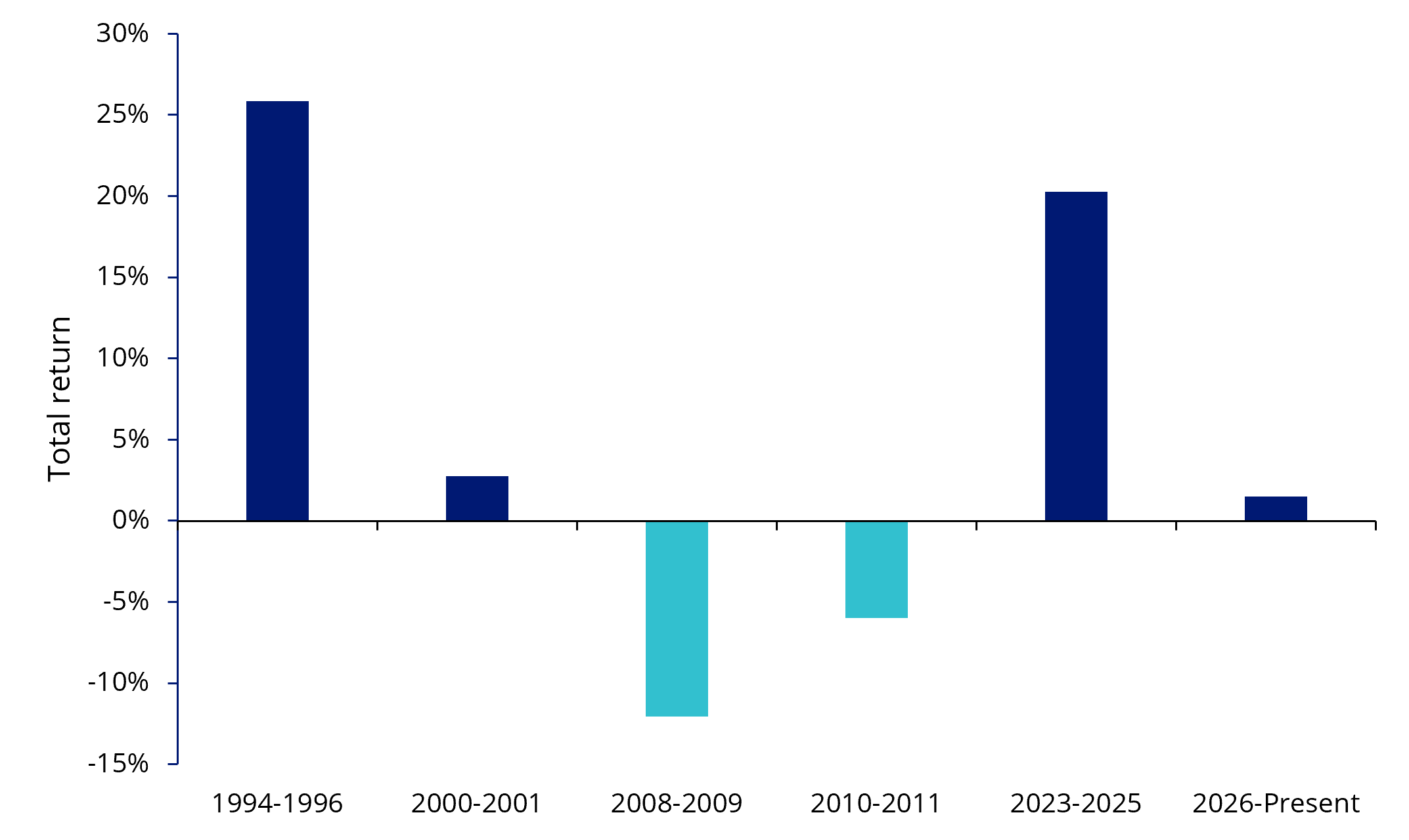
Source: Bloomberg, RBA, ASX, CEIC. Past performance is not indicative of future performance. You cannot invest directly in an index.
The lesson is not that Australian shares will always grind higher between the final rate increase and the first cut. Outcomes vary because monetary policy is just one influence on returns. Rates can remain restrictive for many months, while earnings, valuations and economic conditions help determine which companies fare best. When the index offers no certainty, quality has to be engineered.
Quality designed for the Australian market
Rather than relying on traditional quality measures alone, the VanEck MSCI Australian Quality Plus ETF (AQTY) is designed to deliver a more complete definition of quality and a portfolio that is designed to work within the realities of the Australian market rather than against them.
Quality remains at the heart of the portfolio, with the portfolio first and foremost selecting businesses that have demonstrated an ability to generate profits, grow stable earnings and maintain sound balance sheets.
But quality is not the only factor used to build the portfolio. Value introduces a valuation discipline which means potential portfolio holdings are bought at a reasonable price. A filter for low volatility helps to offset some of the cyclical risks that have challenged quality investing in Australia. A final momentum filter helps identify companies whose fundamentals are improving while screening out potential deterioration.
These factors then work together to produce a portfolio of up to 50 stocks. Combining them reduces dependence on any one factor or market regime and lowers the risk that one attractive characteristic masks weakness elsewhere.
AQTY aims to hold companies with the potential to cushion the downside when markets weaken, without giving up the upside when they recover. That is the quality outcome the strategy was designed to pursue.
No equity strategy is immune to market falls. But as earnings expectations decline and the cost of capital rises, investors should expect quality to do more than appear in a fund’s name. This is when it must earn its name.
Key risksAn investment in the ETF carries risks associated with: financial markets generally, individual company management, industry sectors, fund operations and tracking an index. See the PDS and TMD for more details.
AQTY is likely to be appropriate for a consumer who is seeking capital growth and a regular income distribution, is intending to use the product as a core, minor or satellite allocation within a portfolio, has an investment timeframe of at least 5 years, and has a high risk/return profile.


Published: 21 September 2026
Any views expressed are opinions of the author at the time of writing and is not a recommendation to act.
VanEck Investments Limited (ACN 146 596 116 AFSL 416755) (VanEck) is the issuer and responsible entity of all VanEck exchange traded funds (Funds) trading on the ASX. This information is general in nature and not personal advice, it does not take into account any person’s financial objectives, situation or needs. The product disclosure statement (PDS) and the target market determination (TMD) for all Funds are available at vaneck.com.au. You should consider whether or not an investment in any Fund is appropriate for you. Investments in a Fund involve risks associated with financial markets. These risks vary depending on a Fund’s investment objective. Refer to the applicable PDS and TMD for more details on risks. Investment returns and capital are not guaranteed.
VanEck MSCI Australian Quality Plus ETF (AQTY) is indexed to a MSCI index. AQTY is not sponsored, endorsed or promoted by MSCI, and MSCI bears no liability with respect to AQTY or the MSCI Index. The PDS contains a more detailed description of the limited relationship MSCI has with VanEck and the Fund.
The report that included the rating was published by Lonsec Research Pty Ltd ABN 11 151 658 561 AFSL 421 445 (Lonsec) on 1 July 2026. Lonsec receives a fee from fund managers for the preparation of reports. The report / rating is general advice only. An investor should be aware that: a) the advice has been prepared without taking into account an investors’ objectives, financial situation or needs; b) an investor should consider the appropriateness of the advice having regard to their own objectives, financial situation or needs before acting on the advice; and c) an investor should obtain a PDS relating to the product, consider the PDS and seek independent financial advice before making any decision about whether to acquire the product. The rating is not a recommendation to purchase, sell or hold any product.
Past performance is not a reliable indicator of future performance. Ratings are prepared based on information available at the time of preparation and may be subject to change by Lonsec without notice. Visit lonsec.com.au for important documents (FSG, Conflicts Statement).
© 2026 Lonsec. All rights reserved.