How quality investing can lead to better dividend income


Discover why quality investing can help generate more sustainable dividend income without sacrificing stronger business fundamentals.
Generating income from your investments is about as Australian as spending a hot summer's day at the cricket. Three recent hikes from the Reserve Bank of Australia, heightened market volatility and the Government's proposed changes to the taxation of capital gains have only sharpened investors' focus on it.
That shift is already evident. Cash and fixed income accounted for 30% of all Australian ETF flows in June 2026, while Australian equity income ETFs recorded their strongest month on record.
While the renewed demand for income-generating assets is understandable, the challenge is that many income strategies prioritise yield over quality, leaving investors exposed to businesses with more cyclical earnings or dividends that may prove difficult to sustain. Investors don't necessarily have to make that trade-off.
Investing in quality first may allow income to follow naturally
The VanEck MSCI Australian Quality Plus ETF (AQTY) tracks the MSCI Australia IMI Quality Plus Index (AQTY Index) which was built on more than a decade of research into quality investing in Australia. It combines measures of profitability, valuation, low volatility and momentum to identify companies with resilient business fundamentals, while accounting for the unique characteristics of the Australian share market.
Quality investing and income investing are often viewed as separate approaches, but in reality, they are closely connected. Companies that consistently generate strong profits and convert those profits into cash flow are generally better placed to return capital to shareholders through dividends. Higher returns on equity reinforce that those profits are being generated efficiently, making dividend payments more sustainable through the cycle.
Although AQTY is not an income-focused strategy, its emphasis on profitable, cash-generative businesses has produced a portfolio that currently offers a higher dividend yield than the broader market. The table below compares AQTY's key fundamental characteristics with those of the S&P/ASX 200.
Table 1: Greater income, supported by stronger fundamentals
|
Metric |
AQTY |
S&P/ASX 200 |
Difference |
|
Free cash flow yield |
5.28% |
4.48% |
+0.80% |
|
Earnings yield |
5.13% |
4.37% |
+0.76% |
|
Return on equity |
14.79% |
13.95% |
+0.84% |
Source: FactSet, as at 10 July 2026. Dividend Yield is the weighted average of each portfolio security’s distributed income during the prior twelve months. Free cash flow is the weighted average of each portfolio’s security operating cash flow after accounting for capital expenditures. Earnings yield is the weighted average of earnings per share divided by the share price. Return on equity is the weighted average of each portfolio’s net income divided by shareholder’s equity. Past performance is not indicative of future performance.
Importantly, the relationship between quality and income is not simply a point-in-time observation.
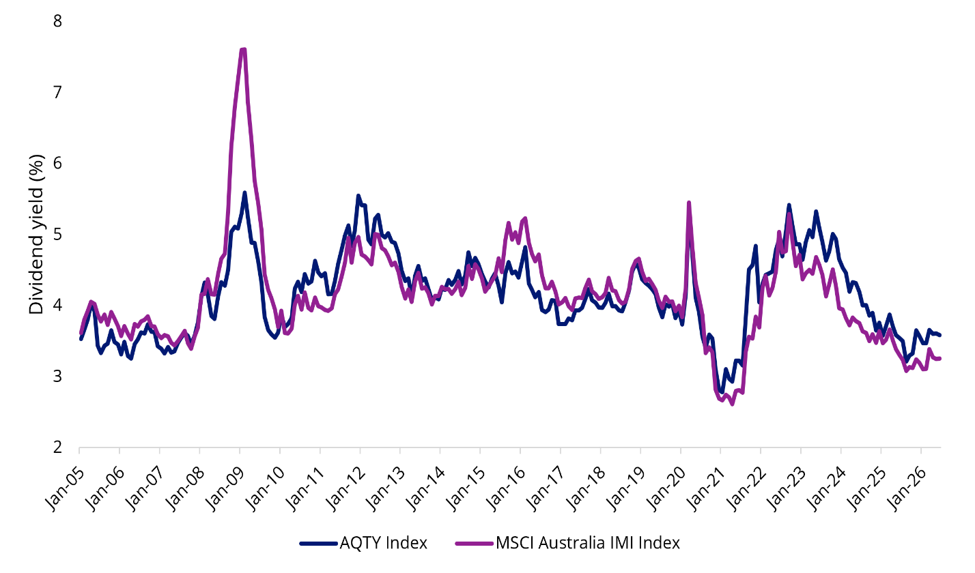
As the chart below shows, AQTY Index's dividend yield has remained broadly competitive with the broader Australian market over the long term and has exceeded the benchmark index for much of the past five years. While the gap has naturally widened and narrowed as market conditions evolved, the strategy demonstrates that investors need not sacrifice dividend income in pursuit of quality.
Chart 1: AQTY Index has consistently delivered a competitive dividend yield
Source: MSCI, FactSet. As at 30 June 2026. Past performance is not an indication of future performance of the index or of AQTY. You cannot invest directly in an index.
Why quality needs to be done differently in Australia
The same structural features that shape the broader market can also influence the outcomes delivered by traditional quality strategies. During favourable parts of the commodity cycle, resource companies can score highly on conventional quality measures, resulting in portfolios that look very different from what investors typically expect from a quality strategy.
The issue is not that the quality factor is broken.
Australia's market structure creates challenges that traditional quality screens do not always overcome.
Rather than relying solely on traditional quality measures, the MSCI Australia IMI Quality Plus Index (which AQTY tracks) combines quality with valuation, low volatility and momentum. Quality remains at the heart of the portfolio, while the additional factors introduce valuation discipline, help moderate cyclical risk and identify companies whose fundamentals are improving.
Together, these characteristics create a more complete definition of quality and a portfolio that is designed to work within the realities of the Australian market.
Quality income
As investors rotate back towards income, the temptation will be to focus on yield alone. History suggests that approach can leave portfolios exposed when earnings or commodity prices weaken.
AQTY takes a different starting point. It is a quality strategy that selects Australian companies with stronger profitability, lower relative volatility and cheap valuations. Owning that kind of business has a natural consequence: AQTY currently carries a dividend yield above the broad market, grounded in fundamentals rather than in reaching for yield.
For investors seeking Australian equity income, that may prove a more durable foundation than simply chasing the highest yield available.
Key risks
An investment in the ETF carries risks associated with financial markets generally, individual company management, industry sectors, fund operations and tracking an index. See the PDS and TMD for more details.
AQTY is likely to be appropriate for a consumer who is seeking capital growth and a regular income distribution, is intending to use the product as a minor or satellite allocation within a portfolio, has an investment timeframe of at least 5 years, and has a high risk/return profile.


Published: 21 July 2026
Any views expressed are opinions of the author at the time of writing and is not a recommendation to act.
VanEck Investments Limited (ACN 146 596 116 AFSL 416755) (VanEck) is the issuer and responsible entity of all VanEck exchange traded funds (Funds) trading on the ASX. This information is general in nature and not personal advice, it does not take into account any person’s financial objectives, situation or needs. You should consider whether or not an investment in any Fund is appropriate for you. Investments in a Fund involve risks associated with financial markets. These risks vary depending on a Fund’s investment objective. Refer to the applicable product disclosure statement (PDS) and target market determination (TMD) available at vaneck.com.au for more details. Investment returns and capital are not guaranteed.