Follow the money into the machine


Cheaper AI models are widening adoption while Asian chipmakers control crucial hardware bottlenecks, reshaping the semiconductor opportunity.
You do not commit US$29 billion to a share buyback to make a subtle point.
In August 2026, South Korean chipmaker SK Hynix committed to buying back and cancelling 24 million shares and lifted its shareholder-return target to more than half the free cash flow generated between 2025 and 2027. As investors questioned how long the artificial intelligence spending boom could last, the company placed an extraordinary amount of money behind its answer.
Its confidence makes more sense once you follow what happens every time somebody uses an AI model. Data must move rapidly between processors and memory. SK Hynix leads the market for the high-bandwidth memory performing that job, while TSMC manufactures and packages many of the advanced processors installed in data centres.
Models can be copied or overtaken. Manufacturing their components at enormous scale and with microscopic failure rates is near-impossible to imitate.
The falling price of intelligence
Asia is no longer competing underneath the bonnet.
Years of targeted and escalating restrictions which limited China’s access to advanced chips did not hamper local players like DeepSeek, Alibaba and Moonshot AI. These firms responded by extracting more intelligence from the computing capacity available to them, competing aggressively on price and by offering open weights that businesses can use.
More efficient models might initially sound like bad news for chipmakers. If each AI task requires less computing power, demand for hardware should fall. But greater efficiency also makes AI cheaper, opening it to more businesses, products and applications. Total demand for computing power can therefore rise even as the amount required for each task falls.
This helps explain why greater model efficiency has coincided with extraordinary physical investment. Combined capital expenditure by Amazon, Alphabet, Microsoft, Meta and Oracle is expected to approach US$800 billion in 2026, more than five times its 2022 level.
Chart 1: Capital expenditure – top five hyperscalers
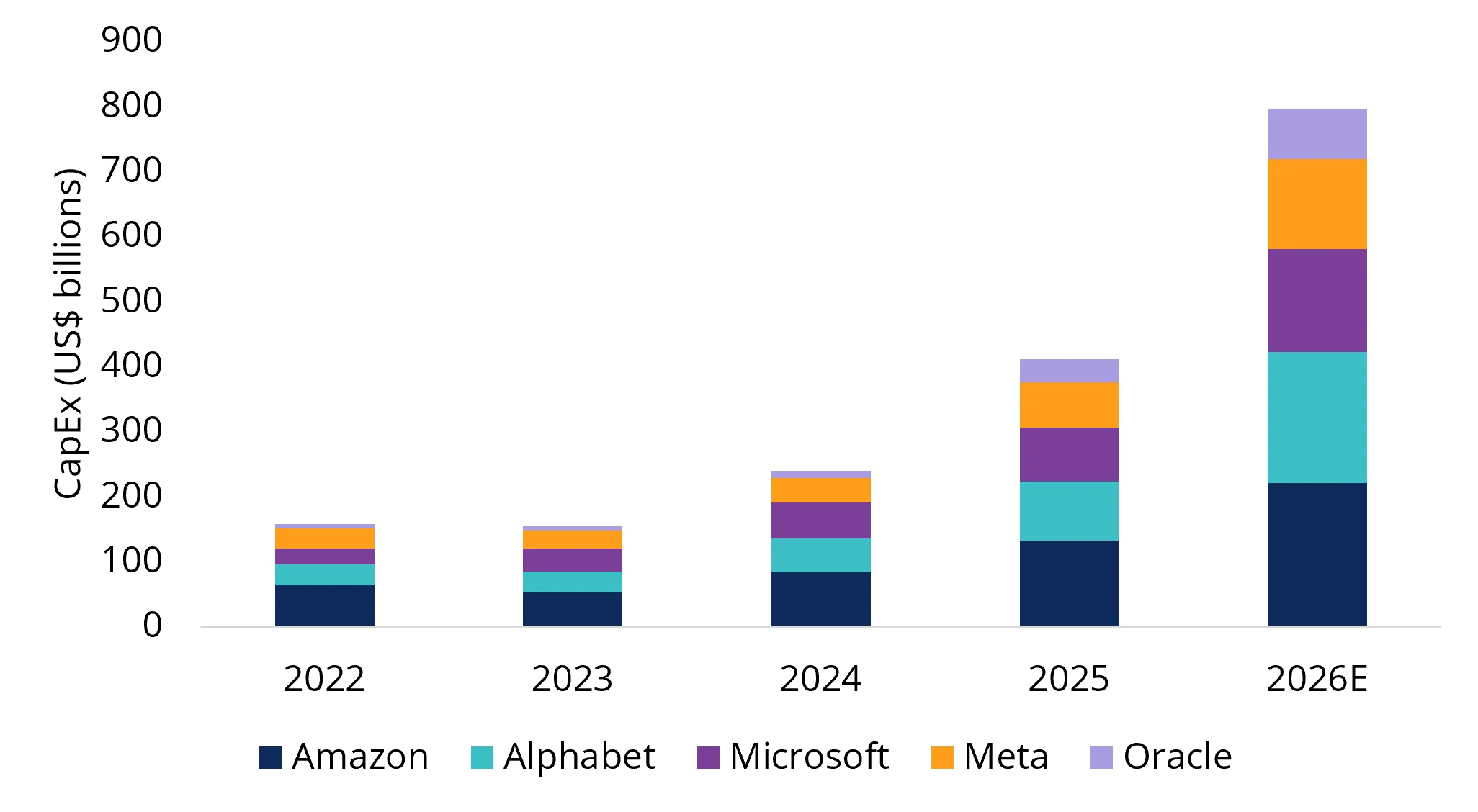
Source: Bloomberg, as at 28 August 2026.
That spending is flowing beyond advanced processors into memory, servers and networking equipment. But investment cannot immediately create the specialised manufacturing capacity each requires. As demand has accelerated, bottlenecks have emerged across the supply chain.
Where demand meets its limits
High-bandwidth memory is among the tightest bottlenecks. An advanced processor can perform calculations at speed only if memory can keep it supplied with data. Capacity for the latest generations is allocated well into 2027, giving leading producers unusual visibility over demand and pricing.
Producing processors and memory is only part of the job. They must also be assembled and connected so they can work together inside a data centre. TSMC’s capacity to perform this advanced assembly is fully booked, while orders for some essential materials extend into 2027. Linking thousands of chips also requires faster connections, increasing demand for equipment that can move enormous volumes of data between them.
The AI supply chain, as the Future Fund has worked out, is a series of interdependent constraints. Each one directs spending towards another part of the value chain, allowing earnings to broaden from AI accelerator designers into memory producers, foundries and other parts of this ecosystem.
Following the earnings
The broadening is already playing out. 12-month forward earnings for global semiconductor companies have increased by approximately 510% over the past five years, compared with about 150% for the Nasdaq 100.
Share prices have historically tended to follow earnings. Recent weakness has opened a gap between the two, suggesting investors have become more cautious about the durability of AI capital expenditure before analysts have made corresponding reductions to semiconductor earnings forecasts.
Chart 2: Semiconductor prices versus earnings growth (% change)
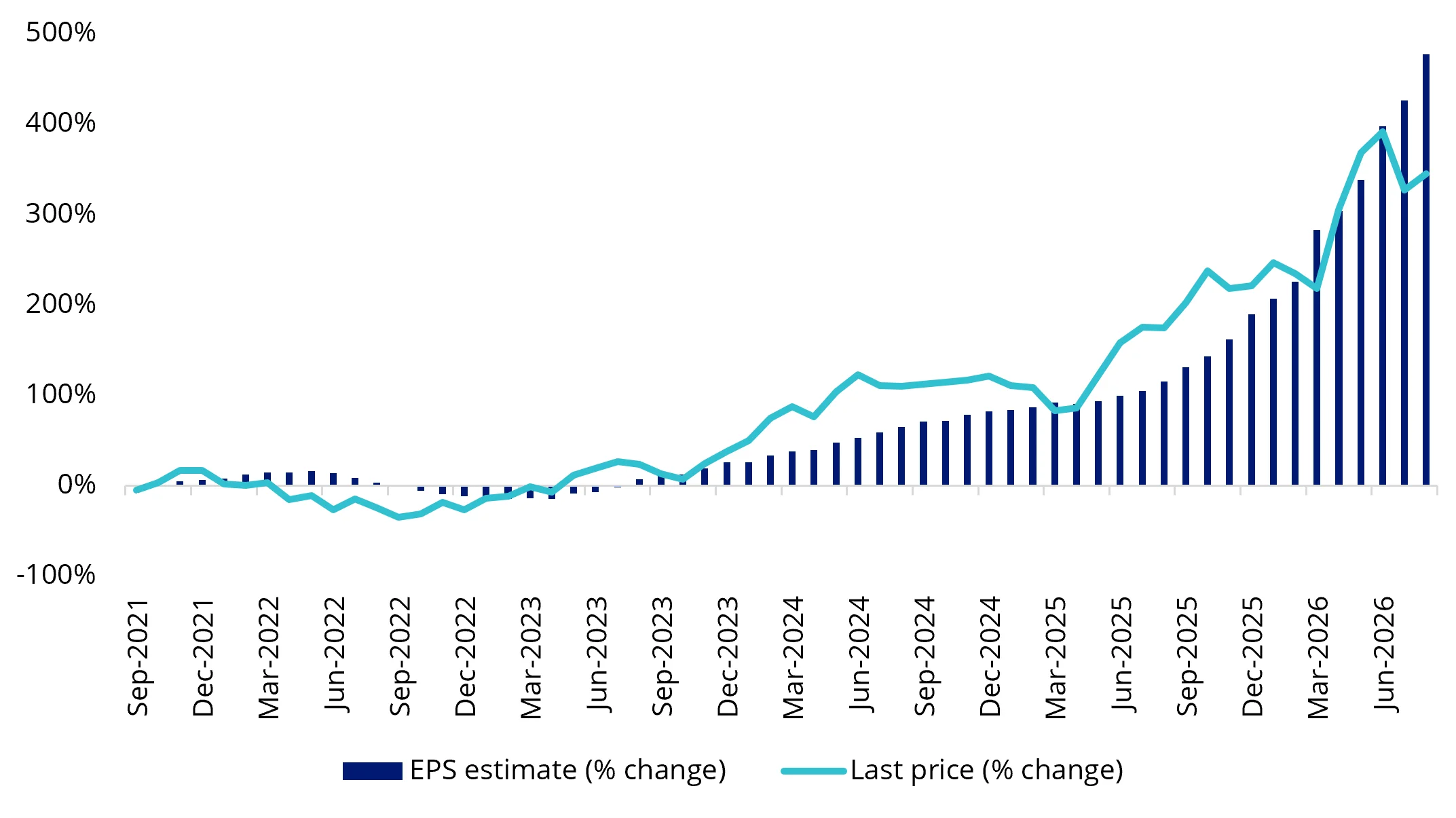
Source: Bloomberg, as at 28 August 2026. Past performance is not indicative of future performance.
That caution is also visible in valuations. As at 28 August 2026, the MSCI World Semiconductors Index traded at 18.2 times 12-month forward earnings, compared with 21.5 times for the Nasdaq-100. That discount exists despite semiconductor earnings having grown considerably faster over the past five years.
Chart 3: Global semiconductors trade at a forward P/E discount to the Nasdaq 100
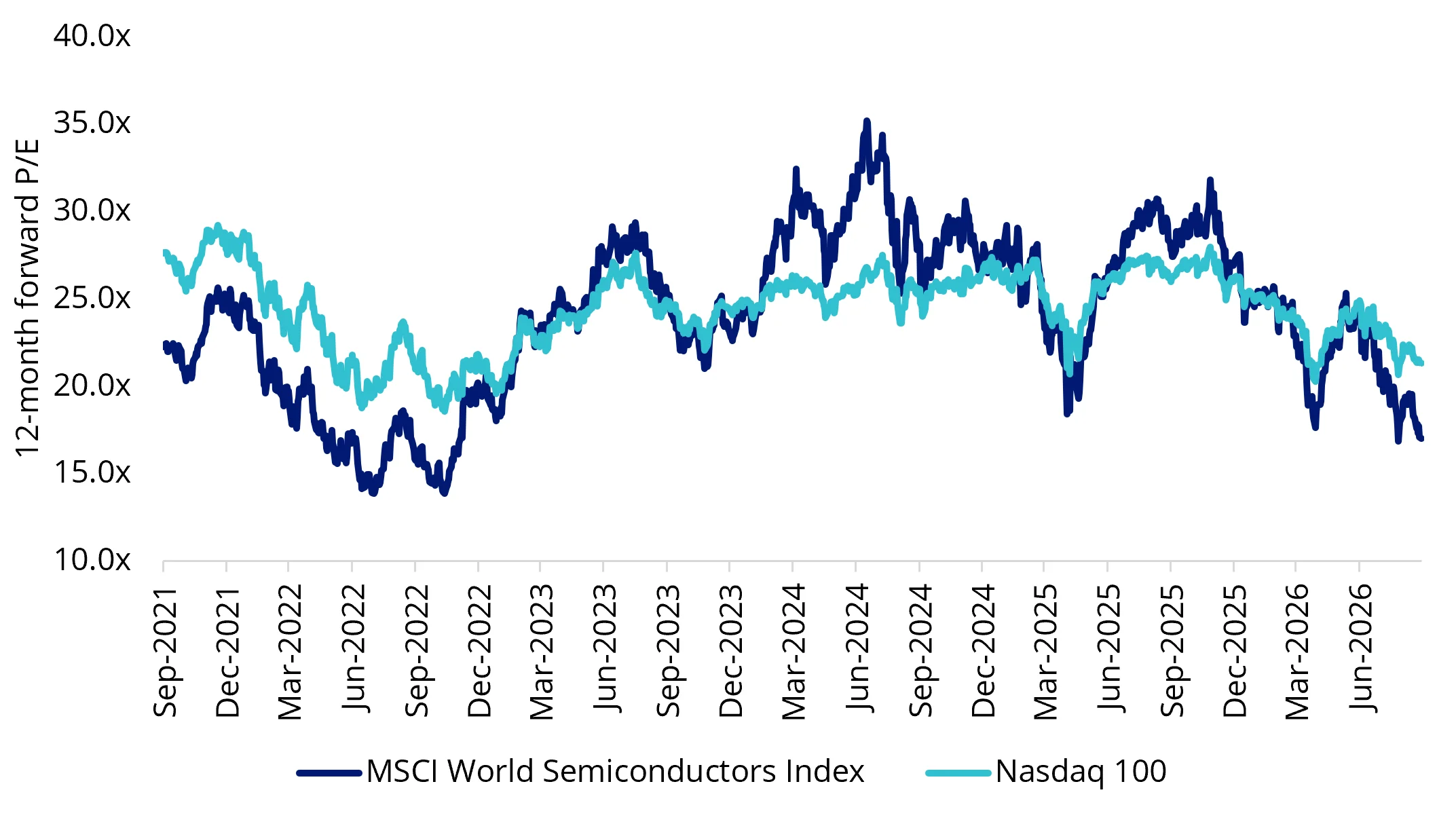
Source: Bloomberg, as at 28 August 2026. MSCI World Semiconductors Index and Nasdaq-100 Index.
The combination of stronger earnings and discounted valuations creates a more compelling starting point for investors, although the benefits may not be shared evenly. Semiconductor cycles can turn quickly as new capacity comes online, while companies across the value chain have different margins and sensitivities to demand. Exposure to geopolitical tensions also varies across the supply chain.
All this means the opportunity is broadening, making careful selection more important.
Redrawing the investment map
The semiconductor supercycle has prompted a rethink among Australian investors who have traditionally approached emerging markets as a commodities or US dollar play.
South Korea and Taiwan control manufacturing capabilities that some of the world’s richest companies cannot readily reproduce. China is competing through the cost, efficiency and accessibility of its AI models. Important parts of the AI economy are not simply spilling into emerging markets. They are being developed and built there.
That shift is visible inside the VanEck MSCI Multifactor Emerging Markets Equity ETF (ASX: EMKT). As at 31 July 2026, information technology represented 44.5% of the portfolio, while TSMC, Samsung Electronics and SK Hynix were its three largest holdings and together accounted for about 30%.
EMKT is not a semiconductor ETF. Its index applies value, momentum, low size and quality factors across emerging market companies, capturing the changing composition of the asset class while remaining selective about an uneven opportunity.
The VanEck Semiconductor ETF (ASX: SMHG) begins from the opposite direction, investing purely in the global semiconductor value chain.
AI is becoming cheaper and easier to access while remaining dependent on scarce manufacturing capabilities. And while new models will continue to arrive with great fanfare, a less visible contest over manufacturing, packaging, connectivity and scale is well underway.
SK Hynix’s US$29 billion decision suggests the companies controlling those constraints increasingly have the earnings and cash flow to show for it.
Key risks
An investment in our emerging markets ETF carries risks associated with: ASX trading time differences, emerging markets, financial markets generally, individual company management, industry sectors, foreign currency, country or sector concentration, political, regulatory and tax risks, fund operations, liquidity and tracking an index. See the VanEck MSCI Emerging Markets Equity ETF PDS and TMD for more details.
An investment in our semiconductor ETF carries risks associated with: ASX trading time differences, financial markets generally, individual company management, industry sectors, foreign currency, country or sector concentration, political, regulatory and tax risks, fund operations and tracking an index. See the PDS and TMD for more details.
EMKT is likely to be appropriate for a consumer who is seeking capital growth, is intending to use the product as a core, minor or satellite allocation within a portfolio, has an investment timeframe of at least 5 years, and has a high risk/return profile.
SMHG is likely to be appropriate for a consumer who is seeking capital growth, is intending to use the product as a satellite allocation within a portfolio, has an investment timeframe of at least 5 years, and has a very high risk/return profile.


Published: 02 September 2026
Any views expressed are opinions of the author at the time of writing and is not a recommendation to act.
VanEck Investments Limited (ACN 146 596 116 AFSL 416755) (VanEck) is the issuer and responsible entity of all VanEck exchange traded funds (Funds) trading on the ASX. This information is general in nature and not personal advice, it does not take into account any person’s financial objectives, situation or needs. The product disclosure statement (PDS) and the target market determination (TMD) for all Funds are available at vaneck.com.au. You should consider whether or not an investment in any Fund is appropriate for you. Investments in a Fund involve risks associated with financial markets. These risks vary depending on a Fund’s investment objective. Refer to the applicable PDS and TMD for more details on risks. Investment returns and capital are not guaranteed.