A new cast for income investors


The James Bond franchise changed stars last week when Robert Pattinson was named as Daniel Craig’s successor. As momentous as this handover is, we think Australian income investors are facing an equally significant changing of the guard.
APRA’s long-telegraphed phase-out of bank hybrids begins in the new year. As securities are called, investors who have relied on those franked distributions will need to find somewhere else to put their capital to work.
But unlike the Craig-to-Pattinson succession, there is no one-for-one replacement that delivers everything a hybrid investor values in the same package of yield, franking and familiarity.
Australian Tier 2 subordinated debt and global capital securities offer ways to continue earning income from banks and other financial institutions at home and abroad. Both are accessible through ETFs.
Hybrid-like income from Australian banks
Bank hybrids may be approaching their final credits, but subordinated debt gives many of the same banks a new role in an investor’s income portfolio.
Subordinated bonds help provide the financial buffer that banks need to absorb losses during severe financial distress. Issuers of Australian dollar-denominated subordinated debt include all four major Australian banks, Macquarie Group and international banks such as HSBC and BNP Paribas. Tier 2 capital is another name for this subordinated debt.
As the diagram below shows, these bonds rank below deposits and senior debt but ahead of ordinary shares and hybrids. This ranking determines investors’ repayment priority if a bank becomes insolvent and helps explain the income offered for taking on that risk.
Figure 1: Simplified capital structure of a financial institution
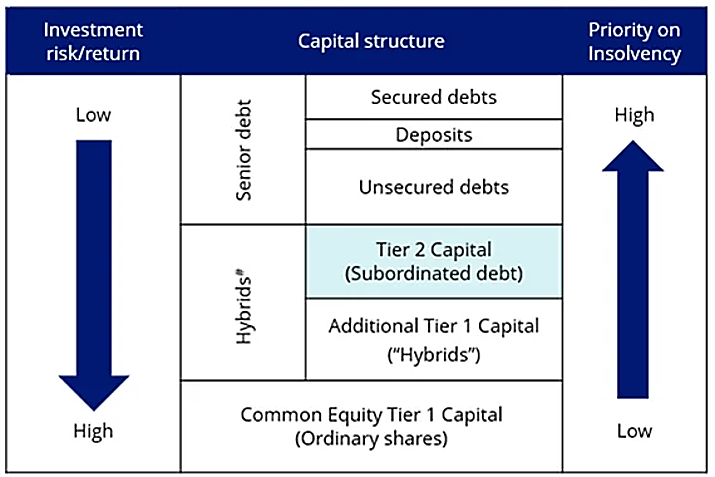
#Per ASIC Report 365. Source: VanEck. For illustrative purposes only.
Subordinated debt can serve different purposes depending on what an investor already owns. For those relying on dividends from shares or ETFs, or rent from an investment property, subordinated debt can add another source of regular income. For investors holding term deposits, subordinated bonds offer the potential for higher income in exchange for greater risk to their capital.
If a bank becomes non-viable, subordinated bonds, like hybrids, may be converted into shares or written off. An ETF spreads exposure across multiple securities and issuers, reducing an investor’s reliance on one holding. Investors still bear the risks of subordinated debt.
The VanEck Australian Subordinated Debt ETF (SUBD) gives investors access to a portfolio of investment-grade subordinated bonds through one ASX trade. Its holdings are Australian dollar-denominated, floating-rate securities issued by banks and other financial institutions, with income distributed monthly.
The floating rate element is particularly relevant now given the RBA has raised interest rates five times this year. As short-term market rates increase, the bonds’ interest payments adjust at their next reset, allowing higher rates to flow through to income.
While the first subordinated bonds issues were floating, as interest rates have risen, investors have demanded fixed rate subordinated bonds. The VanEck Australian Fixed Rate Subordinated Debt ETF (FSUB) gives investors access to a portfolio of investment-grade fixed rate subordinated bonds through one ASX trade.
The potential advantage of fixed rate bonds is that if interest rates do start to fall, because of the inverse relationship between rates and bond prices, these existing fixed rate subordinated bonds increase in value, and they become more sought after. Conversely, when rates are rising, existing fixed rate bonds fall in value.
A broader choice of banks
Global capital securities share a mix of debt and equity characteristics that will be familiar to Australian bank hybrid investors.
They pay income but can also be converted into shares or written off under specified conditions. The market includes Additional Tier 1 hybrids and Tier 2 securities issued by financial institutions around the world, which sit above ordinary shares but below senior debt in the capital structure.
For Australians who own both bank shares and local hybrids, going offshore can help address overlapping exposure to the same institutions. Holding different securities from Australian banks still leaves a portfolio exposed to the domestic economy. A global allocation spreads that exposure across more issuers and economies.
The offshore market also offers a wider selection of securities, many of which are traded between institutions and professional investors rather than on a public stock exchange such as the ASX.
The VanEck Bentham Global Capital Securities Active ETF (GCAP) gives investors exposure to this hard-to-reach market. Bentham Asset Management, a specialist global credit manager, can adjust the portfolio as conditions change, favouring higher-ranking debt when greater caution is warranted or accepting additional risk when the potential return justifies it. GCAP distributes income monthly and hedges foreign currency exposure to Australian dollars.
What reaches your account
As at 31 October 2026, the yield to worst1were 6.20% for SUBD, 6.37% for FSUB and 7.54% for GCAP. This is compared with the ASX 200’s reported dividend yield of 3.4% at the end of September and Australia’s national gross rental yield of 3.9% in October. SUBD, FSUB and GCAP also distribute monthly, offering another way to help fund regular expenses.
The comparison excludes capital growth, the share dividend yield excludes franking credits, and rental yields are before property expenses. The right mix will depend on how much income you need, your tax position and the risks you are prepared to take.
Bond’s producers have chosen one successor. Investors replacing their hybrids can make room for more than one.
Key risks
An investment in the funds carry risks associated with: bond markets generally, subordinated debt, interest rate movements, issuer default, credit ratings, fund operations, and liquidity. See the PDS and TMD for details.
GCAP is likely to be appropriate for a consumer who is seeking capital growth and a regular income distribution, is intending to use the product as a minor or satellite allocation within a portfolio, has an investment timeframe of at least 5 years, and has a very high risk/return profile.
SUBD is likely to be appropriate for a consumer who is seeking capital preservation and a regular income distribution, is intending to use the product as a minor or satellite allocation within a portfolio, has an investment timeframe of at least 3 years, and has a medium risk/return profile.
FSUB is likely to be appropriate for a consumer who is seeking a regular income distribution, is intending to use the product as a minor or satellite allocation within a portfolio, has an investment timeframe of at least 3 years, and has a medium risk/return profile.
1- Yield to worst (% p.a.) is a measure of the lowest possible yield that can be received assuming the security does not default. YTW does not account for fees or taxes. YTW is not a forecast, and is not a guarantee of, the future return of the fund.


Published: 26 November 2026
Any views expressed are opinions of the author at the time of writing and is not a recommendation to act.
VanEck Investments Limited (ACN 146 596 116 AFSL 416755) (VanEck) is the issuer and responsible entity of all VanEck exchange traded funds (Funds) trading on the ASX. This information is general in nature and not personal advice, it does not take into account any person’s financial objectives, situation or needs. You should consider whether or not an investment in any Fund is appropriate for you. Investments in a Fund involve risks associated with financial markets. These risks vary depending on a Fund’s investment objective. Refer to the applicable product disclosure statement (PDS) and target market determination (TMD) available at vaneck.com.au for more details. Investment returns and capital are not guaranteed.