Why investing’s GOAT is rotating into quality stocks


An investor looking at September’s share market performance could be forgiven for acquiring a tech neck. On the one hand, semiconductor and AI-linked companies continued to rally, and international equities continued to outperform Australian equities. But it all happened despite government bond yields hitting two-decade highs due to stubborn inflation and the elevated crude oil price.
But September was one of the most consequential market months for some time for a different reason.
Credit spreads widened alongside rising yields on government bonds. As a result, companies refinancing debt could face a higher base interest rate and a larger premium for their credit risk.
For shareholders, that combination matters as more money spent servicing debt leaves less available for investment, acquisitions and distributions (all else being equal).
Following last month’s heavy exposure to cyclical sectors including materials and energy, VanEck Dynamic International Equity ETF (GOAT) has shifted this month to incorporate more companies with quality traits in addition to keeping some growth-oriented companies, provided they have the financial strength to sustain that growth.
The spread worth watching
A credit spread is the extra yield investors demand to hold a corporate bond. Investors demand more compensation because there is always a possibility that the issuer cannot meet its debt obligations. When credit spreads widen, investors demand further yield.
Catalysts for credit spreads widening include lower economic growth expectations and debt serviceability concerns. As the chart below shows, high-yield credit spreads widened by around 0.75% in both the US and Europe.
Chart 1: The benchmark indices for credit spreads have risen significantly in recent weeks
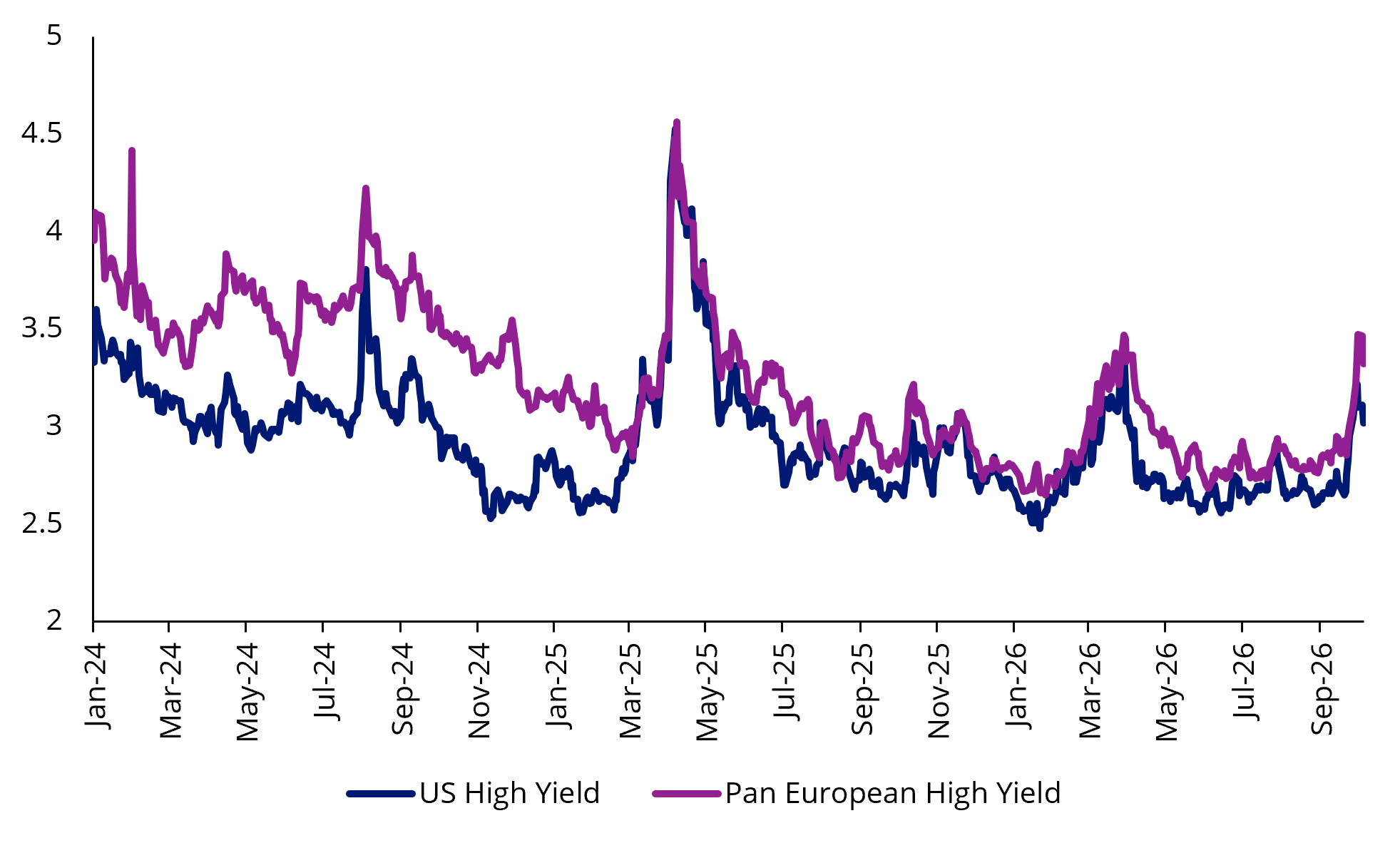
Source: Ice Data Indices, Federal Reserve Bank of St. Louis, as at 6 October 2026. You cannot invest directly in an index.
We've also seen pockets of weakness emerge in private credit which could have had a cascading effect on higher yielding debt.
For companies with debt approaching maturity, refinancing could become more expensive. Businesses with little to no debt and a track record of strong profitability may have greater capacity to fund operations in a tougher environment.
The chart below illustrates a ‘flight to quality’ in equities, showing how companies with higher profitability, stable year-on-year earnings and lower financial leverage typically outperform the broader international market when US high-yield credit spreads widen. Quality has gained relative ground during several periods of widening spreads, including the Global Financial Crisis and the COVID-19 pandemic.
Chart 2: Quality’s relative performance and US high-yield credit spreads
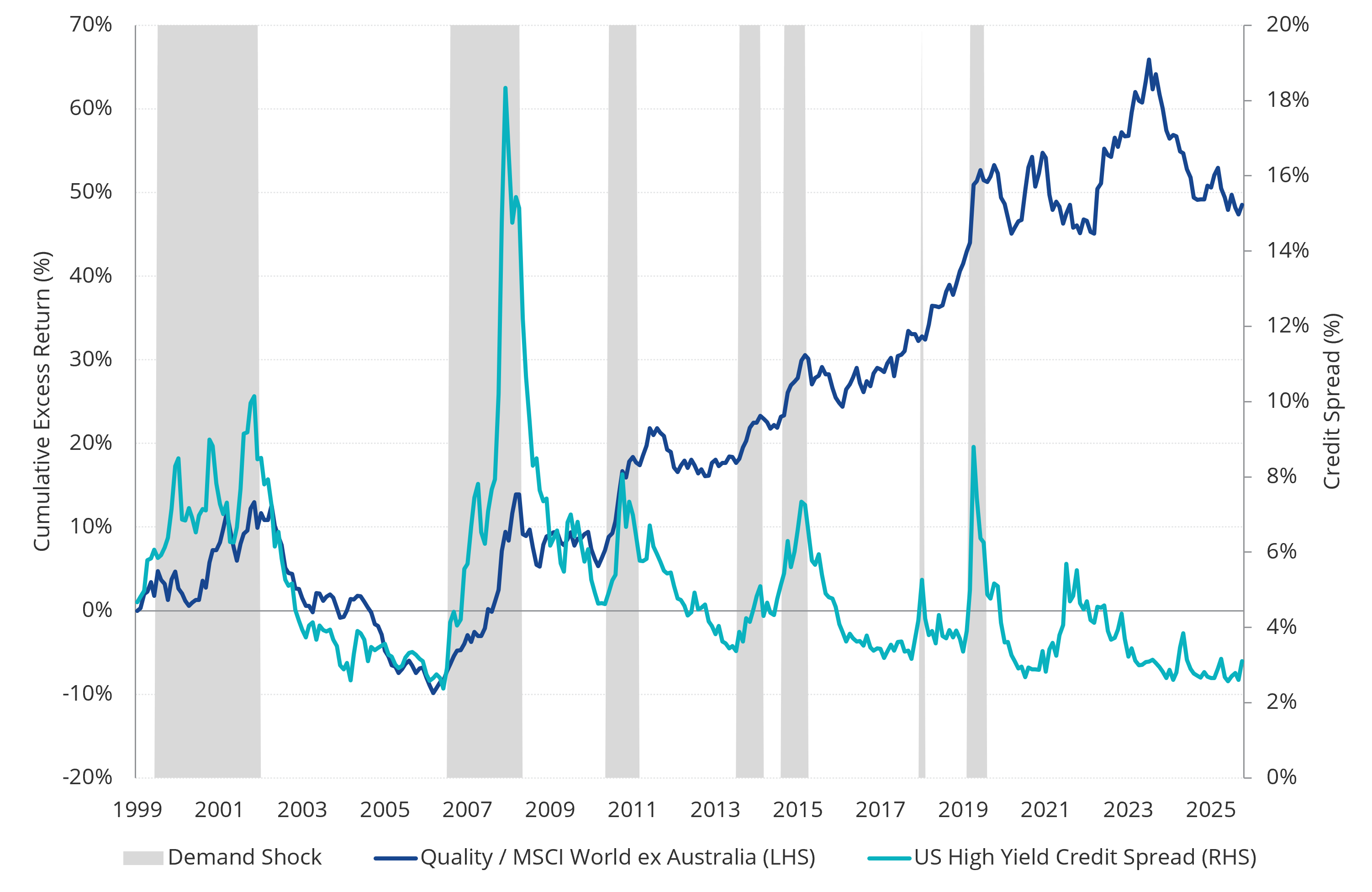
Source: MSCI, Bloomberg,1 January 1999 to 30 September 2026. Cumulative return performance is represented by MSCI World ex-Australia Index and MSCI Quality Index. You cannot invest in an index. Past performance is not indicative of future performance.
Quality runs through the portfolio
The AI generative learning process behind GOAT searches for signals to select the final portfolio.
The chart below breaks down the signal weighting behind the composite scores of the current portfolio by theme. Profitability and quality, and fundamental growth and change, lead at 21% and 20% respectively, with macroeconomic conditions and valuation following close behind.
Chart 3: The investment signal groups supporting GOAT’s holdings
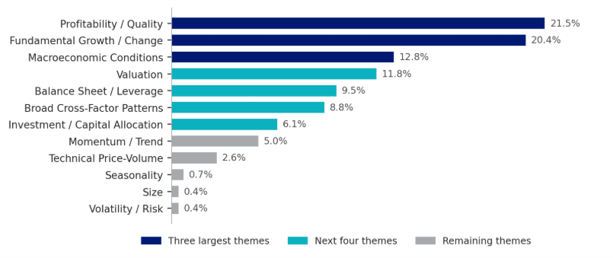
Source: VanEck, Akros. Share of positive signal evidence by theme across the portfolio. This describes the evidence behind current holdings and is not a forecast of returns.
Over the past three rebalances, as the below chart demonstrates, GOAT has increased exposure to US mega-cap technology companies with quality characteristics.
In that same time, it has tweaked its value exposure while remaining underweight relative to the benchmark, reversed its growth position from a material underweight to a small overweight and pared its significant underweight toward small caps (size).
A score of zero implies that GOAT’s exposure to a style is the same as the index’s.
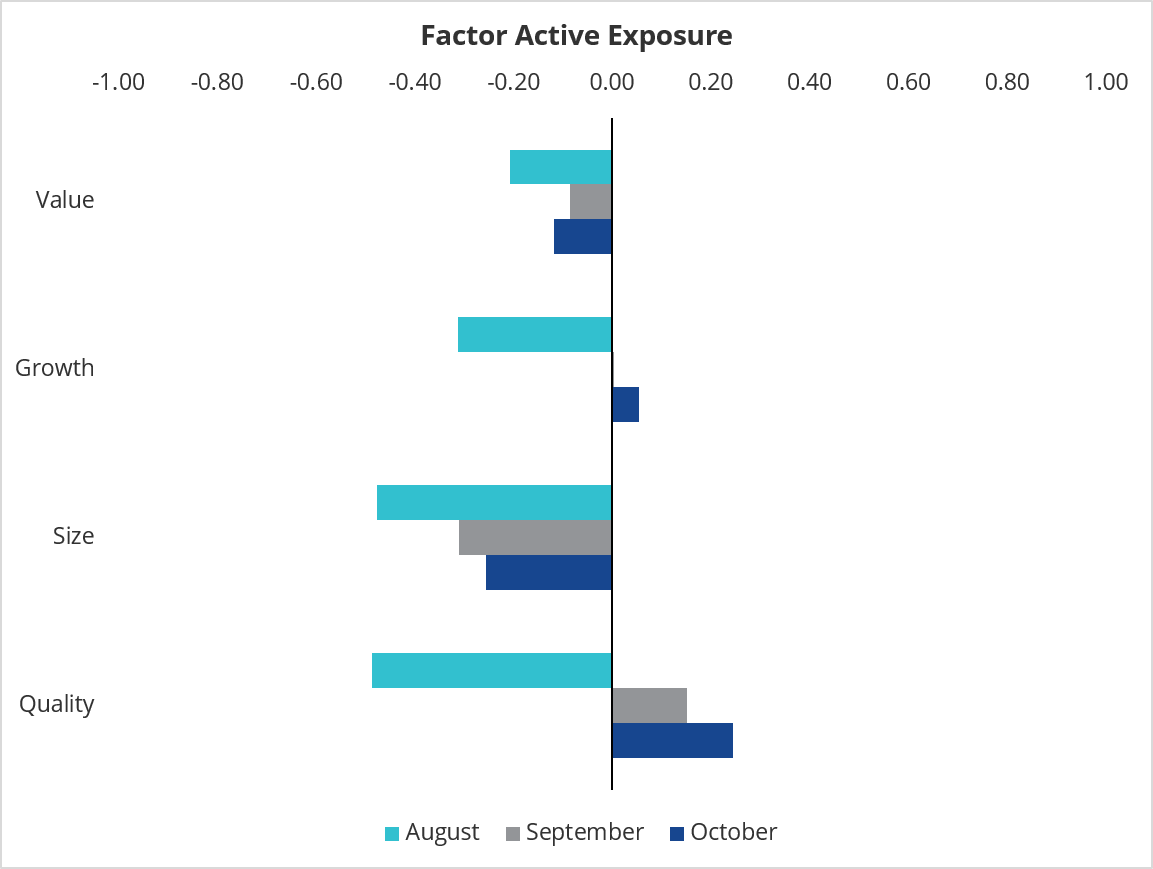
Source: VanEck, Akros, 5 October 2026.
Our global quality ETF, the VanEck MSCI International Quality ETF (QUAL), also counts five of the Magnificent Seven among its top 10 stocks implying growth companies can also be quality names too.
A changing opportunity set
The latest GOAT rebalance added and removed 39 companies. Some of the new holdings include global conglomerate Siemens, Post-It note maker 3M and American insurer Allstate.
Widening spreads offer a plausible explanation for the appeal of quality, even as a tactical play. But the investment case for GOAT goes beyond quality. The fund provides an international equity exposure that can hunt down the world’s best opportunities irrespective of style, stock or sector biases.
For those seeking a pure quality exposure, VanEck’s International Quality ETF (QUAL) gives investors access to a diversified portfolio of companies that excel in key fundamental measures such as high return on equity, earnings stability and low financial leverage.
Key risks
An investment in the ETF carries risks associated with: ASX trading time differences, financial markets generally, individual company management, industry sectors, foreign currency, country or sector concentration, political, regulatory and tax risks, fund operations and tracking an index. See the PDS and TMD for more details.


Published: 12 October 2026
Any views expressed are opinions of the author at the time of writing and is not a recommendation to act.
VanEck Investments Limited (ACN 146 596 116 AFSL 416755) (VanEck) is the issuer and responsible entity of all VanEck exchange traded funds (Funds) trading on the ASX. This information is general in nature and not personal advice, it does not take into account any person’s financial objectives, situation or needs. The product disclosure statement (PDS) and the target market determination (TMD) for all Funds are available at vaneck.com.au. You should consider whether or not an investment in any Fund is appropriate for you. Investments in a Fund involve risks associated with financial markets. These risks vary depending on a Fund’s investment objective. Refer to the applicable PDS and TMD for more details on risks. Investment returns and capital are not guaranteed.