Vigilantes and vigilance


Higher bond yields are changing the investment equation. Quality shares and higher-grade bonds offer investors opportunities to be selective.
“I used to think that if there was reincarnation, I wanted to come back as the President or the Pope or as a .400 baseball hitter. But now I would like to come back as the bond market. You can intimidate everybody.” — James Carville
In 1993 the bond market forced the Clinton administration, of which Carville was a member, to drop its big spending plans. The past quarter it has been sending a message to the Trump administration about government debt, interest costs and structurally higher term premia.
The US 10-year has marched to highs not experienced in two decades. Locally the Australian 10-year yield has hit 20-year highs. Both, in the US and here, inflation remains above band, and each central bank has acted accordingly with rate rises. But the path forward for both is different.
In the US, core PCE (Personal Consumption Expenditures) combined with growth indicators pointing to a resilient economy leaves the US Federal Reserve with limited scope to ease policy and keeps the risk of further tightening in play if inflation fails to moderate.
The difference locally is the lack of growth indicators. The weaker economy and increased inflationary pressure from the 6% increase in the National Minimum Wage and 4.75% rise in minimum award wages that took effect from 1 July could keep domestic cost pressures further elevated and make a return to the RBA’s inflation target more difficult.
While bond vigilantes are ringing alarms, many global equity markets have continued to carry on. US equities, spurred on by continued semiconductor strength, continued to march higher over the past quarter. Globally, the energy sector has also performed well this past quarter. Safe haven gold and its miners also had a relatively strong quarter.
The ASX has been flat over the past three months. The local energy sector also did well. The other standout sector, healthcare, was driven by the return of one stock, CSL, on the back of its FY26 results signalling the worst of its operational struggles appears over.
Chart 1: Mainstream asset class returns for the quarter
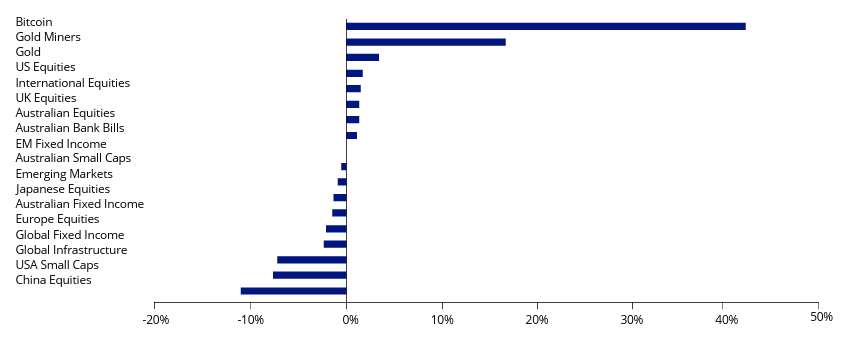
Source: 1 July 2026 to 30 September 2026, returns in Australian dollars. Gold Miners is NYSE Arca Gold Miners Index, US Equities is S&P 500 Index, International Equities is MSCI World ex Australia Index, European Equities is MSCI Europe Index, UK Equities is FTSE 100 Index, Australian Equities is S&P/ASX 200 Accumulation Index, Australian Small Caps is S&P/ASX Small Ordinaries Index, Gold is Gold Spot US$/oz, US Small Caps is Russell 2000 Index, China Equities is CSI 300 Index, Global Fixed Income is Bloomberg Global Aggregate Bond Hedged AUD Index, Australian Bank Bills is Bloomberg AusBond Bank Bill Index, Australian Fixed Income is Bloomberg AusBond Composite 0+ yrs Index, EM Fixed Income is 50% J.P. Morgan Emerging Market Bond Index Global Diversified Hedged AUD and 50% J.P. Morgan Government Bond-Emerging Market Index Global Diversified, EM Equities is MSCI Emerging Markets Index, Japanese Equities is Nikkei 225 Index. Global Listed Infrastructure is FTSE Developed Core Infrastructure 50/50 Hedged into Australian Dollars Index, Bitcoin is The MarketVector™ Bitcoin Benchmark Rate. Past performance is not indicative of future performance.
This highlights the need for vigilance and selectivity. Recently the market has been rewarding companies generating strong cash flows and trading on attractive valuations. Should volatility return, seeking out quality companies could be prudent as market volatility could support quality outperformance. We saw this during the 2000 dot com frenzy, 2021 COVID reopening and 2023 soft landing, when US inflation and economic growth were above 2.5%.
Chart 2: Global and Australian equity sectors quarterly performance
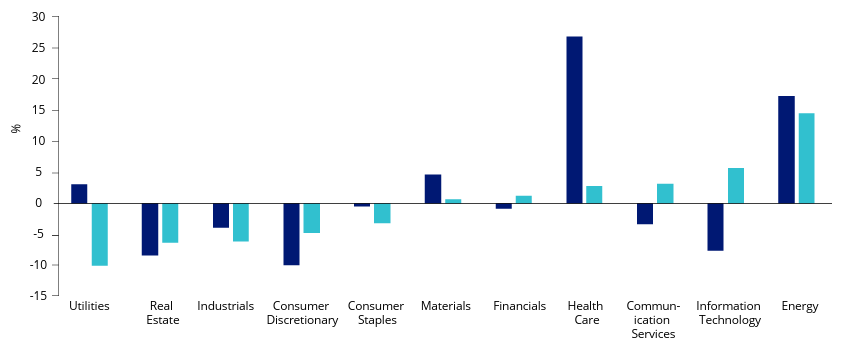
Source: 1 July 2026 to 30 September 2026, returns in Australian dollars. Utilities is MSCI World Utilities Index / S&P/ASX 200 Utilities Index, Industrials is MSCI World Industrials Index / S&P/ASX 200 Industrials Index, Materials is MSCI World Materials Index / S&P/ASX 200 Materials Index, Consumer Staples is MSCI World Consumer Staples Index / S&P/ASX 200 Consumer Staples Index, Consumer Discretionary is MSCI World Consumer Discretionary Index / S&P/ASX 200 Consumer Discretionary Index, Financials is MSCI World Financials Index / S&P/ASX 200 Financials Index, Energy is MSCI World Energy Index / S&P/ASX 200 Energy Index, Healthcare is MSCI World Health Care Index / S&P/ASX 200 Health Care Index, Telecommunications is MSCI World Telecommunications Index / S&P/ASX 200 Telecommunications Index, Information Technology is MSCI World Information Technology Index / S&P/ASX 200 Information Technology Index, Real Estate is MSCI World REIT Index / S&P/ASX 200 AREIT Index. Past performance is not indicative of future performance.
Volatility could be higher going forward as markets navigate an environment of diverging economic growth alongside uncertainty around interest-rate paths, geopolitical tensions, and elevated valuation concerns across some sectors.
In fixed income, higher-grade credits, indicating better quality, could be sensible especially when layering in duration at the current, attractively higher levels.


Published: 11 October 2026
Any views expressed are opinions of the author at the time of writing and is not a recommendation to act.
VanEck Investments Limited (ACN 146 596 116 AFSL 416755) (VanEck) is the issuer and responsible entity of all VanEck exchange traded funds (Funds) trading on the ASX. This information is general in nature and not personal advice, it does not take into account any person’s financial objectives, situation or needs. The product disclosure statement (PDS) and the target market determination (TMD) for all Funds are available at vaneck.com.au. You should consider whether or not an investment in any Fund is appropriate for you. Investments in a Fund involve risks associated with financial markets. These risks vary depending on a Fund’s investment objective. Refer to the applicable PDS and TMD for more details on risks. Investment returns and capital are not guaranteed.