A new dawn for small caps could be coming


There’s an old saying, “it is always darkest before dawn”, and it means that things often seem their worst, before relief or change.
Sometimes investors might feel the need to consider this proverb. International quality small caps investors may be considering it now. While not entirely dark, quality small caps have endured their deepest relative drawdown on record, and what followed earlier setbacks makes this one worth examining.
We think they could represent the dawn.
What quality is meant to do
As a refresher, quality investing begins with the company’s fundamentals rather than its share price. It favours businesses that earn high returns on shareholders’ capital, produce stable profits and carry less debt.
These traits do not stop a share price from falling. They can, however, leave a company better placed to fund its own growth, withstand a setback and recover without needing to raise additional money.
Small caps are where this focus can really earn its keep. Rather than owning the whole market, a quality approach favours profitable niche leaders over businesses still proving their model or relying on debt to grow.
As we noted earlier this year, investors do not have to choose between the growth potential of small caps and stronger fundamentals. According to MSCI and VanEck data from March 2001 to May 2026, quality small caps (as measured by the MSCI World ex Australia Small Cap Quality 150 Index) beat the broad small-cap market (the MSCI World ex Australia Small Caps Index) by 3.6 percentage points a year during expansions and held close to flat during slowdowns, when the benchmark fell 2.5% a year.
Why quality was left behind
Value’s strength explains part of the recent shortfall, but not all of it. Quality tends to command a premium when dependable earnings are scarce. When the earnings outlook improves across the broader market, investors become less willing to pay extra for reliability.
According to VanEck analysis as at 31 July 2026, analysts expect earnings across the broad small-cap market to grow by 13.7% a year, one of the strongest outlooks of the past 16 years. Second-quarter results also favoured the broader small companies market, as represented by the MSCI World ex Australia Small Companies Index, with benchmark companies beating earnings expectations by 6.3%, compared with 5.9% for companies in the quality small-cap index.
When earnings growth is plentiful, investors have less reason to pay a premium for dependability. Companies with more debt, weaker profits or greater exposure to the cycle can rise faster if conditions improve. A quality strategy will miss some of those gains by design.
The result is a familiar investment paradox: quality can become most attractive when the market feels least need for it.
What history says about low-quality rallies
There has also been a rally in low quality small caps, especially in the US. But history suggests these rallies struggle to hold their lead.
VanEck analysis found three completed episodes since 2002 when the broad international small-cap index (the MSCI World ex Australia Small Caps Index) beat its quality counterpart (the MSCI World ex Australia Small Cap Quality 150 Index) by more than five percentage points over 12 months.
| Episode | Worst excess during episode (%) | Excess over next 12 months (%) | Excess over next 36 months p.a. (%) |
| 2004 | -6.04 | 9.33 | 2.85 |
| 2005 to 2006 | -8.54 | 7.24 | 5.13 |
| 2009 to 2010 | -9.63 | 7.60 | 5.80 |
| Current episode | -13.69 | TBC | TBC |
Source: Morningstar Direct. All series in Australian dollars, net returns, monthly to 31 July 2026. Past performance is not indicative of future performance
In all three cases, quality moved back ahead over the following year, outperforming by between 7.2 and 9.3 percentage points. Its advantage continued over the next three years as well, proving that the broad market did not have to fall for quality to regain ground. More profitable, less indebted companies simply began outperforming again.
While three episodes is a small sample, and the current junk rally has gone further than any of them, history still offers valuable perspective. In each previous episode, investors returned to profitable businesses with sound balance sheets once the initial rush into weaker companies had run its course.
What investors are being offered
VanEck analysis shows the MSCI World ex Australia Small Cap Quality 150 Index has fallen 15.0% from its March 2024 peak against the broad international small-cap benchmark. It is the deepest relative drawdown in the index’s history.
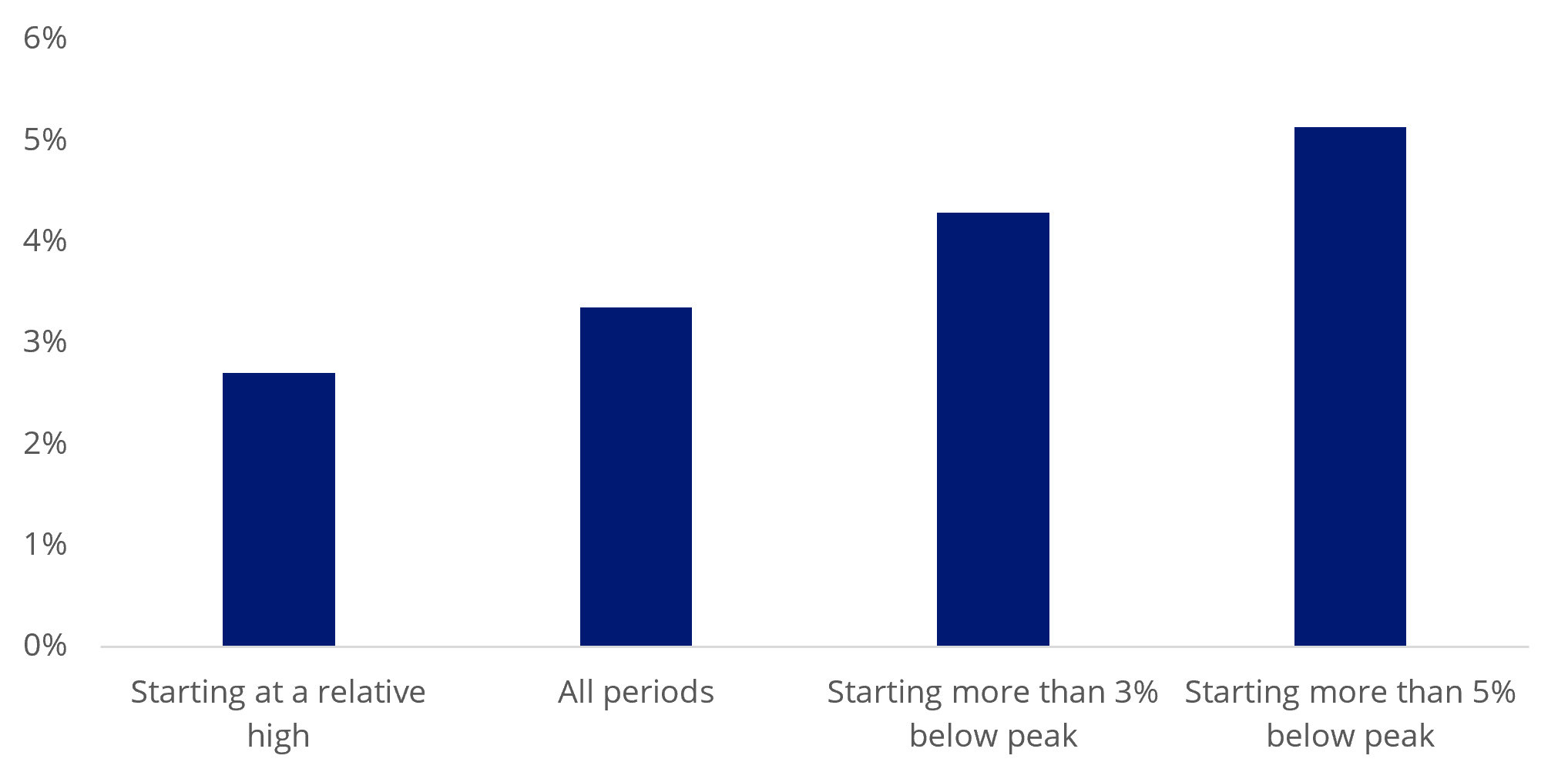
Previous setbacks have rewarded investors prepared to look again. Across all monthly starting points since June 2002, the quality index outperformed the benchmark by an average of 3.35 percentage points a year over the next three years. When the starting point was more than 5% below the previous relative peak, the average rose to 5.13 percentage points a year. All 27 monthly observations in that group produced a positive relative return, although some of the periods overlap.
Chart: Average 3 year excess return from different underperformance starting period: Buying after a period of weakness has historically produced better outcomes
Source: VanEck, MSCI as at 31 July 2026. Past performance is not indicative of future performance.
Recent underperformance has not been matched by a deterioration in the companies themselves. Our analysis found that, as at 31 July 2026, the quality small-cap companies held by the VanEck MSCI International Small Companies Quality ETF (ASX: QSML) generate a return on shareholders’ capital more than twice that of the benchmark while carrying about one-third as much debt for each dollar of shareholders’ equity. Their strengths remain, but the premium investors pay for them has fallen.
QSML applies its quality screen across a range of industries. As at 31 August 2026, its holdings included Carpenter Technology, which makes high-performance alloys for jet engines, medical devices and power generation; East West Bancorp, the parent of East West Bank, which provides personal, commercial and cross-border banking services; and Medpace Holdings, which helps biotechnology companies manage clinical trials and bring new treatments through development.
What investors pay for those strengths has fallen too. Our analysis suggests that once profitability is considered, the quality portfolio costs about one-quarter less than the benchmark for each unit of return on equity.
The case does not depend on the market rediscovering quality next month. It rests on a more durable observation: investors are being offered businesses with higher returns on equity and far less debt without the premium those qualities have tended to command.
Earlier drawdowns gave no timetable for the turn, but they rewarded investors willing to buy before the dawn.
Key risks
An investment in the ETF carries risks associated with ASX trading time differences, financial markets generally, individual company management, industry sectors, foreign currency, country or sector concentration, political, regulatory and tax risks, fund operations, liquidity and tracking an index. See the PDS for details.
QSML is likely to be appropriate for a consumer who is seeking capital growth, is intending to use the product as a core, minor or satellite allocation within a portfolio, has an investment timeframe of at least 5 years, and has a high risk/return profile.


Published: 03 September 2026
Any views expressed are opinions of the author at the time of writing and is not a recommendation to act.
VanEck Investments Limited (ACN 146 596 116 AFSL 416755) (VanEck) is the issuer and responsible entity of all VanEck exchange traded funds (Funds) trading on the ASX. This information is general in nature and not personal advice, it does not take into account any person’s financial objectives, situation or needs. You should consider whether or not an investment in any Fund is appropriate for you. Investments in a Fund involve risks associated with financial markets. These risks vary depending on a Fund’s investment objective. Refer to the applicable product disclosure statement (PDS) and target market determination (TMD) available at vaneck.com.au for more details. Investment returns and capital are not guaranteed.