Q: How would Benjamin Graham invest internationally?


Benjamin Graham's investment philosophy continues to influence modern approaches to quality and value investing in global markets.
Benjamin Graham is widely regarded as the father of value investing. His classic book, The Intelligent Investor, was described by Warren Buffett as "the best book about investing ever written".
The book defined an investor as someone seeking both the preservation of capital and an adequate return. Decisions made without these objectives, he argued, are speculative in nature and expose investors to greater risks and costs.
A recurring theme throughout The Intelligent Investor is that investors should seek companies with strong financial positions and the ability to maintain earnings through changing market conditions. Graham defined a strong financial position as one characterised by manageable debt levels and consistently high returns on equity (ROE). He also believed that a company's ability to maintain earnings could best be assessed by examining its performance over many years, rather than focusing on short-term results.
While Graham is best known for pioneering value investing, he did not advocate buying companies indiscriminately simply because they appeared cheap. He believed investors should focus on businesses with strong financial positions and a history of stable earnings. Applying these principles across thousands of companies listed around the world can be a difficult task for individual investors.
Today, many of the characteristics Graham looked for can be identified systematically. MSCI, one of the world's largest index providers, evaluates companies across its global universe and selects those with the strongest quality characteristics for inclusion in its Quality indices.
According to MSCI, quality companies tend to exhibit high returns on equity (ROE), stable earnings and strong balance sheets with relatively low levels of financial leverage. These characteristics form the basis of the MSCI World ex Australia Quality Index, which includes companies with the highest quality scores from the MSCI World ex Australia Index.
The VanEck MSCI International Quality ETF (ASX: QUAL) tracks this index and the following chart illustrates the performance of the MSCI World Ex Australia Quality Index versus the standard MSCI World ex Australia Index.
Chart 1: Hypothetical growth of $10,000: MSCI World ex Australia Quality Index vs MSCI World ex Australia Index
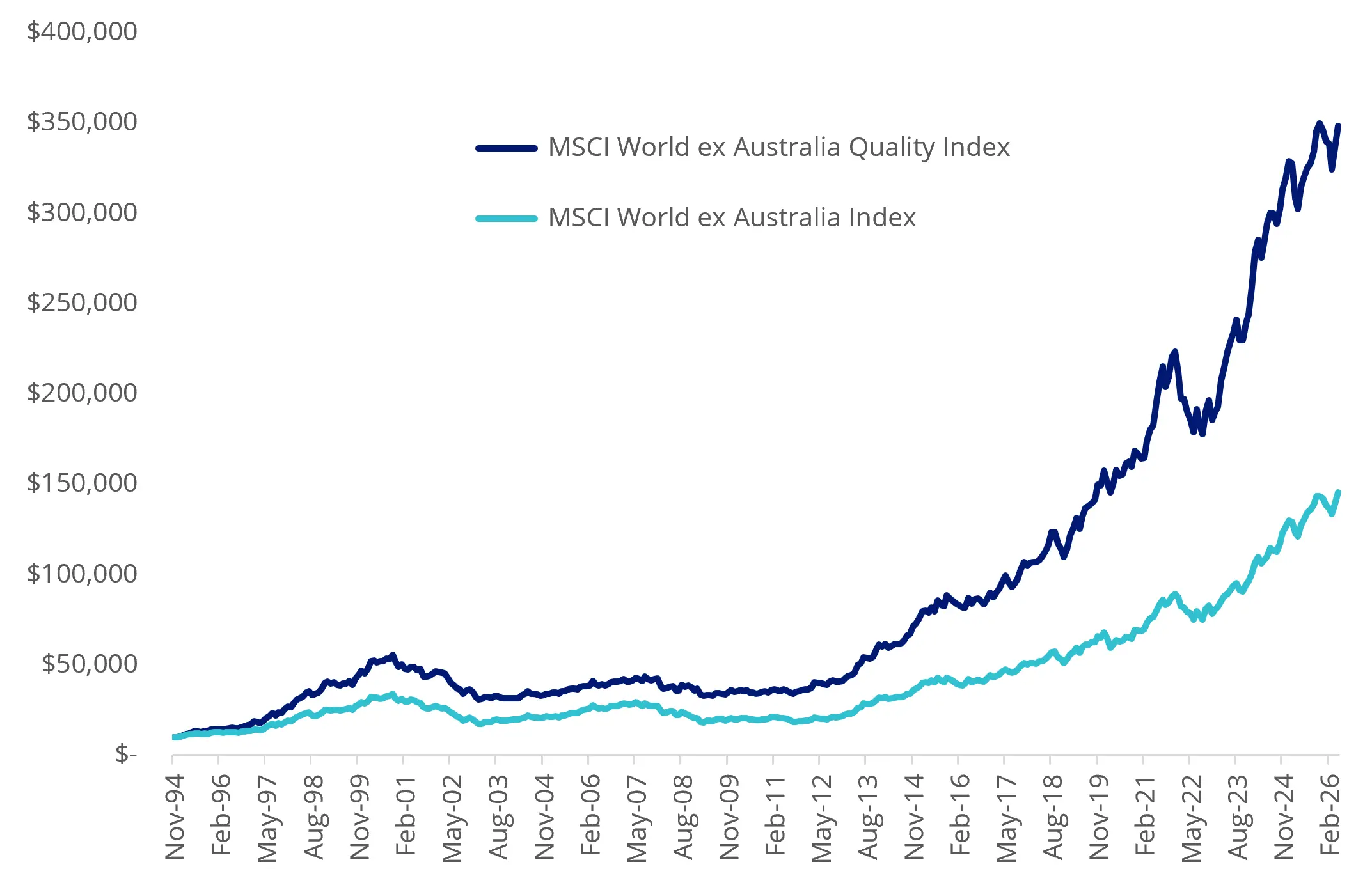
Source: Bloomberg, VanEck. As at 31 May 2026. MSCI World Ex Australia Quality Index base date is 30 November 1994. MSCI World Ex Australia Quality Index launch date is 4 August 2014. Index performance shown on the MSCI World Ex Australia Quality Index, that QUAL tracks, prior to its launch date is simulated based on current index methodology. The above graph is a hypothetical comparison of the performance of a $10,000 investment in the Index and its parent index, the MSCI World ex Australia Index. Results are calculated to the last business day of the month, assuming immediate reinvestment of all dividends and excluding costs associated with investing in the ETF. You cannot invest directly in the Index. The above performance information is not indicative of current or future performance of the indices or QUAL, which may be lower or higher.
Another of Benjamin Graham's enduring contributions to investing was the concept of a "margin of safety". Graham recognised that markets are often driven by emotion in the short term, causing some companies to become overvalued while others are overlooked. For patient investors, these periods of mispricing can create opportunities to buy fundamentally sound businesses at attractive prices.
This means that the aim of value investing is not to beat the market every year. It is to identify companies whose share prices do not fully reflect their underlying worth and to wait patiently for that gap to close. More than 75 years after The Intelligent Investor was first published, this remains one of the most influential ideas in investing.
For investors seeking international value exposure, the VanEck MSCI International Value ETF (ASX: VLUE) provides access to a diversified portfolio of companies selected for their value characteristics. Value investing has experienced periods of both strong outperformance and extended underperformance throughout history. Yet the underlying principle of seeking companies trading below their perceived worth has remained remarkably consistent.
Chart 2: Hypothetical growth of $10,000: MSCI World ex Australia Enhanced Value Top 250 Select Index vs MSCI World ex Australia Index
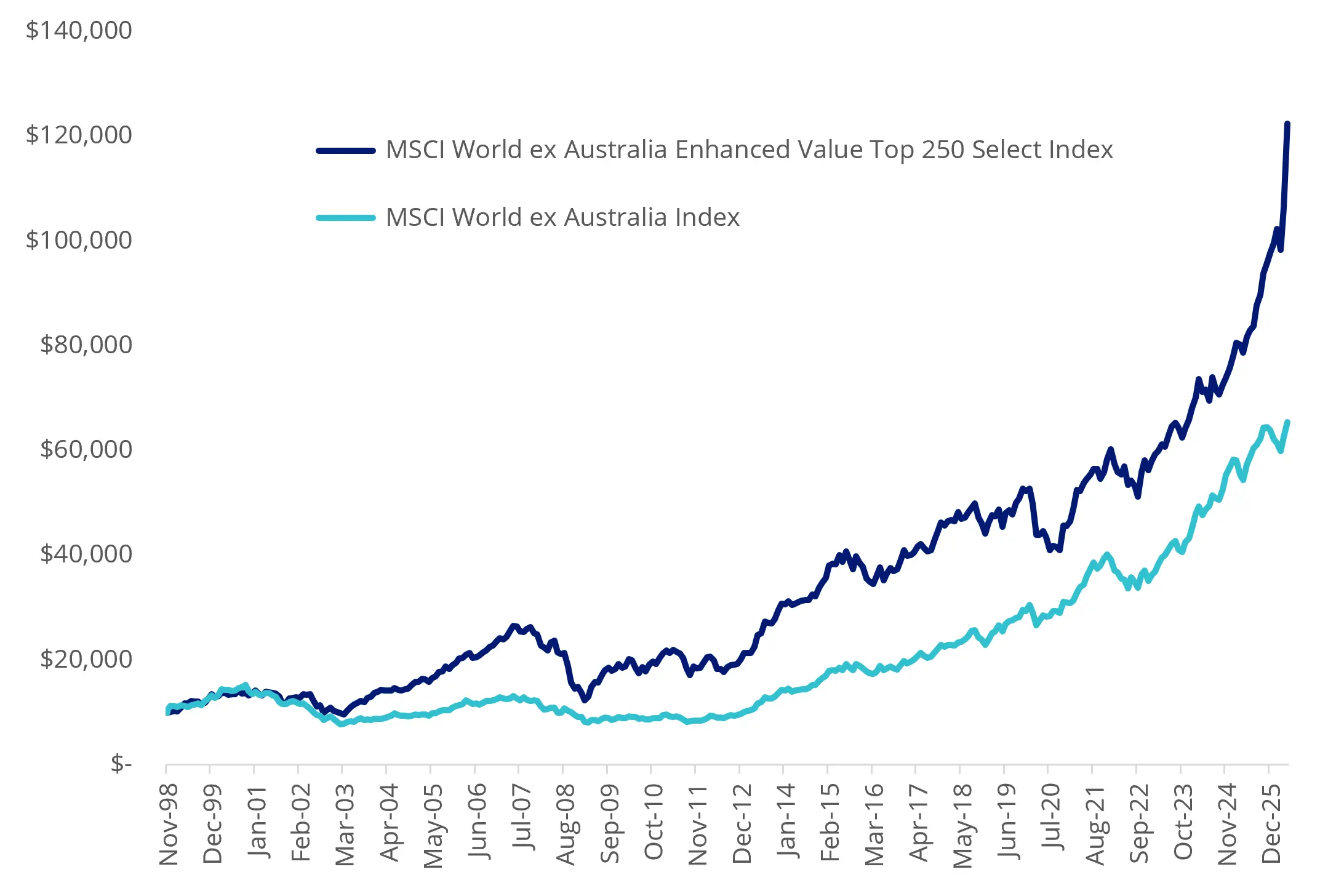
Source: Bloomberg, VanEck. As at 31 May 2026. MSCI World ex Australia Enhanced Value Top 250 Select Index base date is 31 May 2012. MSCI World ex Australia Enhanced Value Top 250 Select Index launch date is 15 February 2021. MSCI World ex Australia Enhanced Value Top 250 Select Index, that VLUE tracks, prior to its launch date is simulated based on current index methodology. Prior to 31 May 2012 Index is MSCI World ex Australia Value Index which is calculated to 30 November 1998. The above graph is a hypothetical comparison of the performance of a $10,000 investment in the Index and its parent index, the MSCI World ex Australia Index. The above graph is a hypothetical comparison of the performance of a $10,000 investment in the Index and the parent index. Results are calculated to the last business day of the month, assuming immediate reinvestment of all dividends and excluding costs associated with investing in the ETF. You cannot invest directly in the Index. The above performance information is not indicative of current or future performance of the indices or VLUE, which may be lower or higher.
Markets have changed dramatically since Graham first published The Intelligent Investor, but the fundamentals of successful investing have changed far less. For investors looking beyond Australia, his lessons on quality, value and discipline remain as relevant today as ever.
Key risks
An investment in either our international quality ETF or our international value ETF carries risks associated with: ASX trading time differences, financial markets generally, individual company management, industry sectors, foreign currency, country or sector concentration, political, regulatory and tax risks, fund operations and tracking an index. See the respective PDS and TMD for more details.
QUAL and VLUE are likely to be appropriate for a consumer who is seeking capital growth, is intending to use the product as a major, core, minor or satellite allocation within a portfolio, has an investment timeframe of at least 5 years, and has a high risk/return profile.


Published: 24 June 2026
Any views expressed are opinions of the author at the time of writing and is not a recommendation to act.
VanEck Investments Limited (ACN 146 596 116 AFSL 416755) (VanEck) is the issuer and responsible entity of all VanEck exchange traded funds (Funds) trading on the ASX. This information is general in nature and not personal advice, it does not take into account any person’s financial objectives, situation or needs. You should consider whether or not an investment in any Fund is appropriate for you. Investments in a Fund involve risks associated with financial markets. These risks vary depending on a Fund’s investment objective. Refer to the applicable product disclosure statement (PDS) and target market determination (TMD) available at vaneck.com.au for more details. Investment returns and capital are not guaranteed.