The invisible architecture behind today’s most important technologies


AI may dominate the headlines, but history suggests the biggest investment opportunities are often found in the ecosystem built around it.
When historians write about the Industrial Revolution, they usually begin with the steam engine. The idea that one invention changes everything is an appealing and simple way to tell the story.
But the reality was rather less dramatic.
By the time railways transformed Britain in the nineteenth century, the foundations had already been laid over decades. Coal production had expanded, ironworks had multiplied and new financial institutions had emerged to fund projects on an unprecedented scale. While railways created a faster way to move people and goods, markets and societies in Britain, and then the world, had been transformed.
That same habit of compressing history into a single invention is repeating itself today.
Much of today's conversation about artificial intelligence revolves around models, algorithms and whichever company has announced the latest breakthrough. But this story is not about one invention. It is about the ecosystem those inventions create, and the industries required to build it.
If artificial intelligence progresses as many expect, the next frontier of computing will demand far more than better models. It will require more computational power, more advanced semiconductor manufacturing and greater volumes of the rare earths and strategic metals that make both possible.
AI: the latest in a long line of societal changing megatrends
Artificial intelligence is the latest in a long line of investment ideas to be described as a megatrend.
At its core, however, a megatrend tends to be long lasting and fundamentally changes society and/or industry. They change how economies grow, where capital is invested and, eventually, the commerce that come to define an era. The term has become increasingly common over the past decade, often used to describe everything from ageing populations and healthcare innovation to clean energy, gaming and artificial intelligence.
Healthcare is one example. Scientific breakthroughs rarely remain confined to the laboratories that first produce them. Advances in medicine have steadily reshaped the broader healthcare sector, driving growth in everything from biotechnology and medical devices to diagnostics and genomics. Medical advances, having saved lives and irradicated some diseases, has changed the way we live, and it continues to do so. Today, the global medical technology market alone now generates almost US$600 billion in annual revenue. Investors have been able to access the healthcare megatrend via the VanEck Global Healthcare Leaders ETF (HLTH) since 2020.
Video gaming has undergone a similar transformation. Once dismissed as a niche hobby, it has become one of the world's largest entertainment industries, with revenues now exceeding the global film and recorded music industries combined. It is expected, when it launches in November that Grand Theft Auto 6 will be the largest game opening in history, expected to generate US$7.6 billion in sales in its first 60 days. What began as arcade games now encompasses streaming, esports, specialised hardware and cloud infrastructure – and is the basis for the VanEck Video Gaming and Esports ETF (ESPO).
Not every investment theme follows that trajectory. Financial markets have a habit of declaring a new "megatrend" every few years. Some previous examples that have fallen by the wayside include the metaverse or the future of payments.
But genuine megatrends such as healthcare, gaming and the energy transition, however, are different. Rather than remaining confined to the products that first captured investors' attention, they evolve into ecosystems that reshape adjacent industries, redirect capital and continue attracting investment over decades.
Far from a pure software revolution
Artificial intelligence, we think, is a genuine megatrend, but software is only part of the story.
Every technological revolution eventually places greater demands on the physical economy than first meets the eye. Railways required coal and steel. Electrification depended on power stations, transmission networks and copper. The internet, perhaps the defining technological revolution of the past half century, relied on decades of investment in fibre optic cables, semiconductor manufacturing and the data centres that became the backbone of the digital economy.
Artificial intelligence appears to be following the same path.
Every improvement in AI demands more computational power than the one before it. That demand is already translating into physical infrastructure. The International Energy Agency expects electricity consumption from data centres to more than double by 2030, reaching roughly the equivalent of Japan's annual electricity use, as AI drives an unprecedented expansion in computing capacity.
Chart 1: Global data centre electricity consumption, by equipment, Base Case, 2020-2030
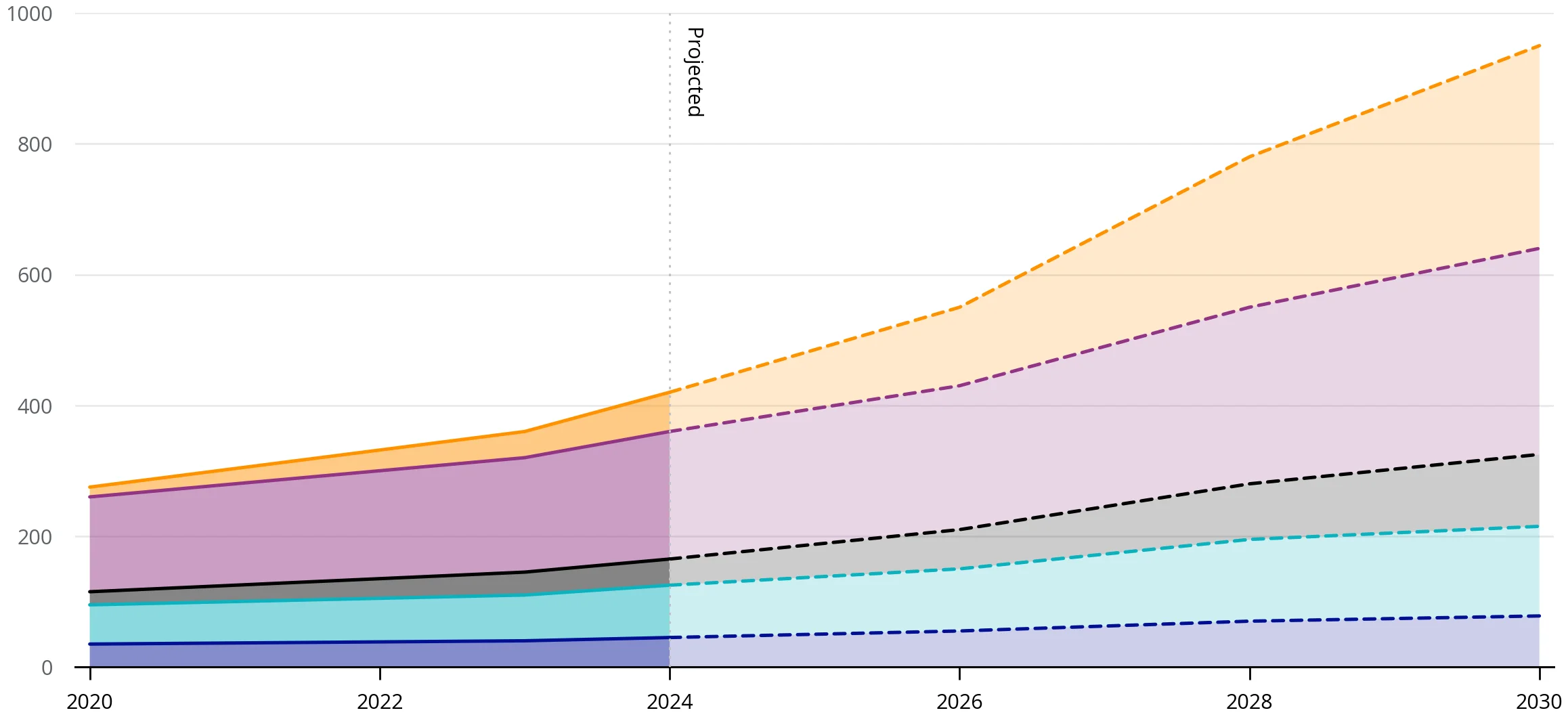
More computing power requires more advanced semiconductor manufacturing, which in turn demands increasingly sophisticated equipment and greater volumes of specialised materials. Follow that supply chain backwards and artificial intelligence begins to look less like a software revolution and more like an industrial one, with every advance placing greater demands on the physical economy that supports it.
Where capital is flowing
Another ways to identify a structural shift is to ignore the headlines altogether and follow where governments and capital are investing. By that measure, the AI race looks considerably less like a battle between software companies and far more like an industrial arms race.
Consider what has happened over the past few years from governments. Around the world, tens and, in some cases, hundreds of billions of dollars are being committed to semiconductor manufacturing, strategic supply chains and the infrastructure needed to support the next generation of computing.
Table 1: Governments are helping to build the next industrial ecosystem
|
Year |
Conservative |
Optimistic |
|
2025 |
US$15 billion |
|
|
2030 |
US$25 billion |
US$34 billion |
|
2035 |
US$43 billion |
US$71 billion |
|
2040 |
US$77 billion |
US$148 billion |
Sources: https://www.mckinsey.com/industries/public-sector/our-insights/the-chips-and-science-act-heres-whats-in-it, https://digital-strategy.ec.europa.eu/en/factpages/chips-act, https://www.taipeitimes.com/News/biz/archives/2026/06/30/2003859951 and https://www.smh.com.au/politics/federal/the-projects-to-benefit-from-australia-s-5-billion-rare-earth-funding-deal-20260412-p5zn8r.html.
Importantly, these are not subsidies for software developers. They are investments in the factories, equipment and supply chains needed to manufacture the physical infrastructure of the next computing era.
The private sector has reached much the same conclusion. This calendar year, Taiwan Semiconductor Manufacturing Company (TSMC), the world's largest contract chipmaker, expects capital expenditures to be between US$52 billion and US$56 billion. Elsewhere, Samsung Electronics and SK Hynix are leading a ₩622 trillion investment into what is expected to become the world's largest semiconductor manufacturing cluster, built on the assumption that demand for AI infrastructure will continue growing for decades.
Taken individually, these developments appear to belong to different industries. Viewed together, they show that the capital flowing into semiconductors, electricity networks, advanced manufacturing and strategic materials is a response to one huge megatrend.
One ecosystem, three layers
Artificial intelligence is usually explained through the evolution of software. It may be more useful to follow the supply chain instead. What first appears to be a technology story gradually becomes one about manufacturing, industrial capability and access to resources.
Rare earths and strategic metals, for instance, are used in a range of applications including high-performance magnets, semiconductor manufacturing equipment, robotics, electricity networks and defence systems. Governments increasingly view access to these materials as a strategic imperative, reflecting the same concerns around supply, security and resilience that have long shaped manufacturers' thinking.
Few practical substitutes exist, and much of the world's processing capacity remains concentrated in one country. China accounts for around 61% of global magnet rare earth mine production and 92% of refining, highlighting why governments are investing heavily in alternative supply chains.
Chart 2: China dominates mining and refining of rare earths
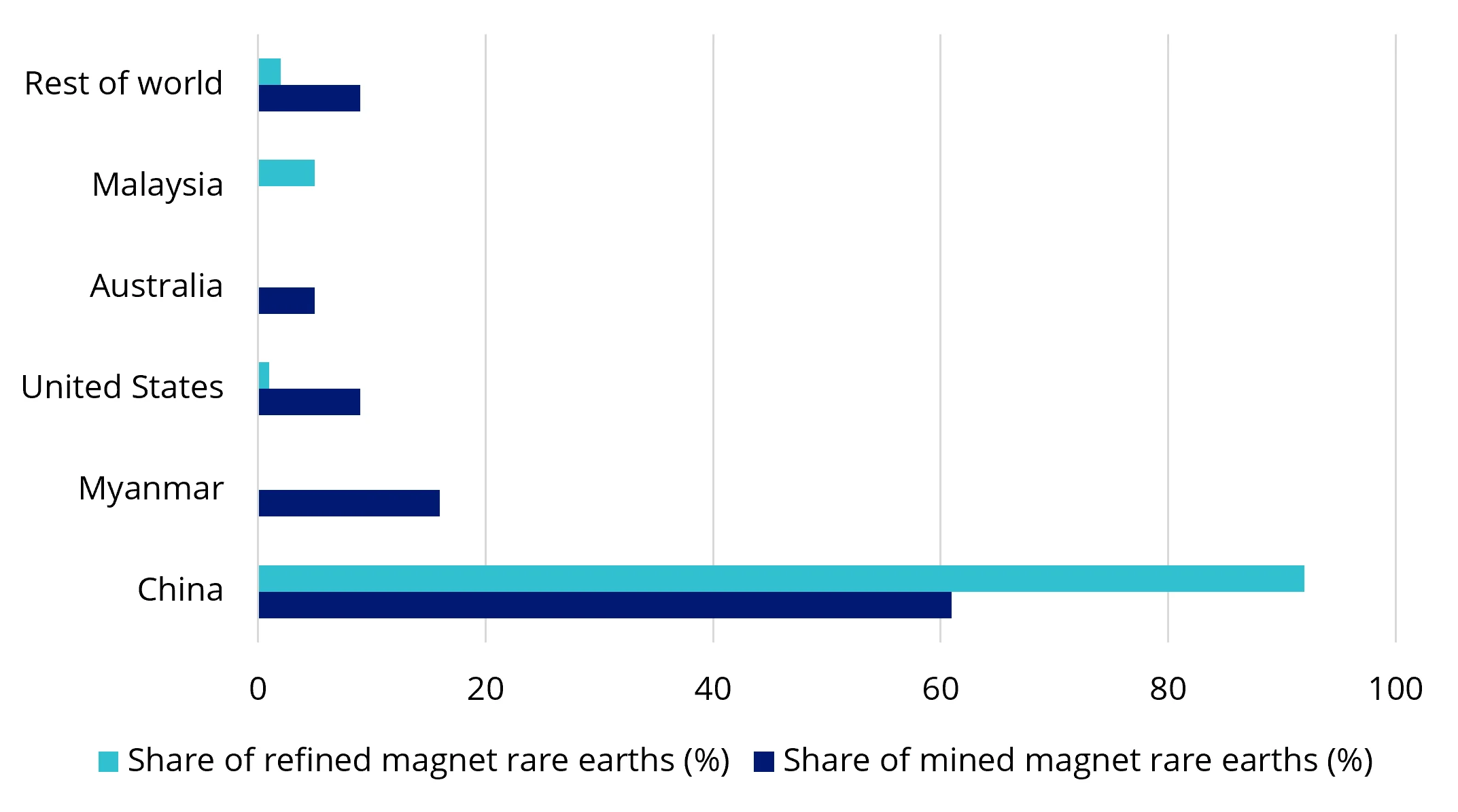
Source: International Energy Agency (2025), Global Critical Minerals Outlook 2025; Critical Minerals Data Explorer.
Those supply chains ultimately converge on one destination: semiconductor manufacturing. Every advance in computing depends on more capable chips, yet producing them requires extraordinary engineering precision, billions of dollars in fabrication facilities and the specialised materials sitting further back along the supply chain. Strip those materials away and semiconductor manufacturing stops.
Every improvement in semiconductor technology expands what artificial intelligence can do. Every advance in artificial intelligence, in turn, demands more from the next generation of chips, raising a bigger question: what comes after today's computing architecture?
One answer is quantum computing.
Unlike today's computers, which process information as a series of binary ones and zeros, quantum computers promise to solve classes of problems that are effectively beyond the reach of even the world's fastest supercomputers. While the technology remains in its infancy, governments and industry are already investing heavily because of its long-term potential. Like artificial intelligence before it, however, quantum computing does not emerge in isolation. It depends on the same ecosystem of advanced manufacturing, semiconductor capability and specialised materials that has been expanding around AI from the very beginning.
And while a nascent topic to most Australian investors, McKinsey estimates the quantum computing market could reach between US$43 billion and US$71 billion by 2035, growing to as much as US$148 billion by 2040.
Table 2: Estimated quantum computing market size, US$ billion
|
Region |
Recent commitments |
|
US |
US$52.7 billion CHIPS and Science Act funding |
|
Europe |
€43 billion European Chips Act target |
|
South Korea |
US$1.2 trillion to be invested in new chip-building hub and data centres over next 10 years |
|
Australia |
$5 billion Critical Minerals Facility, as part of the Made in Australia initiative |
Source: Quantum Technology Monitor, April 2026. Expert interviews; press search; McKinsey analysis.
Viewed this way, the distinction between rare earths, semiconductors and quantum computing begins to feel increasingly artificial. They are not competing investment stories, but different stages in the same industrial ecosystem.
Investing in ecosystems, not inventions
If history teaches us anything, it is that technological revolutions rarely reward just one industry. They create ecosystems that expand over decades, drawing in new technologies, new supply chains and new forms of capital as they mature.
We think the Fourth Industrial Revolution is beginning to follow the same pattern. That is the philosophy underpinning the latest additions to VanEck's ETF suite that the AFR covered last weekend. The article states, “VanEck will launch three new ETFs on the ASX in the first week of August alone, including the exchange’s first quantum computing product, a global semiconductors fund and a rare earths and strategic metals ETF focused on companies outside China. The firm launched the ASX’s first AI-powered stock-picking ETF just weeks ago.”
Rather than viewing semiconductors, quantum computing and rare earths as isolated investment themes, we see them as complementary parts of the same structural shift. Each provides exposure to a different stage of the industrial ecosystem emerging around advanced computing.
We expect the new ETFs to list this week.
Each fund stands on its own as a long-term investment opportunity. Viewed together, they provide exposure to different parts of the same industrial ecosystem; one that is already taking shape around what may become the defining megatrend of the coming decades.
Key risks
An investment in these ETF carries risks associated with: ASX trading time differences, financial markets generally, individual company management, industry sectors, foreign currency, country or sector concentration, political, regulatory and tax risks, fund operations and tracking an index. See the PDS and TMD for more details.


Published: 31 July 2026
Any views expressed are opinions of the author at the time of writing and is not a recommendation to act.
VanEck Investments Limited (ACN 146 596 116 AFSL 416755) (VanEck) is the issuer and responsible entity of all VanEck exchange traded funds (Funds) trading on the ASX. This information is general in nature and not personal advice, it does not take into account any person’s financial objectives, situation or needs. You should consider whether or not an investment in any Fund is appropriate for you. Investments in a Fund involve risks associated with financial markets. These risks vary depending on a Fund’s investment objective. Refer to the applicable product disclosure statement (PDS) and target market determination (TMD) available at vaneck.com.au for more details. Investment returns and capital are not guaranteed
© 2026 VanEck Investments Limited. All rights reserved.